This article contains affiliate links. As an Amazon Associate I earn from qualifying purchases.
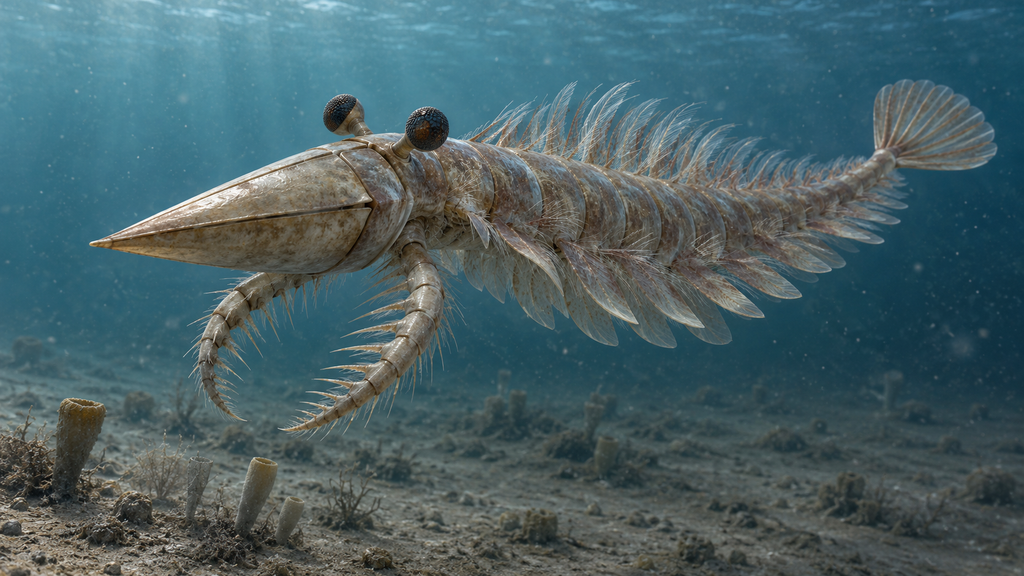
| Name | Hurdia victoria. The genus is named after Mount Hurd in Yoho National Park, Canada |
| Classification | Early branch of the arthropod lineage; Radiodonta, Hurdiidae |
| Age | Middle Cambrian (the Burgess Shale is about 505 million years old) |
| Where found | Burgess Shale, British Columbia, Canada; also Utah (USA), China and the Czech Republic |
| Length | About 18–30 cm (estimated from fossil size; when the animal was announced in 2009, some reports put it at close to 50 cm) |
| Head shield | Three plates, one central and two lateral, projecting forward from the head |
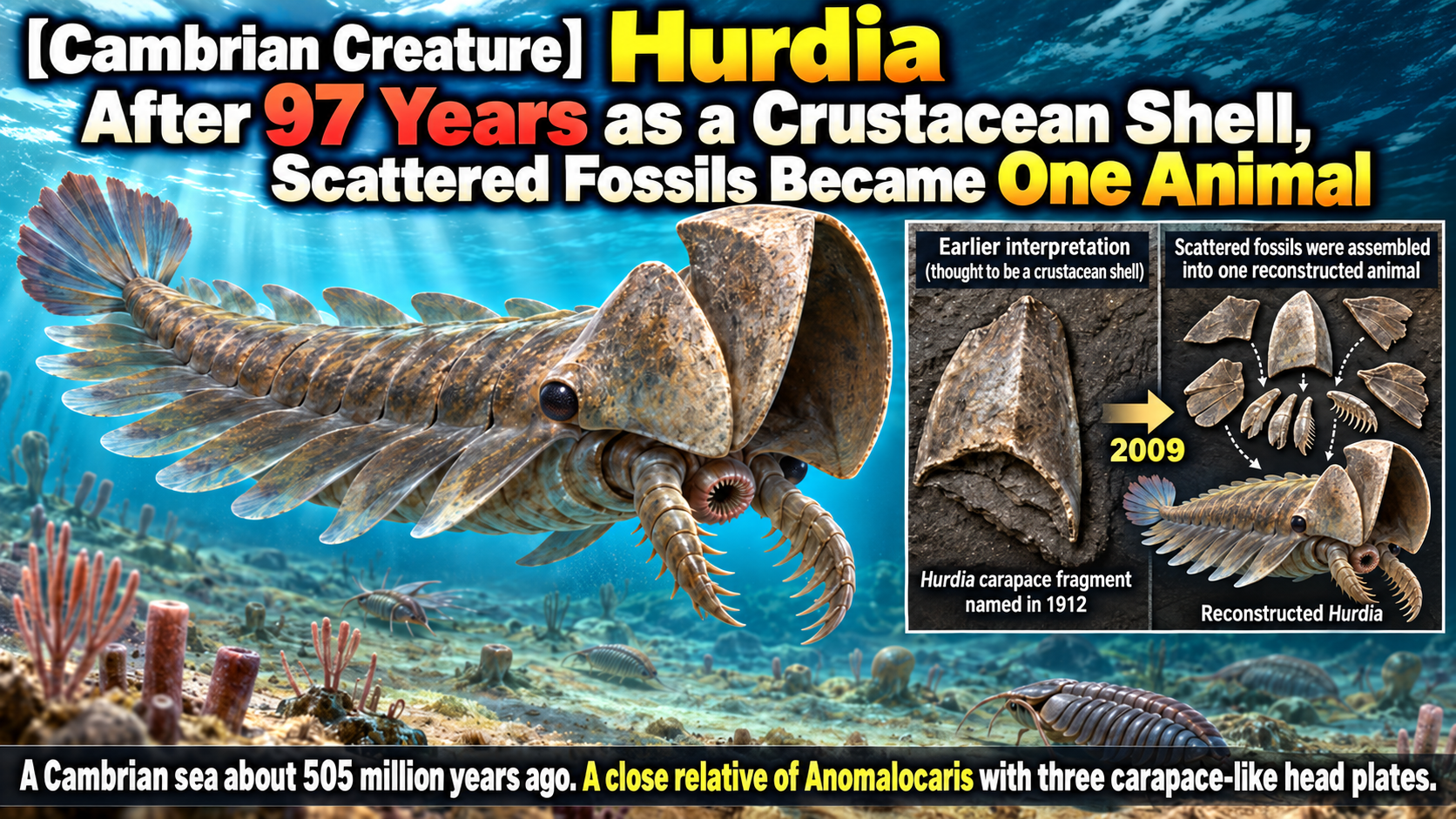
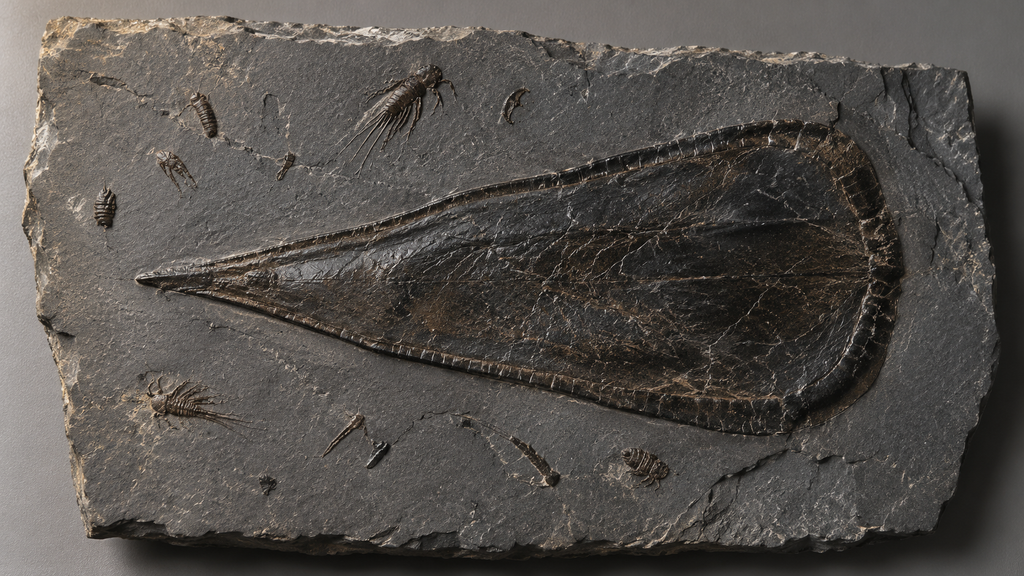
Hurdia is a radiodont that lived in Cambrian seas, a relative of Anomalocaris. At the front of its head is a large projection made of three shield plates. In 1912 that shield alone was named as the shell of a crustacean, and the rest of the body was attributed to other animals. Hurdia was not reconstructed as a single animal until 2009.
Appearance and Way of Life
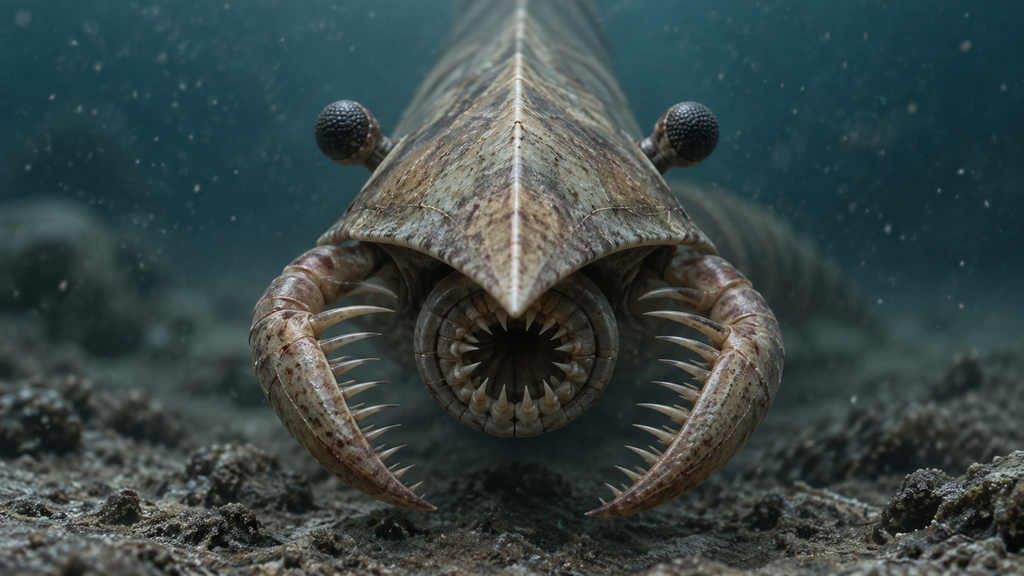
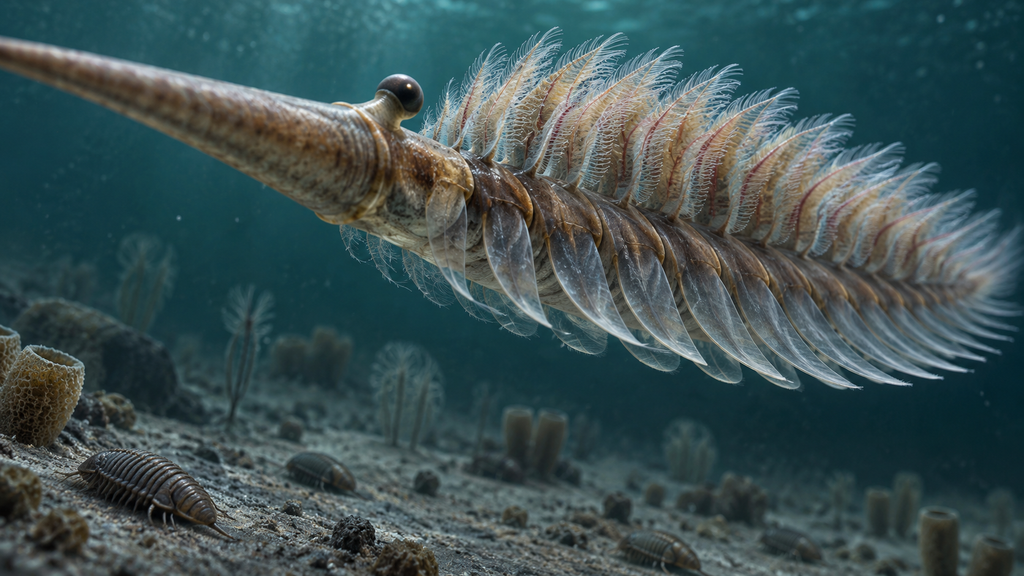
The body is long and segmented. At the front of the head is a pair of large spiny limbs, and beneath their bases lies a mouth made of tooth-lined plates arranged in a ring. The mouth is built around four large plates, with more rows of teeth on their inner sides. The eyes sat at the ends of stalks, like a shrimp’s.
The most striking feature is the head shield. One plate on the top and one on each side fit together and project far in front of the head. The Hurdiidae are the radiodonts with this three-part shield, and the family takes its name from Hurdia.
Swimming flaps ran along both sides of the trunk, with a smaller row of flaps on the back. Most of the trunk was covered in gills made of many thin, closely packed blades, and they are known as some of the best-preserved gills in the fossil record. A large animal swimming actively would have needed a lot of oxygen.
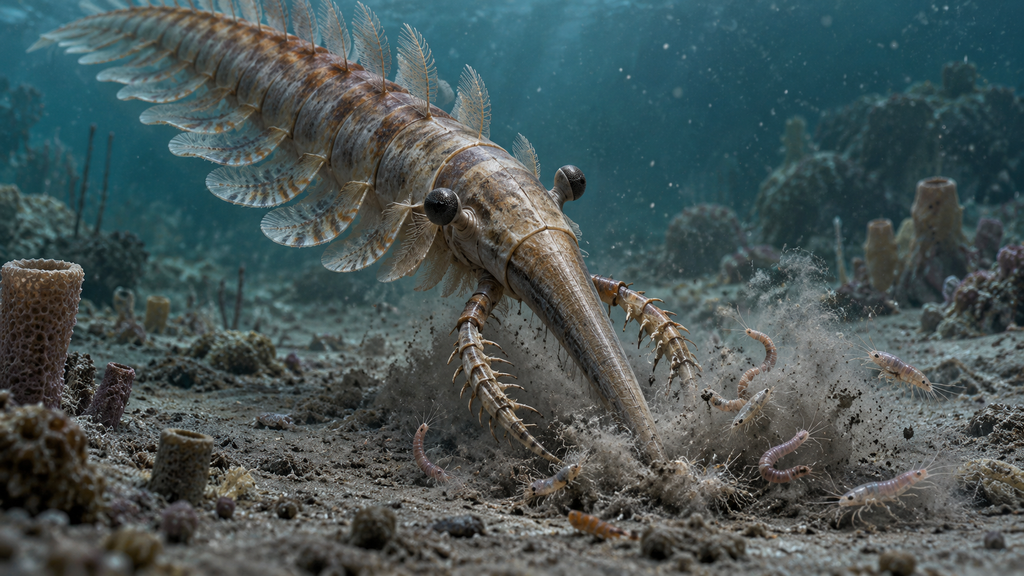
Each frontal limb has about nine segments. Long spines point inward from each segment, and finer spines line those spines. Where the limbs of Anomalocaris are shaped for grasping prey, those of Hurdia are rake-like, and one interpretation is that it sifted small animals out of seafloor mud. Jean-Bernard Caron of the Royal Ontario Museum, one of the authors of the description, has suggested it may have used its pointed head shield to stir up the sediment while searching for food.
In the Burgess Shale, Hurdia shared the sea with trilobites, Opabinia, Hallucigenia and Anomalocaris. Its fossils have also been reported from Utah and Nevada in the United States, from China and from the Czech Republic, showing that it was widespread in the seas of its time.
Still Mistaken for Part of Other Animals After the Anomalocaris Puzzle Was Solved
Anomalocaris is known for having had its limbs named as a shrimp and its mouth as a jellyfish before the pieces were united into one animal in 1985. Hurdia was likewise split into separate parts, but it was not put together in 1985. For more than twenty years after that, it was still treated as part of other animals.
The first part to be named was the head shield. In 1912 Charles Walcott, who discovered the Burgess Shale, gave the names Hurdia victoria and Hurdia triangulata to fossils of the central plate. Walcott interpreted them as the shells of an unidentified crustacean. In 1962 the side plates were described as the shell of another creature under a different name, Proboscicaris.
Other parts of the body had been described separately as well. Museum collections held parts of Hurdia that had been described as jellyfish, sea cucumbers and other arthropods. Specimens assigned to Peytoia, another radiodont, also turned out to include Hurdia.
The best-preserved specimen had been collected by Walcott in the early twentieth century and kept at the Smithsonian National Museum of Natural History in Washington. In the 1970s and 1980s it was first classified as an arthropod and then regarded as an unusual specimen of Anomalocaris. Once the identity of Anomalocaris was settled, the whole body of Hurdia was being treated as one of its individuals.
The turning point came with excavations led by Desmond Collins of the Royal Ontario Museum in the 1980s and 1990s, which produced more complete specimens and hundreds of isolated parts. In 1996 Collins established Radiodonta, a group for Anomalocaris and its close relatives, and placed Hurdia and Proboscicaris in it. He had also recognized that the two fossils described as crustacean shells were different parts of the same animal’s shield.
The person who finally brought it all together was Allison Daley, then a doctoral student at Uppsala University in Sweden. Over three years she examined hundreds of specimens and, by comparing them with the Royal Ontario Museum’s material, showed that the Smithsonian specimen was not Anomalocaris but the complete body of a different, shield-bearing animal. In March 2009 Daley, Graham Budd, Caron, Gregory Edgecombe and Collins published a reconstruction in Science that united the shield, limbs, mouth and gill-bearing trunk into one animal, 97 years after Walcott had named it.
The function of the head shield revealed by the reconstruction is still undecided. The shells of crabs and shrimps cover and protect the soft body, but the shield of Hurdia simply projects in front of the head. It was empty inside and covered no part of the body. When the work was announced, Daley said that nothing like it is seen in other fossils or in living arthropods, and that its use can only be guessed at.
Related products
You can find books and products related to this article on Amazon.
If you buy through the links above, this blog may earn a commission.
Sources
Daley, A. C., Budd, G. E., Caron, J.-B., Edgecombe, G. D. & Collins, D. (2009). The Burgess Shale anomalocaridid Hurdia and its significance for early euarthropod evolution. Science 323(5921): 1597–1600. https://doi.org/10.1126/science.1169514
Daley, A. C., Budd, G. E. & Caron, J.-B. (2013). Morphology and systematics of the anomalocaridid arthropod Hurdia from the Middle Cambrian of British Columbia and Utah. Journal of Systematic Palaeontology 11: 743–787. https://doi.org/10.1080/14772019.2012.732723
Lerosey-Aubril, R. & Pates, S. (2018). New suspension-feeding radiodont suggests evolution of microplanktivory in Cambrian macronekton. Nature Communications 9: 3774. https://doi.org/10.1038/s41467-018-06229-7
Royal Ontario Museum (March 2009). ROM collections reveal 500 million-year-old monster predator. https://www.rom.on.ca/news-releases/rom-collections-reveal-500-million-year-old-monster-predator
Uppsala University (20 March 2009). Fossil fragments reveal 500 million year old monster predator. https://www.uu.se/press/pressmeddelanden/2009/2009-03-20-fossil-fragments-reveal-500-million-year-old-monster-predator

コメント