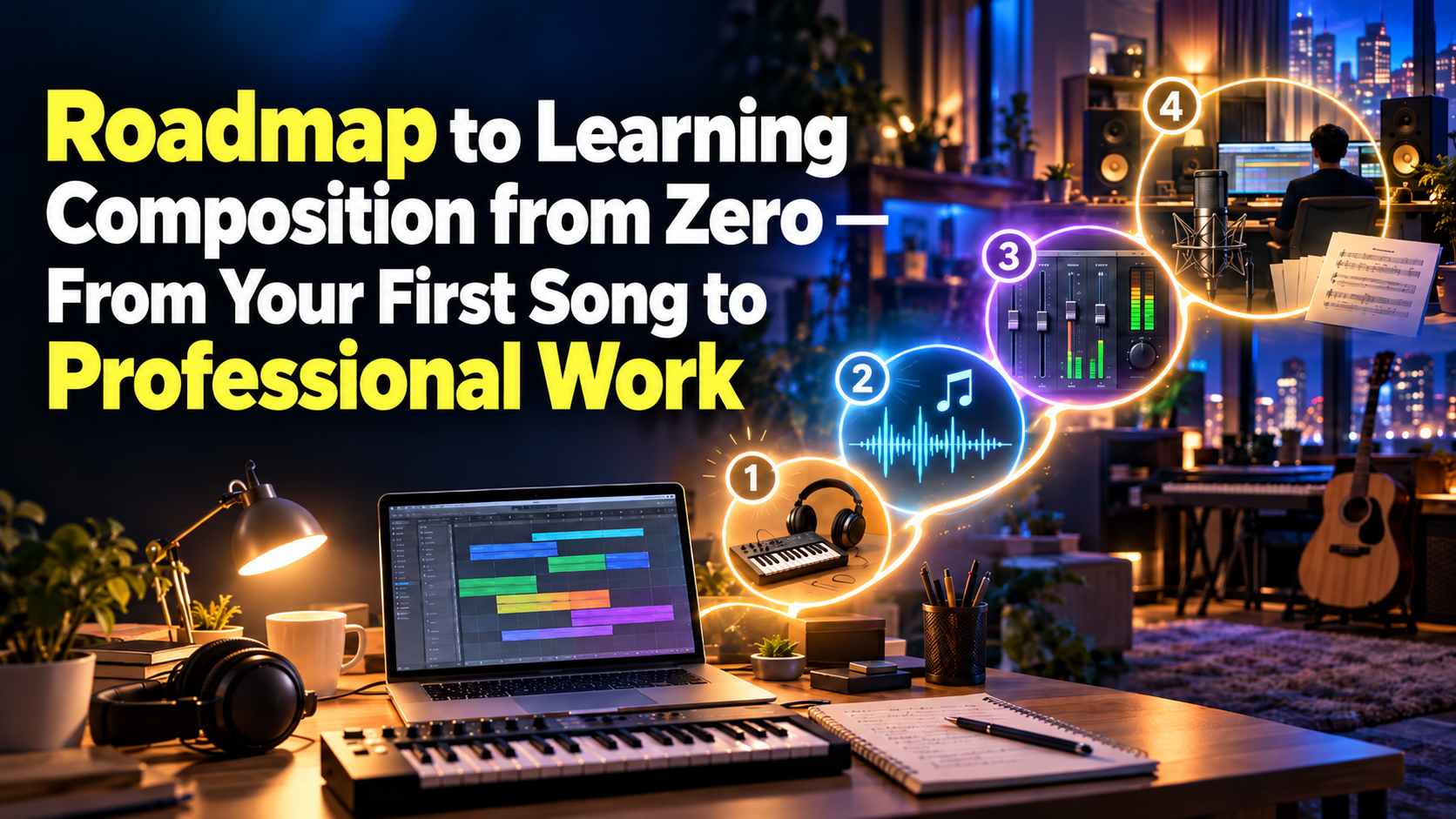
This page lays out a path for learning music composition, starting from no instrument and no ability to read sheet music, and ending at the point where you can take on commissions and deliver finished tracks. Each stage is covered in detail in its own article, and this page is updated as new articles go up.
Composition Is a Process More Than a Flash of Inspiration
Break songwriting down and you get five jobs: melody, chords, rhythm, arrangement, and sound design and mixing. Professional composers don’t always work through them in that order, but every track is built from decisions in those five areas.
You can write music even if melodies don’t just come to you. Plenty of composers pick a chord progression first and then hunt for notes that fit, or program a rhythm first and add pitches afterward. Learning the steps one at a time gets you further than worrying about whether you have talent.
Finish a Song Before You Finish the Theory
This roadmap does not ask you to learn all of music theory before you start writing. Early on, you finish something, even just 8 or 16 bars, and export it as an audio file. Theory gets added after that.
Most music theory is a set of tools for explaining why a note sounds satisfying, or why a passage feels like it is missing something. Once you have hit a weak spot in one of your own songs, ideas like borrowed chords and voice leading become things you can use right away. Reading theory books without ever having written a song tends to end with a list of memorized terms.
Stage 1: Get Your Tools and Make a Sound
The first goal is to make a sound on your computer, record it, and play it back.
A DAW and the Gear Around It
The software used for composing is called a DAW (digital audio workstation). Some are free, so a computer and a pair of headphones are enough to start. A MIDI keyboard makes entering notes faster, but you can do everything with a mouse. DAW prices and the terms of free versions change often, so the individual articles check the current details at the time of writing.
Reading the Piano Roll
Almost every DAW has a piano roll: a grid with time running left to right and pitch running bottom to top. You can write a whole song here without reading notation, just by placing blocks on the grid. At this stage, it is enough to know that a block’s length is the note’s length and its height is the note’s pitch.
Note Names and Scales
Learn the order of the notes and the difference between a half step and a whole step. The major scale follows the pattern whole, whole, half, whole, whole, whole, half. Keep that pattern and you can build a major scale with the same sound starting from any note.
Stage 2: Finish Your First Song
The goal here is to export a complete song as an audio file, with a beginning and an ending, however short it is.
Chords and Common Progressions
Learn how to stack three notes into a triad, and learn the seven chords that belong naturally to a major key, the diatonic chords. Much of what you hear in pop music is built mostly from combinations of those seven.
Writing a Melody
Put an 8-bar melody over a chord progression. Land on notes from the current chord on the strong beats and connect them with neighboring notes in between, and the melody will not sound off. Repeating a shape with small changes makes it easier to remember.
Drums and Bass
Build a basic beat from kick, snare, and hi-hat, and start the bass by following the lowest note of each chord, the root. With those in place, the piece starts to sound like a real song.
Song Structure
Arrange sections such as verse, pre-chorus, and chorus to set the overall length and decide where the song peaks. About two minutes is plenty for a first song.
Stage 3: Make It Worth Listening To
Compare your song with a commercial release and you will hear differences in the richness of the harmony, the development, and how clearly each instrument comes through. This stage closes those gaps one at a time.
Stepping Outside the Diatonic Chords
Secondary dominants, borrowed chords, and key changes add surprise or a bittersweet color to a progression. Check them against progressions in real songs to learn where they work and where they stick out.
Voicing and Voice Leading
The same chord sounds different depending on how high each note is stacked (voicing) and how each note moves to the next chord (voice leading). Keeping those movements small makes chord changes smoother and takes the stiffness out of programmed parts.
Arrangement
Sort out each instrument’s role (rhythm, harmony, melody, ornament) and the range it plays in. Instruments piled into the same range make the mix muddy, so taking a part out often helps more than adding one.
Sound Design and Mixing
Learn what the basic controls on a synthesizer do so you can build your own sounds. In the mix, use EQ to clean up frequency ranges, compression to even out level changes, reverb to add space, and panning to spread instruments left and right.
Stage 4: Working Like a Professional
From here on, what matters is less how much you know and more whether you can produce the sound you are aiming for by a deadline.
Analysis and Transcribing by Ear
Pick songs you like and write down their chord progressions, structure, and instrument layout by ear. Taking a song apart shows you where the professionals put in extra work and where they rely on standard moves.
Genre Conventions
Pop, scoring for film and games, and dance music each expect different lengths, structures, and production approaches. Scoring calls for stretching and shrinking a cue to fit the picture; dance music depends on carefully shaping how the kick and bass work together.
Mastering and Loudness Targets
Major streaming services apply loudness normalization to even out volume differences between tracks. Spotify, for example, explains in its help page for artists that it adjusts playback so tracks measure -14 LUFS under the ITU 1770 standard. Tracks pushed too loud get turned down on playback, so mastering decisions come down to how listenable a track is rather than how loud it is.
Deadlines and Rights
When you write to commission, agree up front on the number of revisions, the delivery format (for example, whether you hand over stems, the separate audio files for each part), and how copyright is handled. When releasing your own music, you also choose whether to register with a performing rights organization or manage the rights yourself.
Where to Start Reading
With no musical experience at all, reading from Stage 1 in order is the safest route. If you play piano or guitar and have used a DAW, starting around song structure in Stage 2 works fine. If you already write songs and want them to sound more finished, the arrangement and mixing sections in Stage 3 are likely to make the biggest difference.
Articles for each stage will be published over time.


コメント