| Name | Anomalocaris canadensis. The genus name combines the Greek for “different” with the Latin for “shrimp” — “unlike an ordinary shrimp” |
| Classification | An early lineage (stem group) of arthropods. Order Radiodonta, family Anomalocarididae |
| Age | Middle Cambrian (the Burgess Shale strata date to about 508 million years ago) |
| Found in | The Burgess Shale and its surroundings in British Columbia, Canada. Close relatives are reported from China, the United States and Australia |
| Length | About 25 cm in near-complete specimens. From the size of isolated parts, maxima of about 60 cm to 1 m have been estimated (the range varies by study) |
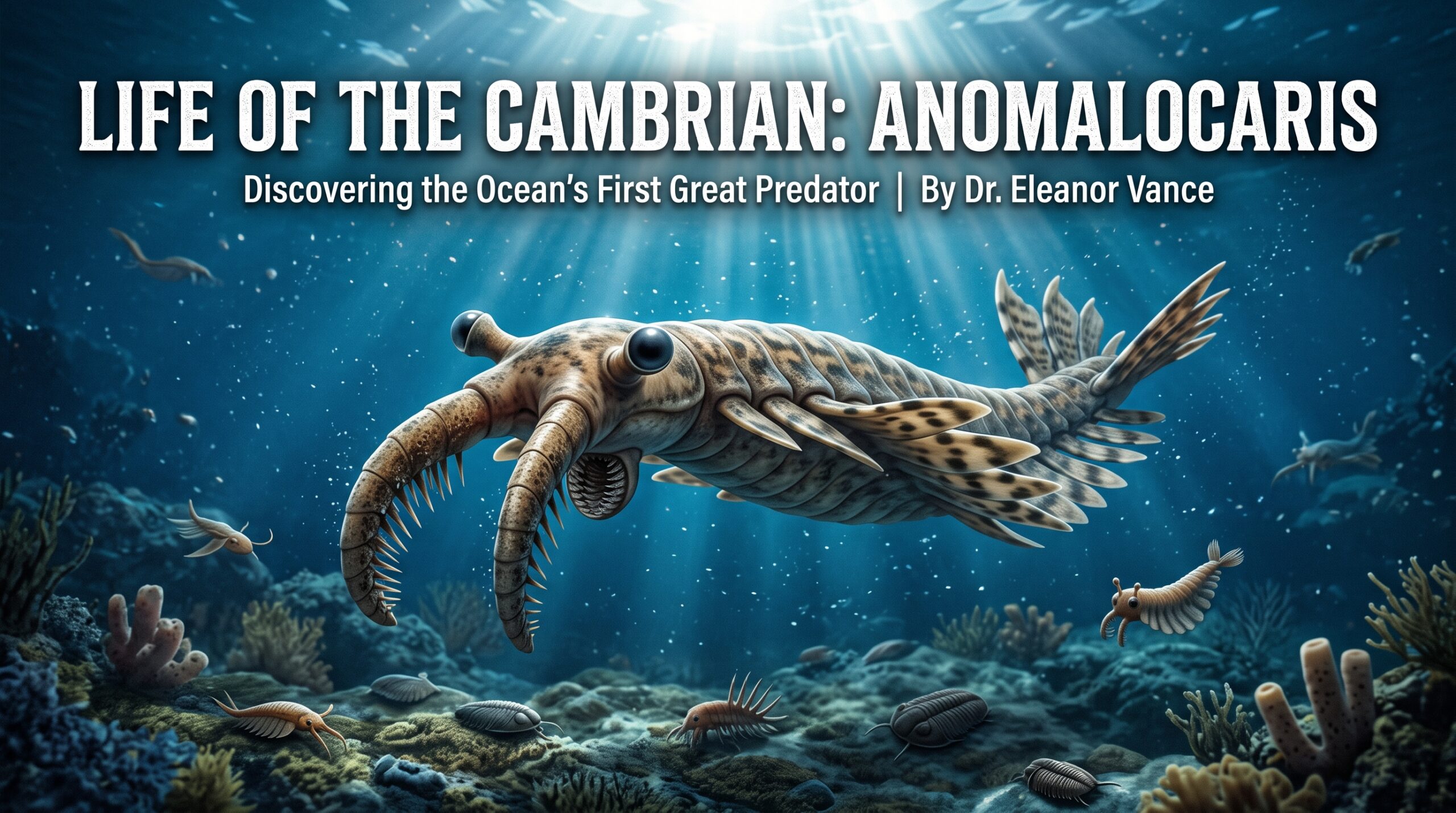
Anomalocaris is a marine animal belonging to a very early arthropod lineage. It was among the largest predators in the Cambrian sea, with a pair of large appendages extending from the front of the head and a mouth ringed with teeth. Since 1892, when the appendages alone were described as a shrimp, the mouth and other parts were each named as separate organisms, and it was only in 1985 that the whole was reconstructed as a single animal.
Form and way of life
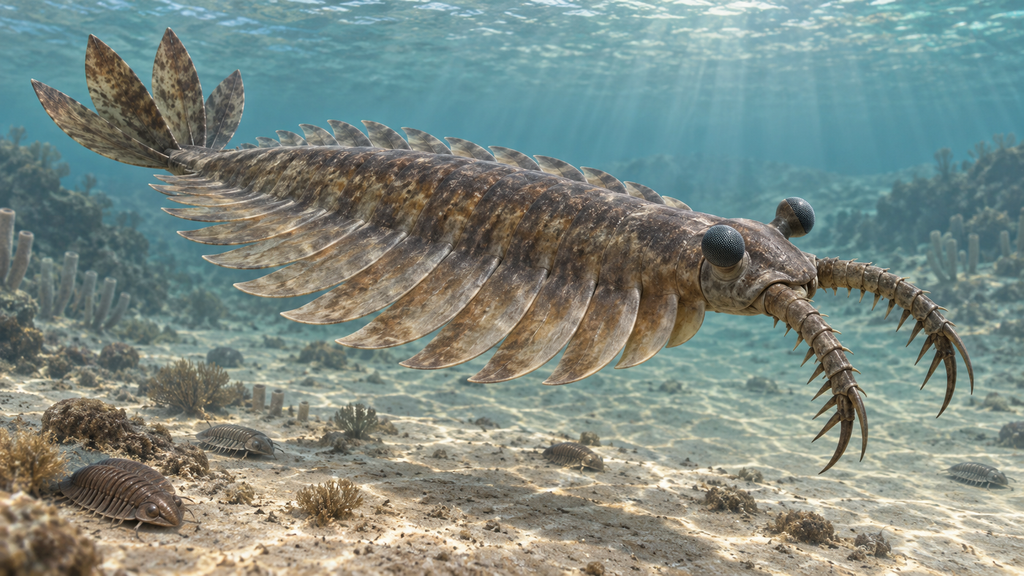
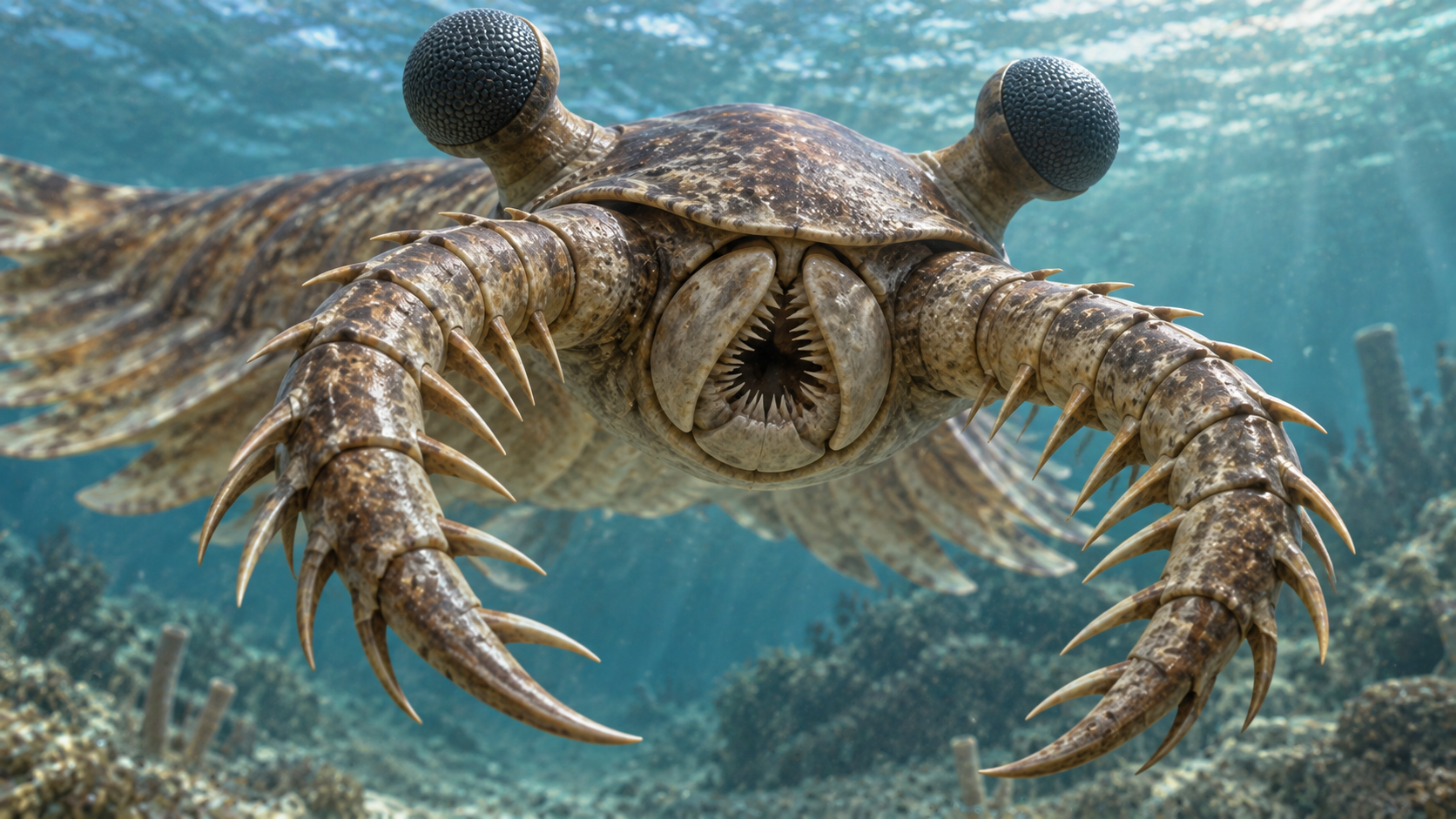
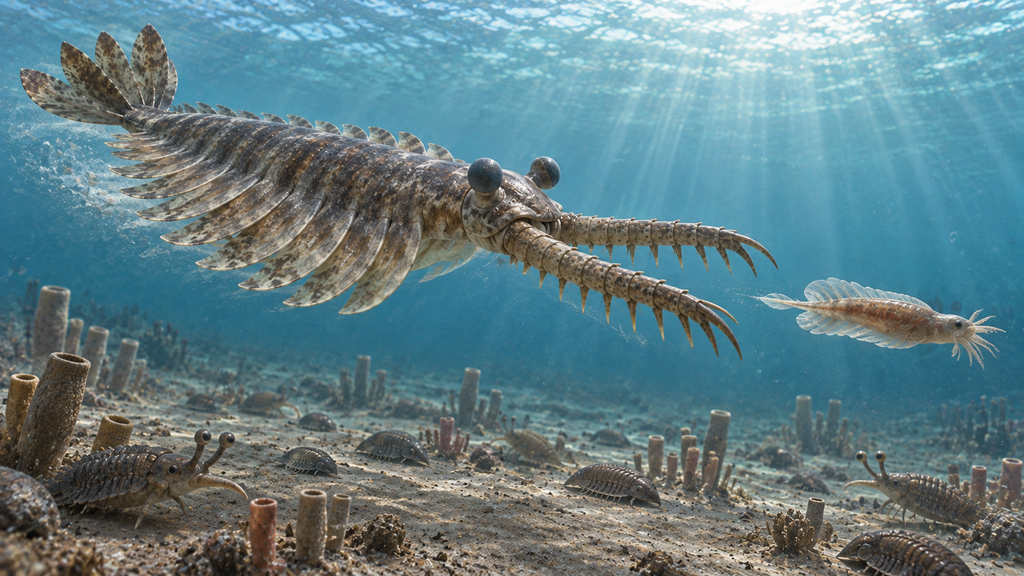
The body is dorsoventrally flattened and elongate. Sixteen pairs of flat swimming flaps (lateral lobes) line the sides of the body, with gills at their bases. At the tail, three pairs of large flaps stand upward and spread like a fan. The head carries a pair of large compound eyes on stalks, and from in front of them extends a pair of appendages divided into fourteen segments. Each segment bears trifurcate spines, thought to have served to draw prey inward.
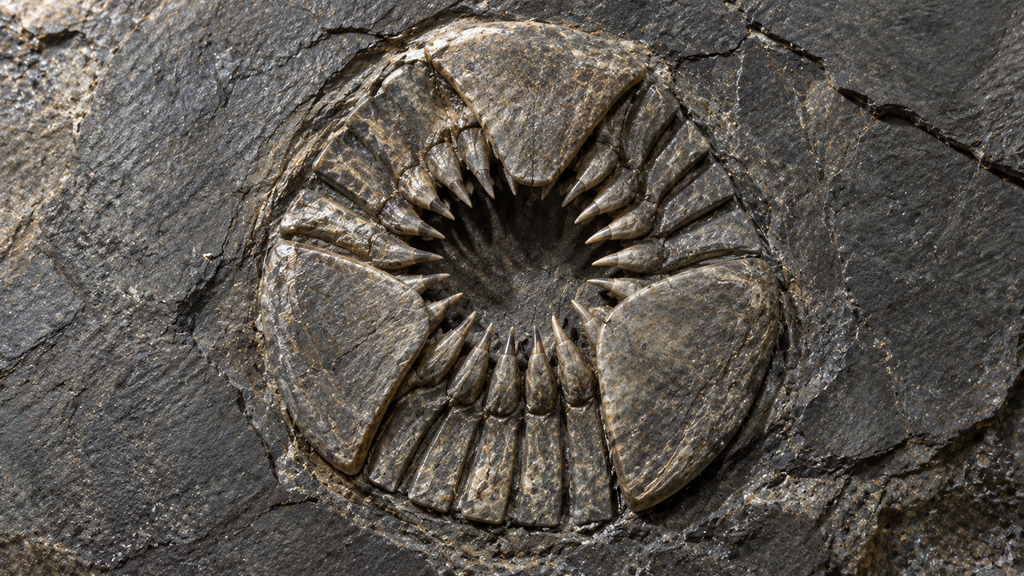
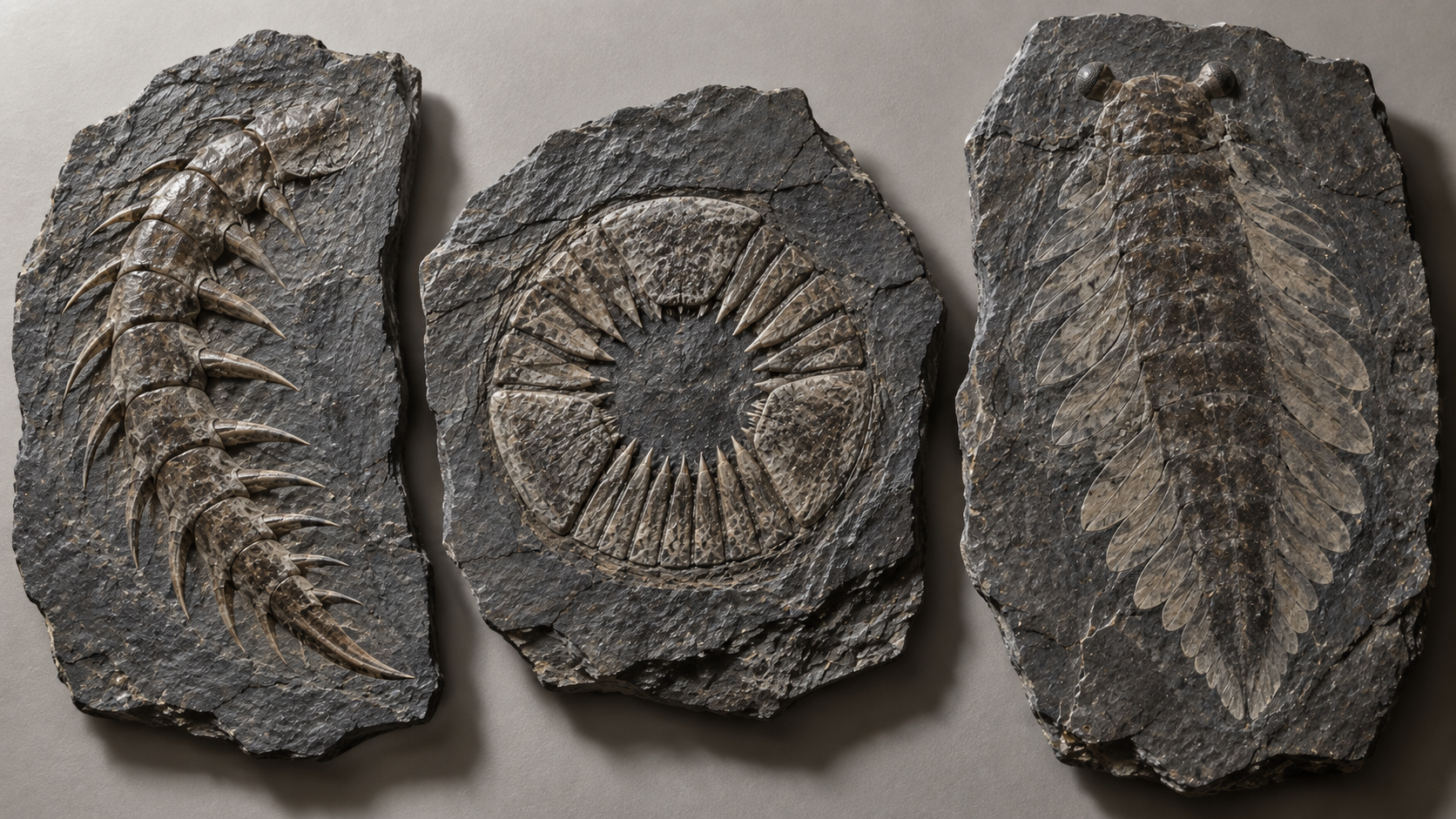
The mouth opens downward on the underside of the body, formed of three large plates and smaller plates arranged in a ring, with pointed teeth lining the inner edges. This ring-shaped mouth is a feature shared across the radiodonts, the group to which Anomalocaris belongs, and no living animal has the same structure. It has been inferred that the plates moved to press the teeth against prey, or worked to draw prey into the mouth, but the exact mechanism is undecided.
It swam by undulating the lateral lobes for propulsion and steering with the tail flaps. The streamlined body suits swimming, and some studies argue from the shape of the tail fan that rapid changes of direction were possible. Compound eyes of a close relative have been found in the Emu Bay Shale of Australia, with over 24,000 lenses in a single eye. This was an animal that hunted by tracking moving prey visually, in water where light reached well.
In the Burgess Shale, several hundred fossils of appendages and mouths have been found, while specimens preserving the whole body number only about ten. Most of the body lacked a hard shell and therefore fossilized poorly. The same strata yield many animals emblematic of the Cambrian, including trilobites, Opabinia, Hallucigenia and Marrella, and Anomalocaris lived in the same sea as these.
Described as three separate organisms
The research history of Anomalocaris is known for the way parts of the body were each described under different names and only brought together more than ninety years later.
The first part named was the appendage. In 1892, Joseph Whiteaves of the Geological Survey of Canada interpreted fossils from the trilobite beds of Mount Stephen as the trunk of a crustacean with its ventral legs missing, and named it Anomalocaris, meaning “unlike an ordinary shrimp.” The elongate segmented shape, with spines on each segment, looked like the tail of a shrimp.
In 1911, Charles Walcott, who had discovered the Burgess Shale, took a ring-shaped fossil for a jellyfish and named it Peytoia nathorsti, the projections around the ring’s outer edge appearing to be jellyfish tentacles. In the same paper, Walcott interpreted another fossil preserving a complete flattened body as a sea cucumber and gave it the name Laggania cambria.
Interpretations continued to shift afterward. In 1928, the Danish researcher Henriksen reconstructed the Anomalocaris appendage combined with the carapace of another arthropod, Tuzoia. In 1978, Simon Conway Morris re-examined Laggania and concluded it was not one organism but a fossil in which the “jellyfish” Peytoia lay superimposed on a sponge. The following year, 1979, Derek Briggs pointed out that Anomalocaris was not the trunk of a shrimp but the appendage of an unidentified arthropod. That assessment later proved correct.
The matter was settled in the early 1980s at Harry Whittington’s workbench. Examining unidentified specimens from the Geological Survey of Canada by grinding away the rock little by little to expose the structures beneath, Whittington found two “shrimp” Anomalocaris attached side by side to the head of a large body, with the “jellyfish” Peytoia seated beneath as its mouth. The same structure was confirmed in Smithsonian specimens, and the specimen Conway Morris had called a jellyfish-on-sponge turned out to be an individual of the same kind of animal. In 1985, Whittington and Briggs published these findings together and concluded that the shrimp’s tail was not a shrimp’s body but a predator’s arm, and the jellyfish was that predator’s mouth.
Even that 1985 reconstruction has since been revised. In 2012, Allison Daley and Jan Bergström re-examined the mouth of Anomalocaris canadensis and found that its oral plates were arranged triradially around three large plates, different from the tetraradial mouth of the Peytoia Walcott had described. The mouth described as a jellyfish, in other words, did not belong to Anomalocaris canadensis but to a different radiodont. That animal now carries the name Peytoia unchanged. The jellyfish Walcott named survived, a century later, as the name of another animal.
Did it eat trilobites?
Anomalocaris has long been depicted as a predator attacking trilobites. The grounds are healed injuries resembling bite marks found on Cambrian trilobites, and large coprolites composed of trilobite fragments. In 1999, Nedin proposed a predation model in which the mouth gripped one end of a trilobite while the appendages worked the other end back and forth to crack the shell.
Current research treats this view cautiously. It had already been noted that the oral plates were not calcified and that the fossils show no traces of wear or breakage, making them too weak to pierce a trilobite’s hard shell. In 2023, Russell Bicknell and colleagues built a three-dimensional model of the appendages of Anomalocaris canadensis and computed joint motion, stress and water resistance. The result: the appendages were suited to grasping prey but had no capacity to crack hard shells, and were built to accelerate with resistance minimized in an extended posture. The team concluded that Anomalocaris canadensis was a predator pursuing soft-bodied animals swimming in well-lit water, not trilobites crawling on the seafloor. As the maker of the trilobite injuries and the coprolites, other animals such as large trilobites are among the candidates. Soft trilobites freshly moulted could still have been eaten.
Sources
Royal Ontario Museum, The Burgess Shale: Anomalocaris canadensis (a summary of research history, morphology and ecology)
Daley, A. C. & Edgecombe, G. D. (2014) Morphology of Anomalocaris canadensis from the Burgess Shale. Journal of Paleontology 88(1): 68–91. https://doi.org/10.1666/13-067
Bicknell, R. D. C. et al. (2023) Raptorial appendages of the Cambrian apex predator Anomalocaris canadensis are built for soft prey and speed. Proceedings of the Royal Society B 290: 20230638. https://doi.org/10.1098/rspb.2023.0638
Paterson, J. R., Edgecombe, G. D. & García-Bellido, D. C. (2020) Disparate compound eyes of Cambrian radiodonts reveal their developmental growth mode and diverse visual ecology. Science Advances 6(49): eabc6721. https://doi.org/10.1126/sciadv.abc6721
コメント