This article contains affiliate links. As an Amazon Associate I earn from qualifying purchases.
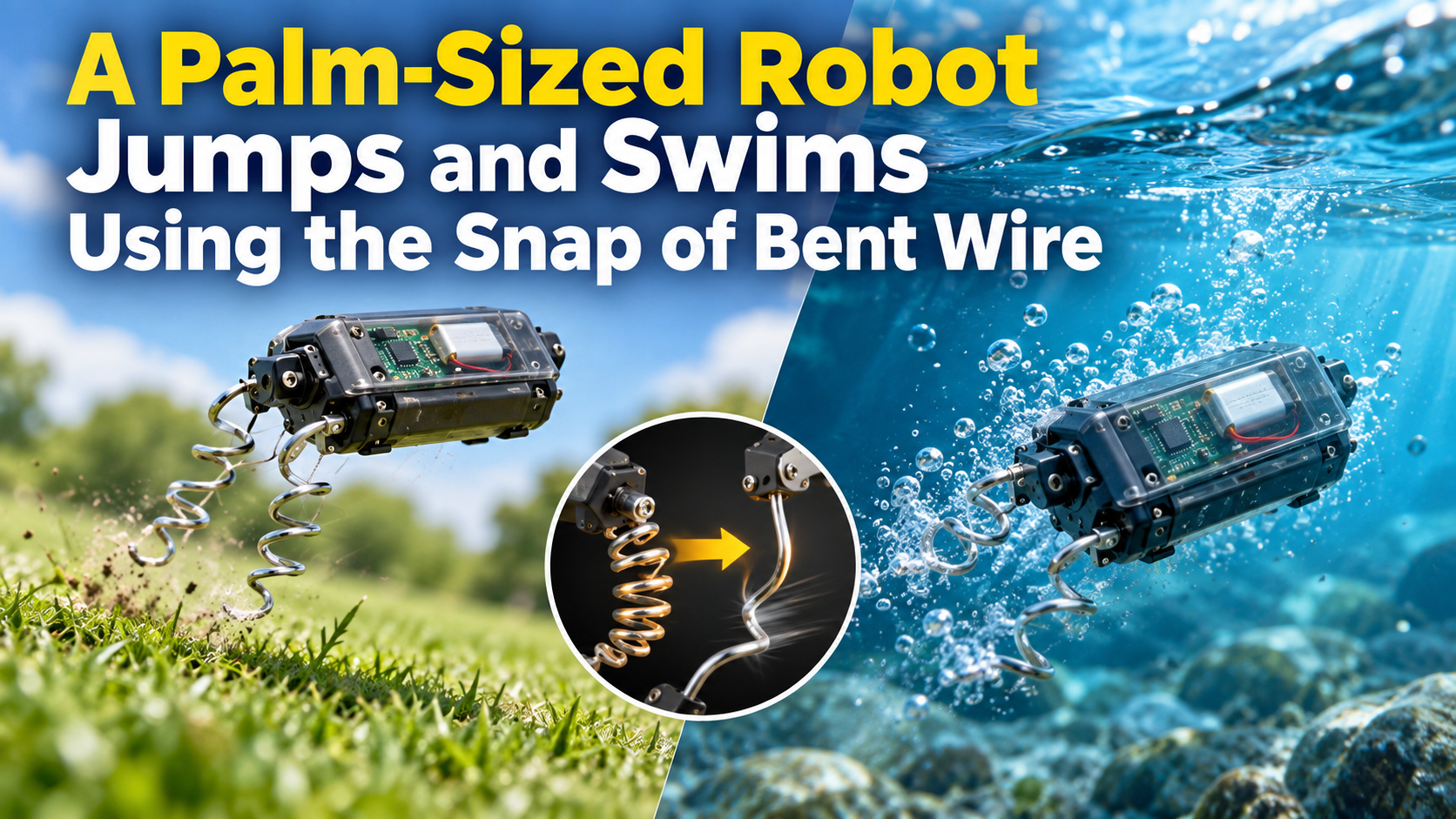
A robot small enough to sit in your palm kicks off the ground with its hind legs and hops forward, a little like a frog. It keeps hopping on a wooden floor, on cloth, on grass and on sand, and sealed inside a watertight shell it swims. It is 11 centimeters long and weighs 98.2 grams. The only motors on board are two small hobby servos.
Those servos cannot launch the robot by pushing on the ground directly. The jumping power comes from somewhere else. Each leg is a thin metal rod, 13.5 centimeters long and 0.8 millimeters thick. The servo slowly twists the rod into a coil, and at a certain limit the rod suddenly snaps into a different shape. That instant of recoil is what sends the robot into the air. A team from the University of California, Los Angeles (UCLA) and the University of Michigan described the design method and the robot’s performance in Science Advances on September 18, 2026.
How a Small Motor Delivers a Hard Kick
The rod is made of nitinol, a superelastic alloy that bends without breaking and springs back straight when released. One end is fixed to the robot’s body, and the other is rotated slowly by a servo. As it turns, the rod bends and twists at the same time and settles into a helical shape. The more it deforms, the more elastic energy it stores, like a loaded spring.
Up to that point it is only a slow deformation. But once the rotation passes a critical angle, the helix loses its stability and the whole rod flips at once into a different shape. The phenomenon is called snap-through. It belongs to the same family as the lid of a jam jar that clicks inward when you press its center. Part of the stored energy is released in that single instant.
The small motor spends a relatively long time loading energy into the rod, and the rod gives it back in a much shorter burst. That is why the kick is far stronger than anything the motor could produce on its own. The robot carries two of these rods as hind legs. The servo twists the rod a little past its critical angle, the rod snaps and strikes the ground, the robot leaves the ground, the servo resets the rod while the robot is still airborne, and the robot lands. The cycle repeats 2.13 times per second.

Rods That Snap and Rods That Merely Sag
A twisted rod does not always snap, however, and this is the central problem of the study. Move the two ends of a straight rod in the same general way, and depending on the helix you create, the rod does one of two things at its limit. One outcome is the snap-through just described. The other is a smooth, gradual sagging that continues past the limit without any sudden jump, known as continuous buckling. In the second case almost no stored energy is released, so the rod is useless as a leg.
Predicting which of the two will happen has been difficult. The behavior of a rod deforming in three dimensions is sensitive to its shape, to how its ends are held and to the direction in which it is loaded. The researchers combined three approaches: the mathematical theory of thin elastic rods, simulations that break the rod into many small elements, and automated experiments in which an industrial robot arm held one end of a real rod and deformed it over and over. From these they built a map of the conditions under which a rod snaps.
The map is organized by an angle that characterizes the helix’s shape, called the helix angle, which is set by the ratio of how much the rod is bent to how much it is twisted. Within the range the team examined for the robot, helix angles between roughly 0.24 and 0.45 release almost no energy at the limit. Those rods simply sag. Large energy releases occur near 0.24 and near 0.57. But the shapes near 0.57 end up strongly asymmetric and three-dimensional after snapping, which makes them awkward to build as legs and unreliable at striking the ground.
So the team restricted itself to the small-angle side and built three legs, with helix angles of 0.01, 0.11 and 0.20, to compare. A larger angle gives a more forceful snap, but it also requires the servo to turn farther, which takes longer to reset. The compromise that came out of this trade-off was 0.11. A leg of this design kept working through a reliability test of 1,200 consecutive twist-and-reset cycles.
The map is written in a form that contains no absolute dimensions. Whether a rod snaps is decided by its shape, not its size. Khalid Jawed, an associate professor at UCLA who co-led the study, has pointed out that this means the same design rules carry over to robots of very different sizes.

What a Rigid-Legged Twin Revealed
Building a hopping robot that moves quickly does not by itself show that the speed comes from the snapping mechanism rather than, say, from a light body. So the researchers built a control robot with the same body, the same battery, the same control board and the same servos, replacing only the legs with rigid 3D-printed rods. Leg length, the material of the pads that touch the ground, the command sequence sent to the servos and the cycle rate of 2.13 per second were all kept identical. The snapping robot weighed 98.2 grams and the rigid-legged one 92.6 grams.
The two robots were run on six surfaces. Speeds below are given in body lengths per second, with the snapping legs first and the rigid legs second.
- Wood: 3.21 versus 1.20
- Cloth: 2.50 versus 0.10
- Acrylic: 2.48 versus 1.11
- Leather: 2.09 versus 1.08
- Grass: 1.91 versus 0.22
- Sand: 2.54 versus 1.05
Averaged over the six surfaces, the snapping legs managed 2.46 body lengths per second and the rigid legs 0.79. With a body 11 centimeters long, the top speed on wood works out to about 35 centimeters per second.
On hard, flat surfaces such as wood and acrylic, the rigid legs did move the robot forward. The gap opened up on cloth and grass. The rigid-legged robot nearly stalled on cloth and made little progress on grass, while the snapping legs kept hopping on every surface without a large drop in speed. On cloth the difference in speed reached a factor of 25.
Power consumption, meanwhile, was not very different: an average of 1.63 watts for the snapping legs and 1.41 watts for the rigid ones. With almost the same electrical input, the snapping legs produced a taller, shorter and sharper spike of force against the ground, with the peak push rising from 1.53 to 2.46 newtons. Rigid legs stay in contact with the ground longer, and on a surface that gives way or slips, that contact bleeds away energy. Snapping legs kick briefly and then spend the rest of the stride in the air, so the character of the surface matters less. The comparison shows that both the speed and the tolerance for difficult ground come from the structure of the leg itself.
The robot also scores 4.79 on a measure called cost of transport, which divides the electrical energy used by the robot’s weight and the distance covered. The paper places this figure alongside previously reported untethered walking and hopping robots and animals and notes that the robot sits in a favorable region for both speed and efficiency. The authors add that this comparison is meant as context rather than as a central claim.
Turning, Backflips, Swimming and the Open Questions
The two legs can be driven independently. Snapping only one of them rotates the body at an average of 163 degrees per second, so a 90-degree turn takes 0.55 seconds. Changing the timing of the snap lets the robot perform repeated backflips, rising up to 3.2 times its own body height. Sealed in a watertight enclosure and placed in water, the same leg motion becomes a paddling stroke, and the robot swam at 0.5 body lengths per second.
The team also took the robot out of the laboratory. It climbed and descended a purpose-built staircase, recovering from misaligned landings and continuing forward. On an outdoor sand patch strewn with small rocks, it followed a prescribed path under remote control. In a natural outdoor pool it swam through underwater obstacles in gusty wind. Fitted with a light sensor on each side and a simple rule that favors the leg on the brighter side, it reoriented itself and moved toward a light source from several different starting positions.
The authors are open about the limitations. The output of this mechanism is burst-like: it delivers short, discrete pushes, and the force cannot be varied continuously. The leg has to be reset after every snap, and the timing of snap and reset has to be coordinated with the robot’s body motion and its contact with the ground, or the hopping falls apart. Neither the leg nor the body has yet been optimized for swimming, which the paper lists as future work.
Still, what the study delivers is less the performance of one particular robot than a route from mechanics to design: predict in advance what shape makes a thin rod snap, then turn that prediction into a rule for building legs. Instead of using the motor’s force directly, the motor is given only the job of loading energy slowly, and the job of releasing it is left to the shape of the rod. For small, light machines with limited power that need short, strong bursts of motion, it looks like a broadly useful way of thinking. The research was funded by the U.S. National Science Foundation.
Related products
You can find books and products related to this article on Amazon.
If you buy through the links above, this blog may earn a commission.
Sources
- Tong, D., Wang, J., Chen, Z., Borum, A., Huang, W., Huang, X., Jawed, M. K. (2026). Geometry-controlled instability pathway selection in elastic helices enables fast, efficient robotic locomotion. Science Advances, 12(38). https://doi.org/10.1126/sciadv.aeh2779 (open access; a free full-text copy is also available on Europe PMC)
- UCLA / University of Michigan news release via EurekAlert!, September 21, 2026: Frog-like hopping robot propelled by twisting elastic rods
- Tech Xplore, September 2026: Snapping rods let frog-like robot outrun rigid legs across six terrains


コメント