This article contains affiliate links. As an Amazon Associate I earn from qualifying purchases.

| Name | Pterygotus (Pterygotus). From Greek, “the winged one” |
| Classification | Arthropoda, Chelicerata, Eurypterida (sea scorpions), family Pterygotidae |
| Age | Late Silurian to Middle Devonian (about 427 to 383 million years ago). The type species P. anglicus is Early Devonian |
| Where found | Scotland (Angus), England, Canada, the United States, the Czech Republic, Australia and elsewhere; fossils known from five continents |
| Length | 50 cm to 1.75 m depending on species; about 1.6 m for the type species P. anglicus (not counting the claws) |
| Lenses per compound eye | About 4,300 (counted on a single fossil of P. anglicus) |
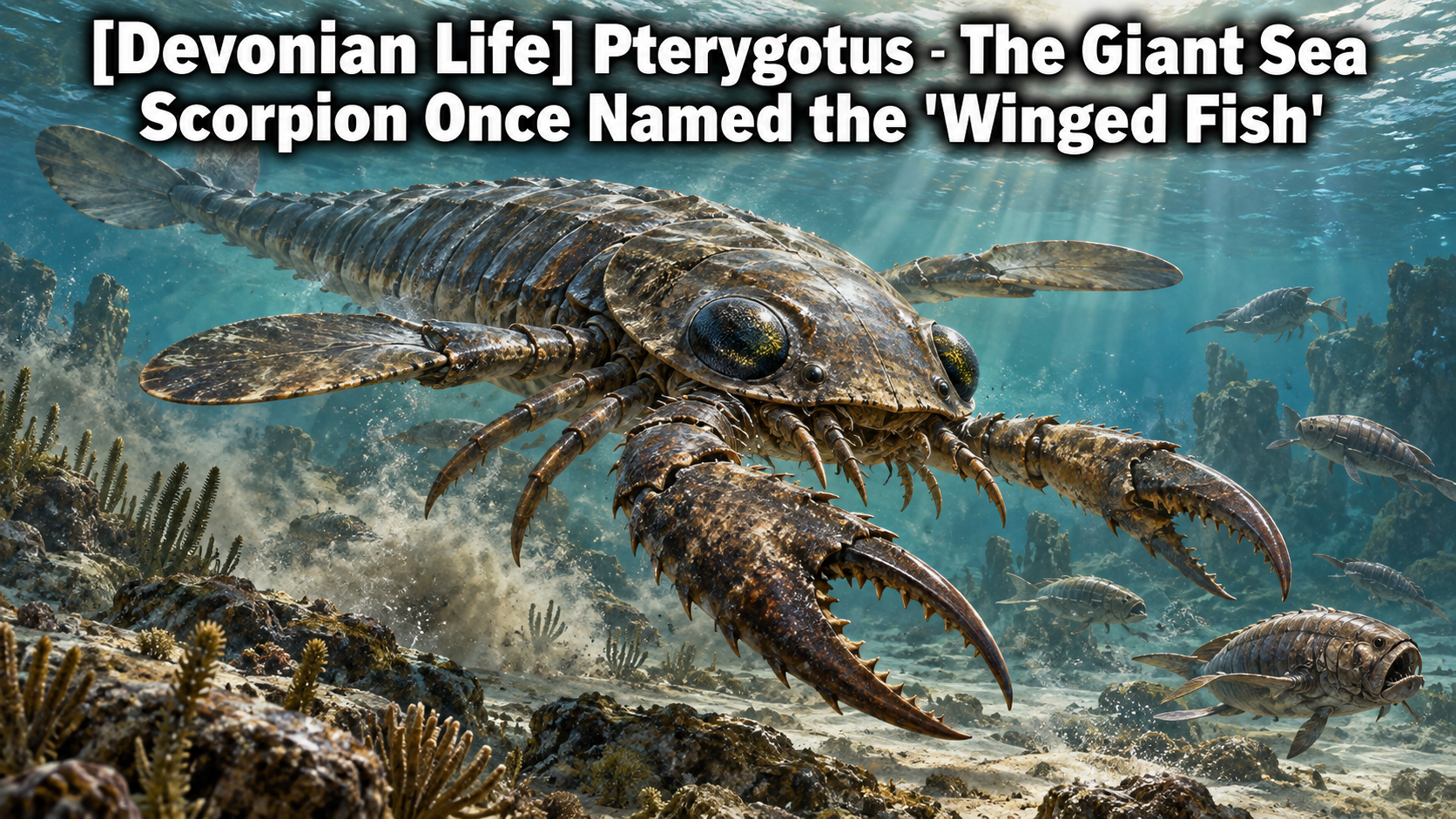
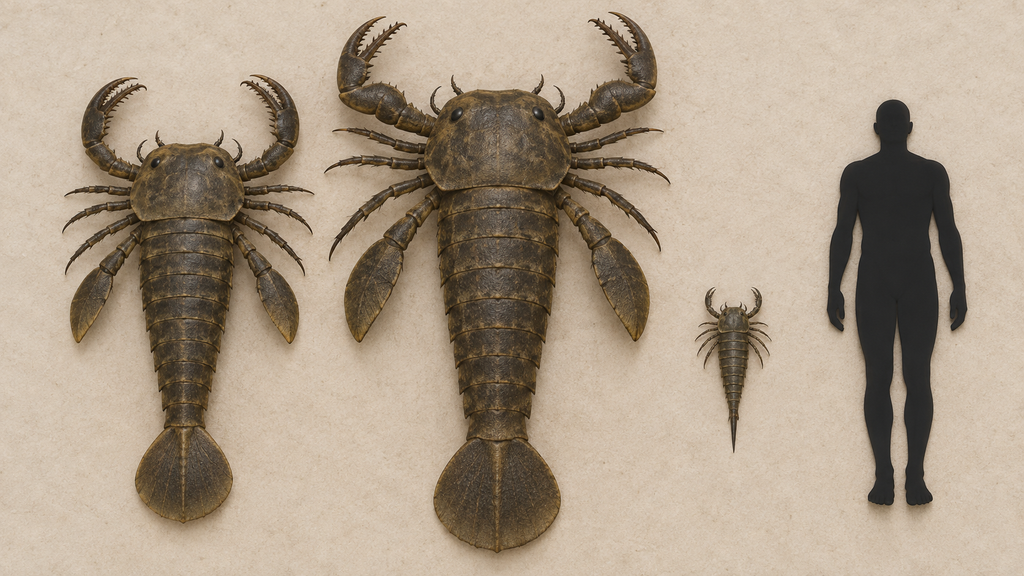
Pterygotus is a large sea scorpion (eurypterid) that lived in Silurian and Devonian seas. It had a pair of long claws held out in front of the head, flat oar-like swimming legs and large compound eyes, and it hunted by swimming after its prey. The genus was named in 1839 from fragments dug up in a Scottish quarry, but the man who named it believed at the time that he was looking at a fish. The genus name, “the winged one”, still records that mistake.
Appearance and Way of Life
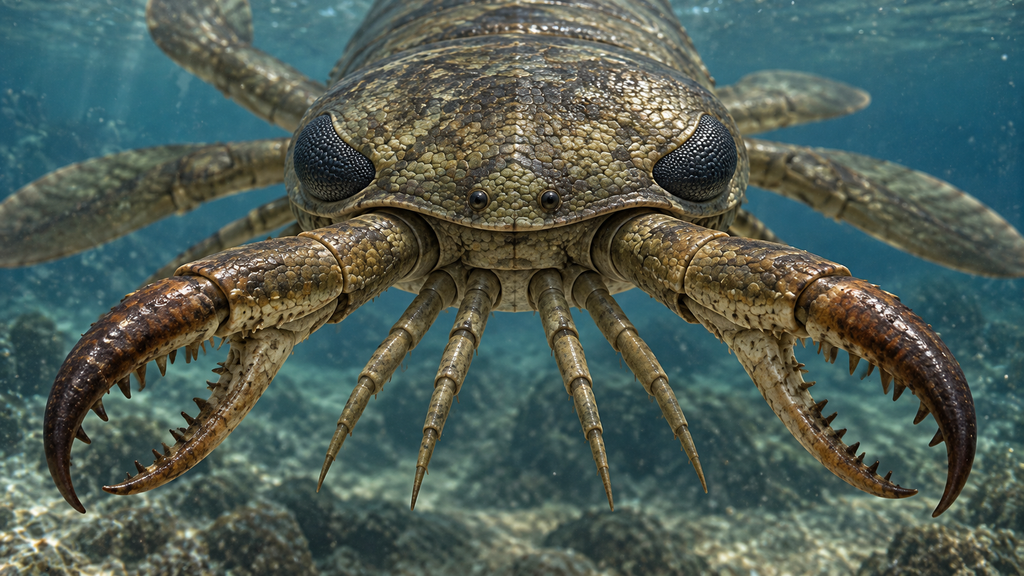
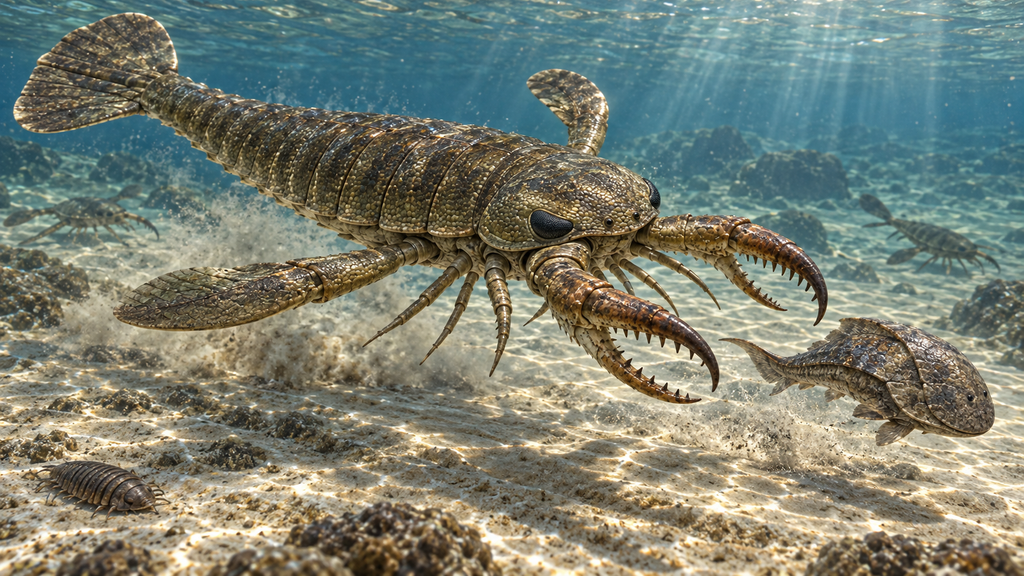
The body was long and slender: a head shield (prosoma), twelve segments behind it, and a tail piece (telson) at the end. At the front of the head sat a pair of large claws, the chelicerae, which alone ran to a sizeable fraction of the body length. Their tips were rounded and curved, and the inner edges carried teeth of different sizes. They were tools for stabbing and pinning prey and bringing it to the mouth. A pair of large compound eyes sat on the edge of the head shield, with small simple eyes between them.
Of the six pairs of appendages, the rearmost pair was broad and paddle-shaped and provided propulsion in the water. The remaining walking legs were thin and had no spines. In Eurypterus, another sea scorpion, the walking legs carry spines suited to walking on the bottom; the legs of Pterygotus were poorly suited to walking on land or on the seafloor, and the animal is thought to have spent most of its time swimming. The telson was flat and broad and served as a rudder.
The surface of the body was covered in a pattern that looks like rows of semicircular scales. This ornament stands out even on broken fragments, and it later lay behind the confusion over the animal’s name.
The family Pterygotidae is the group of sea scorpions that grew largest. Within the genus Pterygotus, the type species P. anglicus reached about 1.6 m, and P. grandidentatus, estimated from fragmentary claws, about 1.75 m. The title of largest arthropod ever, however, does not belong to this genus. In 2007 a claw estimated at about 46 cm long was reported from Early Devonian rocks in the Eifel region of Germany, and the body length of its owner, the closely related Jaekelopterus (Jaekelopterus rhenaniae), was put at about 2.5 m. That beat the previous record, Acutiramus at about 2.1 m, by nearly half a metre. Pterygotus and Jaekelopterus look very much alike and can be told apart only by details of the genital appendage and the telson.
Fossils of the genus come from Scotland and England, from New Brunswick in Canada, from the United States, the Czech Republic, Australia and elsewhere, five continents in all. Most sea scorpions are concentrated in North America and Europe; Pterygotus is one of the few genera with a nearly worldwide distribution. Sharing its waters were other sea scorpions such as Eurypterus, jawless and armoured fishes, trilobites and brachiopods.
What the Eyes and Claws Say About Hunting
How active a predator the giant sea scorpions really were has long been debated. In 2010 the structure of the claws of Acutiramus was examined, with the conclusion that they lacked the strength to pierce thick cuticle or to hold struggling prey. A big pair of claws, in other words, does not by itself make a powerful predator.
In 2015 McCoy and colleagues approached the question through fossil compound eyes. In an arthropod eye, the more lenses there are and the smaller the angle between neighbouring lenses (the interommatidial angle), the finer the detail the animal can resolve. In a fossil of P. anglicus from Early Devonian rocks in New Brunswick, Canada, the interommatidial angle was about 0.77 degrees and the lens count about 4,300. Jaekelopterus averaged 0.85 degrees and about 3,200 lenses. These values overlap with those of living arthropods that actively chase down prey. Acutiramus, in the same family, had a larger interommatidial angle and fewer lenses, and was judged to have had poor vision. In Acutiramus, moreover, vision got worse as the body grew, which makes it hard to picture the adults as active hunters.
The shape of the claws matches this split. The claws of Pterygotus and Jaekelopterus are thick and robust, with a row of teeth of different lengths, built for stabbing and gripping. The claws of Acutiramus have fine teeth suited to cutting and slicing. Among the “giant sea scorpions”, then, Pterygotus is now seen as a sharp-eyed predator that seized prey with powerful claws. Candidate prey includes the fishes and other arthropods that lived in the same waters.
The Quarrymen’s “Seraphim” and the Winged Fish
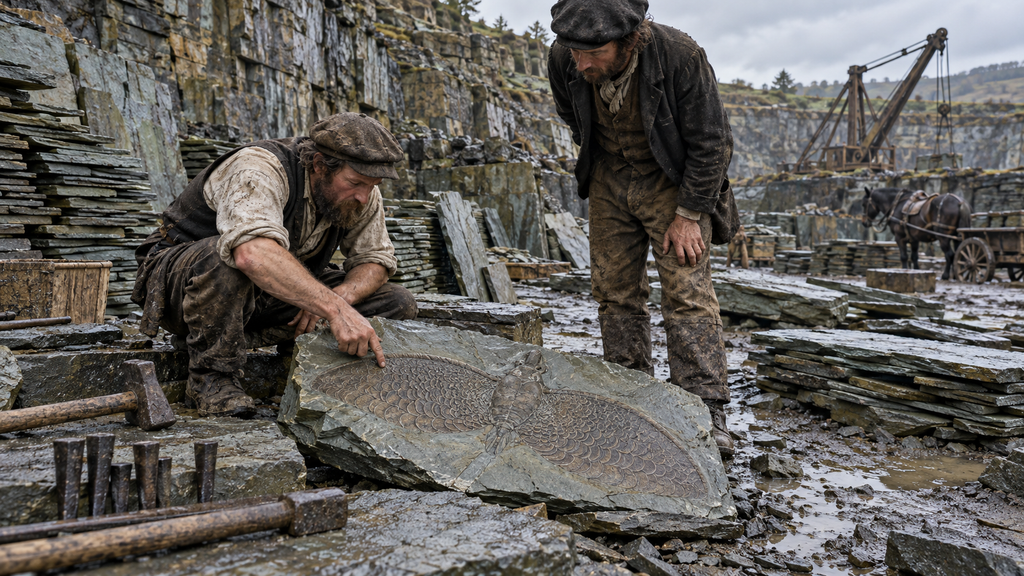
The first fossils of Pterygotus came from quarries in Angus, in eastern Scotland (then Forfarshire). The Early Devonian sandstones of the district, part of the Old Red Sandstone, split into thin, even slabs and were quarried in quantity for paving. At Carmyllie and Turin Hill, fossils kept turning up as the stone was split.
The quarrymen called the flat, plate-like fossils that appeared there “Seraphim”, after the angels. Murchison’s 1839 book The Silurian System records that the name was given by the Scottish quarrymen. According to Hugh Miller, writing in 1841, the reason was that the wavy, scale-like ornament on the surface closely resembled the carved wings of cherubs on gravestones. The way the fossils fanned out to either side suggested wings as well.
The first person to describe the “Seraphim” scientifically was Louis Agassiz, the Swiss naturalist and leading authority on fossil fishes. In an appendix he contributed to Murchison’s book, Agassiz named the fossil Pterygotus, “the winged one”. He took it to be the remains of a large fish: the scale-like ornament on its surface looked to him like fish scales.
The error was corrected five years later. As more complete specimens accumulated from the Old Red Sandstone of Scotland, it became clear that the scaly plates were not the body of a fish but parts of an arthropod exoskeleton. In 1844, in his monograph on the fossil fishes of the Old Red Sandstone, Agassiz reassigned Pterygotus to the crustaceans. The genus name stayed, however, and the animal is still called “the winged one” today.
The identity of the “Seraphim” itself was settled later. In 1860 the local geologist Powrie reported a specimen of P. anglicus from the Carmyllie quarries with all of its body segments preserved. That specimen showed that the wing-like, “duck-bill” plate was a plate-like structure on the underside of the body, near the base of the tail. What the quarrymen had called angel wings was neither fish nor wing, but part of the belly of a giant arthropod.
Placing Pterygotus in the eurypterids as a group of their own, and recognising them as chelicerates related to living scorpions and horseshoe crabs, came with later research. Only the name has stayed as it was, a record of the first guess.
Related products
You can find books and products related to this article on Amazon.
If you buy through the links above, this blog may earn a commission.
Sources
Braddy, S. J., Poschmann, M. & Tetlie, O. E. (2008). Giant claw reveals the largest ever arthropod. Biology Letters 4, 106–109. https://doi.org/10.1098/rsbl.2007.0491
McCoy, V. E., Lamsdell, J. C., Poschmann, M., Anderson, R. P. & Briggs, D. E. G. (2015). All the better to see you with: eyes and claws reveal the evolution of divergent ecological roles in giant pterygotid eurypterids. Biology Letters 11, 20150564. https://doi.org/10.1098/rsbl.2015.0564
Lamsdell, J. C. & Braddy, S. J. (2010). Cope’s Rule and Romer’s theory: patterns of diversity and gigantism in eurypterids and Palaeozoic vertebrates. Biology Letters 6, 265–269. https://doi.org/10.1098/rsbl.2009.0700
Tetlie, O. E. & Briggs, D. E. G. (2009). The origin of pterygotid eurypterids (Chelicerata: Eurypterida). Palaeontology 52, 1141–1148. https://doi.org/10.1111/j.1475-4983.2009.00907.x
Powrie (1860). On the Old Red Sandstone and its fossil fish in Forfarshire. The Geologist 3. Cambridge University Press
Scottish National Dictionary, “Seraphim” (quoting Murchison 1839 and Miller 1841). Dictionaries of the Scots Language
Scottish Geology Trust, Geosite: Turin Hill. https://geosites.scottishgeologytrust.org/geosite/734
University of Edinburgh, Cockburn Geological Collection: Pterygotus anglicus, Balruddery Den. https://collections.ed.ac.uk/cockburn/record/111601

コメント