This article contains affiliate links. As an Amazon Associate I earn from qualifying purchases.
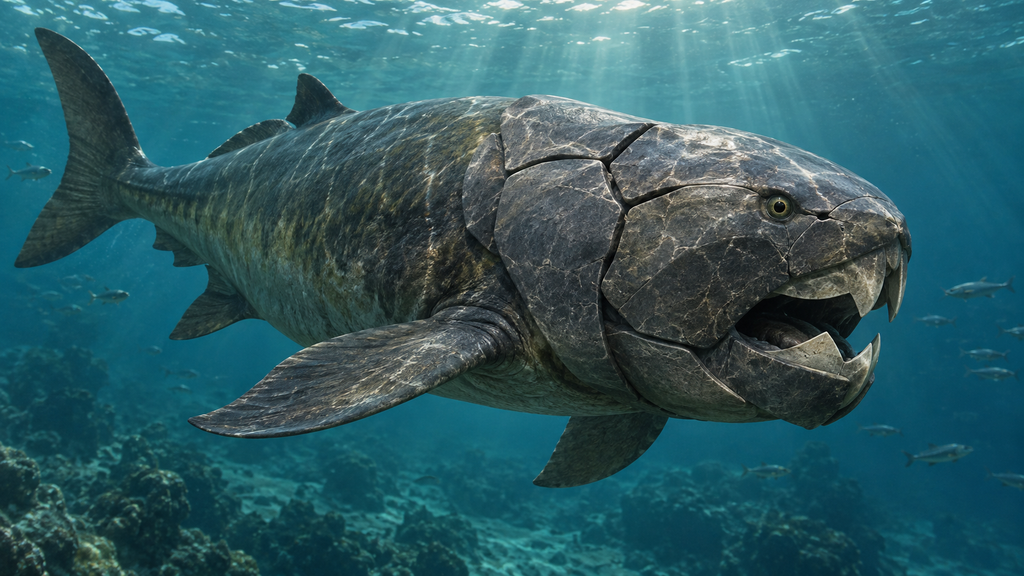
| Name | Dunkleosteus (Dunkleosteus terrelli). The genus name means “Dunkle’s bone” and was given in 1956 for David Dunkle, a curator at the Cleveland Museum of Natural History. The species name honors Jay Terrell, who found the first fossils in 1867 |
| Group | Placoderm, arthrodire. One of the earliest groups of jawed fishes; the placoderms died out at the end of the Devonian |
| Age | Late Devonian (about 382 to 358 million years ago) |
| Found in | Mainly Ohio, USA (Cleveland Shale). Also Pennsylvania, Tennessee, Canada, Morocco, Belgium, Poland and Russia |
| Length | About 3.4 m for a typical adult, up to about 4.1 m for the largest individual (2023 estimate). Earlier figures ranged from 6 to 10 m |
| Weight | About 950 to 1,200 kg for a 3.4 m individual, about 1,500 to 1,800 kg for the largest (2023 estimate) |
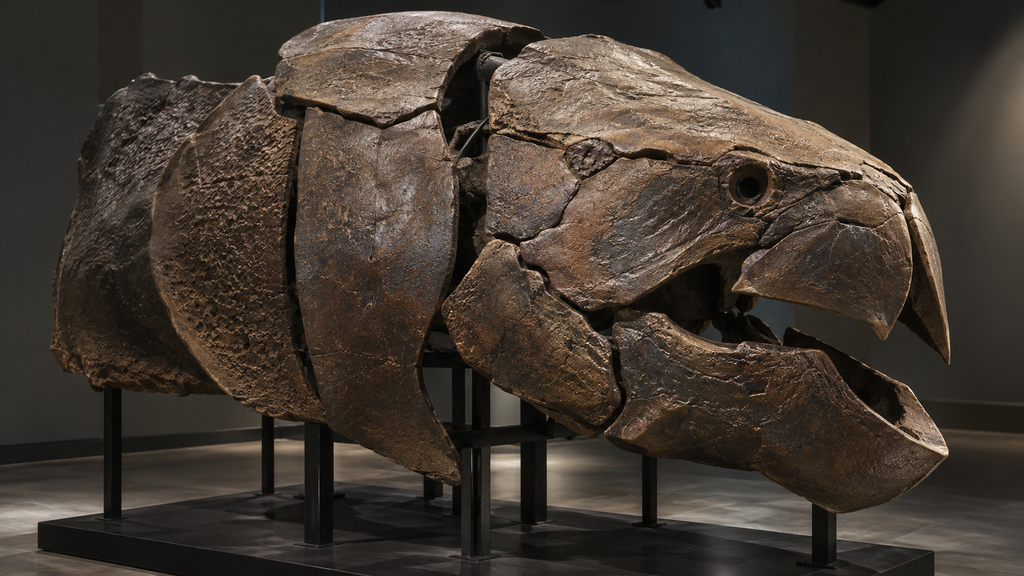
| Head | Skull 60 to 70 cm long. Bony plates cover the head and the front half of the trunk; the plate behind the neck is 5 to 7.6 cm thick |
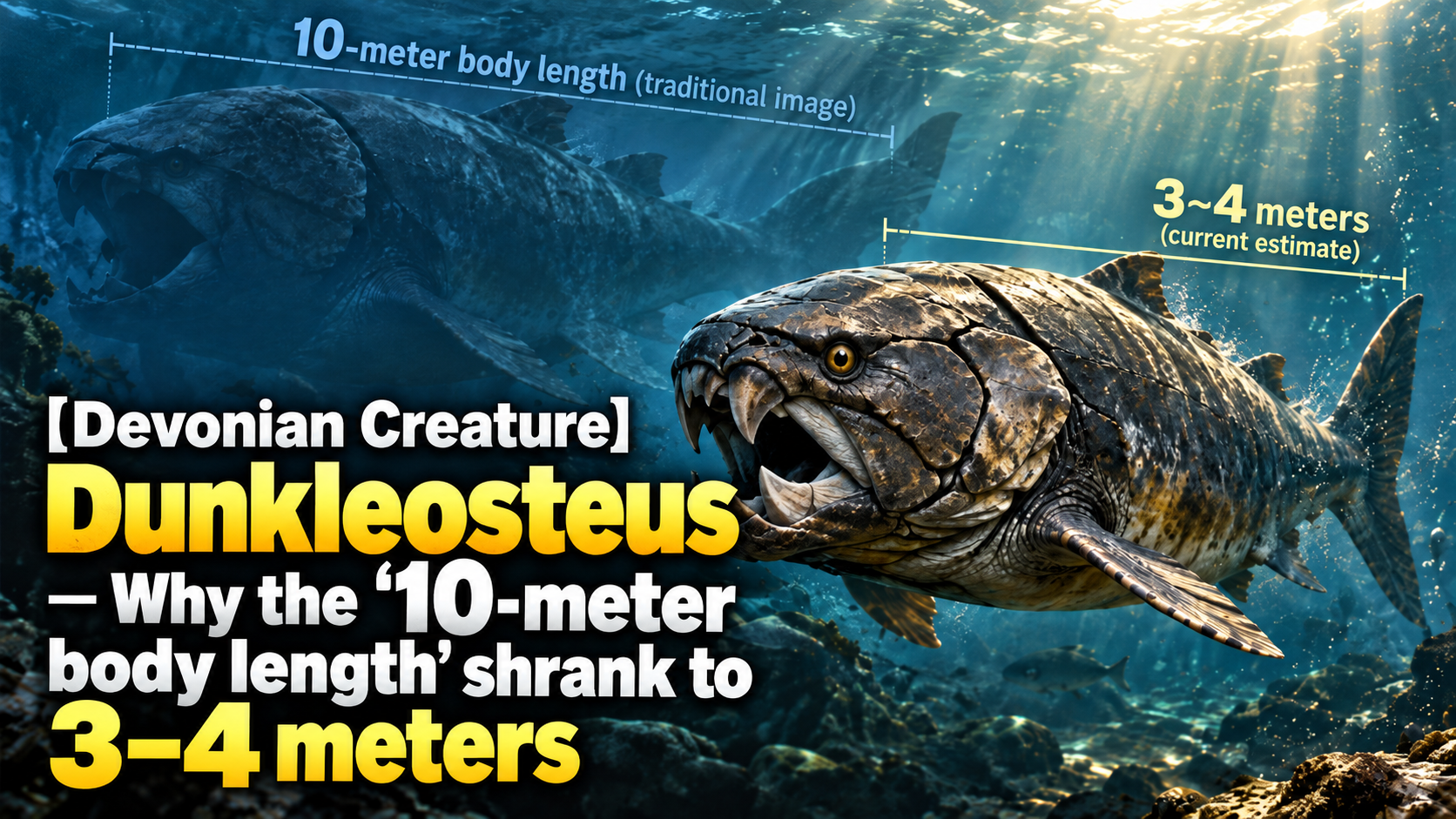
Dunkleosteus is a placoderm fish of the Late Devonian seas. Thick bony plates covered its head and the front half of its body, and instead of teeth the jaw bones themselves were honed into blades. It ranks among the earliest apex predators of the vertebrates. Reference books long gave its length as 6 to 10 meters, but the only parts ever found as fossils are the armor of the head and front trunk; the rest of the body has never been recovered. In 2023 the method of estimating its size was revised, and the length shrank to 3 to 4 meters.
Appearance and way of life
Fossils of Dunkleosteus consist almost entirely of the head and the front half of the trunk. This part was sheathed in bony plates, with the plates of the head and those of the trunk joined at the neck by a hinge. The plates had a hard outer layer and an inner layer filled with marrow, and the thickest plate, behind the neck, exceeds 5 centimeters. The name placoderm, “plate skin”, comes from these plates.
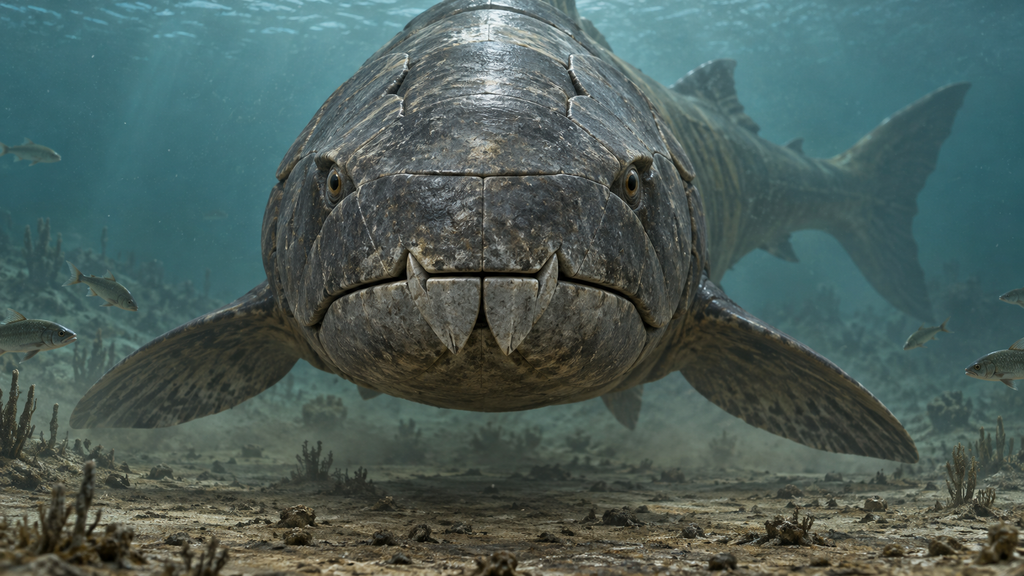
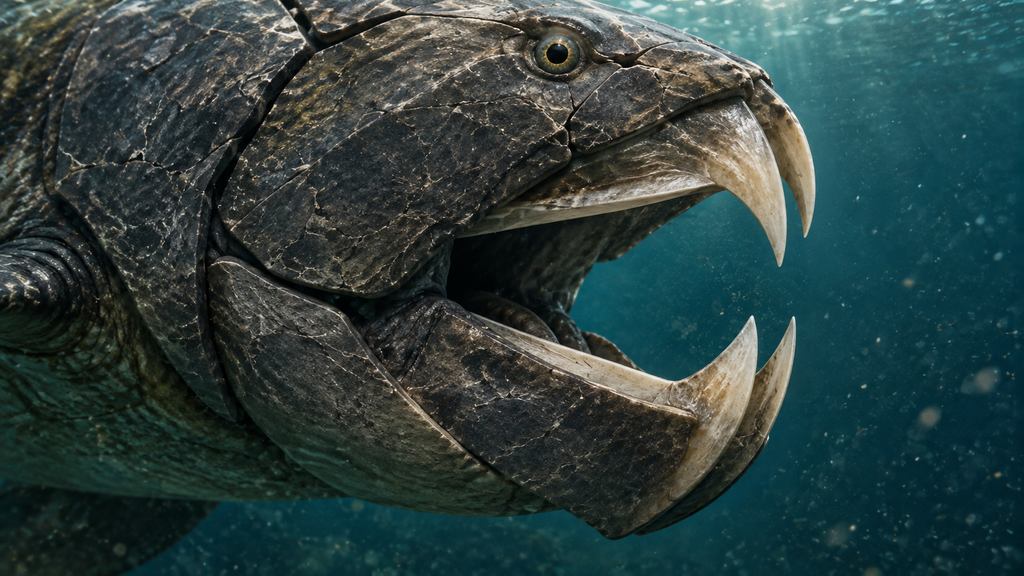
The jaws had no teeth. The edges of the upper and lower jaw bones served as blades, and as the upper and lower edges slid past each other they are thought to have honed one another. At the front the edges rose into fang-like points; behind them ran straight edges like a cleaver. A biomechanical model published in 2007 estimated a bite force of 4,400 newtons at the tip of the jaws and over 5,300 newtons at the rear blades, among the highest of any fish living or fossil. The same model found that the jaws opened fast enough to suck in prey along with the water. In 2025, however, a re-examination found that the skull contained more cartilage than assumed and that the jaw muscles attached differently, so the bite-force and suction estimates are now under review.
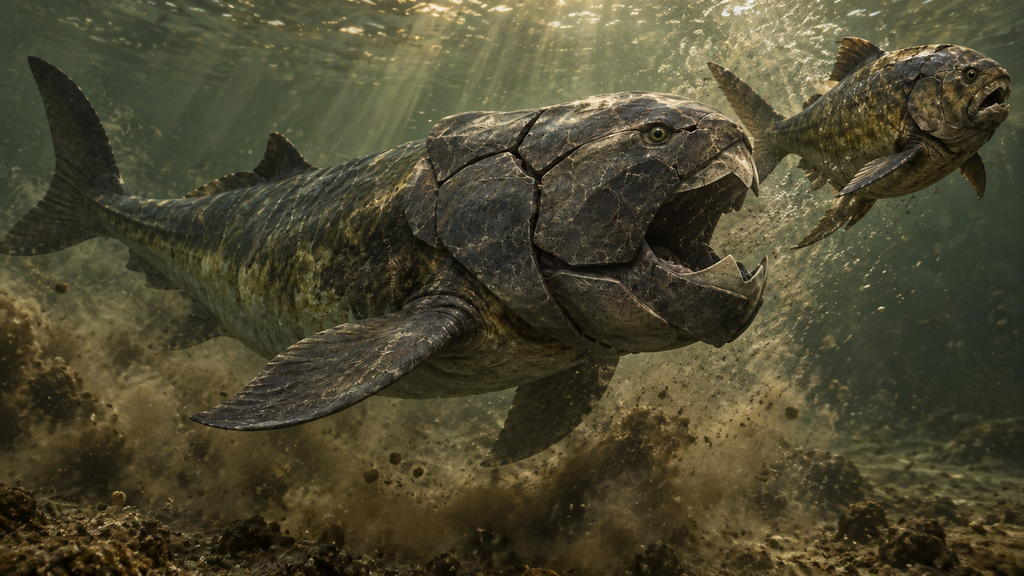
The rear half of the body had no bony plates and is not preserved. Even the backbone is known from a single specimen with 16 fused vertebrae. The shape of the tail fin is unknown, and most reconstructions assume a shark-like tail inferred from the trace of a pectoral fin and from the animal’s way of life. Its diet is inferred from shark teeth found with its remains and from masses of fish bone that it apparently regurgitated. The armor of other placoderms sometimes carries puncture marks from Dunkleosteus blades, and some specimens show bites attributed to fights between individuals of the same species.
From six to ten meters down to three to four
The first fossils were found in 1867 by Jay Terrell, a hotel keeper who collected fossils, in cliffs on the shore of Lake Erie in Ohio. The geologist John Newberry described them in 1873 and in 1875 named a species after Terrell. The genus name at the time was Dinichthys, “terrible fish”; the name Dunkleosteus was not given until 1956. The Cleveland Museum of Natural History holds the world’s largest collection, and most of the reconstructed heads on display in museums around the world are casts of one of its specimens, CMNH 5768.
The animal’s length has depended on estimates since it was first described. Newberry suggested 4.5 to 5.5 meters, but mid-twentieth-century textbooks gave 9 meters, and a figure of 10 meters appeared in 2009. In 2017 a study measured the relationship between the circumference of the upper jaw and total length in large living sharks and applied it to the jaws of Dunkleosteus, arriving at 6.9 meters for a typical adult and 8.8 meters for the largest individual. These were the figures behind the “8 to 10 meters” of recent reference books and exhibits.
In 2023 Russell Engelman of Case Western Reserve University tested the method itself. When the shark relationship between mouth size and length is applied to small placoderms known from complete bodies, it yields lengths far greater than the real ones. Placoderms are built differently from sharks, with large mouths and short trunks. Engelman used instead the distance from the eye socket to the rear of the gill cover (orbit-opercular length). Across more than 3,000 measurements of 972 species of living fish and placoderms, this distance tracks total length closely, and it predicts the length of complete placoderms correctly. Applied to Dunkleosteus, it gave 3.4 meters for a typical adult and 4.1 meters for the largest individual.
Only the length shrank; the weight went up. Estimating volume on the basis of a short, deep body gives about one tonne for a 3.4-meter individual and more than 1.5 tonnes for the largest. No vertebrate over 5 meters long existed in the Devonian; such sizes did not appear until the Carboniferous. The long-standing “10-meter monster fish” was a number produced by applying the body plan of a shark. Current reconstructions redraw the animal as a short, stocky body carrying a large head and mouth.
Related products
You can find books and products related to this article on Amazon.
If you buy through the links above, this blog may earn a commission.
Sources
- Engelman, R. K. (2023). A Devonian Fish Tale: A New Method of Body Length Estimation Suggests Much Smaller Sizes for Dunkleosteus terrelli (Placodermi: Arthrodira). Diversity 15, 318. https://doi.org/10.3390/d15030318
- Engelman, R. K. (2023). Giant, swimming mouths: oral dimensions of extant sharks do not accurately predict body size in Dunkleosteus terrelli. PeerJ 11, e15131. https://doi.org/10.7717/peerj.15131
- Ferrón, H. G., Martínez-Pérez, C. & Botella, H. (2017). Ecomorphological inferences in early vertebrates: reconstructing Dunkleosteus terrelli (Arthrodira, Placodermi) caudal fin from palaeoecological data. PeerJ 5, e4081. https://doi.org/10.7717/peerj.4081
- Anderson, P. S. L. & Westneat, M. W. (2007). Feeding mechanics and bite force modelling of the skull of Dunkleosteus terrelli, an ancient apex predator. Biology Letters 3, 77–80. https://doi.org/10.1098/rsbl.2006.0569
- Engelman, R. K., Carr, R. K., Trinajstic, K. & Johanson, Z. (2025). Functional anatomy, jaw mechanisms, and feeding behavior of Dunkleosteus terrelli (Placodermi, Arthrodira). The Anatomical Record. https://doi.org/10.1002/ar.70075


コメント