This article contains affiliate links. As an Amazon Associate I earn from qualifying purchases.

| Name | Titanokorys gainesi. From the Titans of Greek mythology and the Greek word for “helmet.” The species name honors geologist Robert Gaines, who helped discover a new fossil site |
| Classification | An early branch of the arthropod lineage; Radiodonta, Hurdiidae |
| Age | Middle Cambrian (about 506 million years ago) |
| Where found | Marble Canyon, Kootenay National Park, British Columbia, Canada (Burgess Shale) |
| Length | About 50 cm (estimated from the size of the head shield and the body proportions of a close relative) |
| Head shield length | Up to about 27 cm (length of the central shield) |
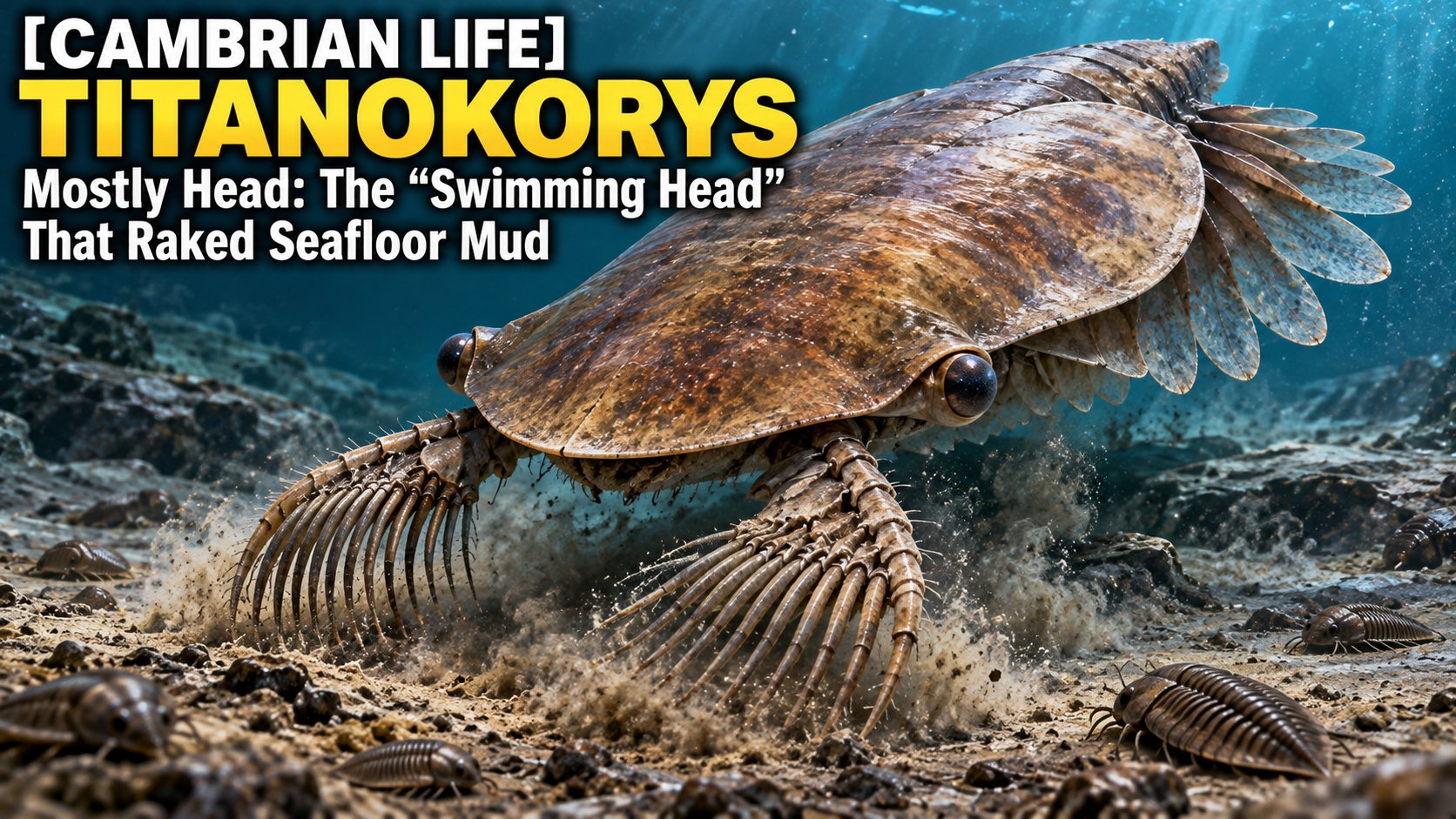
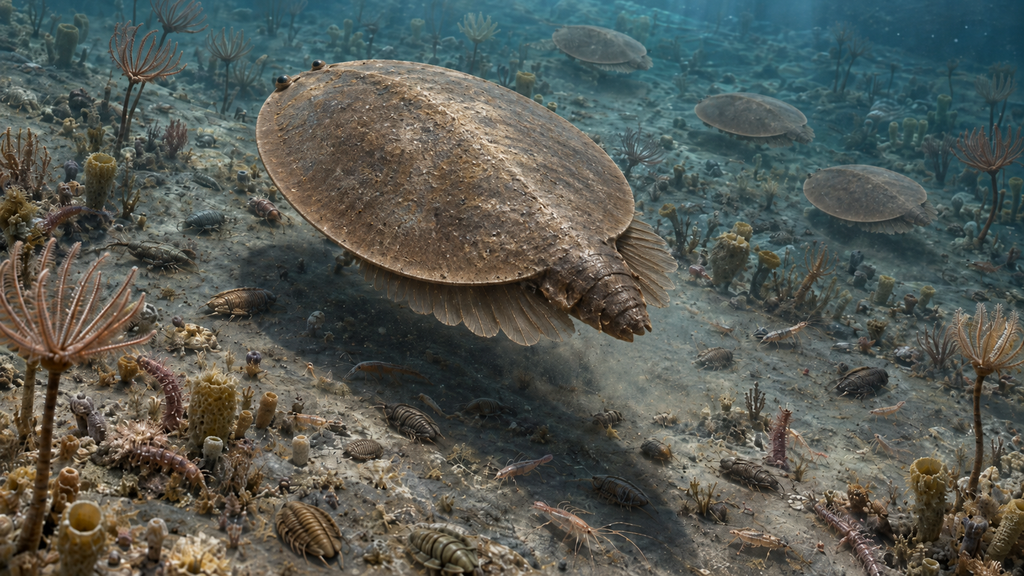
Titanokorys is a radiodont, a member of the group that lived in Cambrian seas and includes Anomalocaris. It is estimated to have reached about 50 centimeters, the largest known Cambrian hurdiid, at a time when most animals were no bigger than a fingertip. A huge, flat head shield covered most of its body, and the researchers who described it said it was little more than a “swimming head.”
Appearance and Life
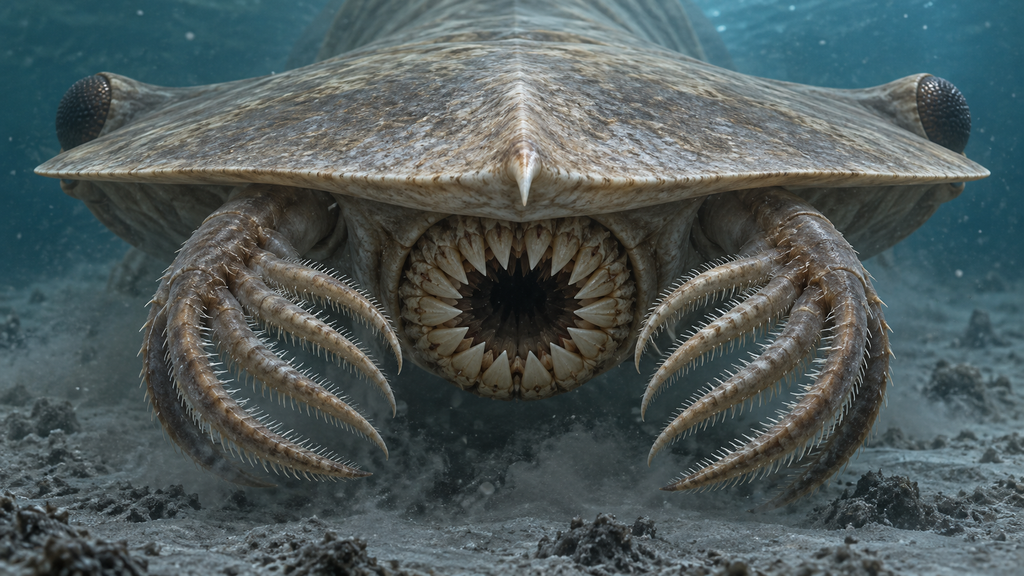
Radiodonts are early relatives of the arthropods, the group that includes shrimp, crabs and insects. They carried a pair of large limbs at the front of the head, with a mouth beneath their bases formed by a ring of tooth-lined plates. Swimming flaps lined both sides of the body.
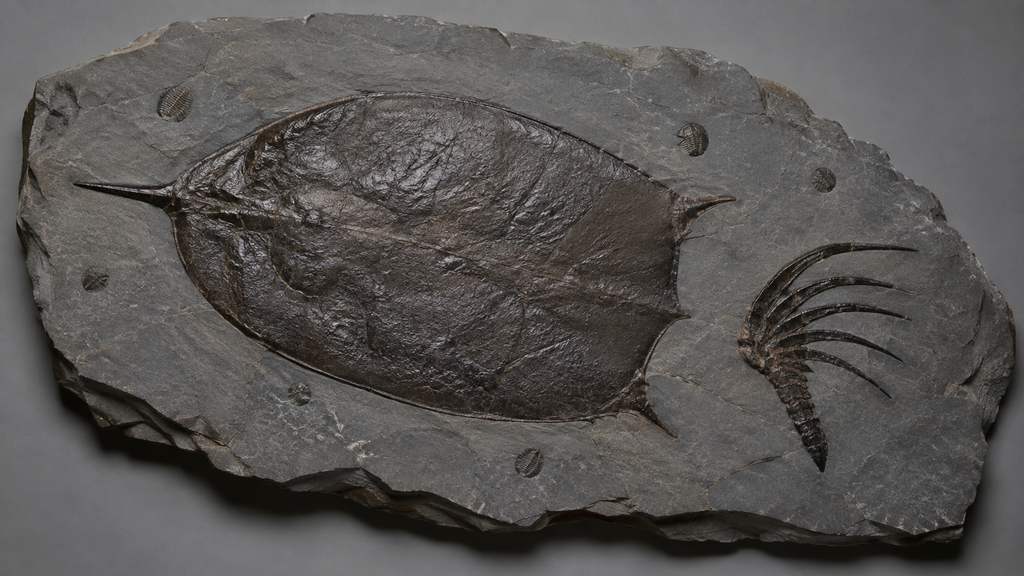
Hurdiids are the radiodonts with especially long heads. The head was covered by three shields: one in the middle on the back and one on each side. In Titanokorys the central shield is a broad oval, with a single spine at the front and short points at the rear corners. The largest central shield found so far is about 27 centimeters long. Because the shield is flat and wide, the animal is thought to have swum slowly just above the seafloor.
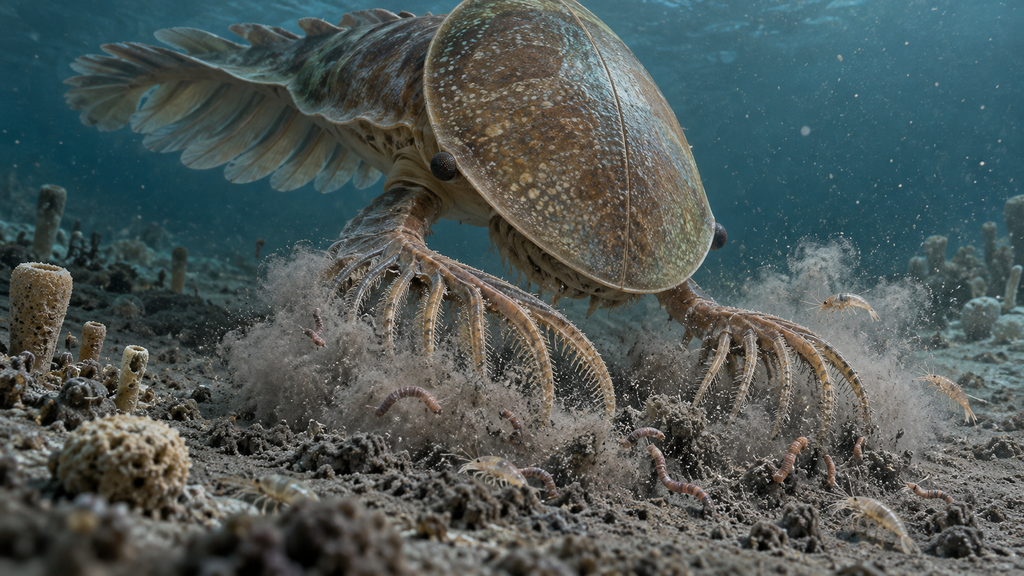
Each front limb has a stalk of short segments from which five long branches curve inward, every branch lined with dense, slender spines. Jean-Bernard Caron of the Royal Ontario Museum, who described the species, compared them to “multiple stacked rakes.” The current view is that the animal used these rakes to scoop and sift seafloor mud, straining out small animals living in or on the sediment and carrying them to its mouth. Caron has also suggested that the large shield might have worked like a plough.
The fossils come from Marble Canyon, a site about 40 kilometers from the famous Burgess Shale quarry found in 1909, discovered only in 2012. Here a smaller and far more common hurdiid, Cambroraster, occurs on the same rock surfaces. The front limbs of the two species are almost indistinguishable, and they may have competed for the same kind of prey on the same seafloor. One view is that Titanokorys avoided competition by going after larger prey.
The “Swimming Head” and Another Picture of Radiodonts
Anomalocaris, long treated as the typical radiodont, has been portrayed as a top predator that cruised with a streamlined body and seized prey with spiny limbs. For a long time this “swimming hunter” defined what a radiodont was.
That picture began to change as hurdiids became better understood from the 2010s on. Cambroraster, described from Marble Canyon in 2019, is known from many well-preserved fossils. They showed a huge horseshoe-shaped shield covering the head and the front of the body, a short trunk and rake-shaped front limbs. Rather than cruising the open water, it was an animal that stayed close to the bottom and sifted mud for food.
Surveys at Marble Canyon also turned up shields that looked like those of Cambroraster but were much larger. The researchers at first took them for large Cambroraster individuals and reportedly nicknamed the animal “the mothership.” On closer study the shield shape turned out to be different, and in September 2021 Joseph Moysiuk of the University of Toronto and Caron described it as a new genus and species, Titanokorys, based on 12 specimens. The type specimen appears to be a cluster of molted remains.
What has been found is shields, front limbs and mouth plates; no fossil of the trunk is known. The estimate of about 50 centimeters comes from applying the body proportions of Cambroraster, whose whole body is known, to the largest shield. It assumes that, as in Cambroraster, the head made up most of the body. On those proportions Moysiuk said, “The head is so long relative to the body that these animals are really little more than swimming heads.”
The description also compared the shapes of hurdiid shields. Shield shape varies greatly from species to species, but similar shapes do not mean similar feeding, so the shield alone cannot tell how an animal lived. Titanokorys and Cambroraster had different shields yet nearly identical rakes. Cambrian seas held not only swimming hunters like Anomalocaris but also several kinds of large animals that searched the seafloor with enormous heads.
Related products
You can find books and products related to this article on Amazon.
If you buy through the links above, this blog may earn a commission.
Sources
Caron, J.-B. & Moysiuk, J. (2021). A giant nektobenthic radiodont from the Burgess Shale and the significance of hurdiid carapace diversity. Royal Society Open Science 8, 210664. https://doi.org/10.1098/rsos.210664
Moysiuk, J. & Caron, J.-B. (2019). A new hurdiid radiodont from the Burgess Shale evinces the exploitation of Cambrian infaunal food sources. Proceedings of the Royal Society B 286, 20191079. https://doi.org/10.1098/rspb.2019.1079
Caron, J.-B. et al. (2014). A new phyllopod bed-like assemblage from the Burgess Shale of the Canadian Rockies. Nature Communications 5, 3210. https://doi.org/10.1038/ncomms4210
Royal Ontario Museum (8 September 2021). Massive new animal species discovered in half-billion-year-old Burgess Shale. https://www.rom.on.ca/news-releases/massive-new-animal-species-discovered-half-billion-year-old-burgess-shale


コメント