This article contains affiliate links. As an Amazon Associate I earn from qualifying purchases.
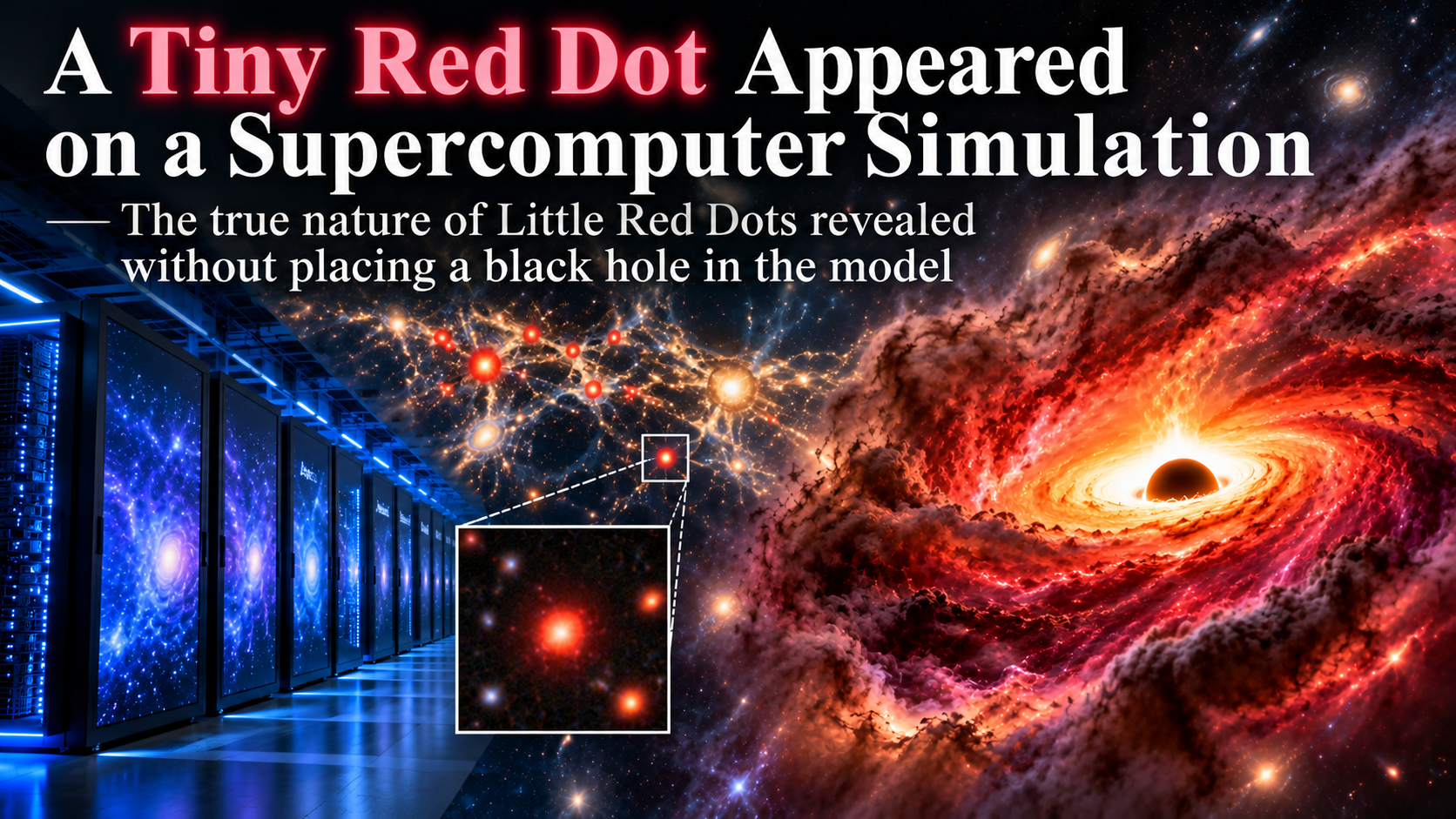
The “little red dots” that the James Webb Space Telescope found in the early universe have become one of astronomy’s biggest puzzles over the past few years. There are several candidates for what they might be, and every new observation adds another clue, yet nothing has settled the question. Then, in September 2026, a study of a somewhat different flavor came out. Instead of a telescope, it reported that little red dots had emerged on their own inside a supercomputer.
The work comes from an international team led by Sunmyon Chon of the Max Planck Institute for Astrophysics, together with Shingo Hirano of Kanagawa University and Tomoaki Ishiyama of Chiba University, among others. The paper was published in the peer-reviewed journal Nature on September 16. The calculations were run on ATERUI III, the astronomy-dedicated supercomputer operated by the National Astronomical Observatory of Japan.
Red Dots Scattered Across the Early Universe, and Black Holes That Are Too Heavy
First, a quick recap of the little red dots, or LRDs for short. Soon after Webb began observing in 2022, astronomers noticed that its images of the universe less than a billion years after the Big Bang were strewn with small, red points of light. Too small to be galaxies, too bright to be stars. When the light is split by wavelength, the emission lines from hydrogen turn out to be unusually broad, a sign that something at the center is moving extremely fast. The straightforward interpretation is that a growing black hole is inside, swallowing gas.
That interpretation, however, ran into two snags. One is that a growing black hole should emit X-rays, yet almost none are detected from LRDs. The other is that the black hole masses estimated from the width of the emission lines are far too large for the galaxies around them. In today’s universe, the total stellar mass of a galaxy and the mass of its central black hole follow a roughly fixed ratio. Work that ratio out for LRDs and the black holes come out orders of magnitude heavier than their stellar mass would predict. That means “overmassive black holes,” which have fattened up before their galaxies have grown, existed in the very early universe, and in large numbers.
How supermassive black holes formed in the first place was an open problem even before Webb. If you start from the light black holes left behind by the first stars, there simply is not enough time to grow to tens of millions of solar masses within a few hundred million years of the Big Bang. Theorists have therefore proposed “seed” black holes that are born heavy from the start. But no one had ever calculated, in a single continuous run starting from the formation of large-scale cosmic structure, where such seeds are actually born and how they grow.
A Simulation That Does Not Place a Black Hole at the Start
What this team did was a calculation with no black hole put in beforehand. Most previous simulations assumed “there is a black hole here” at some point and then followed its growth from there. This time, the team started from the distribution of dark matter and gas and followed everything, with no assumptions along the way: the gas cloud contracting, stars forming, those stars dying and becoming black holes, and the black holes swallowing surrounding gas and growing.
To do this, they used a “zoom-in” approach that raises the resolution in stages. The foundation was Uchuu, a large-scale mock universe generated on ATERUI II, the previous-generation machine at the National Astronomical Observatory of Japan. From it, they picked out about 60 regions where galaxies were crowded together and heavy black holes seemed likely to form, chose the one growing fastest, and recalculated it in detail on ATERUI III. The calculation used “radiation hydrodynamics,” which solves not only gravity and gas flow but also, at the same time, the effect that light from stars and black holes has on the temperature and chemistry of the gas.
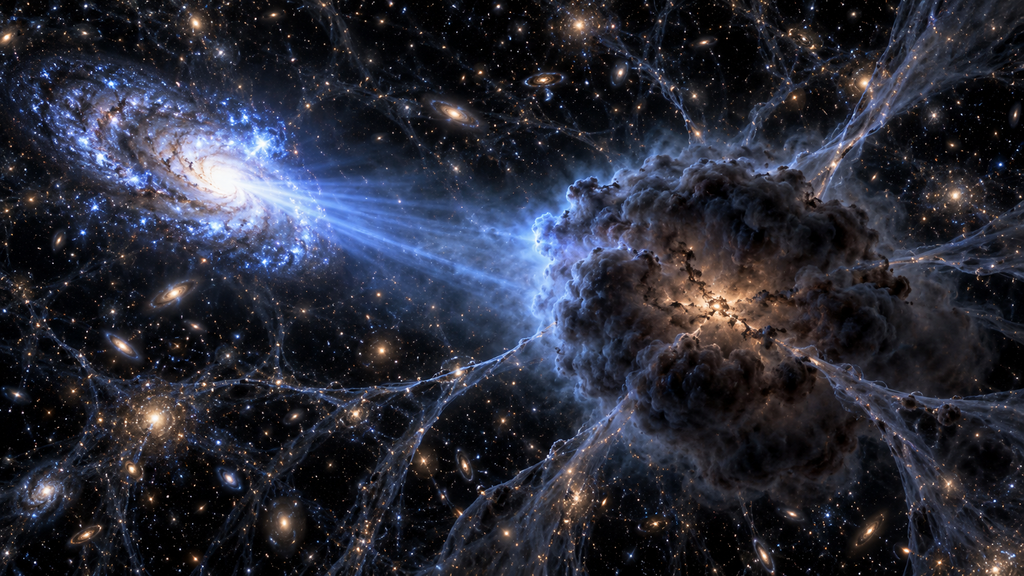
A scene like the one above is the starting point of the calculation. The selected region was a corner of a “protocluster,” a region that will later grow into a cluster of galaxies, and nearby was a brightly shining star-forming galaxy. The intense ultraviolet light from this galaxy kept illuminating the neighboring gas cloud. Ultraviolet light interferes with gas cooling, so the cloud had trouble contracting and star formation was postponed. Meanwhile, the gravity of the dark matter kept working, so the cloud grew heavier than usual before it finally began to collapse.
Once collapse began, the newborn stars (protostars) pulled in gas at a tremendous rate and grew into “supermassive stars,” the heaviest reaching 500,000 to 900,000 times the mass of the Sun. Stars this heavy do not last long, and in the end they collapse directly into black holes. The seed black holes born this way had masses of roughly a million Suns, a full order of magnitude above the “heavy seed” values theory had typically assumed. This happened about 300 million years after the birth of the universe.
The Red Face of a Newborn Black Hole
Here is where the study gets most interesting. The team’s goal had been nothing more than to find out where and how heavy seed black holes form. In the press release, Chon recalls that he did not initially expect the simulation to reproduce anything like an LRD. But as the calculation went on, the vigorous inflow of gas refused to stop even after the black hole had formed. While discussing this with his collaborators, the idea came up that, seen from the outside, this black hole might look like an LRD.
Sure enough, when the surroundings of the newborn seed black hole were recalculated at high resolution, a dense, thick disk of gas had formed there. At 26,000 years after birth, the hydrogen density in the disk exceeded ten billion atoms per cubic centimeter. There is an upper limit, called the “Eddington limit,” on how fast a black hole can swallow matter, because the pressure of its own light pushes material back out. Inside this disk, however, gas was carried inward faster than light could escape outward, so “super-Eddington accretion” at several to a few tens of times the limit went on for a while.
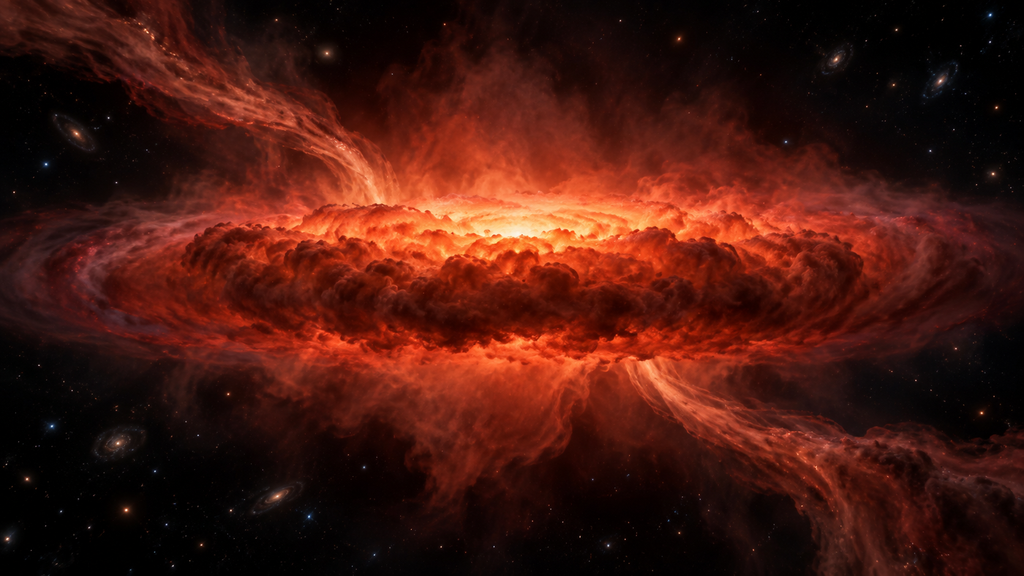
And when the team estimated how a black hole in the state shown above would look if observed from far away, all the LRD features were there. First, light produced in the interior is absorbed and scattered over and over in the dense gas before it gets out, so the red light is strengthened. Next, the light emitted by hydrogen is bounced around by electrons in the dense gas, spreading its wavelength into the broad emission lines seen in LRDs. The calculated brightness of the hydrogen line was comparable to that of observed LRDs. Furthermore, the column density of gas around the black hole was extremely high from every viewing direction, so X-rays are scattered and cannot get out. The biggest contradiction of LRDs, “bright but no X-rays,” was explained without strain.
In other words, the very environment in which overmassive black holes are born also creates the conditions that make the object appear as an LRD. The team describes this as the first result to tie together the birth of heavy seeds, their rapid growth into overmassive black holes, and their appearance as LRDs as a single physical process.
A Red Phase That Ends Within a Few Hundred Thousand Years
Another thing not to overlook is how short this “red phase” is. In the calculation, the state of being deeply wrapped in the gas disk lasted only a few hundred thousand years. At around 520,000 years after birth, the black hole was still surrounded by dense gas, but the disk had thinned and the hydrogen line had dropped below the brightness that would qualify as an LRD. From there, the team expects it to shift gradually into a less-shrouded form closer to an ordinary active galactic nucleus (the center of a galaxy hosting an active black hole).
Under this scenario, an LRD is less “a particular kind of object” than a snapshot of one period: the first few hundred thousand years after a black hole is born. Compared with the age of the universe, that is the blink of an eye, but in a protocluster several similar heavy seeds are born at nearly the same time, so the odds that one of them is in that phase are fairly good. The paper notes that this is also consistent, in terms of numbers, with how many LRDs Webb has found.
The subsequent growth was tracked as well. The seed black hole, having fattened to several million solar masses in one burst of super-Eddington accretion, switched to slower growth as the gas supply settled down, was pulled toward a nearby massive galaxy, and settled at its center. About 600 million years after the birth of the universe, its mass was roughly 30 million Suns. The galaxy hosting it had a total stellar mass of about a billion Suns, making the black hole-to-stellar mass ratio about 1 percent. That is an order of magnitude larger than the ratio in today’s universe, and it landed almost exactly where the overmassive black holes Webb is finding in the early universe sit.
The contrast was a light seed born earlier in the same calculation, about 200 million years after the birth of the universe. This was a black hole of about 800 solar masses, left behind by one of the first stars, and it lacked the gravity to hold on to the surrounding gas; the gas evaporated and escaped, and the black hole barely grew at all. Whether a seed is born heavy or light changes its fate by orders of magnitude. This contrast supports the need for heavy seeds as the reason excessively massive black holes exist in the early universe.
The Road to Quasars and the Remaining Questions
Reading this far, it is tempting to say “so that settles what LRDs are,” but the research team itself does not say that. There are several caveats.
First, the region followed in detail was one of about 60 candidates, and only two black holes formed there. What fraction of the diverse observed LRDs can be explained by this mechanism is something still to be worked out by comparison. Second, the calculation does not include the effects of jets or disk winds blowing out from the black hole. If those operate, the gas inflow weakens, so the paper cautions that the growth rate found here should be treated as an upper limit. And whether a black hole that has grown to about 30 million solar masses goes on to become a quasar (one of the brightest objects in the universe, radiating enormous energy from a galaxy’s center) exceeding a billion solar masses must be checked with calculations that include a long-sustained, galaxy-scale gas supply. Some overseas coverage ran headlines flatly declaring that “LRDs are the seeds of quasars,” but the paper’s claim goes only as far as “a pathway leading there has been shown.”
Even so, the picture this study paints is quite concrete. A gas cloud near a bright galaxy, bathed in ultraviolet light, waiting to collapse. A supermassive star born from it becomes a seed black hole of a million Suns and, for just the first few hundred thousand years after birth, glows red inside a shroud of dense gas. In time the shroud thins, the black hole settles into the center of a galaxy, and it keeps growing as an overmassive black hole. No one intervened partway through; a calculation that began with dark matter and gas followed this path on its own. That is what gives it meaning as theoretical support for a hypothesis that had been built up from observations.
As a way to test the scenario, the team also points to gravitational waves. Heavy seed black holes born in the same protocluster should eventually merge with one another as their galaxies merge, and the team estimates that LISA, the space-based gravitational wave observatory scheduled for launch in the 2030s, could detect tens to hundreds of such events over a three-year mission. The red dots Webb photographed, gravitational waves from space, and a universe inside a supercomputer: if these three lines of evidence come to point at the same objects, we will begin to see the first step in where the giant black holes at the centers of today’s galaxies came from.
Related products
You can find books and products related to this article on Amazon.
If you buy through the links above, this blog may earn a commission.
Sources
Chon, S. et al., “Overmassive black holes and little red dots naturally form in simulations”, Nature 657, 621–625 (published September 16, 2026; open access)
https://www.nature.com/articles/s41586-026-10985-8
National Astronomical Observatory of Japan, Center for Computational Astrophysics, press release (September 17, 2026; in Japanese)
https://www.cfca.nao.ac.jp/pr/20260917
Universe Today, “Little Red Dots Are The Seeds of Quasars and Supermassive Black Holes” (September 17, 2026, Brian Koberlein)
https://www.universetoday.com/articles/little-red-dots-are-the-seeds-of-quasars-and-supermassive-black-holes


コメント