This article contains affiliate links. As an Amazon Associate I earn from qualifying purchases.
On September 26, 2022, NASA’s DART spacecraft slammed into the asteroid Dimorphos. It caught up with the roughly 160-meter body from behind at a little over 6 kilometers per second and shortened its orbit around the parent asteroid from 11 hours 55 minutes by 32 minutes. It was the first time humans deliberately changed the orbit of a celestial body.
That figure of 6 kilometers per second, though, is quite modest for pushing an asteroid. The spacecraft and the asteroid both orbit the Sun in the same direction, and when you approach from behind, only the difference in speed goes into the collision. DART worked because the target’s orbit was well known and the mission had years to prepare. To move a larger body on shorter notice, the impact speed itself has to go up.
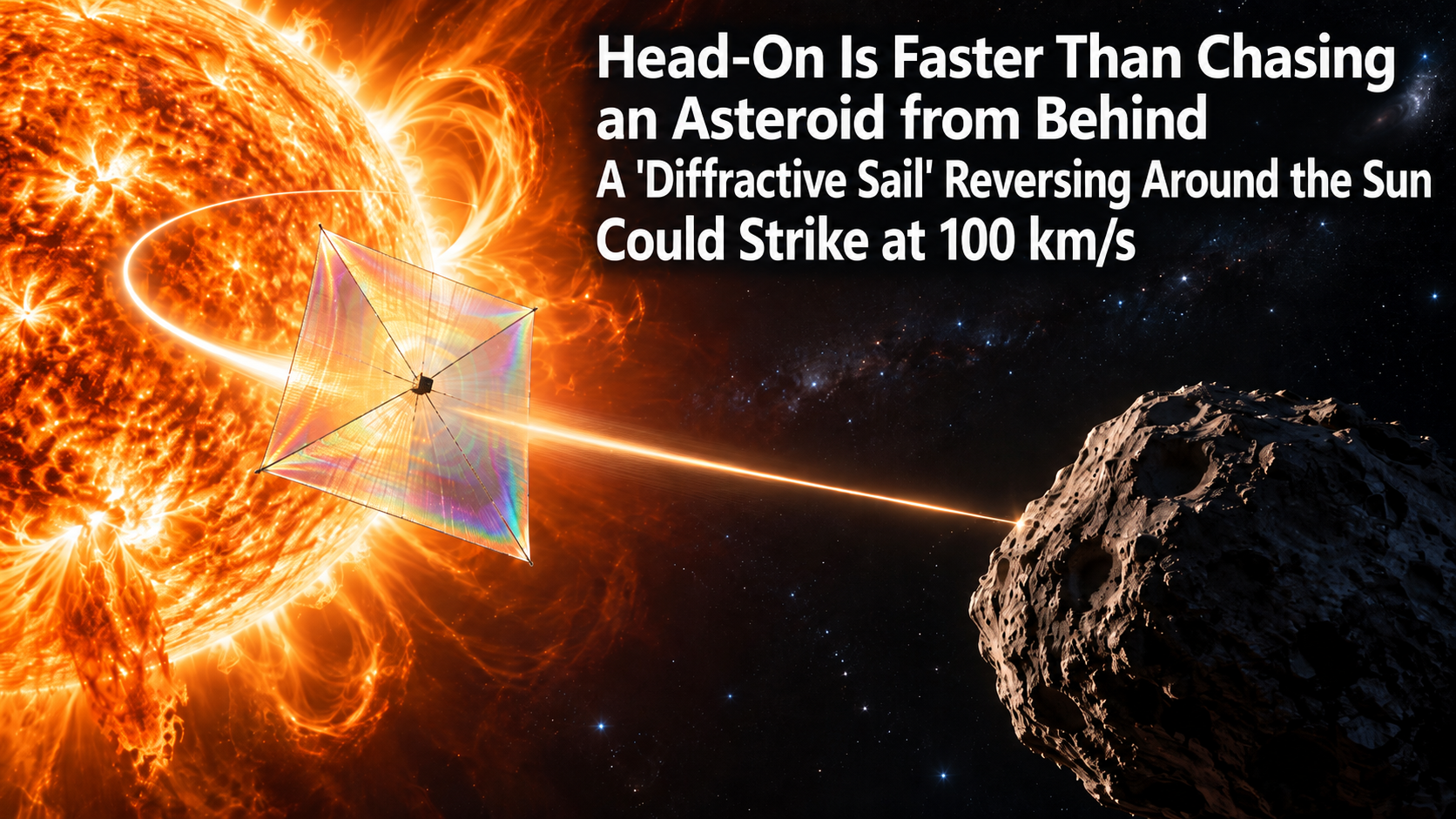
A study from Beihang University, posted as a preprint in August 2026, lays out a way to raise that speed to 100 kilometers per second by calculation. The vehicle is not a rocket but a solar sail, pushed along by sunlight. And instead of the conventional sail that reflects light like a mirror, it uses a sail that bends light by diffraction. Such a sail can push sideways while keeping its face squarely toward the Sun, so it reaches a head-on collision with an asteroid faster, and in fewer days, than a reflective sail can.
Gaining Speed Means Orbiting the Wrong Way
Nearly everything in the solar system orbits the Sun in the same direction, counterclockwise as seen from the north. So does Earth, and so does any probe launched from it. When a probe catches up with an asteroid, only the difference between their speeds remains.
If the probe alone could run clockwise, it would meet the asteroid head-on and the two speeds would add together. Earth moves at about 30 kilometers per second in its orbit, so that alone adds tens of kilometers per second. The problem is how to get into a retrograde orbit. A probe leaving Earth is already moving with Earth at 30 kilometers per second, and bringing that to zero and then accelerating the other way takes far more propellant than any rocket can carry. More fuel needs more fuel to carry it, the wall known as the rocket equation.
This is where solar sails come in. A sail uses no propellant, and as long as sunlight keeps falling on it, it keeps being pushed, so a small force applied over a long time can produce a large change in velocity. In the 1990s the Italian researcher Giancarlo Vulpetti proposed the “H-reversal trajectory,” a flight path that uses this property to swing a probe into a retrograde orbit.
It happens in three stages. First the sail produces a force opposite to the direction of travel, braking the probe’s orbital motion. As its orbital momentum (angular momentum) approaches zero, the Sun’s gravity pulls the probe into a steep dive toward the Sun. Then, as it passes close by the Sun, the sunlight is more than ten times stronger than near Earth, so the same sail delivers more than ten times the force. Pushed hard through that passage, the probe swings around the Sun and climbs back out, now moving clockwise.
A Mirror Sail Gets Weaker the More You Tilt It
The H-reversal idea has been around for nearly 30 years, but conventional reflective sails have an awkward limitation. A mirror is pushed in the direction opposite to where it sends the light, which means the force on a sail only ever acts perpendicular to its surface.
What H-reversal needs is a sideways force to brake the orbit. To get a sideways force from a mirror sail, you have to tilt the sail steeply with respect to the Sun. But tilting it reduces the amount of light it catches. In the paper’s equations the force falls off as the cube of the cosine of the tilt angle. The harder you push for a sideways component, the smaller the total force becomes. Holding that angle precisely all the way through the close pass by the Sun is no easy task for attitude control either.
A Sail That Bends Light Can Push Sideways While Facing the Sun
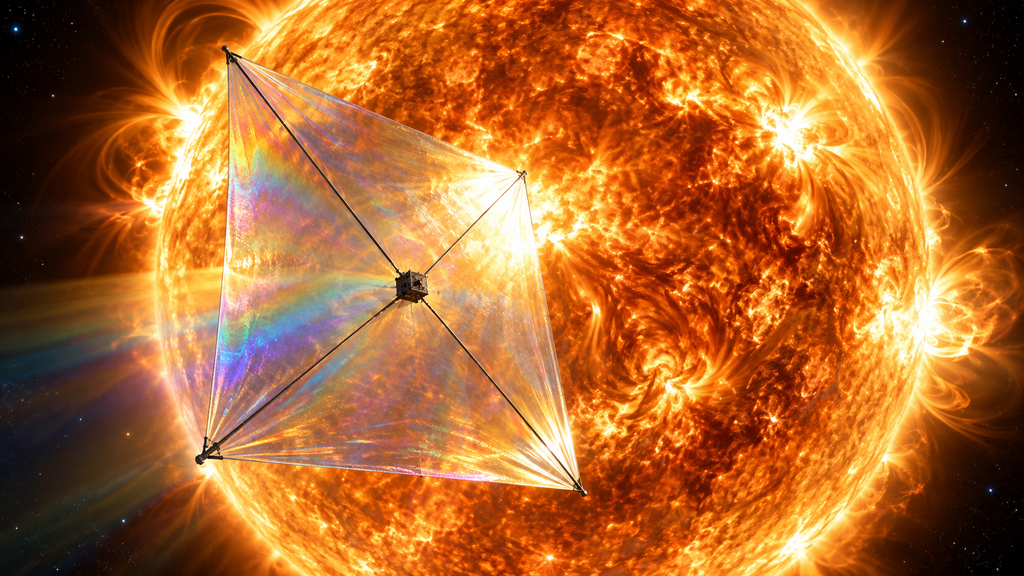
The sail in this paper is diffractive. Its surface carries a grating, a fine periodic structure with a spacing comparable to the wavelength of light. Light hitting it is not bounced back as from a mirror but redirected at a set angle, the same phenomenon that makes the recording surface of a CD or DVD shimmer with rainbow colors. When the light leaves at an angle, the recoil pushes the sail at an angle too.
The key point is that this angle is fixed by the structure of the grating. The sail itself does not need to tilt, so it can face the Sun squarely, catching the maximum amount of light while still producing a sideways force. The paper calls this a “Sun-facing diffractive sail” and examines two kinds: a reflection type, where the light is bent back toward the side it came from, and a transmission type, where it passes through the grating and is bent on the far side.
According to the calculations, the lightness a sail needs to pull off an H-reversal is slightly lower for a reflection-type diffractive sail than for a mirror sail. A sail’s performance is expressed by a “lightness number,” where a value of 1 means light pressure exactly balances the Sun’s gravity. With no limit on how close the sail approaches the Sun, a mirror sail needs at least 0.49 and a reflection-type diffractive sail at least 0.43. The transmission type, which bends light in the direction it is traveling, produces too little force pushing away from the Sun and could not satisfy the constraint of not getting too close, so the authors judge it unsuited to this task.
102 Kilometers Per Second, Head-On, in 226 Days
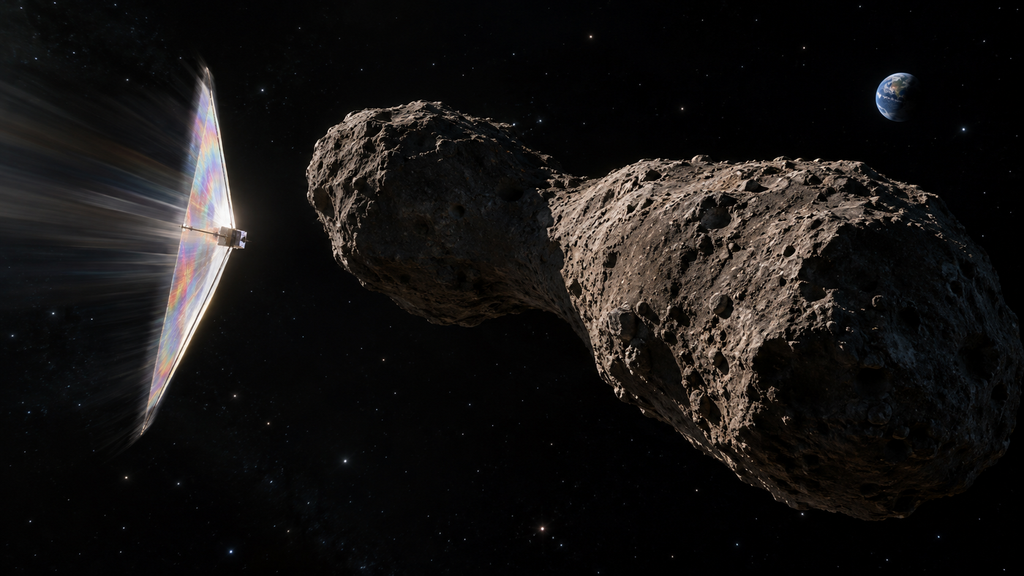
The team applied the method to a real body: the roughly 340-meter asteroid Apophis. It is known for its pass on April 13, 2029, at about 38,000 kilometers from Earth’s center, inside the ring of geostationary satellites, and a European Space Agency probe is planned to launch on Japan’s H3 rocket to accompany it. There is no chance of impact on that pass, so it serves purely as a worked example.
With a reflection-type diffractive sail of lightness number 0.85 and a closest approach to the Sun of 0.3 astronomical units (30 percent of the Earth-Sun distance, a little inside Mercury’s orbit), the probe reached a head-on collision 0.62 years, about 226 days, after leaving Earth, while Apophis was heading toward its own perihelion. The relative velocity at impact was 102.46 kilometers per second. That is about 16 times DART’s speed, and since the momentum that does the work of shifting an orbit is proportional to speed, a probe of the same mass would push about 16 times as hard.
How close the sail dives changes the timeline. Tightening the closest approach from 0.4 to 0.2 astronomical units cut the flight time from 260 days to 190, because the nearer the Sun, the stronger the light and the harder the sail can push.
The gap to a mirror sail was also computed. Comparing sails with a lightness number of 0.70, the diffractive sail hit 17 kilometers per second faster, a 21 percent increase, and took 35 percent less time. At 0.66 it arrived 300 days ahead of the mirror sail. A mirror sail has to tilt to produce its sideways force and accelerates more slowly as a result, which is where the difference comes from even at equal sail weight.
The authors also tried a “two-stage” scheme in which the grating’s bending angle is switched once during the mission. During the dive toward the Sun the angle is kept moderate to speed the fall, and near the Sun it is changed over to accelerate into the retrograde orbit. Adding that single switch raised the impact speed by about 9 kilometers per second, and for some sails by as much as 19 kilometers per second while trimming 318 days. In every case the final speed landed in the range of 100 to 106 kilometers per second.
The Catch: A Sail One-Fortieth the Weight of Paper
These results rest on an explicit assumption. A lightness number of 0.85 means the spacecraft’s total mass divided by its sail area, the areal density, is 1.8 grams per square meter. Ordinary copy paper weighs around 80 grams per square meter, so the sail would have to be lighter than a fortieth of that, and carry the spacecraft body and its radio on top. The paper restricts its calculations to lightness numbers below 1, so these are not outlandish values within the field, but they still demand a sail far lighter than any solar sail that has ever flown.
The model is simplified too. The grating is treated as ideal, Earth’s orbit as circular, the Sun as a point mass, and the orbits of probe and asteroid as lying in the same plane. The angle switch in the two-stage scheme is assumed to be instantaneous. Stacked liquid-crystal layers are a candidate for changing the angle on a real diffractive sail, but the authors themselves note that more layers mean more mass and more loss from reflections at each surface.
In other words, this study is not a report on flying a diffractive sail. It asks whether, given such a sail, a retrograde head-on impact works out as a matter of orbital mechanics. The answer was that a sail facing the Sun squarely gets there faster, and sooner, than a mirror sail. Apophis is only the example. If a body that genuinely needs pushing is ever found, the question will be whether a sail can deliver speeds a rocket cannot. This paper adds one block to the foundation for answering that.
Related products
You can find books and products related to this article on Amazon.
If you buy through the links above, this blog may earn a commission.
Sources
- Zhang, J., Fu, S., Wu, D., Cheng, L. & Gong, S. (2026) “Diffractive Sail H-Reversal Trajectory: Theoretical Feasibility, Design Strategies, and Applications”, arXiv:2608.04596 (preprint, not yet peer-reviewed; v1 August 5, 2026, v2 August 21) https://arxiv.org/abs/2608.04596
- Universe Today (September 23, 2026, Andy Tomaswick) “How Diffractive Solar Sails Could Stop a Killer Asteroid at 100 km/s” https://www.universetoday.com/articles/how-diffractive-solar-sails-could-stop-a-killer-asteroid-at-100-kms
- NASA, DART mission page https://science.nasa.gov/mission/dart/
コメント