This article contains affiliate links. As an Amazon Associate I earn from qualifying purchases.
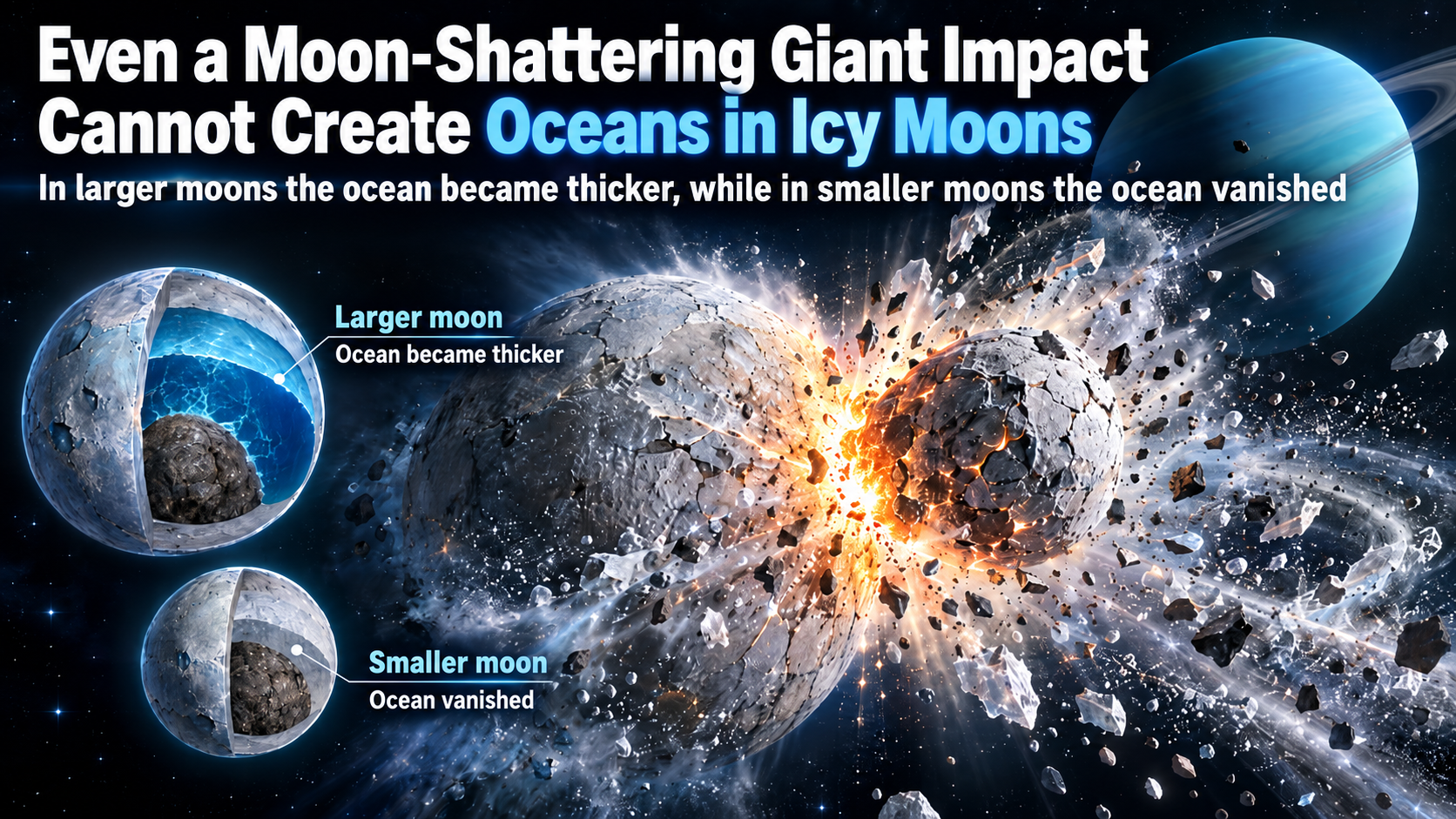
Many of the mid-sized moons orbiting Saturn and Uranus are thought to hide oceans of liquid water beneath their icy shells. Enceladus sprays water from its south pole, and Mimas, Dione, and the Uranian moons Miranda and Ariel are all suspected of holding oceans too. These same moons share a second trait: many of them are suspected of having been smashed apart at some point and reassembled from the debris.
One line of thinking holds that Saturn’s mid-sized moons were rebuilt from the wreckage of an earlier generation of moons. Uranus spins on its side, which is widely read as the scar of a giant impact, and that impact is thought to have scrambled the orbits of the planet’s original satellites until they collided with one another and re-formed. Ocean-bearing moons and shattered-and-rebuilt moons overlap. So did the collisions that shattered these moons help create their oceans, or destroy them?
A simulation study that tackles this question head-on appeared in Nature Astronomy on August 20, 2026. The lead author is Marc Neveu of the University of Maryland and NASA’s Goddard Space Flight Center, working with colleagues at the Southwest Research Institute (SwRI) and Israel’s Weizmann Institute of Science. When English-language space outlets picked the paper up in September, they ran opposite headlines. Universe Today wrote that smashed icy moons cool too rapidly to retain oceans. Five days later, Space.com wrote that icy moons may hold on to their underground oceans even after being smashed apart. Both articles were about the same paper.
Two Simulations Bridging the Moment of Impact and the Following 4.5 Billion Years
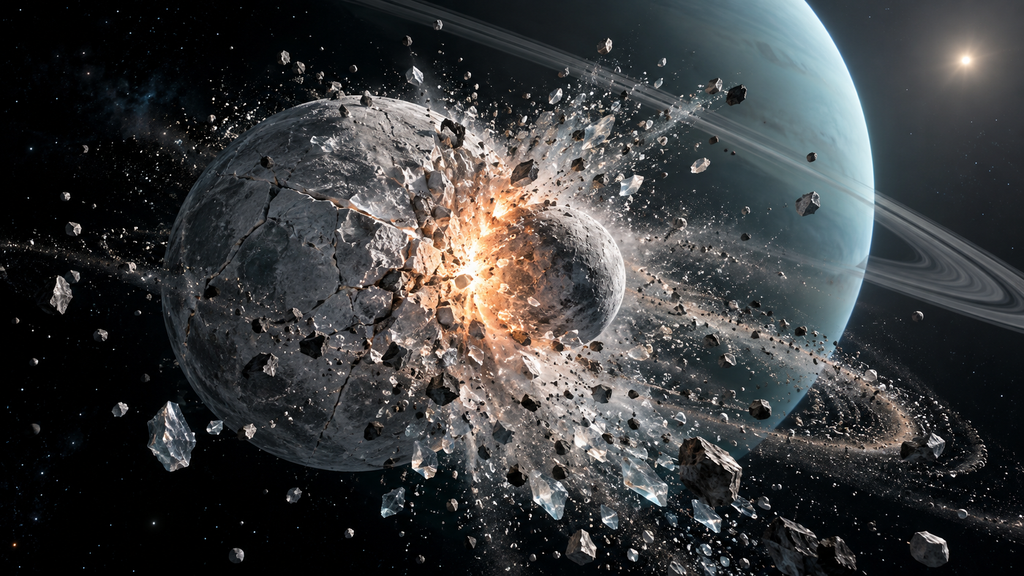
A collision between moons and the slow cooling of a moon’s interior play out on utterly different timescales: hours to days for the first, hundreds of millions to billions of years for the second. No single calculation can follow both, so the team stitched two kinds of simulation together.
The collision side uses smoothed-particle hydrodynamics (SPH), a method that treats each body as an enormous collection of particles. It tracks how two colliding moons shatter, how hot they get, and how the fragments gather back together. The interior-evolution side is a model that follows, from formation to the present day, how heat from radioactive decay escapes from the center to the surface, where ice melts, and how rock and ice separate. The workflow runs like this: grow a pre-impact moon in the interior model, hand it to SPH to be smashed, then put the reassembled moon back into the interior model and follow it to the present. The same moons were also evolved with no collision at all, to serve as a baseline.
Two sizes were tested: a moon 500 km in radius struck head-on by a body 250 km in radius, and a moon 1,000 km in radius struck by a body 500 km in radius. Real moons fit neatly inside this range: Saturn’s Tethys (radius 531 km), Dione (561 km) and Rhea (763 km), and Uranus’s Ariel (579 km), Umbriel (585 km), Titania (789 km) and Oberon (761 km). The smaller impactor is close in size to Mimas (198 km), Enceladus (252 km) and Miranda (236 km). Impact speeds were set at one, two and three times the mutual escape velocity, the speed needed for the two bodies to pull free of each other’s gravity. For the smaller pair that velocity is about 0.4 km per second, so the fastest case is around 1.2 km per second. The larger pair only broke apart at three times escape velocity, about 2.1 km per second. The planet was modeled on Uranus, with the moons placed at ten planetary radii.
A Thicker Ocean in the Large Moon, No Ocean in the Small One
The results split cleanly by size.
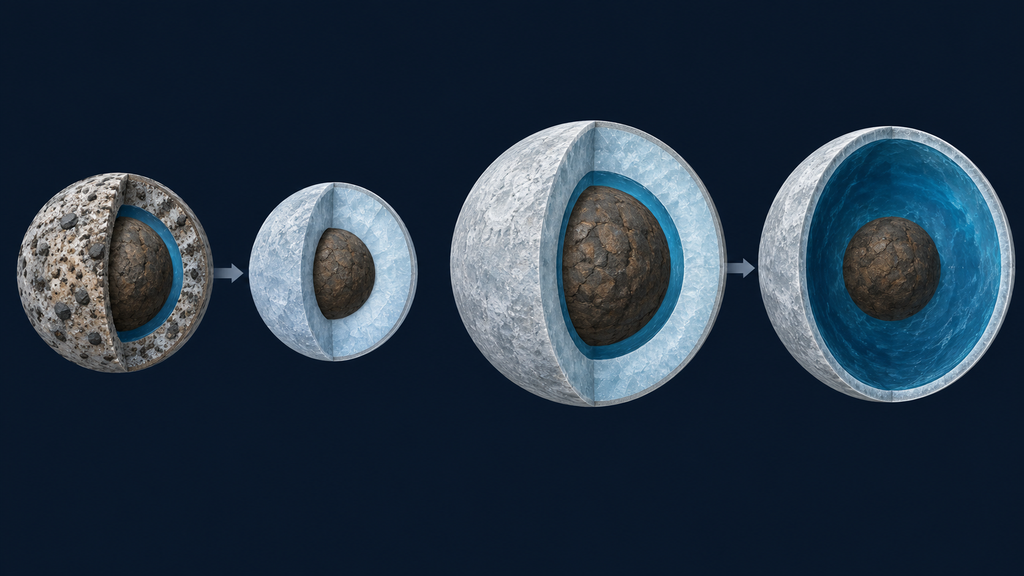
The 1,000-km-class moon holds an ocean even without a collision. Rock and ice separate completely about 300 million years after formation, the base of the ice melts into an ocean at around 500 million years, the ocean grows to roughly 200 km thick, and then it very nearly freezes solid by the present day. Add a collision at the 500-million-year mark, and the ocean stays far thicker for the next two billion years. Most of the water layer is molten, with only a thin shell of ice on top. The ocean eventually refreezes quickly, but the balance between radiogenic heating and heat escaping through the shell then shifts, and the bottom 100 km or so of the ice shell melts again and stays liquid to the present. Compared with the no-collision case, where almost no ocean survives today, the difference is stark.
The 500-km-class moon tells the opposite story. Without a collision, even a moon this size develops an ocean 250 to 300 million years after formation and keeps it for about a billion years before freezing (for the cases that end up 421 km and 527 km in radius after the collision; the case that shrinks to 366 km never melts at all, collision or not). Add a collision at any of the tested speeds, and no lasting ocean forms. The post-impact moon is warmer than its undisturbed twin, yet it has no ocean.
What Decided the Ocean’s Fate Was Not the Heat but the Rock-and-Ice “Blanket”
Intuition says a bigger collision releases more heat, melts more ice and makes an ocean. The calculations did not come out that way. The reason is that the collision rearranges the moon’s insides.
Before the impact, a small moon wears an outer layer in which rock and ice are still jumbled together. That layer acts as insulation, slowing the escape of heat from the center and propping up the ocean beneath it. When a collision breaks the whole moon apart, the heat of impact melts that outer layer, heavy rock sinks toward the center, light ice floats upward, and what re-forms is a moon with rock and ice neatly separated. That means two things: water now sits closer to the cold surface, and the rock that used to lie above it is gone. Both weaken the insulation. Neveu calls the outer layer a blanket, and explains that losing the blanket is what makes it harder for a small moon to keep an ocean. In the slowest case, at one times escape velocity, the outer layer never gets hot enough to separate and rock and ice stay mixed. Even then, no ocean lasts.
How much heat does the collision actually deliver? By the paper’s estimate, the heat released as the fragments reassemble is equivalent to only about 10 million years of radiogenic heating for the 500-km-class moon and 30 million years for the 1,000-km class. Against a 4.5-billion-year history, that is a brief heat source. Even in the large moon, the thicker ocean is less a case of impact heat creating an ocean than of extra heat being added to a moon that could sustain one anyway, making the ocean bigger and longer-lived.
In none of the cases the team ran did a collision produce an ocean in a moon that would otherwise have stayed frozen. That holds for direct heating by the impact and reaccretion, and also for the indirect route in which the collision changes the moon’s orbit and boosts tidal heating from the planet. The team estimated the orbital effect separately: the collision changes the moon’s orbital speed by only 0.1 to 2 percent, and the eccentricity, a measure of how stretched the orbit is, rises by at most about 0.04. The extra tidal heat from such a shift is too small to leave a visible mark on the interior’s evolution. In the University of Maryland’s press release, Neveu summed it up: if there was an ocean before, there is likely to be an ocean after, and vice versa. He added that these were about the biggest collisions the team could come up with, so smaller ones are unlikely to make a difference either.
Why the Headlines Disagreed, and the Case of Rhea
By now the reason for the dueling headlines is clear. Universe Today led with the small-moon result and Space.com with the large-moon result. The paper’s conclusion is that, depending on the moon’s size, a collision can thicken an ocean or erase one, but it does not create one. Each headline captured half of that.
The team points to Saturn’s Rhea as a real moon the results may apply to. At 763 km in radius, Rhea sits almost exactly between the two sizes tested. Its large craters have the softened look of relaxed craters, with uplifted floors and rounded rims, which indicates that tens of milliwatts per square meter of heat once flowed out of the interior. Rhea’s orbital inclination is also about ten times smaller than theory predicts, which makes sense if a precursor moon was destroyed and Rhea reassembled from the debris. In the new simulations, the post-impact 500-km-class moons never push more than 5 milliwatts per square meter of heat to the surface, but the 1,000-km-class moon reaches 20 milliwatts per square meter around the time its ocean freezes. A moon whose ocean was thickened by a collision could plausibly have produced enough internal heat to relax its craters.
The paper carries several caveats. The calculations assume Uranus’s distance from the Sun, about 20 astronomical units. At Saturn’s distance, surface temperatures are roughly 20 percent higher, and an extra run with a warmer surface made it harder for even the 1,000-km-class moon to keep an ocean to the present, suggesting that closer to the Sun, collisions may work against oceans in the long run. The team also tested ice containing 2 percent ammonia, which acts as an antifreeze, and found it barely extended the ocean’s lifetime in the 421-km moon. Because the SPH and interior models rest on different assumptions, the handoff between them involves many simplifications: material strength is ignored, and debris that falls back onto the moon later is left out.
What the study does not cover are the smaller, closer-in moons such as Mimas, Enceladus and Miranda. They show signs of oceans or geological activity, but at roughly 250 km in radius they are the size of the impactors in this setup, not the targets. Closer to the planet, tidal heating is far more effective, so a warm, ice-rich shell reassembled after a collision could still be the trigger for tidal heating. The team names applying this framework to those nearby moons as the next step.
Moons shattering and reassembling seems to have been a common event in the outer Solar System. Those collisions did not work in favor of creating the oceans that might serve as habitats for life. At least for moons of the sizes tested here, that is the finding.
Related products
You can find books and products related to this article on Amazon.
If you buy through the links above, this blog may earn a commission.
Sources
- Neveu, M., Rufu, R., Rhoden, A., Walsh, K. J. & Steinberg, Y. (2026). The role of disruptive impacts on ocean generation and longevity in icy moons. Nature Astronomy. https://doi.org/10.1038/s41550-026-02955-x
- Author’s accepted manuscript (free to read): NASA Technical Reports Server https://ntrs.nasa.gov/citations/20260008319
- University of Maryland, Department of Astronomy, press release (September 10, 2026): Scientists Simulate Cosmic Crashes to Test Whether Icy Moons Gain or Lose Their Ability to Sustain Life
- Southwest Research Institute press release (September 8, 2026): SwRI simulations indicate large impacts may limit ocean formation in icy moons
- Universe Today (September 22, 2026): Smashed Icy Moons Cool Too Rapidly to Retain Oceans
- Space.com (September 27, 2026): Icy moons may hold on to their underground oceans even after being smashed apart

コメント