
This article contains affiliate links. As an Amazon Associate I earn from qualifying purchases.
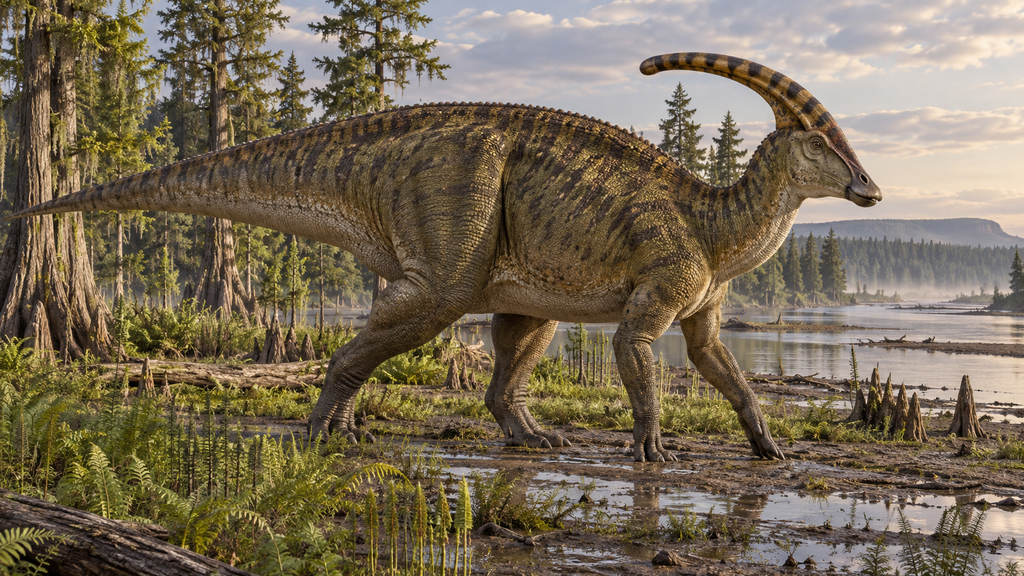
| Name | Parasaurolophus (Parasaurolophus), “near Saurolophus”; Saurolophus itself means “crested lizard” |
| Classification | Dinosauria, Ornithopoda, Hadrosauridae, Lambeosaurinae |
| Age | Late Cretaceous, Campanian (about 76.5–73.5 million years ago) |
| Where found | Canada (Alberta), United States (New Mexico, Utah) |
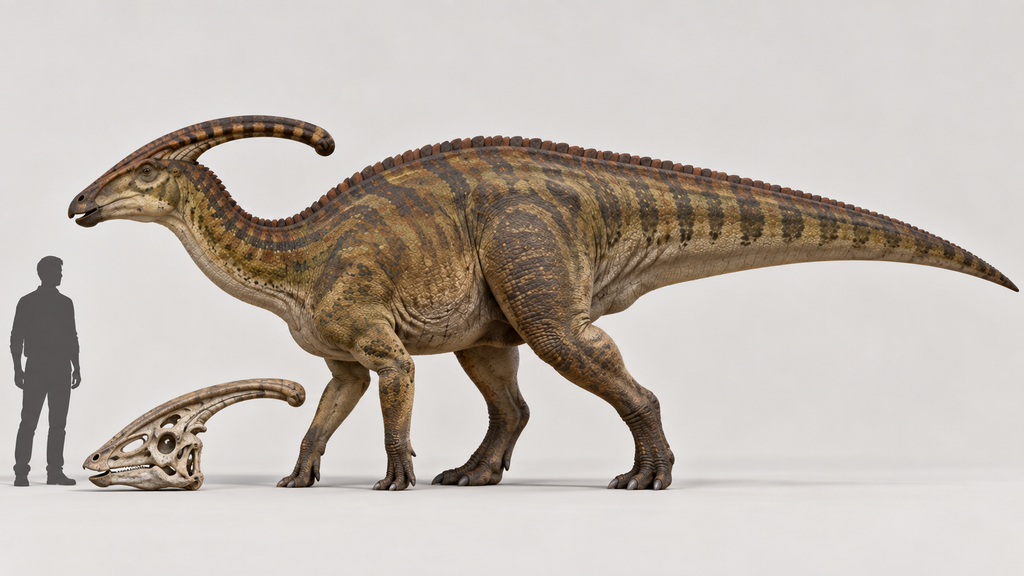
| Length | Estimated 7.5–9.5 m |
| Weight | Estimated 2.6–5 t (the range reflects different estimation methods) |
| Skull length | About 1.6 m including the crest (type specimen of P. walkeri) |
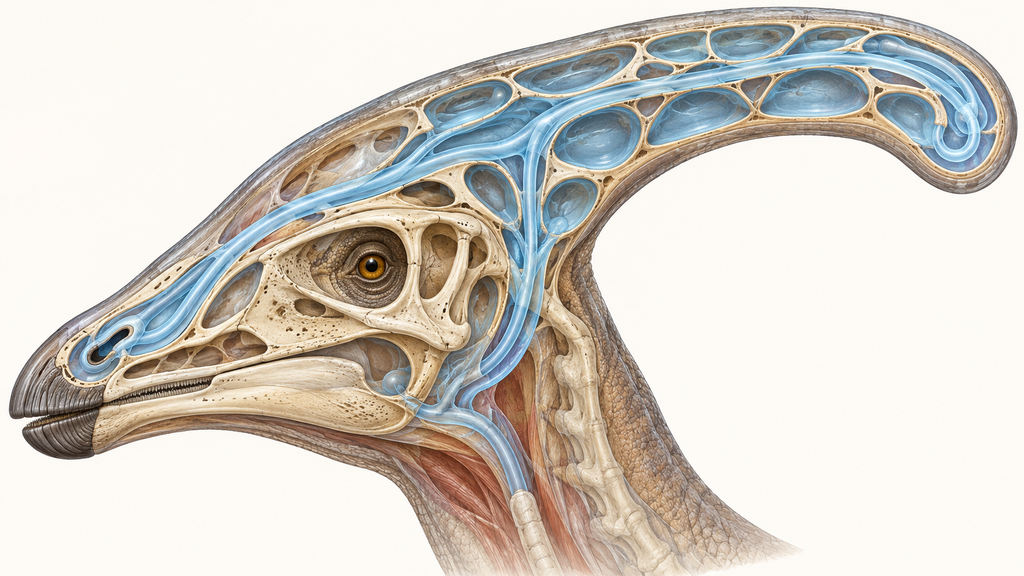
Parasaurolophus was a plant-eating dinosaur of Late Cretaceous North America, one of the duck-billed hadrosaurs. Its most striking feature is a tubular crest that sweeps more than a metre back from the skull. Inside, the airway from the nostrils runs up the tube, loops at the tip and comes back down. What the crest was for has been argued over for a century, with more than ten proposals on record, and the leading view today is that it worked as a resonating chamber for the animal’s calls. In 1997, researchers used CT data from a fossil skull to calculate what those calls might have sounded like.
Appearance and Way of Life
The first fossil was found in 1920 by a University of Toronto field party along the Red Deer River in Alberta, Canada. It preserves the skull and most of the body, lacking only most of the tail and the hind legs below the knee. William Parks described it in 1922 as the new genus and species Parasaurolophus walkeri, naming it after Sir Byron Edmund Walker, then chairman of the board of the Royal Ontario Museum. The specimen is still at the museum and remains the most complete Parasaurolophus skeleton known.
In build, Parasaurolophus was a typical hadrosaur, with heavy hind legs and shorter forelimbs. It probably walked on all fours most of the time and ran on its hind legs when it needed speed. The front of the mouth was a toothless beak; behind it sat hundreds of teeth packed into tight columns, a “dental battery” in which new teeth rose to replace the worn ones above them. The animal cropped plants with the beak and ground them with the batteries.
The crest is made of the premaxilla and nasal bones, which in most dinosaurs sit around the nostrils but here extend far back over the head. Air entering the nostrils travelled up the tubes inside the crest to the tip, turned round and came back down toward the throat. There is no opening at the tip of the crest. In his original description, Parks noted a notch in the neural spines above the shoulders and suggested that a ligament might have connected the tip of the crest to the back.
Three species are recognised. P. walkeri comes from the Dinosaur Park Formation of Alberta; P. tubicen (“trumpeter”, named by Carl Wiman in 1931) from the Kirtland Formation of New Mexico; and P. cyrtocristatus (“curved crest”) from the Fruitland Formation of New Mexico and the Kaiparowits Formation of Utah. Because the crest of P. cyrtocristatus is short and strongly curved downward, researchers suggested from the 1970s onward that it might be a female or a young individual of a long-crested species. In 2021, Gates and colleagues re-examined the species using a newly found skull and confirmed it as distinct, on the basis of features at the back of the skull that do not depend on crest shape.
Parasaurolophus lived on the river plains along the western shore of the inland sea that then split North America from north to south. The same Alberta rocks yield the helmet-crested hadrosaurs Corythosaurus and Lambeosaurus, the horned dinosaur Centrosaurus and the predator Gorgosaurus. Several kinds of duck-billed dinosaurs, each with a differently shaped crest, shared the same landscape.
What Was the Crest For?
Proposals came thick and fast in the half century after the first description. In 1924, Othenio Abel suggested the crest was a weapon. Hadrosaurs were then widely thought to be semi-aquatic animals of the waterside, and in 1933 Alfred Romer proposed that the crest was a snorkel, a view undermined by the absence of any opening at the tip. In 1935, Charles Sternberg suggested it was an air trap that kept water out of the lungs during dives, and in 1945 Edwin Colbert proposed an air reservoir for long stays underwater. In 1947, Martin Wilfarth argued that it anchored a mobile trunk.
Later ideas included a housing for enlarged olfactory tissue (John Ostrom, 1960s), a site for salt glands (Halszka Osmólska), a shield for pushing through vegetation, and a radiator for cooling the brain.
The idea that the crest produced sound dates to 1931, when Wiman named P. tubicen. He compared the looped tubes inside the crest to the windpipe of a swan, which folds back on itself inside the breastbone, and suggested the crest worked as a resonator. David Weishampel put this to the test in a 1981 paper. Treating the nasal cavity as the tube of a wind instrument, he showed that lambeosaurine crests were well suited to resonance, that large adults would have produced low notes while juveniles called at higher pitches, and that the side pouches branching off the main tube in adults (the lateral diverticula) suppressed parts of the sound spectrum.
In 1997, Carl Diegert, a computer scientist at Sandia National Laboratories, and Tom Williamson, a palaeontologist at the New Mexico Museum of Natural History and Science, reconstructed the sound from a fossil. Their specimen was a P. tubicen skull found near Farmington, New Mexico, in 1995, with a crest about 1.4 m long. They CT-scanned it in about 350 slices at 3 mm intervals and separated bone from rock by density to build a three-dimensional model of the crest’s interior. Instead of the simple trombone-like loop described in earlier studies, the model revealed more tubes and additional chambers inside the crest. Computing the natural frequencies of air passing through this shape gave a low, resonating rumble that could change pitch. The researchers suggested that each animal probably had a distinctive voice and that the calls may have sounded somewhat birdlike.
Later work has backed this interpretation. In 2009, David Evans and colleagues CT-scanned lambeosaurine skulls and found that the olfactory bulbs of the brain were small, which argues against the smell hypothesis. The cochlear part of the inner ear, by contrast, was elongated, which is read as an emphasis on hearing low frequencies. A crest that made low calls was paired with an ear tuned to hear them.
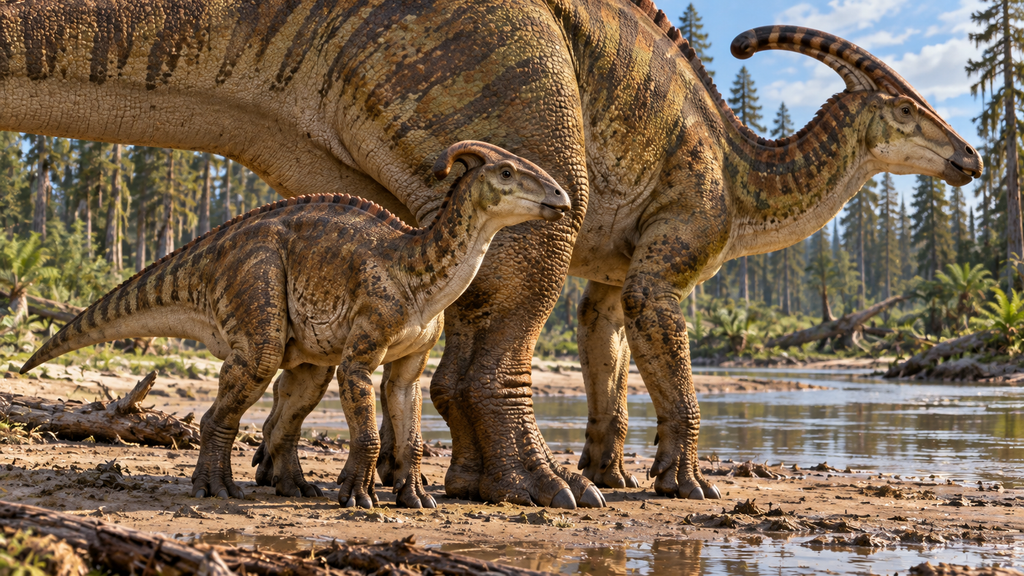
In 2013, a nearly complete juvenile skeleton from the Kaiparowits Formation of Utah was described. At about 2.5 m long, a quarter of adult size, it is thought to have been about one year old when it died. Its crest was not a tube but a low, half-round dome on top of the head. In the related Corythosaurus, the crest begins to grow only once the skull reaches about half its adult size; in Parasaurolophus, growth had begun before the skull reached a quarter of adult size. This also fits Weishampel’s inference that juveniles, with their short tubes, called at a higher pitch.
The crest’s function has not been settled on a single answer. Given its size and conspicuous shape, it is thought to have served at the same time as a visual signal for recognising and displaying to other members of the species. The current consensus, in short, is that it was a tool for social communication, both heard and seen.

Related products
You can find books and products related to this article on Amazon.
If you buy through the links above, this blog may earn a commission.
Sources
Weishampel, D. B. (1981). Acoustic analyses of potential vocalization in lambeosaurine dinosaurs (Reptilia: Ornithischia). Paleobiology, 7(2), 252–261. https://doi.org/10.1017/S0094837300004036
Sandia National Laboratories (5 December 1997). Scientists Use Digital Paleontology to Produce Voice of Parasaurolophus Dinosaur. https://newsreleases.sandia.gov/scientists-use-digital-paleontology-to-produce-voice-of-parasaurolophus-dinosaur/
Evans, D. C., Ridgely, R., & Witmer, L. M. (2009). Endocranial anatomy of lambeosaurine hadrosaurids (Dinosauria: Ornithischia): A sensorineural perspective on cranial crest function. The Anatomical Record, 292(9), 1315–1337. https://doi.org/10.1002/ar.20984
Farke, A. A., Chok, D. J., Herrero, A., Scolieri, B., & Werning, S. (2013). Ontogeny in the tube-crested dinosaur Parasaurolophus (Hadrosauridae) and heterochrony in hadrosaurids. PeerJ, 1, e182. https://doi.org/10.7717/peerj.182
Gates, T. A., Evans, D. C., & Sertich, J. J. W. (2021). Description and rediagnosis of the crested hadrosaurid (Ornithopoda) dinosaur Parasaurolophus cyrtocristatus on the basis of new cranial remains. PeerJ, 9, e10669. https://doi.org/10.7717/peerj.10669

コメント