This article contains affiliate links. As an Amazon Associate I earn from qualifying purchases.
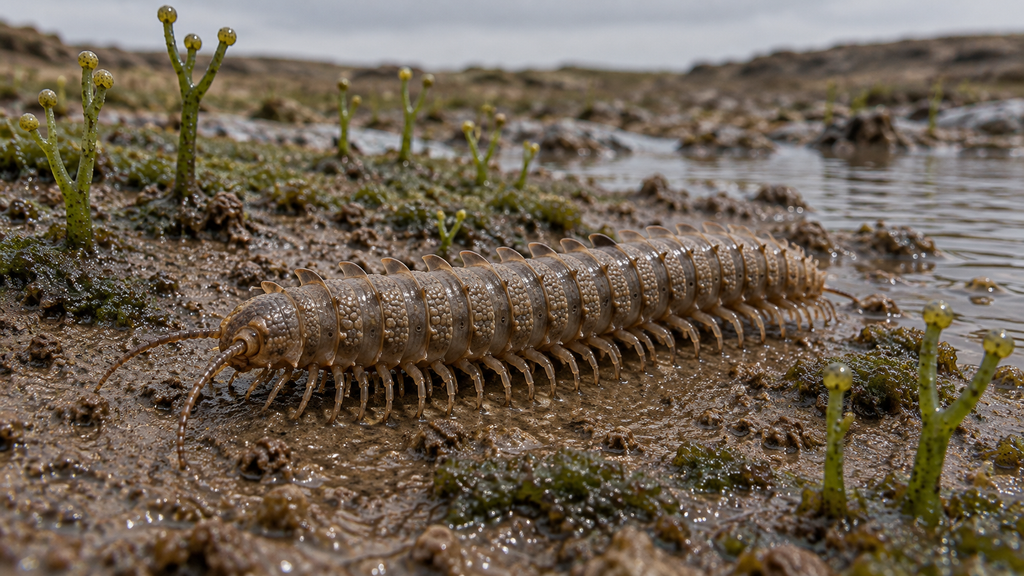
| Name | Pneumodesmus (Pneumodesmus newmani). The genus name combines the Greek word for “air” or “breath” (pneuma) with -desmus, a common ending in millipede names. The species name honors Mike Newman, who found the fossil |
| Group | Arthropod, myriapod, millipede (Diplopoda). Placed in the Archipolypoda, an extinct Palaeozoic group. Not a direct ancestor of living millipedes |
| Age | Disputed. Either late Silurian (Wenlock, about 427 million years ago) or latest Silurian to earliest Devonian (Pridoli to Lochkovian, about 423 to 414 million years ago) |
| Found in | Cowie Harbour near Stonehaven, Aberdeenshire, in northeastern Scotland (Cowie Formation), in rock exposed on the shore |
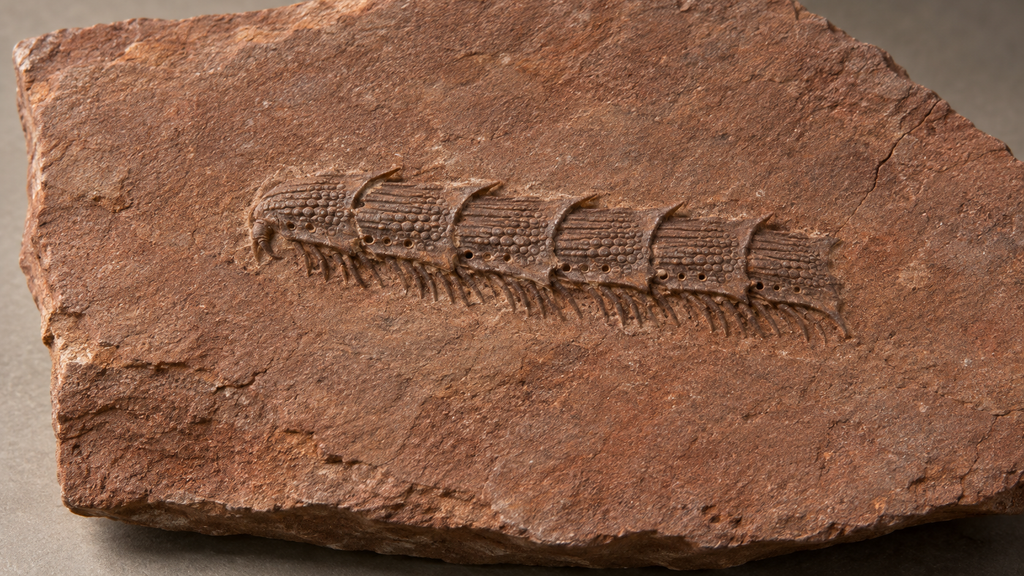
| Size | The fossil is a fragment about 1 cm long preserving six body segments. The full length of the animal is unknown |
| Specimen | Known from a single specimen, held by National Museums Scotland in Edinburgh |
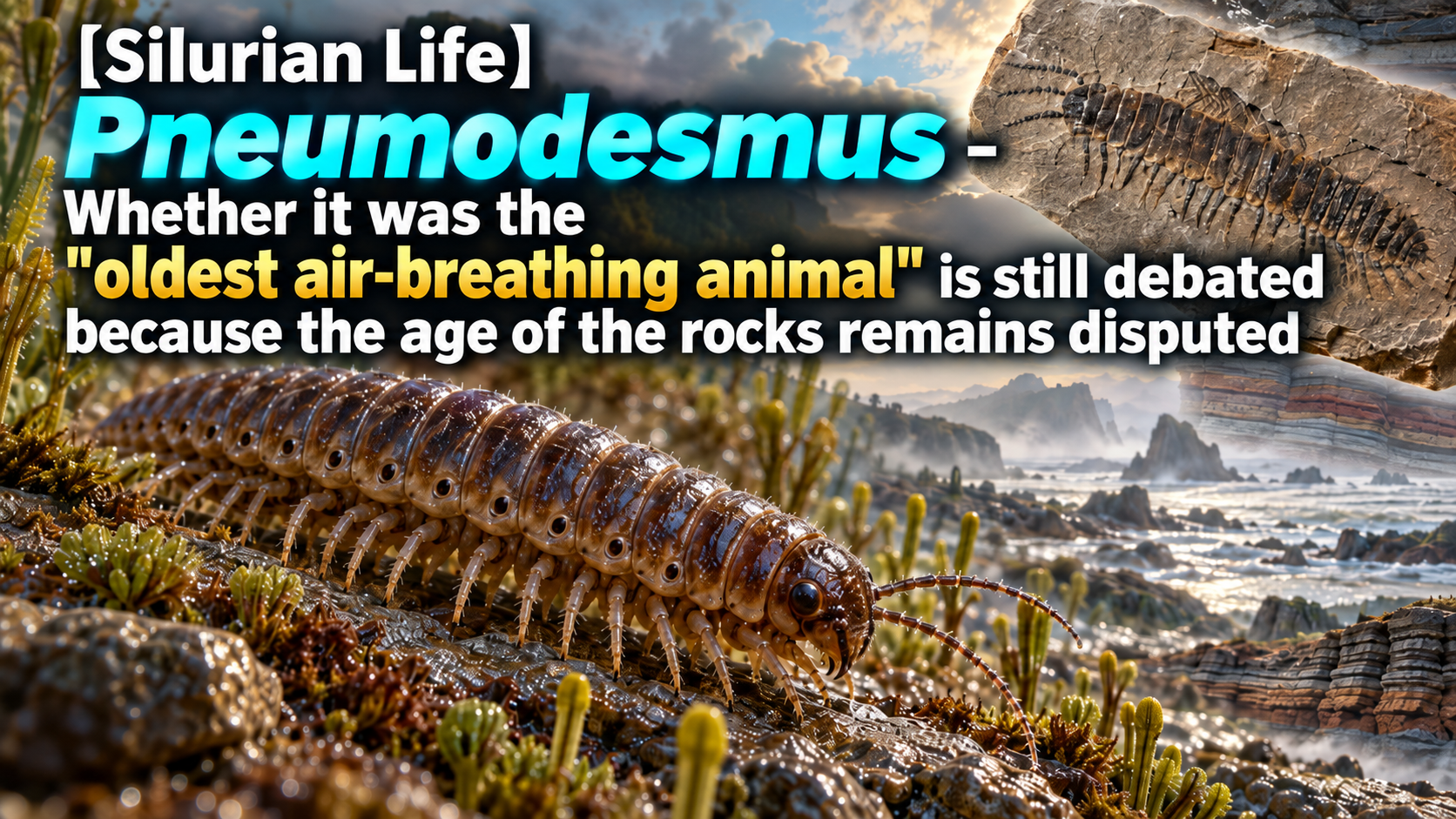
Pneumodesmus is a small millipede found on the Scottish coast. The sides of its body preserve spiracles, the openings through which air enters the body, and it has been regarded as the oldest animal for which breathing air on land can be confirmed directly from a fossil. Since 2017, however, the age of the rock it came from has been under dispute, so the title of “oldest” is not settled.
Appearance and way of life
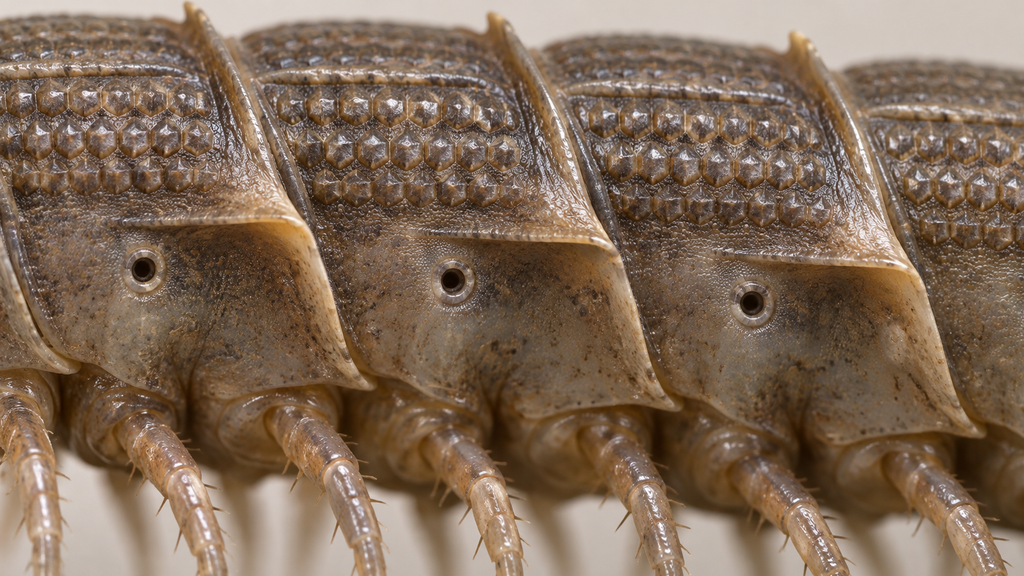
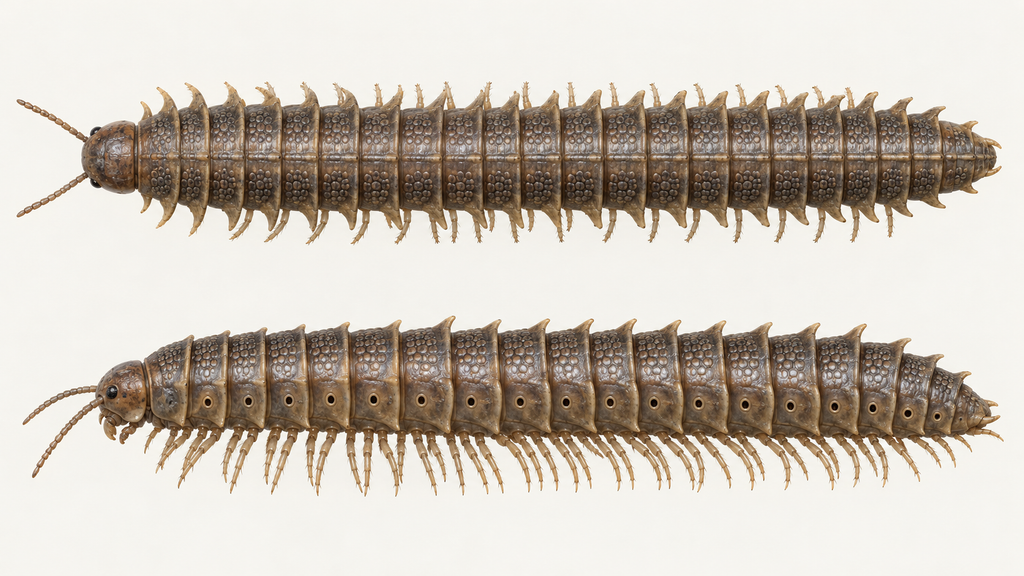
The fossil is a fragment about a centimeter long with six body segments. The back of each segment carries a horizontal ridge and three rows of small, roughly hexagonal bumps. Small flanges project from high on the sides of the body, and the legs were long and slender. Pneumodesmus belongs among the millipedes (Diplopoda), but it is placed in the Archipolypoda, an extinct Palaeozoic group, and is not on the line leading to living millipedes.
What makes this fossil special are the small openings on the sides of the body. Heather Wilson and Lyall Anderson, who described the fossil in 2004, identified these openings as spiracles. Spiracles are the inlets through which land arthropods take air into the body; behind them, tubes called tracheae branch through the body and carry oxygen to the tissues. This system does not work under water, so an animal with spiracles was breathing air on land. As far as is known, Pneumodesmus is the oldest fossil in which spiracles can be confirmed.
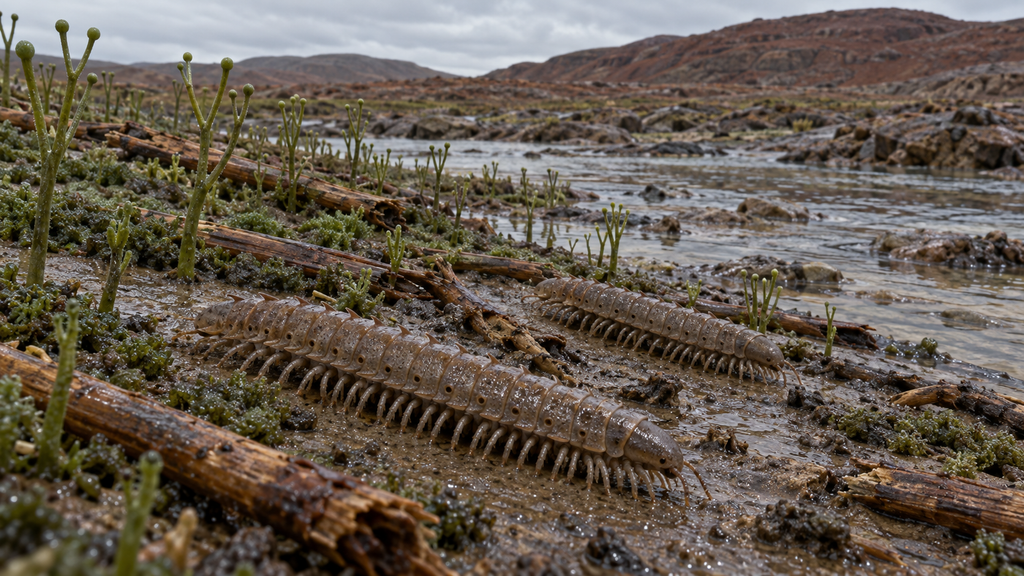
The rock at Cowie Harbour is not marine; it is sand and mud laid down by rivers and lakes. The same beds yield jawless fish (anaspids) and early land plants. Two other millipedes come from the same rock, and one of them, Cowiedesmus eroticopodus, has modified legs on the eighth body segment in males, thought to have been used in mating. Pneumodesmus is thought to have lived at the water’s edge among these early land plants, feeding on fallen plant fragments and similar material.
An age that swings by thirteen million years
The fossil was found by Mike Newman, a bus driver from Aberdeen and an amateur fossil collector, in sandstone exposed on the shore at Cowie Harbour near Stonehaven. When it was described in 2004, the species was named after him.
The describing paper dated the Cowie Formation to the end of the Wenlock or the start of the Ludlow, in the late Silurian, about 427 million years ago. That age rested not on the shore where the fossil was found but on plant spores from small exposures some distance inland. No spores suitable for dating have been recorded from the Cowie Harbour fish bed itself. The age was accepted, and Pneumodesmus entered reference books and textbooks as the oldest air-breathing land animal.
In 2017 Stephanie Suarez and colleagues at the University of Texas at Austin extracted zircon crystals from volcanic ash layers above and below the fish bed and dated them by the uranium-lead method. The youngest age they obtained was 413.7 million years, with an uncertainty of 4.4 million years, which falls at the very start of the Devonian (the Lochkovian), not in the Silurian. On that date, the centipedes and arachnid from Ludford Lane in England (about 423 million years ago) and the millipede Kampecaris from the island of Kerrera on Scotland’s west coast (about 425 million years ago) are older, and Pneumodesmus is no longer the oldest.
In 2023 Charles Wellman of the University of Sheffield and colleagues published newly found spore assemblages and additional zircon measurements in support of the original late Wenlock age. In 2025 Michael Brookfield and colleagues at the University of Texas, the same group as Suarez, replied that the beds Wellman’s team had dated and the beds that yielded the millipede lie on opposite sides of a fault and differ in depositional environment, sediment source and age, and concluded that the millipede beds are Pridoli to Lochkovian, spanning the end of the Silurian and the start of the Devonian.
The debate continues, and the age of Pneumodesmus remains unsettled between about 427 and about 414 million years ago. Under either age it stays among the oldest land animals with direct evidence of air breathing in the form of spiracles. What moves is the date from which we can say with confidence that air-breathing animals were living on land: the middle of the Silurian, or the beginning of the Devonian.
Related products
You can find books and products related to this article on Amazon.
If you buy through the links above, this blog may earn a commission.
Sources
- Wilson, H. M. & Anderson, L. I. (2004). Morphology and taxonomy of Paleozoic millipedes (Diplopoda: Chilognatha: Archipolypoda) from Scotland. Journal of Paleontology 78, 169–184. https://doi.org/10.1666/0022-3360(2004)078<0169:MATOPM>2.0.CO;2
- Suarez, S. E., Brookfield, M. E., Catlos, E. J. & Stöckli, D. F. (2017). A U-Pb zircon age constraint on the oldest-recorded air-breathing land animal. PLOS ONE 12, e0179262. https://doi.org/10.1371/journal.pone.0179262
- Brookfield, M. E., Catlos, E. J. & Suarez, S. E. (2020). Myriapod divergence times differ between molecular clock and fossil evidence: U/Pb zircon ages of the earliest fossil millipede-bearing sediments and their significance. Historical Biology 33, 2014–2018. https://doi.org/10.1080/08912963.2020.1762593
- Wellman, C. H., Lopes, G., McKellar, Z. & Hartley, A. (2023). Age of the basal ‘Lower Old Red Sandstone’ Stonehaven Group of Scotland: the oldest reported air-breathing land animal is Silurian (late Wenlock) in age. Journal of the Geological Society 181, jgs2023-138. https://doi.org/10.1144/jgs2023-138
- Brookfield, M. E., Catlos, E. J. & Garza, H. K. (2025). Reconciling Divergent Ages for the Oldest Recorded Air-Breathing Land Animal, the Millipede, Pneumodesmus newmani Wilson & Anderson, 2004: A Review of the Geology and Ages of the Basal Old Red Sandstone Stonehaven Group (Silurian–Early Devonian), Aberdeenshire, Scotland. Fossil Studies 3, 6. https://doi.org/10.3390/fossils3020006
コメント