This article contains affiliate links. As an Amazon Associate I earn from qualifying purchases.
| Name | Tiktaalik (Tiktaalik roseae). The genus name is Inuktitut, the language of the Inuit of Arctic Canada, for “large freshwater fish”; it was chosen by elders of Nunavut. The species name honors an anonymous donor |
| Group | Lobe-finned fish (Sarcopterygii), elpistostegalian. The group of fishes closest to four-limbed vertebrates |
| Age | Late Devonian (Frasnian, about 375 million years ago) |
| Found in | Ellesmere Island, Nunavut, Canada (Fram Formation) |
| Length | 1.25 to 2.75 m. The largest known individual is about 2.75 m |
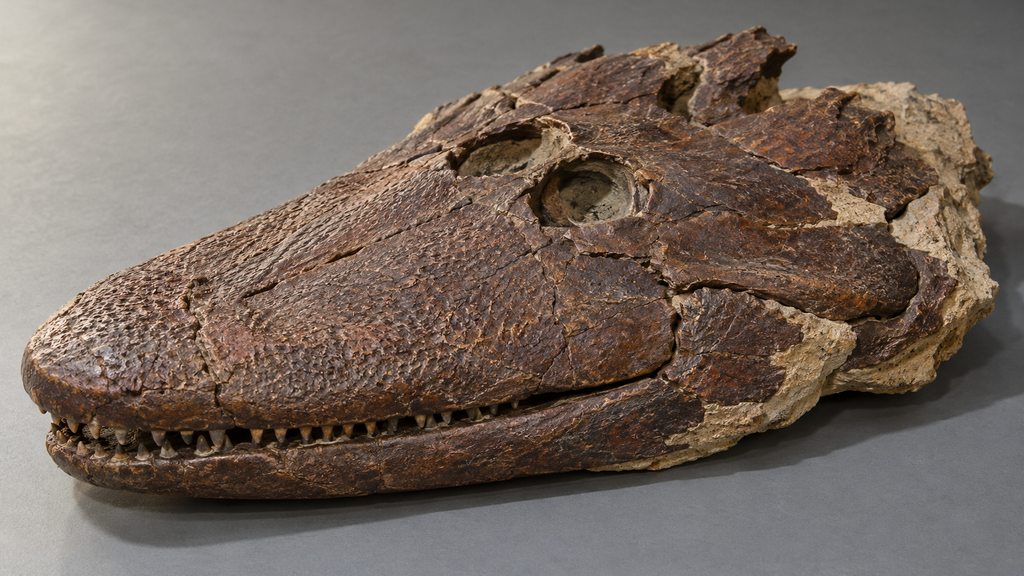
| Head | Flat, with the eyes set on top. The longest lower jaws are about 31 cm |
Tiktaalik is a large lobe-finned fish with a flat head that lived in rivers of the Late Devonian. It had both gills and lungs, bones corresponding to an arm and a wrist inside its pectoral fins, and a neck that let the head move independently of the body. It is known as a fossil that shows the transition from fish to four-limbed animals, but it was not found by chance. The team worked out in advance “a place with rocks of this age and this kind”, went looking, and dug it up in the fifth year.
Appearance and way of life
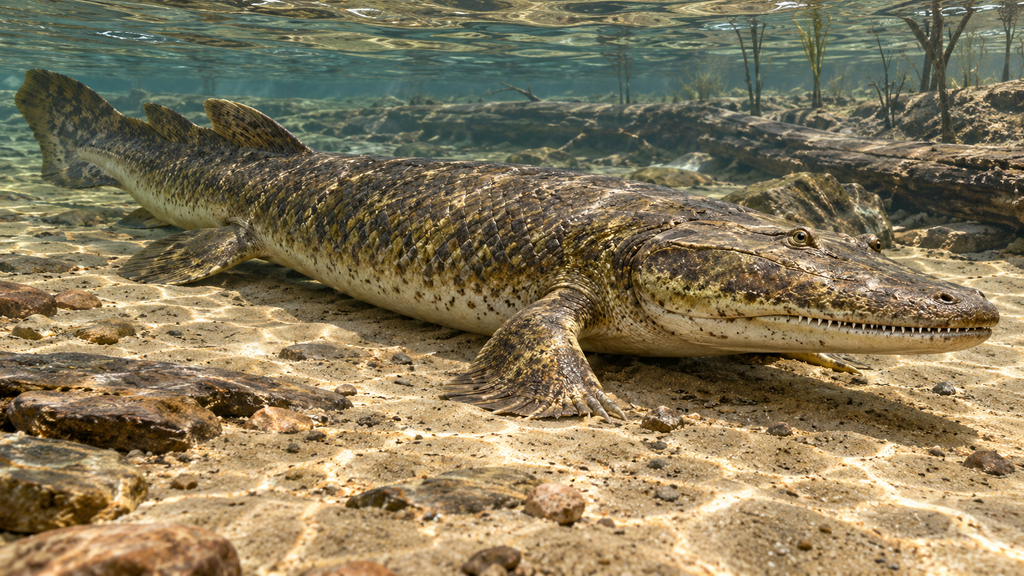
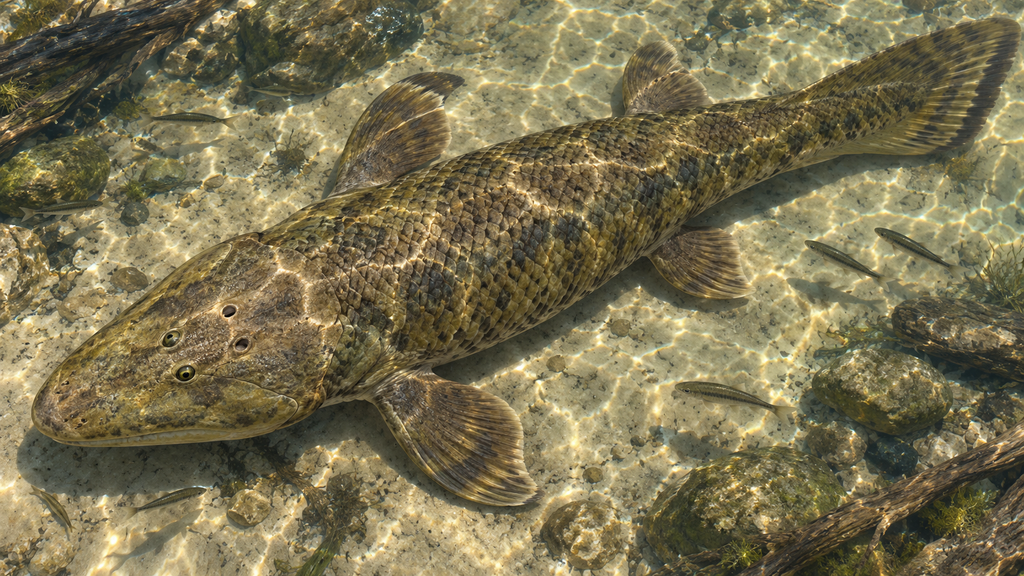
Tiktaalik is a fish with a flat, crocodile-like head and a broad, flattened body. The eyes sit on the upper surface of the head, with a pair of openings called spiracles behind them. In ordinary fish, bony plates covering the gills run along the back of the head and tie the head to the shoulder girdle. Tiktaalik lacks these plates, so the head could move separately from the body. As far as is known, it is the oldest fish with a neck.
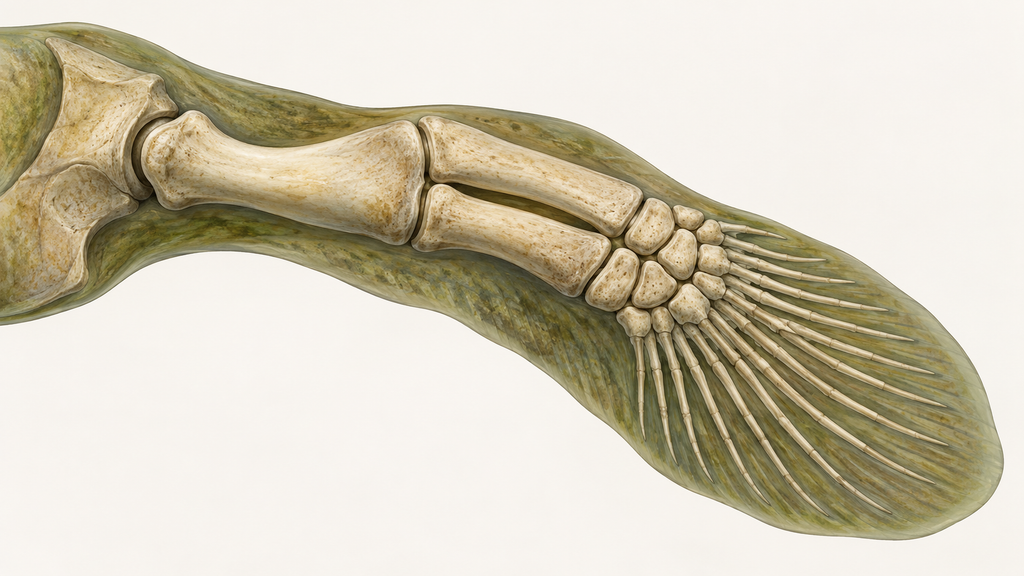
Inside the pectoral fin lie a humerus, a radius and an ulna, and small bones corresponding to a wrist, with the fin rays (the thin bones that support the fin) fanning out beyond them. This framework allowed the fin to bend and bear weight. The trunk has about 45 pairs of ribs, thicker and more overlapping than in other fish, built to support the body without the buoyancy of water. The body is covered in diamond-shaped scales. Besides gills it had lungs, and it is thought to have taken in air through the spiracles on top of its head.
In 2014 the pelvis and pelvic fin, which had not been found before, were reported. The pelvis was nearly the size of the shoulder girdle, far larger than in other lobe-finned fish, and the pelvic fin was close to the pectoral fin in length. The prevailing view had been that the ancestors of four-limbed animals were “front-wheel drive”, supporting the body on the front fins alone; Tiktaalik was already supporting and pushing itself with the hind fins too. In 2024 it was shown that the ribs differ in shape along the body, with those near the hips expanded and linked to the pelvis.
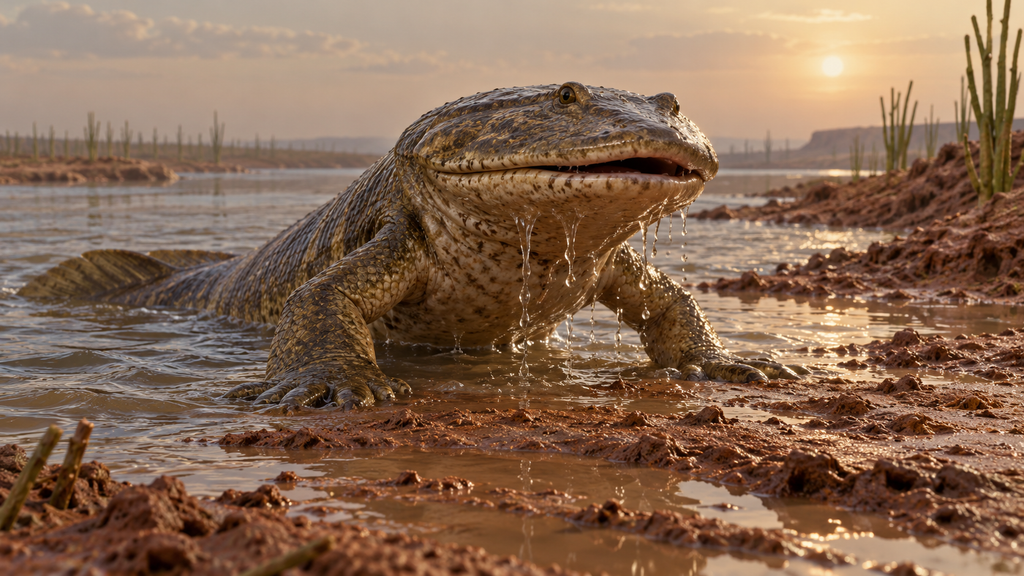
The fossils come from sandstone and mudstone laid down by river currents. In the Late Devonian, Ellesmere Island lay near the equator, a warm plain crossed by shallow meandering rivers. There Tiktaalik lay in wait with its belly on the bottom, and according to a 2021 study it used both the fish method of sucking in prey with water and the four-limbed-animal method of biting with the jaws.
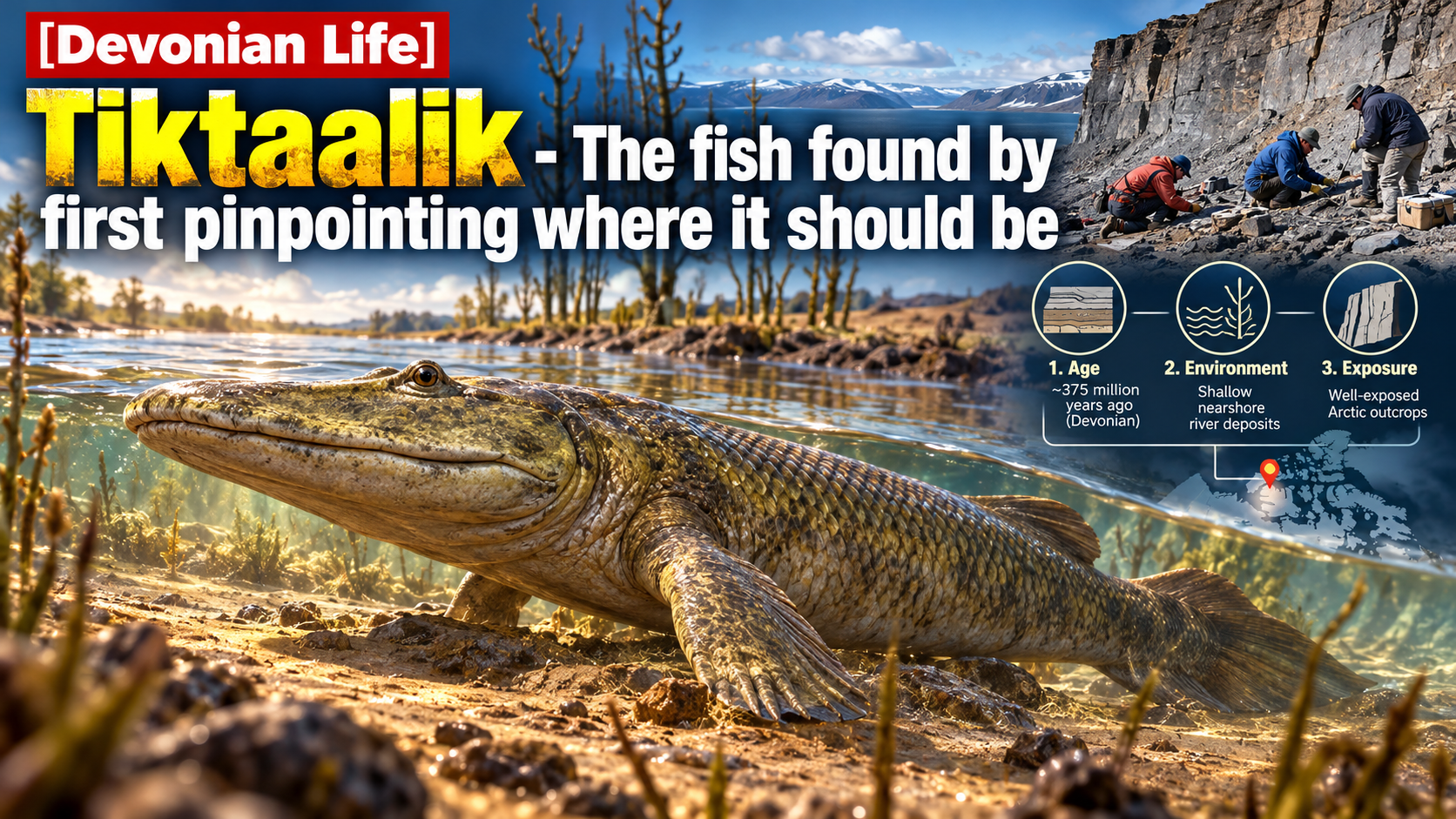
A fish found by deciding where to look first
In the late 1990s, Neil Shubin of the University of Chicago, Edward Daeschler of the Academy of Natural Sciences in Philadelphia and Farish Jenkins of Harvard University considered where a fossil bridging fish and four-limbed animals might be. The closest known fish to tetrapods at the time, Panderichthys, came from rocks about 380 million years old; the oldest four-limbed animals, such as Acanthostega, from rocks about 365 million years old. If an animal of intermediate form existed, it would be in rocks of about 375 million years, in between.
There were two further conditions. Early four-limbed animals come from freshwater deposits, so the rocks had to be those of rivers and lakes, not the sea. And they had to be exposed at the surface and not yet examined by anyone. Checking the maps in an undergraduate geology textbook against these three conditions left only a handful of candidates, among them Ellesmere Island in the Canadian Arctic. The Geological Survey of Canada had mapped the island in the 1970s, but almost no palaeontologists had been there.
Fieldwork began in 1999. Promising outcrops were chosen from aerial photographs, and in the short summer season the team walked them on foot, looking for fragments of bone weathered out of the rock. The first two seasons produced only fossils of fish that were already well known. In 2002 part of a snout was picked up, but its importance was not recognized on the spot; it drew attention only later, when a graduate student looking at the specimen pointed out its resemblance to the skulls of the earliest amphibians. Because Arctic fieldwork is costly, the 2004 season was planned as the last. That summer, the fossils of three individuals were found in the rock of a cliff.
The specimens were taken to Philadelphia and Chicago, and extracting them from the rock took many months. On 6 April 2006 two papers appeared together in Nature, describing the skull and body and the arrangement of bones in the pectoral fin. The name was settled in consultation with Inuit elders of Nunavut: Tiktaalik, “large freshwater fish” in their language. Work at the site has continued since, and the specimens now number more than 60. In 2022 a close relative, Qikiqtania, was described from a site only 1.5 kilometers from the discovery site.
What Tiktaalik demonstrated was not only the intermediate form between fish and four-limbed animals. It showed that by narrowing down age and environment from the fossil record, the whereabouts of an animal not yet found can be predicted.
Related products
You can find books and products related to this article on Amazon.
If you buy through the links above, this blog may earn a commission.
Sources
- Daeschler, E. B., Shubin, N. H. & Jenkins, F. A. (2006). A Devonian tetrapod-like fish and the evolution of the tetrapod body plan. Nature 440, 757–763. https://doi.org/10.1038/nature04639
- Shubin, N. H., Daeschler, E. B. & Jenkins, F. A. (2006). The pectoral fin of Tiktaalik roseae and the origin of the tetrapod limb. Nature 440, 764–771. https://doi.org/10.1038/nature04637
- Downs, J. P., Daeschler, E. B., Jenkins, F. A. & Shubin, N. H. (2008). The cranial endoskeleton of Tiktaalik roseae. Nature 455, 925–929. https://doi.org/10.1038/nature07189
- Shubin, N. H., Daeschler, E. B. & Jenkins, F. A. (2014). Pelvic girdle and fin of Tiktaalik roseae. Proceedings of the National Academy of Sciences 111, 893–899. https://doi.org/10.1073/pnas.1322559111
- Lemberg, J. B., Daeschler, E. B. & Shubin, N. H. (2021). The feeding system of Tiktaalik roseae: an intermediate between suction feeding and biting. Proceedings of the National Academy of Sciences 118, e2016421118. https://doi.org/10.1073/pnas.2016421118
- Stewart, T. A., Lemberg, J. B., Hillan, E. J., Magallanes, I. et al. (2024). The axial skeleton of Tiktaalik roseae. Proceedings of the National Academy of Sciences 121, e2316106121. https://doi.org/10.1073/pnas.2316106121
- The Canadian Encyclopedia, “Tiktaalik” https://thecanadianencyclopedia.ca/en/article/tiktaalik

コメント