This article contains affiliate links. As an Amazon Associate I earn from qualifying purchases.
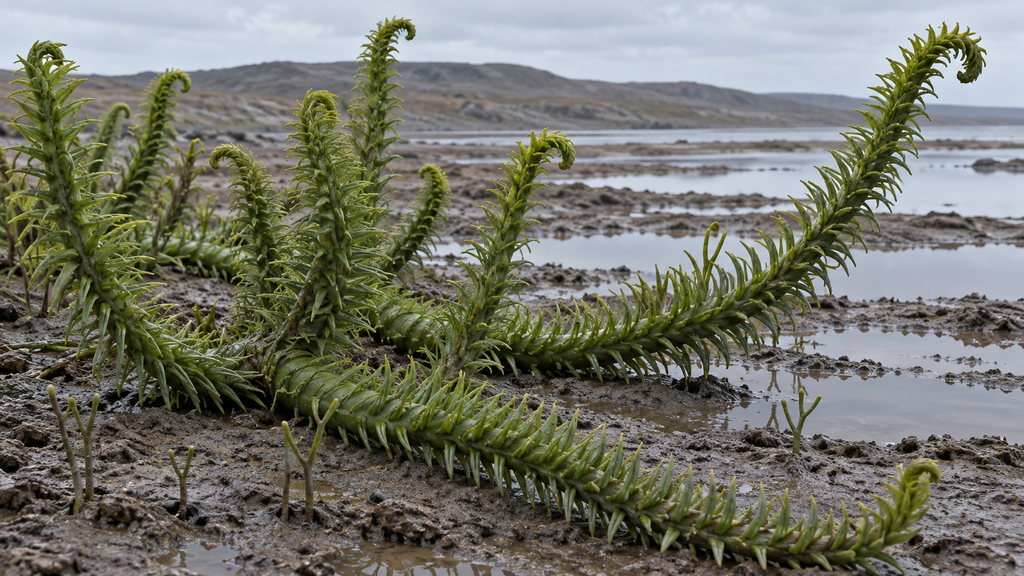
| Name | Baragwanathia (Baragwanathia longifolia). The genus honors William Baragwanath, director of the Geological Survey of Victoria, who collected the first specimens. The species name is Latin for “long-leaved” |
| Classification | Vascular plant, lycophyte (club moss lineage). Placed in the family Drepanophycaceae. A distant relative of living club mosses and tassel ferns |
| Age | Late Silurian (Ludlow, about 425 million years ago) to Early Devonian (about 410 million years ago) |
| Locality | Central Victoria, Australia (around Yea, the Thomson River area and elsewhere). Other species of the genus are known from Canada, China and the Czech Republic |
| Size | Stems up to a few cm thick and up to about 2 m long. Fossils are usually stem fragments 10–50 cm long |
| Leaves | Narrow strap-shaped leaves about 4 cm long, packed in spirals all around the stem |
Baragwanathia is a club moss, or lycophyte, found in late Silurian to Early Devonian rocks of southeastern Australia. It had stout stems densely clothed in long, narrow leaves, a far more complex body than most land plants of its time, which were leafless, rootless stalks a few centimeters tall. That complexity is the reason its age was doubted for decades after the 1930s.
Appearance and Way of Life
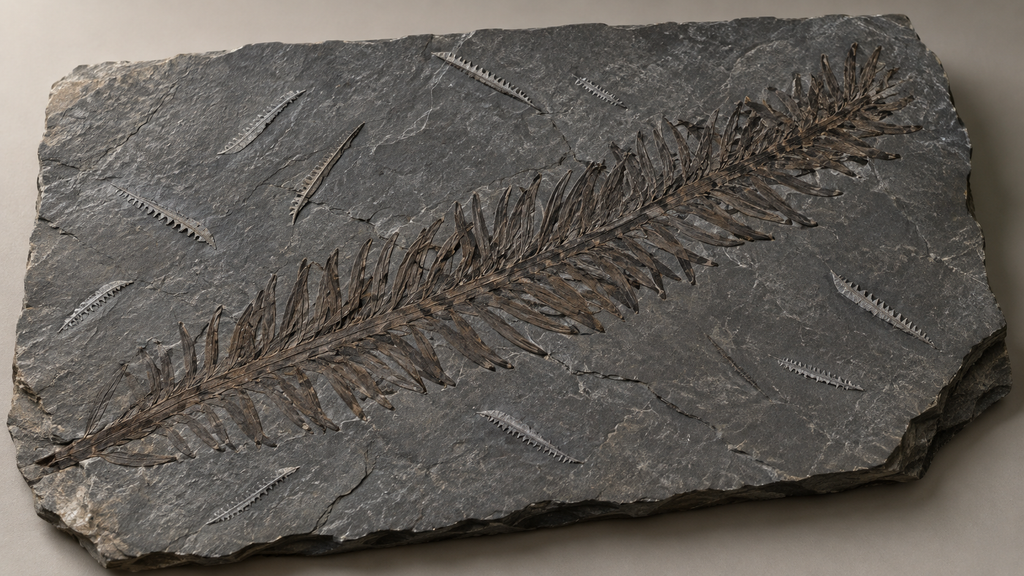
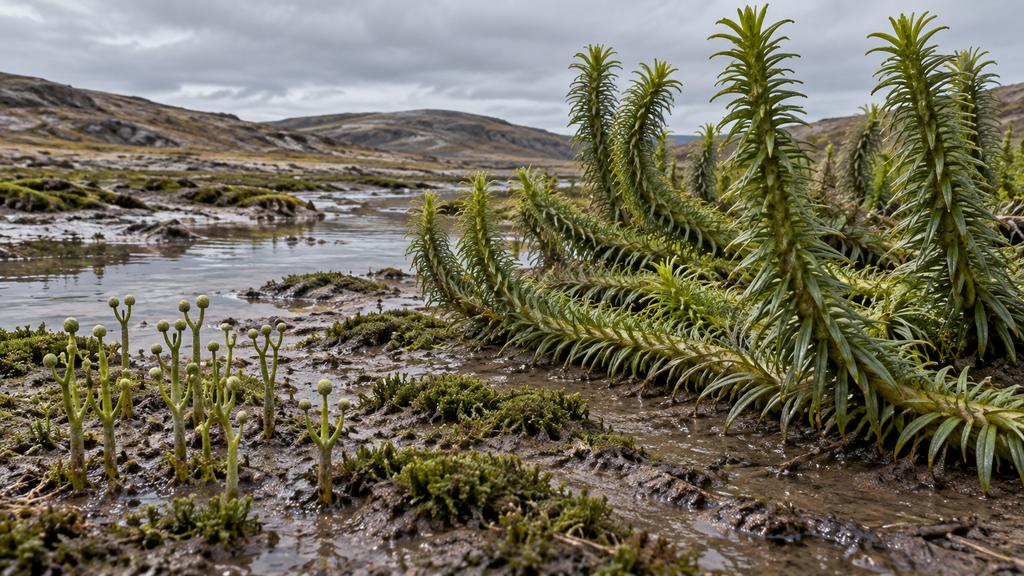
The fossils are leafy stems flattened onto the surfaces of the rock. The stems reach a few centimeters in thickness and occasionally fork in two. Narrow leaves about 4 cm long are arranged in spirals around them, and each leaf carries a single water-conducting strand down its middle. A leaf with only one such strand is called a microphyll, and it is a feature shared with living club mosses. In the center of the stem, the water-conducting cells (tracheids) formed a bundle that was star-shaped in cross section.
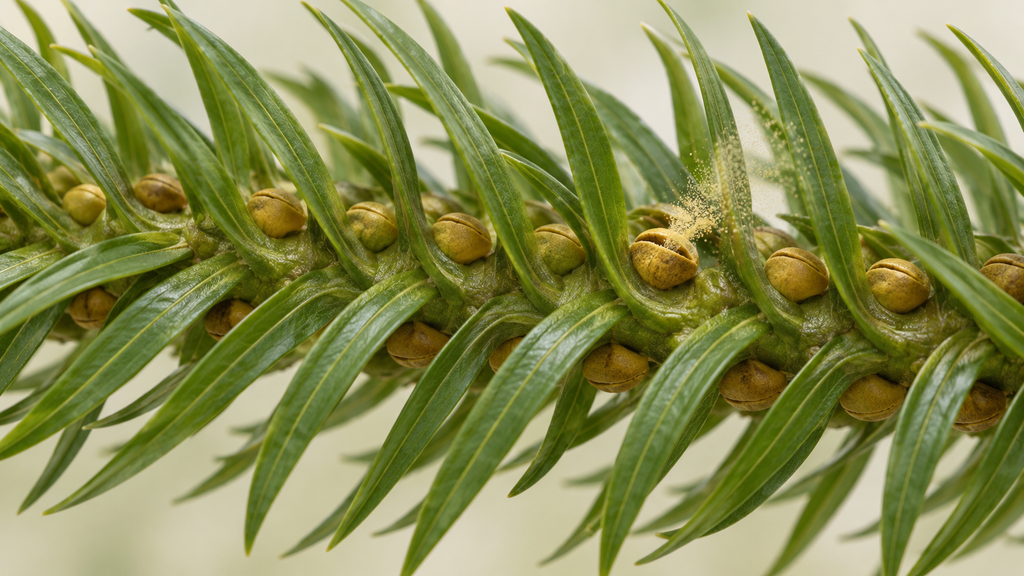
The spore sacs, or sporangia, sat one each in the upper angle where a leaf meets the stem. They were kidney-shaped, wider than tall, and opened along a horizontal slit to release their spores. Living club mosses carry their sporangia in the same position. The overall look closely matches those living relatives, but on a much larger scale: the stems grew to around 2 m long and are thought to have sprawled across the ground.
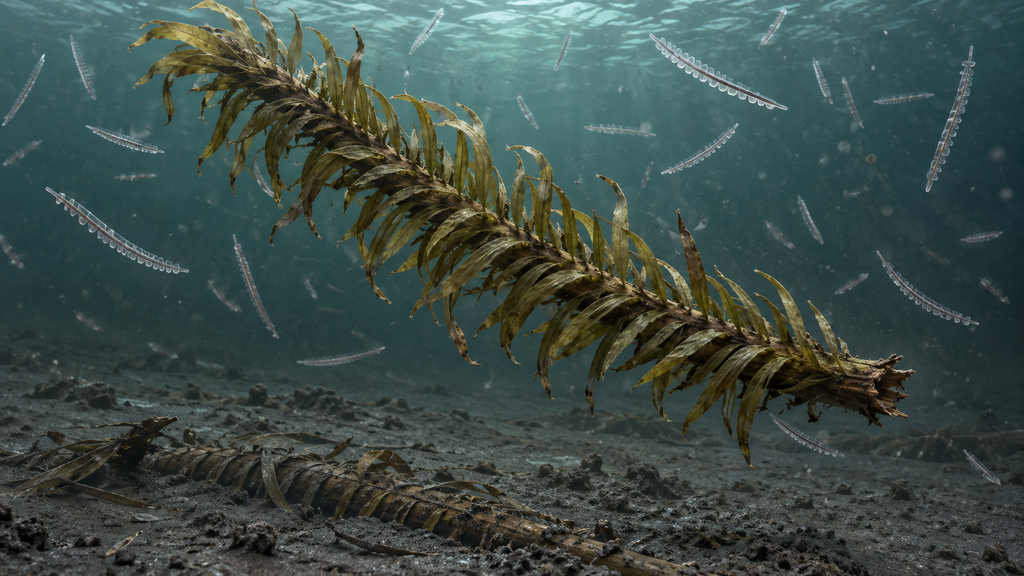
The rocks that yield the fossils are mudstones laid down on the sea floor. The same bedding surfaces carry graptolites, colonial animals that drifted in the open sea. Baragwanathia itself grew on wet ground near water, and its stems are thought to have been carried from land out to sea and to have sunk into the same mud as the graptolites. Smaller and simpler plants occur in the same beds, and the whole assemblage is called the Baragwanathia flora. At the time, this region lay on the eastern margin of Gondwana, the supercontinent spread across the Southern Hemisphere.
A Fossil Too Advanced for Its Age
Baragwanathia was described by the British paleobotanist William Lang and Isabel Cookson of Melbourne. In 1935 the two reported the Victorian plant fossils as vascular land plants from Silurian rocks containing the graptolite Monograptus. Graptolite species replaced one another quickly, which makes them precise markers for dating marine rocks. The British graptolite specialist Gertrude Elles identified the accompanying graptolites as varieties of a species from the early Ludlow, so the plants were assigned to the late Silurian. They were the oldest vascular plants known at the time.
This age soon clashed with other finds. Two years later, in 1937, Lang named Cooksonia, a plant a few centimeters tall with no leaves or roots, from latest Silurian rocks in the Welsh Borderland. The genus was named after Cookson. The Silurian plants then known from Europe and North America were all simple stalks like Cooksonia. Baragwanathia, with stout stems, leaves and sporangia set at the leaf bases, would have lived at the same time or earlier. Many researchers doubted its age because it did not fit the expected order of plant evolution. In 1959 one hypothesis even proposed that the graptolites alone had been washed out of older rocks and redeposited among Devonian sediments.
The most concrete challenge came from a reidentification of the graptolites. Hermann Jaeger, a graptolite specialist at Humboldt University in Berlin, looked at the photographs in the 1935 paper and concluded that the graptolites on the same surfaces as the plants were not early Ludlow species. After studying specimens from the Geological Survey of Victoria, he described them in 1966 as a new species, Monograptus thomasi. Its closest relative was a species that marks the middle of the Lochkovian, the first stage of the Devonian, in Europe. He also found a graptolite species marking the base of the Lochkovian in beds rich in Baragwanathia, about 450 m below the M. thomasi horizon. Jaeger concluded that the Baragwanathia flora appeared only after the Silurian had ended, at about the same time as the earliest undoubted vascular plants in Europe. He rejected the idea of reworked graptolites, because the combination of plants and graptolites occurs abundantly across a wide area of Victoria.
Jaeger’s identification was correct for the beds he studied. In 1978, however, Michael Garratt reported beds at another locality in Victoria where Ludlow graptolites occur together with Baragwanathia. In 1984 he and coauthors including the British graptolite specialist Richard Rickards published a paper restating that Baragwanathia had appeared in the Silurian. In 1987, at an outcrop near Yea, graptolites from the Pridoli, the last epoch of the Silurian, were found with Baragwanathia in strata lying between Ludlow and Devonian rocks. In 2000 Rickards reviewed the graptolite record and concluded that the earliest club mosses date to the Gorstian, the first stage of the Ludlow, and that the Baragwanathia flora continued through the Pridoli into the Early Devonian, changing somewhat along the way.
In other words, Baragwanathia occurs under the same name in rocks of two different ages in Victoria. Many of the localities assigned to the Silurian in 1935 are indeed Devonian, as Jaeger showed. Yet Baragwanathia was also present in older, late Silurian beds. Museums Victoria, which runs Melbourne Museum, now describes the flora as occurring in rocks of two ages: late Silurian, about 425 million years old, and Early Devonian, about 410 million years old.
Support has also come from outside Australia. In 2017 Petr Kraft and Zlatko Kvaček of Charles University described a new, short-leaved species of Baragwanathia from Pridoli rocks at Karlštejn, southwest of Prague (renamed Baragwanathia brevifolioides in 2021 after the original name turned out to be already in use). Its age is fixed by graptolites from the same beds. The fossil shows, independently of Victoria, that lycophytes lived outside Australia during the Silurian. By the late Silurian, then, simple plants like Cooksonia and leafy club mosses were already growing side by side on land.
Related products
You can find books and products related to this article on Amazon.
If you buy through the links above, this blog may earn a commission.
Sources
- Lang, W. H. & Cookson, I. C. (1935). On a flora, including vascular land plants, associated with Monograptus, in rocks of Silurian age, from Victoria, Australia. Philosophical Transactions of the Royal Society of London B 224, 421–449. https://doi.org/10.1098/rstb.1935.0004
- Jaeger, H. (1966). Two late Monograptus species from Victoria, Australia, and their significance for dating the Baragwanathia flora. Proceedings of the Royal Society of Victoria 79, 393–413. (Digitized by the Biodiversity Heritage Library) https://archive.org/details/biostor-259272
- Garratt, M. J. (1978). New evidence for a Silurian (Ludlow) age for the earliest Baragwanathia flora. Alcheringa 2, 217–224. https://doi.org/10.1080/03115517808527779
- Garratt, M. J., Tims, J. D., Rickards, R. B., Chambers, T. C. & Douglas, J. G. (1984). The appearance of Baragwanathia (Lycophytina) in the Silurian. Botanical Journal of the Linnean Society 89, 355–358. https://doi.org/10.1111/j.1095-8339.1984.tb02566.x
- Garratt, M. J. & Rickards, R. B. (1987). Pridoli (Silurian) graptolites in association with Baragwanathia (Lycophytina). Bulletin of the Geological Society of Denmark 35, 135–139. https://doi.org/10.37570/bgsd-1986-35-14
- Rickards, R. B. (2000). The age of the earliest club mosses: the Silurian Baragwanathia flora in Victoria, Australia. Geological Magazine 137, 207–209. https://doi.org/10.1017/S0016756800003800
- Kraft, P. & Kvaček, Z. (2017). Where the lycophytes come from? – A piece of the story from the Silurian of peri-Gondwana. Gondwana Research 45, 180–190. https://doi.org/10.1016/j.gr.2017.02.001
- Kraft, P. & Kvaček, Z. (2021). Baragwanathia brevifolioides, a nomen novum for B. brevifolia P.Kraft et Kvaček, 2017. Fossil Imprint 77, 53–54. https://doi.org/10.37520/fi.2021.006
- Museums Victoria, “Baragwanathia” https://museumsvictoria.com.au/melbournemuseum/state-fossil-emblem/baragwanathia/

コメント