This article contains affiliate links. As an Amazon Associate I earn from qualifying purchases.
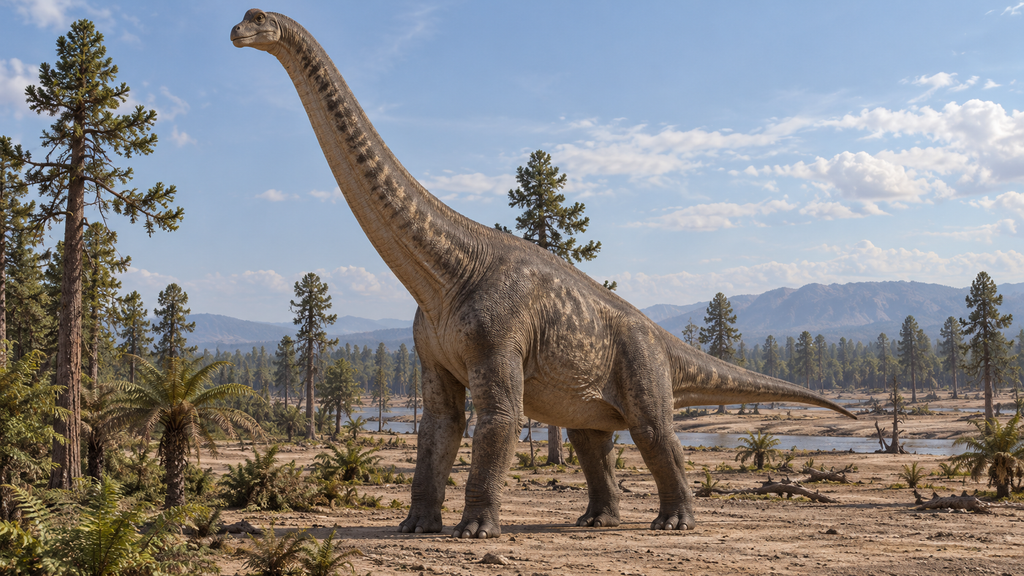
| Name | Brachiosaurus (Brachiosaurus altithorax). The genus name means “arm lizard,” after its long forelimbs. The species name means “deep chest” |
| Group | Saurischia, Sauropoda, Brachiosauridae |
| Age | Late Jurassic (Kimmeridgian to Tithonian). The first specimen came from rocks about 154 to 153 million years old |
| Found in | Colorado River valley near Fruita, Colorado, USA (Morrison Formation) |
| Length | 18 to 22 m |
| Weight | About 28 to 47 tonnes, depending on the study. One estimate goes as high as 56 to 58 tonnes |
| Head height | Thought to have exceeded 9 m |
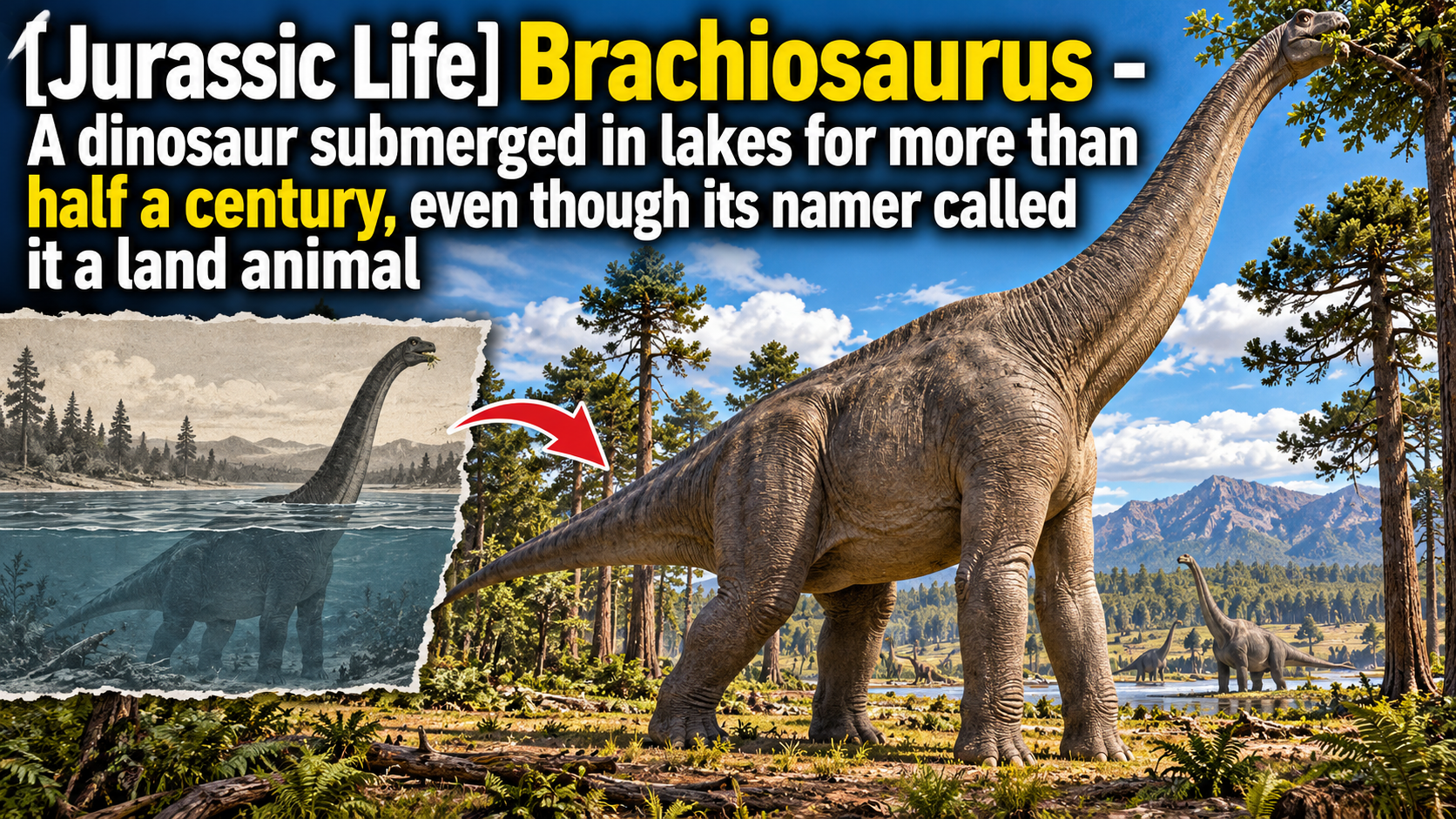
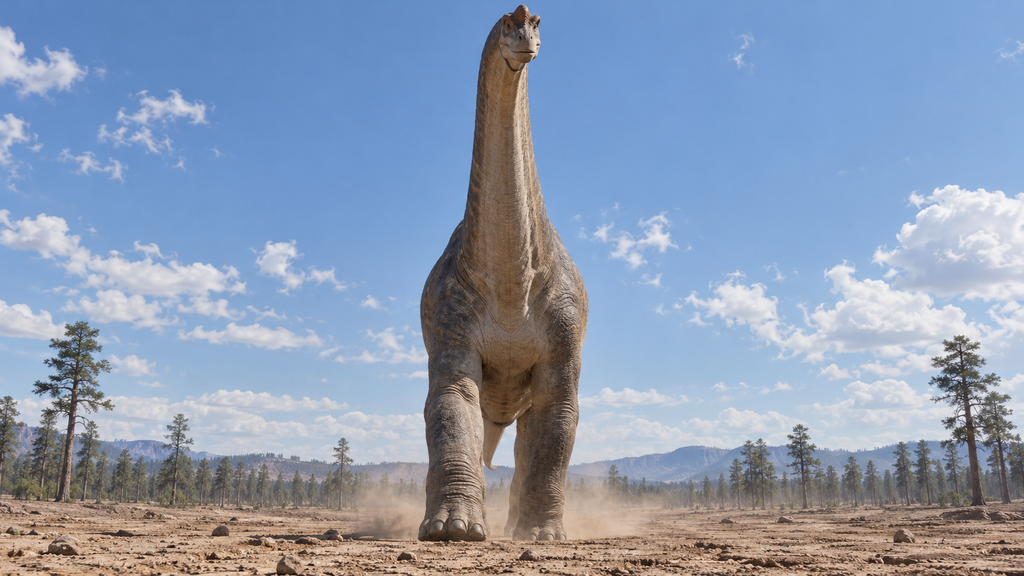
Brachiosaurus was a sauropod that lived in North America in the Late Jurassic. Its forelimbs were longer than its hind limbs and its shoulders stood high, so its back sloped upward toward the base of the neck. Until the middle of the twentieth century it was often shown as an animal too heavy to support itself on land, standing in a lake with only the top of its head above the surface. Today it is reconstructed as a land animal that fed on the leaves of tall trees.
Appearance and Way of Life
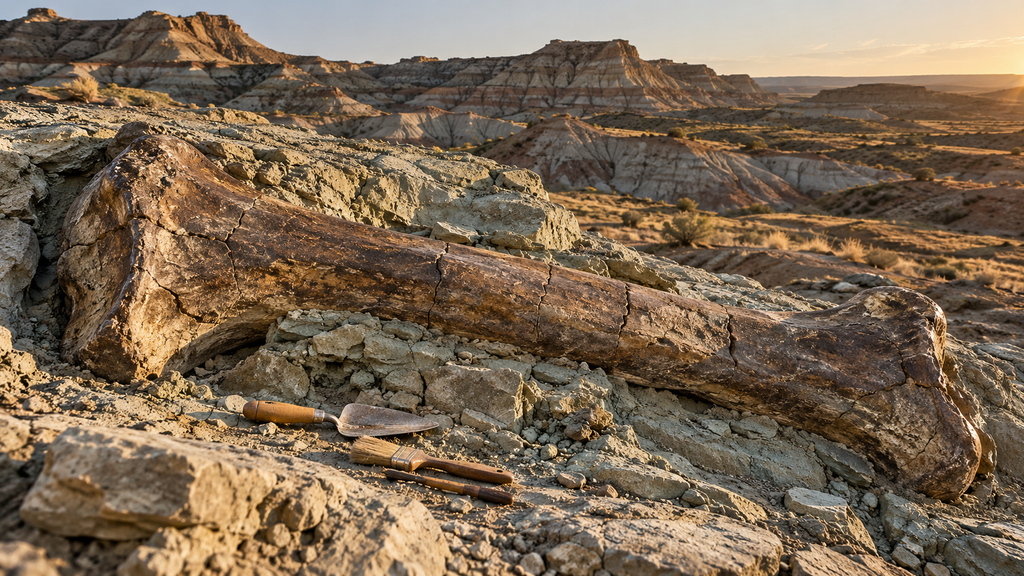
The first specimen was found on July 4, 1900, in western Colorado by an expedition from the Field Columbian Museum in Chicago, now the Field Museum. The expedition was led by Elmer Riggs, and the first bone was spotted by his assistant Harold Menke: an upper arm bone more than 2 m long. In 1903 Riggs named the skeleton Brachiosaurus and reported it as the largest dinosaur then known.
This specimen (FMNH P 25107) preserves vertebrae from the back, the hips, the base of the tail, an upper arm bone, a thigh bone and other parts, but no skull and no neck. Much of the familiar picture of Brachiosaurus, head held high, comes from a related sauropod found in the Tendaguru beds of Tanzania. That animal was described in 1914 as a second species of Brachiosaurus (Brachiosaurus brancai), and an almost complete skeleton was mounted in Berlin in 1937. In 2009 the British paleontologist Mike Taylor compared the bones of the two, listed 26 differences, and concluded that the Tanzanian animal belongs in a separate genus, Giraffatitan (Giraffatitan brancai). Brachiosaurus appears to have had a longer trunk and a longer tail than Giraffatitan. Its neck and head are still reconstructed from the bones of Giraffatitan and other close relatives.
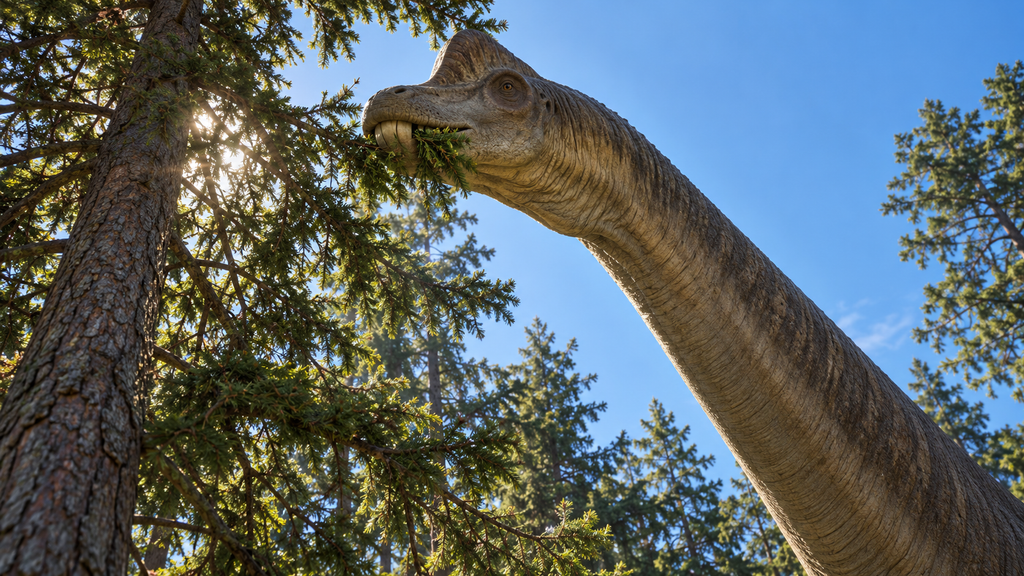
Air sacs extended into the vertebrae of the neck and back, making the skeleton lighter than it looks. With its long neck and high shoulders, its head could probably reach more than 9 m above the ground, and it is thought to have fed mostly on foliage higher than 5 m. Its food likely included conifers, ginkgoes, tree ferns and cycads. In his 1904 paper Riggs wrote that Apatosaurus and Diplodocus may have been able to rear up on their hind legs, but that this would have been much harder for the long-armed Brachiosaurus. That view still fits current research.
The Morrison Formation, where its fossils occur, formed on semi-arid plains with wet and dry seasons. The same rocks have produced the sauropods Apatosaurus, Diplodocus, Camarasaurus and Barosaurus, as well as the meat-eating dinosaur Allosaurus (the Jurassic world as a whole is covered in the Earth Timeline article on the Jurassic). Brachiosaurus, however, is a rare sauropod in this formation. A 2003 survey of more than 200 sites counted 12 Brachiosaurus specimens, against 179 for Camarasaurus and 112 for Apatosaurus.
From the Lake Bottom to Dry Land: How the Reconstruction Changed
From the late nineteenth century to the middle of the twentieth, sauropods were usually drawn as animals of the water’s edge. The reasoning was that bodies weighing tens of tonnes were too heavy for land, so they must have lived in lakes and swamps where water could carry their weight. In 1897 the artist Charles Knight drew a sauropod with only its neck rising above the water.
Yet Riggs, who named Brachiosaurus, had firmly rejected this idea in his detailed 1904 description. Sauropods, he wrote, lack the short, bent limbs and broad feet seen in animals that live in water. Among four-legged animals, straight hind legs are found only in upland dwellers, and the short, stout foot bones were as poorly suited to moving through water or marsh as those of an elephant. If the feet indicated anything, he argued, it was specialization for walking on land.
The argument did not catch on. Pictures of sauropods sunk in water kept appearing in museum murals and books for decades. In the case of Brachiosaurus, the shape of the skull added another reason. In Brachiosaurus and its relatives, the bony nasal opening is large and sits high on the head, above the eyes. With nostrils on top of the head, the animal could supposedly stay submerged and breathe with just the crown of its head above water. In a 1941 painting by the Czech artist Zdeněk Burian, three Brachiosaurus stand on the bottom of a lake: two raise only their heads and upper necks above the surface, while the third is fully submerged, eating plants on the lake bed.
In 1951 Kenneth Kermack of University College London published a short note. With the lungs several meters below the surface, he pointed out, water pressure on the chest would make it impossible to draw air in through a long neck. That ruled out the idea of standing on a lake floor and using the neck as a snorkel. In 1975 Walter Coombs set out a list of evidence: the sauropod trunk is tall and narrow like that of land animals and built for bearing weight; the limbs are straight, the feet compact, the bones lightened by hollow spaces; and the fossils come from rocks laid down on land. He concluded that sauropods lived mainly on land and entered water only occasionally, as elephants do.
Later studies point the same way. In 2001 Lawrence Witmer of Ohio University examined the noses of living reptiles and birds and concluded that the fleshy nostril of dinosaurs sat toward the front of the snout, not at the back of the large bony opening. In 2004 Donald Henderson of the University of Calgary floated computer models of sauropods in water and found that, with their air sacs, they were highly buoyant and unstable when immersed. A body that floats that easily could hardly have stood on the bottom of deep water in the first place. The exact position of the nostrils is still debated, and other placements have been proposed since.
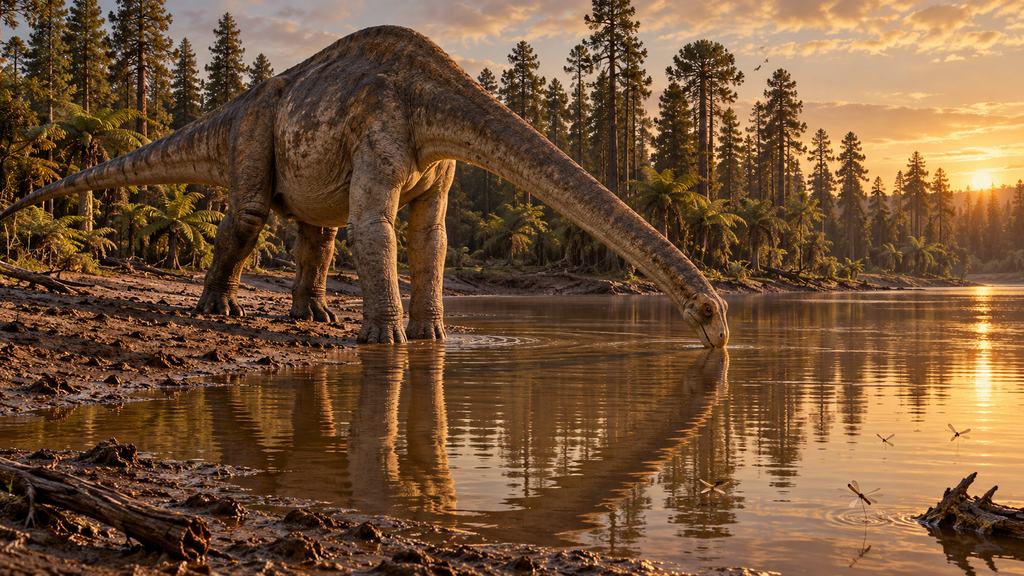
Brachiosaurus is now reconstructed walking across dry plains on four straight legs and feeding on the leaves of tall trees. If it went into water at all, it is thought to have done so about as much as elephants do today.
Related products
You can find books and products related to this article on Amazon.
If you buy through the links above, this blog may earn a commission.
Sources
- Riggs, E. S. (1903). Brachiosaurus altithorax, the largest known dinosaur. American Journal of Science s4-15, 299–306. https://doi.org/10.2475/ajs.s4-15.88.299
- Kermack, K. A. (1951). A note on the habits of the sauropods. Annals and Magazine of Natural History 4, 830–832. https://doi.org/10.1080/00222935108654213
- Coombs, W. P. (1975). Sauropod habits and habitats. Palaeogeography, Palaeoclimatology, Palaeoecology 17, 1–33. https://doi.org/10.1016/0031-0182(75)90027-9
- Witmer, L. M. (2001). Nostril position in dinosaurs and other vertebrates and its significance for nasal function. Science 293, 850–853. https://doi.org/10.1126/science.1062681
- Henderson, D. M. (2004). Tipsy punters: sauropod dinosaur pneumaticity, buoyancy and aquatic habits. Proceedings of the Royal Society B 271, S180–S183. https://doi.org/10.1098/rsbl.2003.0136
- Taylor, M. P. (2009). A re-evaluation of Brachiosaurus altithorax Riggs 1903 (Dinosauria, Sauropoda) and its generic separation from Giraffatitan brancai (Janensch 1914). Journal of Vertebrate Paleontology 29, 787–806. https://doi.org/10.1671/039.029.0309
- Taylor, M. P. (2010). Sauropod dinosaur research: a historical review. Geological Society, London, Special Publications 343, 361–386. https://doi.org/10.1144/SP343.22

コメント