This article contains affiliate links. As an Amazon Associate I earn from qualifying purchases.
| Name | Jaekelopterus. Combines the name of the German paleontologist Otto Jaekel with the Greek word for “wing” |
| Classification | Arthropoda, Chelicerata, Eurypterida (sea scorpions), Pterygotidae |
| Age | Early Devonian (Emsian, about 400 million years ago), for the type species J. rhenaniae |
| Where found | The Rhine region of western Germany (Willwerath in the Eifel, Alken, Overath and other sites). The smaller species J. howelli comes from Wyoming, USA |
| Length | About 2.3–2.6 m for J. rhenaniae, estimated from a single claw (with the claws stretched forward, about another meter). An estimate from a leg-base bone gives about 1.8 m |
| Claw length | About 46 cm (reconstructed; the preserved part is about 36 cm) |
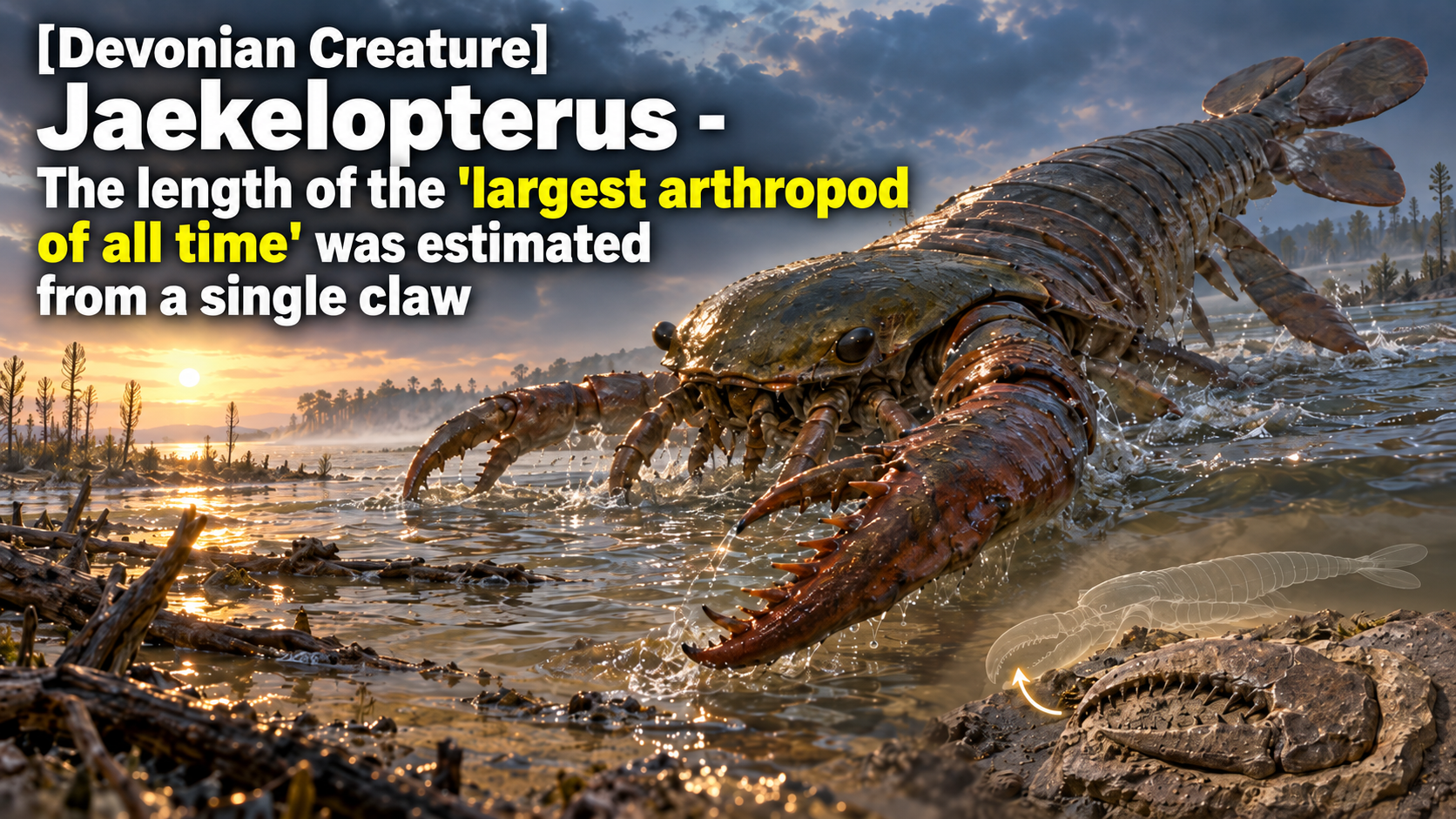
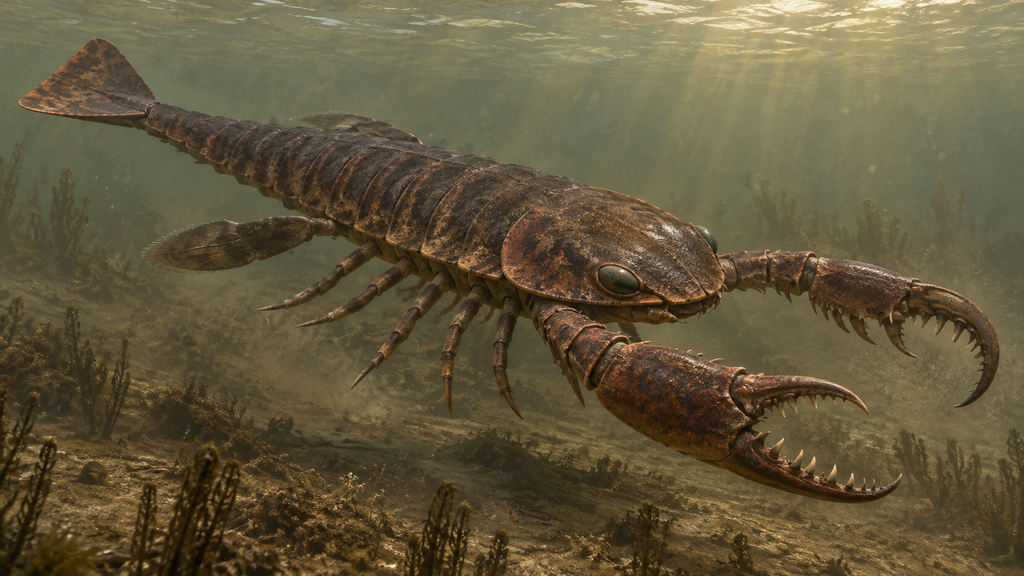
Jaekelopterus was a large sea scorpion that lived in the waters of the Early Devonian. It carried a pair of thick, long claws at the front of its body and swam after prey with flattened legs. In 2007 a fossil claw about 46 cm long was reported from Germany, and the animal’s length was estimated at about 2.5 m, which made it known as “the largest arthropod ever.” That number comes from a calculation that works out the size of the whole body from a single claw.
Appearance and Way of Life
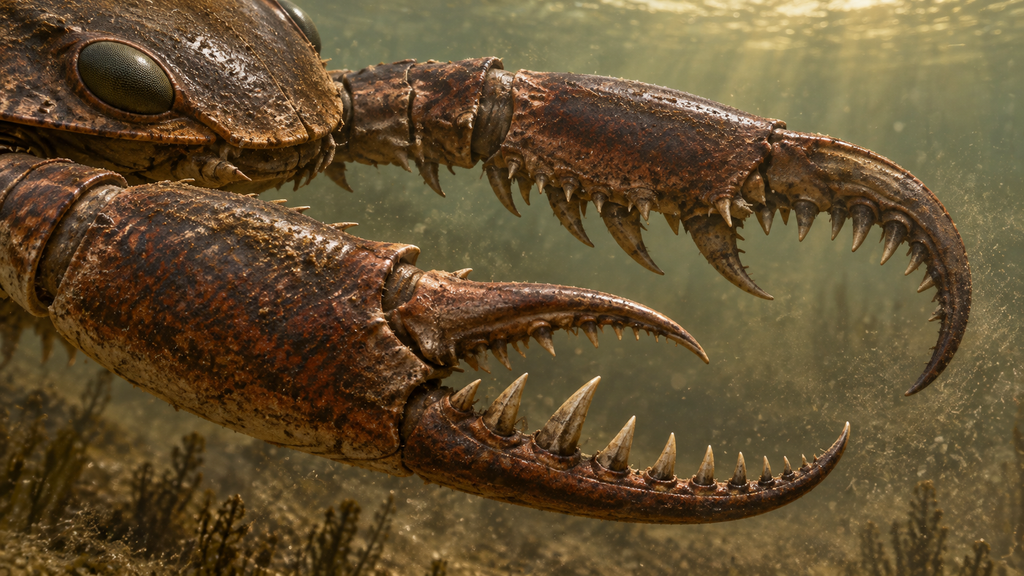
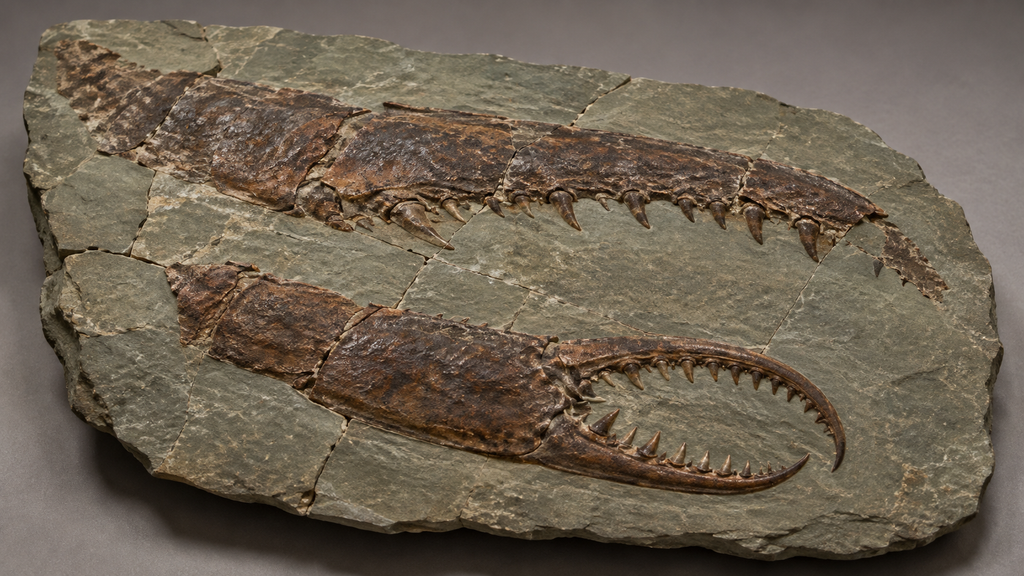
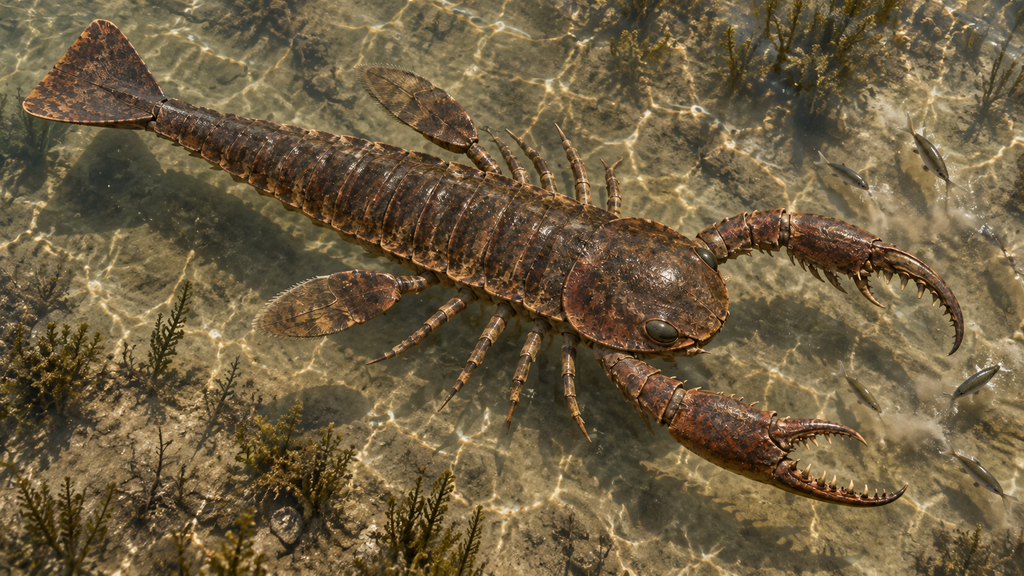
Its body plan closely matches that of its relative Pterygotus. A pair of large claws (chelicerae) project from the front of the head shield. Each claw is made of two fingers, a fixed one on the inner side and a movable one at the tip, lined on the inside with teeth of different lengths and ending in a hooked point. The last pair of legs is broad and paddle-shaped and drove the animal through the water. The tail plate, or telson, is a flat triangle that is thought to have worked as a rudder. The triangular telson and the slanting teeth on the claws are the features that separate it from Pterygotus.
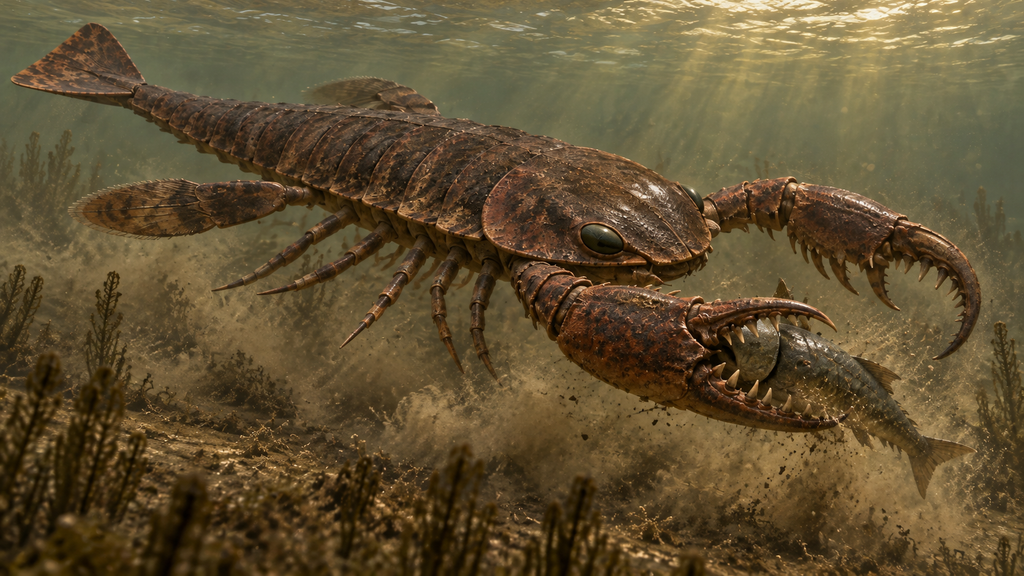
Its eyes are a pair of large compound eyes on the edges of the head. A 2015 study of the lens arrangement in fossil eyes found that neighboring lenses point in only slightly different directions, giving it eyesight close to that of living arthropods that track prey by sight. Together with the heavy claws, the current view is that it was an active hunter that seized and held its prey. Suggested prey include fish and smaller arthropods that shared its waters.
Despite the name “sea scorpion,” the rocks that yield its fossils contain almost no marine life. The beds at Willwerath are interpreted as mudstones laid down in a closed body of water within a delta, either a brackish lagoon or a floodplain lake. Jaekelopterus is thought to have lived in brackish or fresh water near river mouths rather than in the sea. Among living animals it is a chelicerate closer to horseshoe crabs than to scorpions, and an animal of its build is thought to have been unable to walk on land.
The genus also includes a smaller species. J. howelli, from Early Devonian rocks in Wyoming, reached about 80 cm and is known from more than 30 specimens. A fossil jawless fish from Utah bears puncture wounds that are thought to have been made by the claws of this species.
A 2.5-Meter Animal From One Claw
The type species, J. rhenaniae, was described in 1914 by Jaekel as a species of Pterygotus. His specimen was a single body segment from just in front of the telson, and he put the animal’s length at about 1 m. In 1936 the Norwegian paleontologist Leif Størmer described claws and leg-base bones (coxae) from material collected near Overath. The largest coxa was 27 cm wide, which suggested a body length of about 1.8 m. The movable claw fingers known at that point ranged from 2.5 to 12 cm long.
Markus Poschmann, of the cultural heritage authority of the German state of Rhineland-Palatinate, was breaking rock with a hammer and chisel in a quarry near Prüm when he noticed a dark patch of organic matter on a freshly split slab. Once cleaned, it turned out to be part of a giant claw. Poschmann washed and dried the pieces one by one, glued them back together, and wrapped the fossil in a plaster jacket to take it away.
What he found were the two outer parts of the claw, the fixed finger and the movable finger, lying separately. The movable finger was complete at 28.8 cm. The fixed finger was preserved for 36.4 cm but was missing roughly a quarter of its length; restoring the missing part gives about 45.5 cm. That is the “46 cm claw.” It is more than twice as long as the largest movable finger known up to 1936 (12 cm).
Poschmann, Simon Braddy of the University of Bristol and Erik Tetlie of Yale University worked out the body length from this claw. In related sea scorpions known from complete fossils, body length is 8.2 times claw length in Acutiramus and 9.0 times in Pterygotus. Applying those ratios directly gives Jaekelopterus a length of 233 to 259 cm, with an average of 246 cm. Counting the claws stretched out in front adds roughly another meter. The previous candidates for the largest arthropod had been Arthropleura, a giant Carboniferous myriapod (190–230 cm), and the sea scorpion Acutiramus (said to reach 250 cm, but about 210 cm when recalculated the same way). In November 2007 the paper appeared in Biology Letters under the title of “the largest ever arthropod.”
The calculation rested on an assumption: that the claw grows in step with the body. If larger individuals have claws that are disproportionately large for their size (positive allometry), an estimate from the claw will come out too big. In March 2008 the same journal published a comment by Alexander Kaiser and Jaco Klok, biologists at universities in Arizona. They pointed to the single giant claw of living fiddler crabs and to the horns of Onthophagus dung beetles, which grow out of proportion in larger individuals, as examples of how risky it is to estimate body size from one appendage. They also noted that the original paper itself said the large claw teeth showed positive allometry, and that the coxa-based estimate came to only 1.8 m. Kaiser and Klok argued that a range of possible sizes should be given instead of a single figure of 2.5 m.
Braddy and his co-authors replied in the same issue. Positive allometry had not been shown in the claws of sea scorpions or their horseshoe crab relatives, they wrote, and the critics had not offered an alternative estimate of their own. They maintained that 2.5 m was more accurate than the numbers previously used in textbooks and the media, and in fact more conservative. They also mentioned a fixed finger of about the same size from the same beds, held in a private collection, which might be the other claw of the same individual.
No complete body has been found since, and the debate has not been settled. In 2021, part of a molted Arthropleura exoskeleton about 75 cm long turned up in a sandstone block that had fallen from a cliff on the Northumberland coast in northeast England. From this fossil, Neil Davies of the University of Cambridge and colleagues estimated a length of about 2.7 m and a weight of about 50 kg, and called it the largest arthropod in Earth history, bigger than the sea scorpions that had held the record. Both figures are estimates of a whole body from one piece of it. The length of Jaekelopterus still rests on a single claw and on the assumption used to scale it up.
Related products
You can find books and products related to this article on Amazon.
If you buy through the links above, this blog may earn a commission.
Sources
Braddy, S. J., Poschmann, M. & Tetlie, O. E. (2008). Giant claw reveals the largest ever arthropod. Biology Letters 4, 106–109. https://doi.org/10.1098/rsbl.2007.0491
Kaiser, A. & Klok, J. (2008). Do giant claws mean giant bodies? An alternative view on exaggerated scaling relationships. Biology Letters 4, 279–280. https://doi.org/10.1098/rsbl.2008.0015
Braddy, S. J., Poschmann, M. & Tetlie, O. E. (2008). Reply: giant claws and big bodies. Biology Letters 4, 281. https://doi.org/10.1098/rsbl.2008.0116
McCoy, V. E., Lamsdell, J. C., Poschmann, M., Anderson, R. P. & Briggs, D. E. G. (2015). All the better to see you with: eyes and claws reveal the evolution of divergent ecological roles in giant pterygotid eurypterids. Biology Letters 11, 20150564. https://doi.org/10.1098/rsbl.2015.0564
Poschmann, M. & Tetlie, O. E. (2006). On the Emsian (Lower Devonian) arthropods of the Rhenish Slate Mountains: 5. Rare and poorly known eurypterids from Willwerath, Germany. Paläontologische Zeitschrift 80, 325–343. https://doi.org/10.1007/BF02990208
Davies, N. S., Garwood, R. J., McMahon, W. J., Schneider, J. W. & Shillito, A. P. (2022). The largest arthropod in Earth history: insights from newly discovered Arthropleura remains (Serpukhovian Stainmore Formation, Northumberland, England). Journal of the Geological Society 179. https://doi.org/10.1144/jgs2021-115
University of Bristol, News (2007). https://bristol.ac.uk/news/2007/5698.html
University of Cambridge (21 December 2021). Millipedes ‘as big as cars’ once roamed England. https://www.cam.ac.uk/stories/giantmillipede


コメント