This article contains affiliate links. As an Amazon Associate I earn from qualifying purchases.
| Name | Guiyu (Guiyu oneiros). The genus name is Mandarin for “ghost fish”; the species name is Greek for “dream”. Its Chinese name means “dream ghost fish” |
| Classification | Vertebrate, bony fish (osteichthyan). Originally described as one of the earliest sarcopterygians (lobe-finned fishes, the lineage that includes coelacanths, lungfishes and land vertebrates). Since 2017 some analyses place it on the bony-fish stem, before lobe-fins and ray-fins split |
| Age | Late Silurian (Ludlow). About 425 million years ago (the original description gave at least 419 million years; later revisions of the formation’s age made it older) |
| Locality | Kuanti Formation, Qujing, Yunnan Province, China, on the shore of the Xiaoxiang Reservoir |
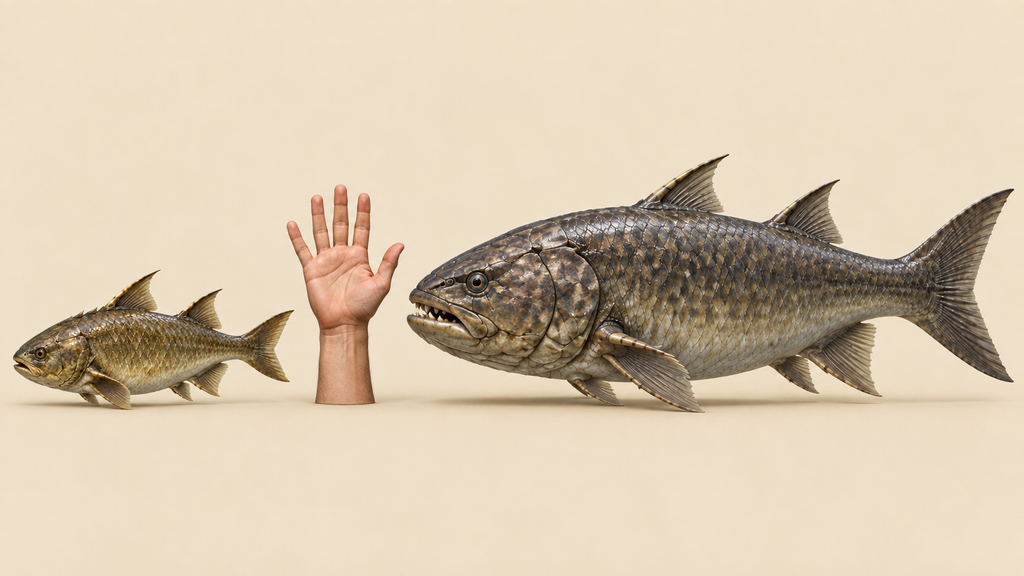
| Length | About 30 cm (the type specimen is about 26 cm long without its tail, and about 11 cm deep) |
| Weight | A few hundred grams (a rough figure based on living fish of the same length and depth; no published estimate exists) |
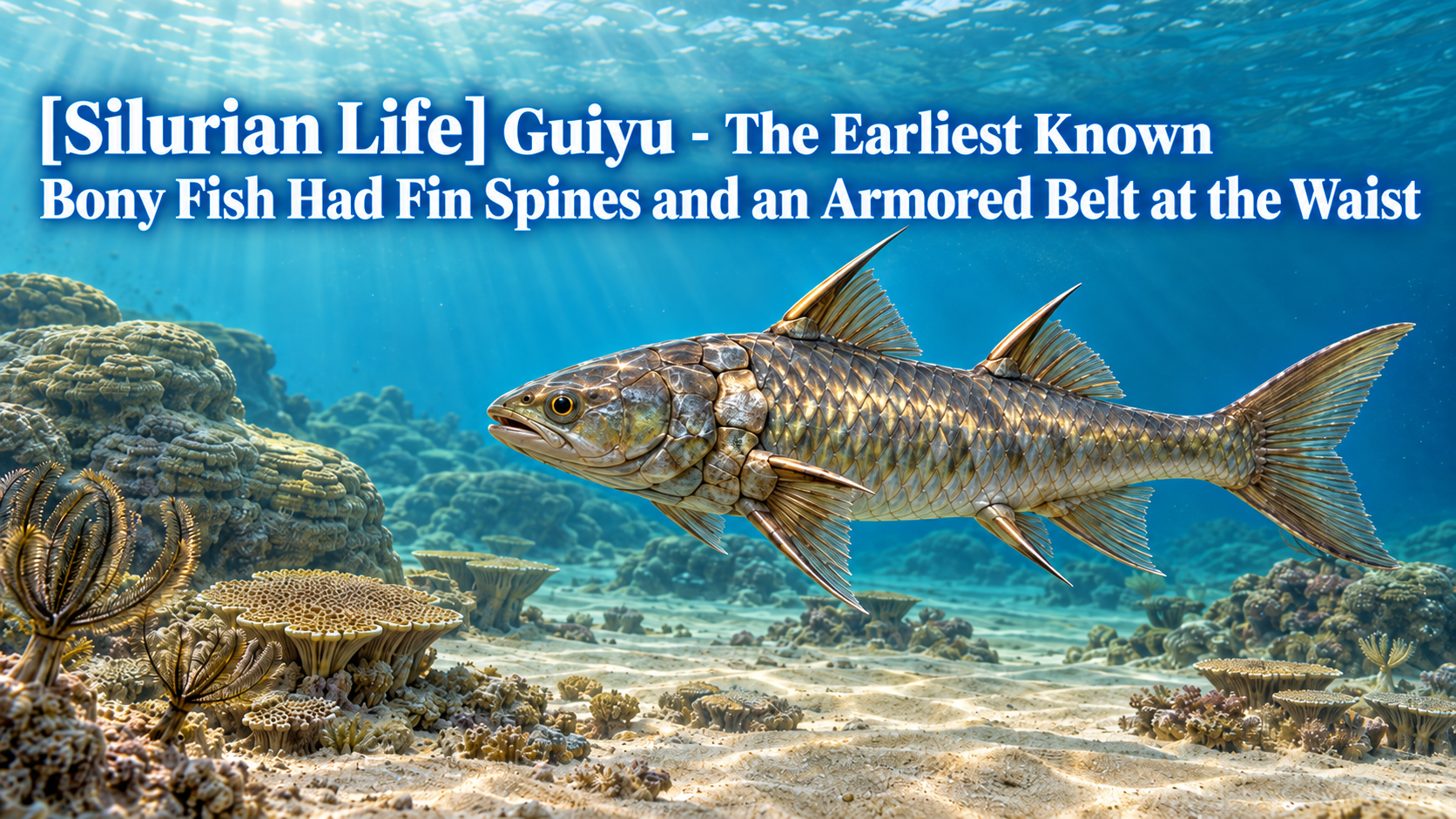
Guiyu is a bony fish, or osteichthyan, from the seas of the late Silurian, about 30 cm long. Osteichthyans form the large lineage that includes most living fishes and every land vertebrate from amphibians to mammals, and Guiyu is the oldest member of that lineage known from a body preserved intact from head to trunk. When it was described in Nature in 2009, it turned out to carry several parts that bony fishes are not supposed to have: stout spines on its fins and bony plates across its underside.
Appearance and Way of Life
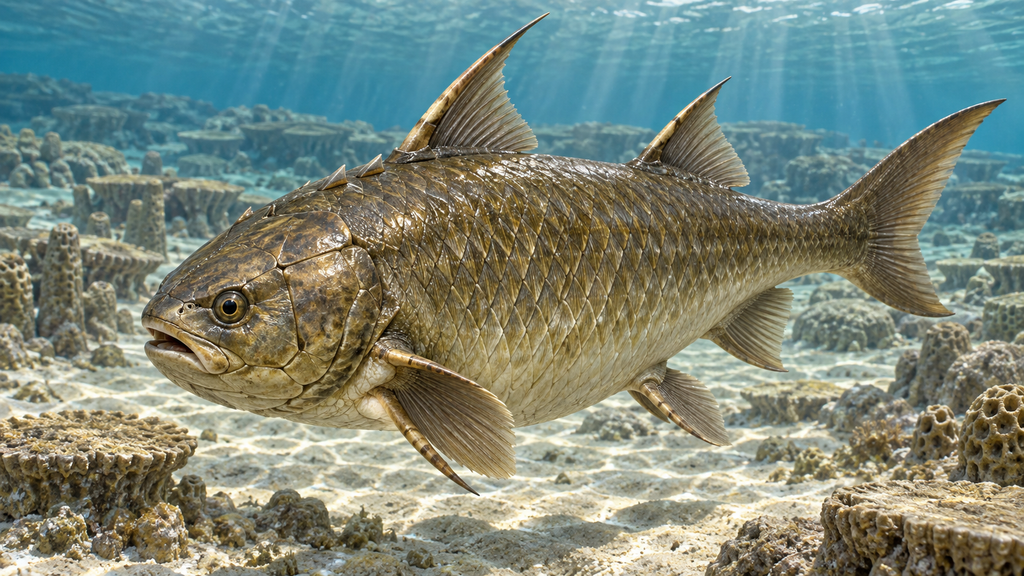
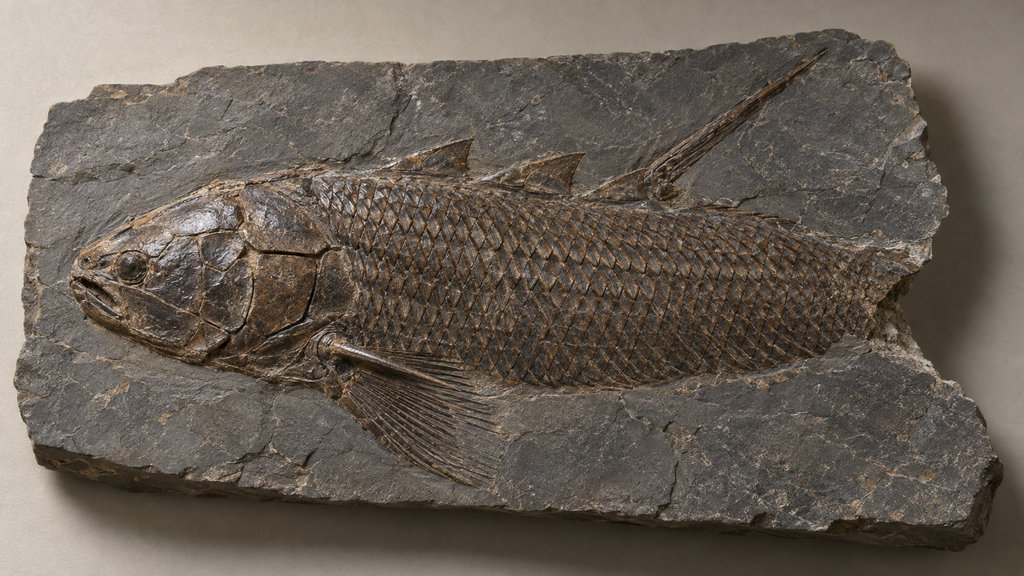
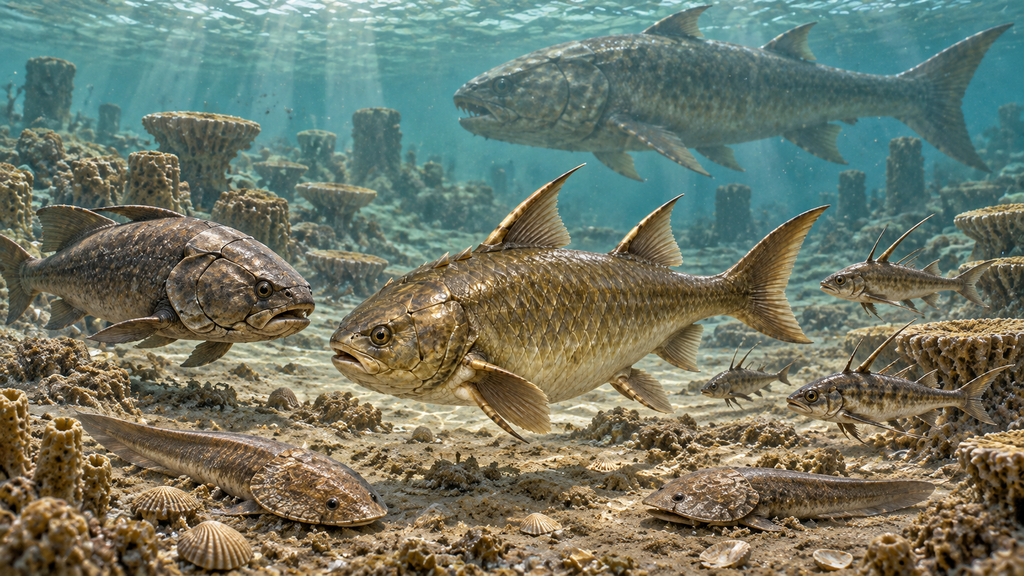
The type specimen is a fossil flattened in side view with the head and trunk still joined, missing the region of the tail fin. The preserved part is about 26 cm long and 11 cm deep, which gives an estimated living length of around 30 cm. The body was short and deep, with a rounded outline in profile. The skull bones and scales were coated in ganoine, a glossy enamel-like layer, and the scales were rhombic, each marked with fine lengthwise ridges. A 2019 study sorted the body scales by shape and reconstructed their arrangement as four belts divided into sixteen areas.
The fin layout consisted of paired pectoral and pelvic fins, two dorsal fins, and an anal fin. The leading edges of the pectoral, pelvic and dorsal fins each carried a stout spine. The first dorsal spine was about 4 cm long, a large structure for a 30 cm fish. Three bony plates ran along the midline of the back behind the head, and the last of them supported the first dorsal spine. At the base of the pelvic fin, a cluster of small rounded scales shows that the fin sat on a fleshy lobe. A fleshy lobe is one of the hallmarks of lobe-finned fishes. The grounds for placing Guiyu among the earliest lobe-fins in 2009, however, lay mainly in the arrangement of its skull bones.
At the type locality on the shore of the Xiaoxiang Reservoir, sediments of a shallow late Silurian sea are exposed, and they yield a coherent fossil assemblage known as the Xiaoxiang fauna. Jawless fishes (galeaspids), placoderms with armored heads and trunks, spiny-finned acanthodians, and several bony fishes have all been found here. The same Kuanti Formation produced Entelognathus, a placoderm with the same jaw bones as bony fishes, and Megamastax, a fish estimated at about 1 m long and the largest Silurian vertebrate known. Guiyu lived in this warm shallow sea as a mid-sized fish, not as a top predator.
A Placoderm’s Hips, an Acanthodian’s Spines, a Bony Fish’s Scales
The bony-fish body plan differs from those of sharks and placoderms in several clear ways. Bony fishes normally have no bony spines along the leading edges of their fins. The bones that support their pelvic fins, the pelvic girdle, consist only of internal bone and include no plates formed in the skin. And their bodies are covered in large scales or bony plates. Fin spines are a trait of placoderms and acanthodians, and a pelvic girdle built of dermal bone was known only from placoderms and some acanthodians.
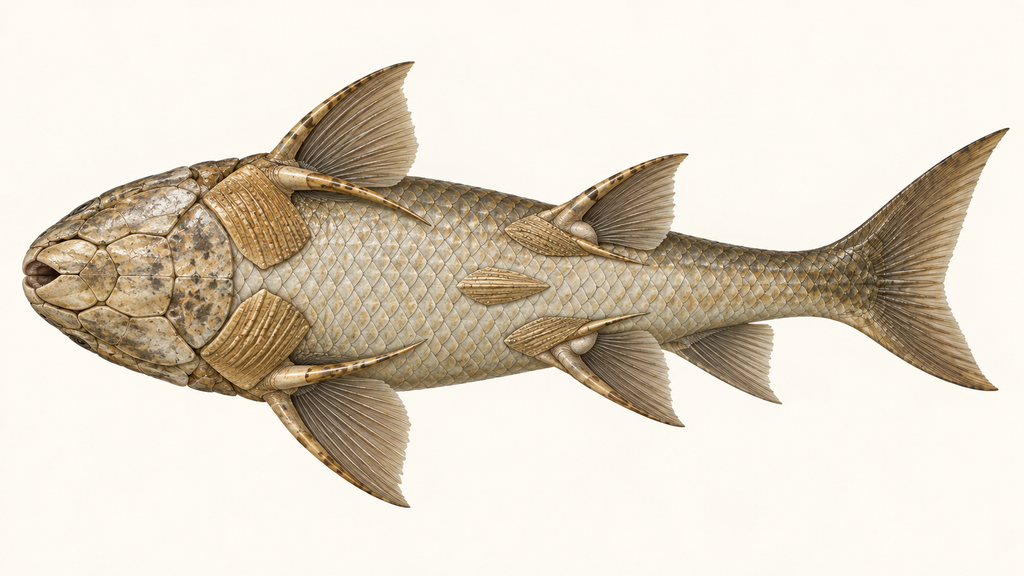
Guiyu’s body lines up a series of parts that cut across these divisions. The shoulder bones that support the pectoral fin carry a spine that bony fishes lack. In front of the dorsal fin sit three midline bony plates, placoderm-like, supporting a spine. The scales are the large rhombic scales of a true bony fish, and the pattern of the skull bones and the fleshy lobe at the base of the pelvic fin are lobe-fin traits. The oldest complete body of a bony fish, in other words, was not assembled from bony-fish parts alone.
This combination had a history. In 1999 a fish named Psarolepis was described from Early Devonian rocks in the same Yunnan Province. Psarolepis had a lobe-fin skull but a spine on its shoulder bones and spines on its fins, the same kind of mismatched set of features. Its fossils, however, were isolated bones found separately, and the possibility that bones of different fishes had been mixed together could never be fully ruled out. Guiyu demonstrated, with an articulated specimen, that the same combination really did exist within a single fish.
In 2010 a second specimen was collected from the same bed at the same site, lacking the head but preserving the trunk back to the middle of the anal fin. It retained the bones at the base of the pelvic fin in place: a pair of bony plates, one on each side, a single plate in front of them, and a sharp spine projecting backward and outward. The right plate measured about 17 mm long and 7 mm wide. A pelvic girdle made of dermal bone, formed in the skin, had until then been known only in placoderms and some acanthodians, and this was the first time one had been confirmed in a bony fish. The researchers interpreted the structure not as something bony fishes had acquired on their own but as an old feature inherited from the common ancestor of all jawed vertebrates. The purely internal pelvic girdle of living bony fishes would then be the result of losing the dermal part later.
A Position That Keeps Shifting
When described, Guiyu was placed at the base of the lobe-finned lineage. In 2017, when a new Early Devonian fish named Ptyctolepis was described, the accompanying phylogenetic analysis indicated that the group containing Guiyu, Psarolepis and Sparalepis from the same Kuanti Formation, the psarolepids, might branch not from the base of the lobe-fins but from the stem of bony fishes as a whole, before lobe-fins and ray-fins diverged. The 2019 study of its scales still treated Guiyu as an early lobe-fin, and the question of where it belongs has not been settled.
What does not change under either reading is that Guiyu is the oldest complete body of a bony fish, and that the split between ray-finned and lobe-finned fishes had already happened by the late Silurian. The original paper put the minimum age of that split at about 419 million years. The age of the Kuanti Formation has since been revised to about 425 million years. The Devonian is sometimes called the Age of Fishes, but the divergence and diversification of bony fishes were already under way in the shallow seas of South China during the Silurian before it. Sparalepis was described from the Xiaoxiang fauna in 2017, bringing the number of pre-Devonian bony fishes known from articulated remains to two.
Related products
You can find books and products related to this article on Amazon.
If you buy through the links above, this blog may earn a commission.
Sources
- Zhu, M., Zhao, W., Jia, L., Lu, J., Qiao, T. & Qu, Q. (2009). The oldest articulated osteichthyan reveals mosaic gnathostome characters. Nature 458, 469–474. https://doi.org/10.1038/nature07855
- Qiao, T. & Zhu, M. (2010). Cranial morphology of the Silurian sarcopterygian Guiyu oneiros (Gnathostomata: Osteichthyes). Science China Earth Sciences 53, 1836–1848. https://doi.org/10.1007/s11430-010-4089-6
- Zhu, M. et al. (2012). Fossil fishes from China provide first evidence of dermal pelvic girdles in osteichthyans. PLOS ONE 7(4), e35103 (open access). https://doi.org/10.1371/journal.pone.0035103
- Choo, B., Zhu, M., Zhao, W., Jia, L. & Zhu, Y. (2014). The largest Silurian vertebrate and its palaeoecological implications. Scientific Reports 4, 5242. https://doi.org/10.1038/srep05242
- Choo, B. et al. (2017). A new osteichthyan from the late Silurian of Yunnan, China. PLOS ONE 12(3), e0170929. https://doi.org/10.1371/journal.pone.0170929
- Lu, J., Giles, S., Friedman, M. & Zhu, M. (2017). A new stem sarcopterygian illuminates patterns of character evolution in early bony fishes. Nature Communications 8, 1932. https://doi.org/10.1038/s41467-017-01801-z
- Cui, X., Qiao, T. & Zhu, M. (2019). Scale morphology and squamation pattern of Guiyu oneiros provide new insights into early osteichthyan body plan. Scientific Reports 9, 4411. https://doi.org/10.1038/s41598-019-40845-7


コメント