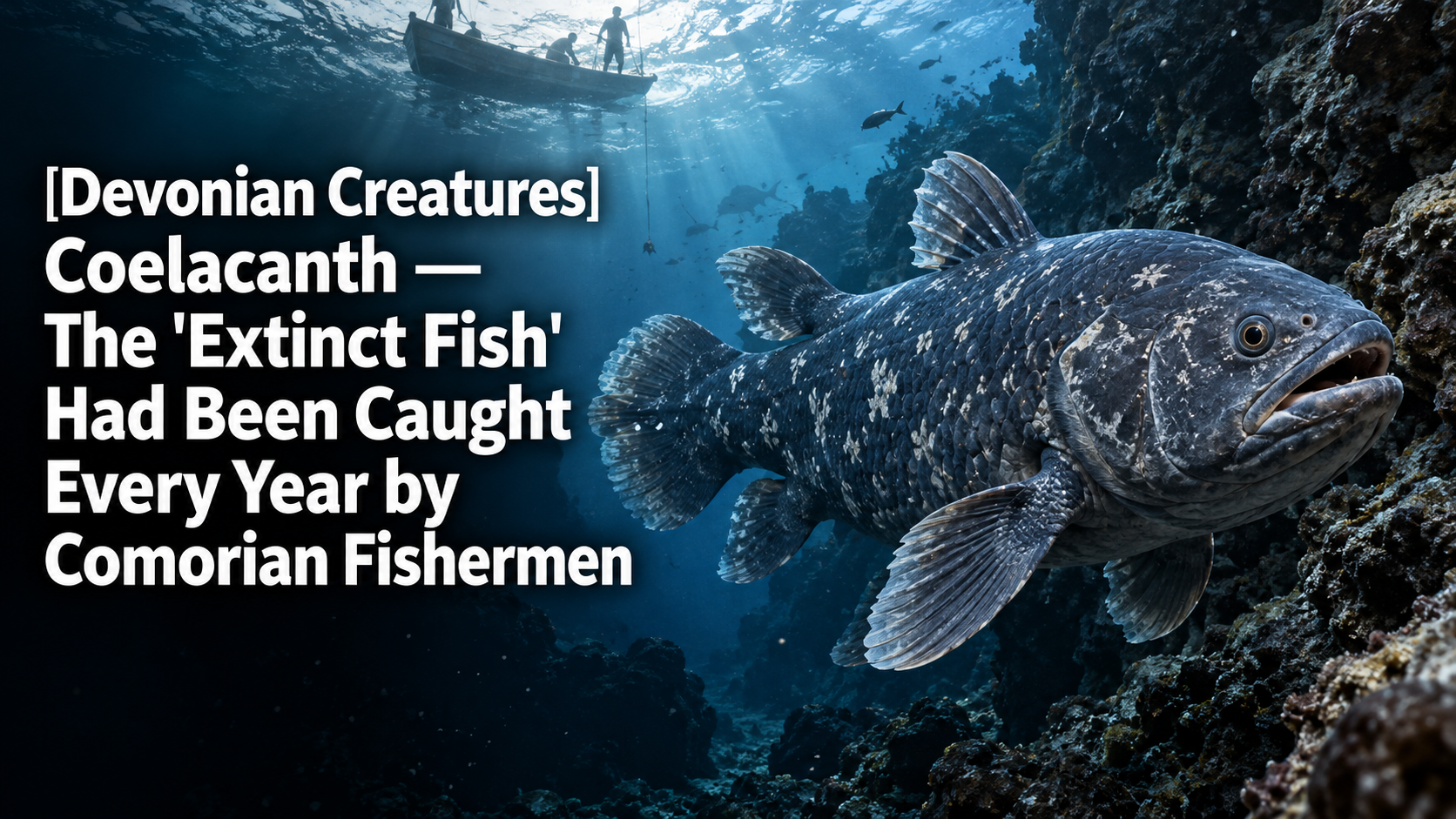
This article contains affiliate links. As an Amazon Associate I earn from qualifying purchases.
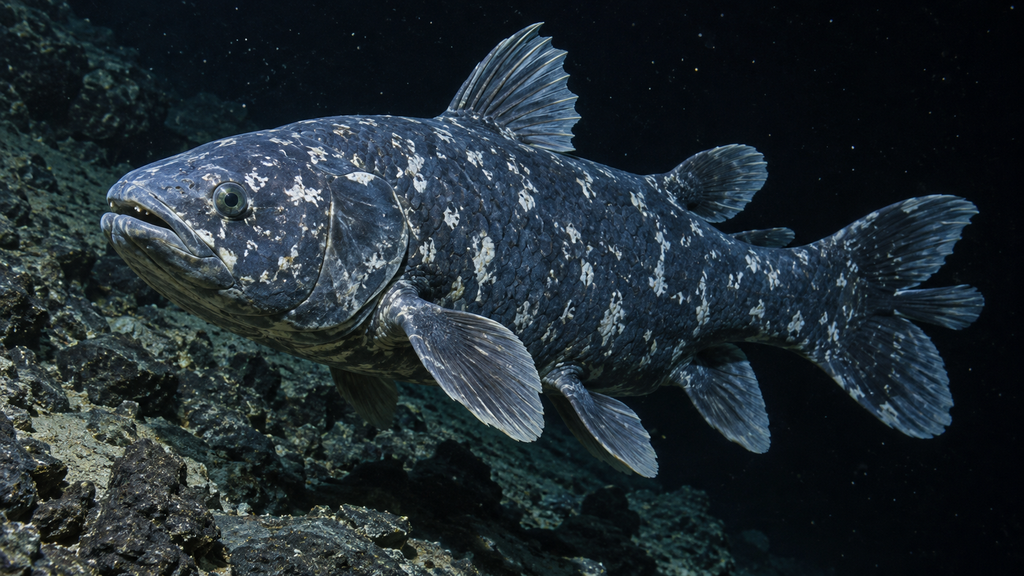
| Name | Coelacanth. From the fossil genus name Coelacanthus, Greek for “hollow spine,” after the hollow bones of its fins. The living genus Latimeria is named for Marjorie Courtenay-Latimer, the museum curator who found the first specimen in 1938 |
| Classification | Vertebrata, Osteichthyes, Sarcopterygii (lobe-finned fishes), Actinistia (two living species in the genus Latimeria, family Latimeriidae) |
| Age | Early Devonian (about 409 million years ago) to the present. The fossil record breaks off at the end of the Cretaceous, about 66 million years ago |
| Where found | Fossils worldwide. Of the living species, the West Indian Ocean coelacanth (L. chalumnae) is centered on the Comoro Islands, with records off South Africa, Mozambique and Madagascar. The Indonesian coelacanth (L. menadoensis) lives off northern Sulawesi |
| Length | Up to about 2 m in the West Indian Ocean species (females; males reach about 1.7 m). About 35 cm at birth |
| Weight | Up to about 95 kg (West Indian Ocean species) |
| Lifespan | About 100 years, according to a 2021 estimate based on growth rings in the scales |
The coelacanth is a lobe-finned fish, one of the group whose fins have bones and muscle at their base. It appeared in the Devonian, and its fossils run up to the end of the age of dinosaurs and then stop abruptly. For that reason it was thought to have died out about 70 million years ago, until a living fish was hauled up in a net off South Africa in 1938. Today two species live in the deep waters of the western Indian Ocean and Indonesia.
Appearance and Way of Life
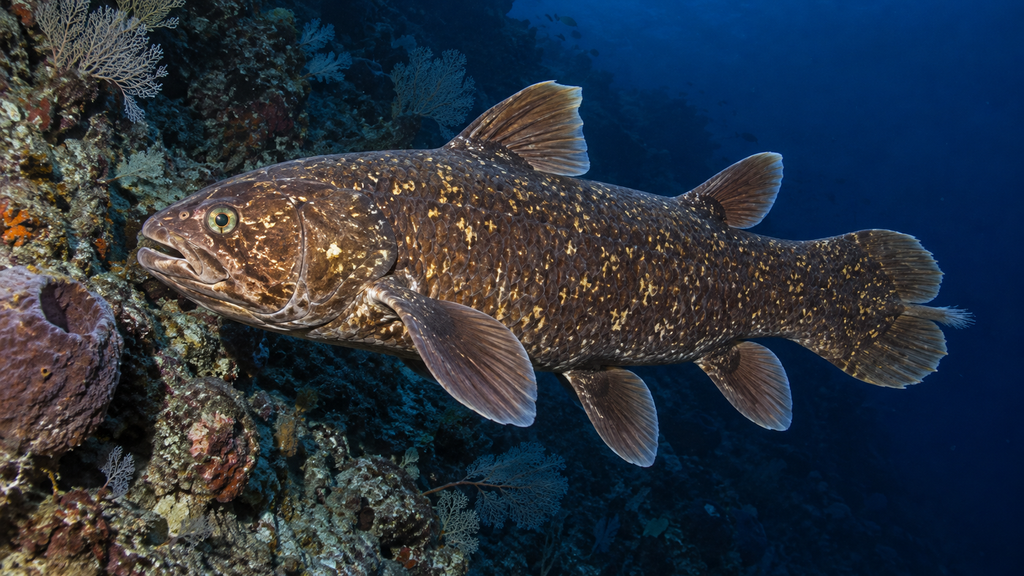
The living coelacanth is a stout fish covered all over in thick, hard scales. The West Indian Ocean species is deep blue scattered with white blotches, and the pattern of blotches differs from one fish to the next. The Indonesian species is brown with golden flecks. Six of its fins, the paired pectoral and pelvic fins plus the second dorsal and anal fins, sit on fleshy stalks. The tail has a large upper and lower lobe with a small extra tuft sticking out between them, giving it three parts.
The skull has a joint partway along its length that lets it hinge up and down, so the fish can open its mouth very wide. No other living vertebrate has a joint like this. The snout holds a rostral organ that is thought to sense the weak electrical signals given off by prey. Instead of a bony backbone, it keeps a thick fluid-filled tube, the notochord.
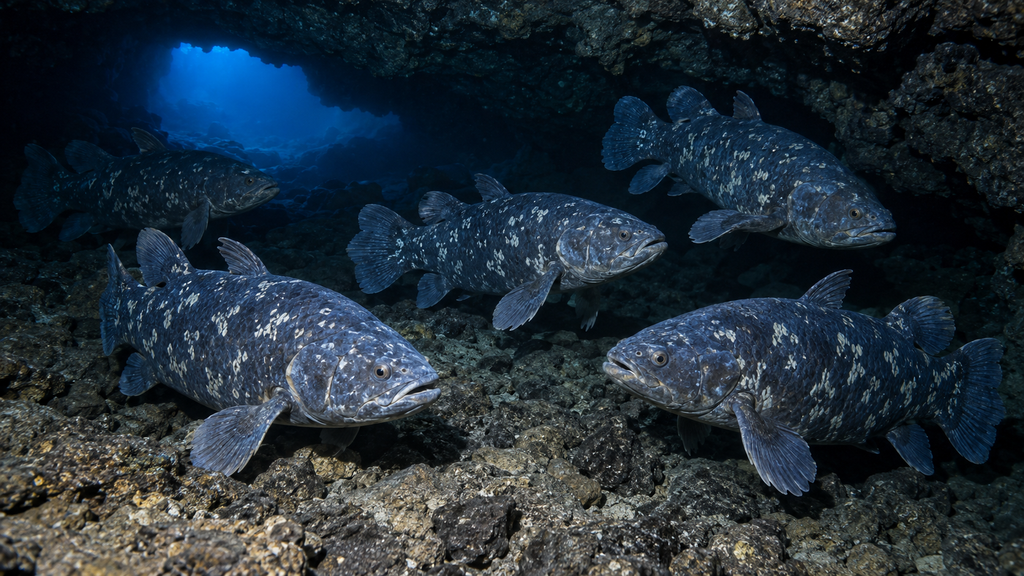
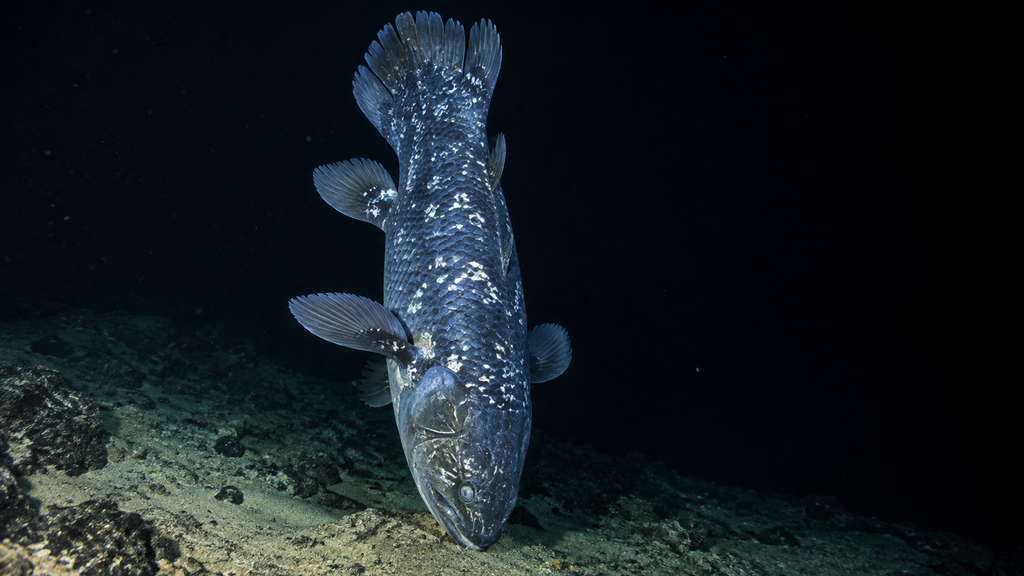
It lives on the slopes of volcanic islands at depths of about 150–700 m. By day it rests in caves formed in lava, sometimes more than a dozen in one cave. At night the fish leave one by one, drift near the seafloor feeding on fish and squid, and return to the caves before dawn. Observations from submersibles show that it never walks on the bottom with its lobed fins. It drifts slowly, moving the fins in the same sequence as the legs of a four-legged animal to turn and hold its position. It has also been filmed holding still for several minutes with its head pointed straight down and its body vertical.
The eggs hatch inside the mother, and the young develop in her body before birth (confirmed in 1975 from a female specimen carrying young). In 2021 a French team examined scales from 27 fish under polarized light and found growth rings too fine to see with the naked eye. The maximum lifespan, previously put at 20 years, was re-estimated at about 100 years, with maturity at 40 to 69 years and a pregnancy of about five years. That places it among the slowest-growing fish in the sea.
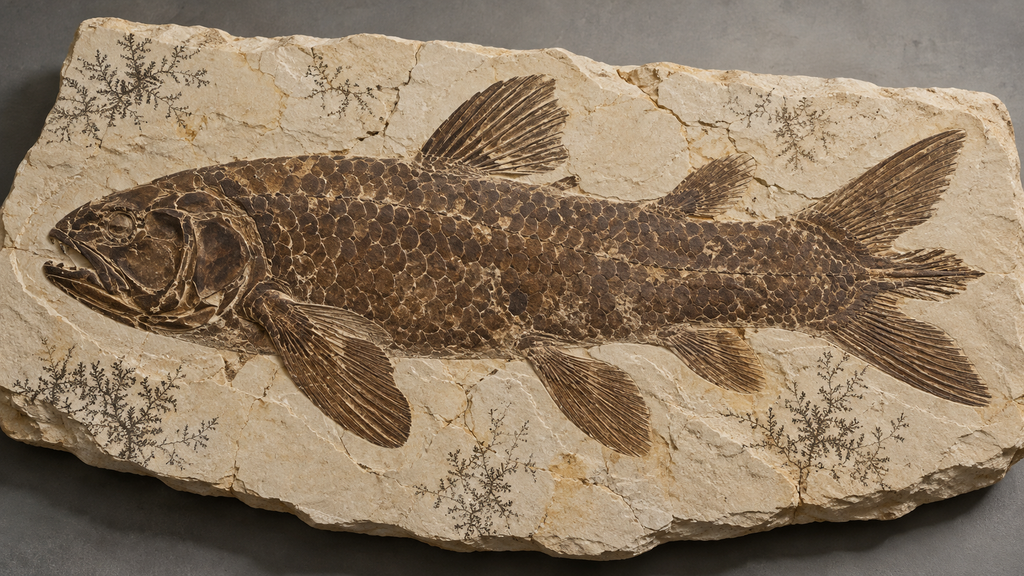
Fossil coelacanths were far more varied. The oldest definite skull comes from Early Devonian rocks in Yunnan, China, and already has the basic body plan of the living species. Later coelacanths spread from the sea into lakes and rivers, and in the rivers of Cretaceous Africa the large Mawsonia shared the water with Spinosaurus. No fossils of the living genus Latimeria itself have been found, however.
One Fish in a Trawl Net, and a Second 14 Years Later
On 22 December 1938 the trawler Nerine returned to East London, a port on South Africa’s eastern coast. Its captain, Hendrik Goosen, had an arrangement with Marjorie Courtenay-Latimer, curator of the East London Museum, to let her know when anything unusual came up in the nets. That day the boat had been fishing off the mouth of the Chalumna River. Sorting through a pile of sharks and starfish on deck, Courtenay-Latimer saw a blue fin poking out. The fish she pulled free was about 1.5 m long, covered in hard scales, with thick fins that looked like limbs.
The fish was not in any of the reference books at the museum. The museum’s chairman dismissed it as a rock cod. Courtenay-Latimer tried to telephone J. L. B. Smith, who taught chemistry at Rhodes University in Grahamstown and studied fishes, but could not reach him. On the 23rd she sent him a letter describing the fish, with a sketch of its fins. Smith was recovering from an illness in the coastal town of Knysna and did not read the letter until 3 January.
From the sketch, Smith concluded it was a coelacanth, a fish known only from fossils, and sent a telegram at once: “MOST IMPORTANT PRESERVE SKELETON AND GILLS FISH DESCRIBED.” Meanwhile, in the summer heat, the fish had begun to decay. Courtenay-Latimer asked the city mortuary and a cold store to keep it and was turned away, so she had a local taxidermist skin and mount it. Before Smith’s next message arrived, the internal organs had gone out with the town’s rubbish.
Smith saw the mounted fish at the museum on 16 February 1939. Scale by scale, bone by bone, fin by fin, it was a coelacanth. In March he reported it in Nature under the title “A Living Fish of Mesozoic Type” and named it Latimeria chalumnae, after the curator and the river where it was caught.
All that survived was the skin and the bones of the head, with no organs and no gills. To get a complete specimen, Smith had leaflets printed describing the fish and offering a reward of 100 pounds, and distributed them along the east coast of Africa.
The second fish came 14 years later, in December 1952, from the island of Anjouan in the Comoro Islands, then a French territory about 2,000 km northeast of East London. A fish caught by a local fisherman, Ahamadi Abdallah, reached someone who knew of the leaflets, and a telegram was sent to Smith. With the approval of South Africa’s prime minister, D. F. Malan, Smith flew to the Comoros on a military aircraft and saw the fish on 29 December. He described it as a separate genus and species, Malania anjouanae, named after the prime minister. It was later judged to be the same species as Latimeria, and the name is no longer used.
The fishermen of the Comoros already knew this fish. They called it “gombessa.” It was caught two or three times a year on hand lines at night, and since it was poor to eat, it was often thrown back. For the 14 years in which science searched for a fish “extinct for 70 million years,” it was being caught every year in its real home. Since then more than 200 have been caught, mostly around the Comoros, and genetic studies suggest that the fish caught off Madagascar and Mozambique are strays from the Comoros population.
The same thing happened in Indonesia. In 1997 the marine biologist Mark Erdmann and his wife, Arnaz Mehta Erdmann, were on their honeymoon in Manado, northern Sulawesi, when they saw a brown coelacanth in a fish market. On 30 July 1998 local fishermen caught a second one in a deep-set net off the island of Manado Tua, and Erdmann received it alive and filmed it swimming for more than three hours. The local fishermen called it “raja laut,” king of the sea. This population, almost 10,000 km east of the Comoros, was found to be genetically distinct and was named Latimeria menadoensis in 1999.
The first fish is still on display, mounted, at the East London Museum. The living coelacanth is often held up as the classic “living fossil,” but the genome sequenced in 2013 showed that the closest living fish to land vertebrates is the lungfish, not the coelacanth. Fossil coelacanths also varied in shape. Latimeria is not the same fish as 400 million years ago; it is the one genus of that lineage that has survived to the present.
Related products
You can find books and products related to this article on Amazon.
If you buy through the links above, this blog may earn a commission.
Sources
Smith, J. L. B. (1939). A Living Fish of Mesozoic Type. Nature 143, 455–456. https://doi.org/10.1038/143455a0
Smith, J. L. B. (1953). The Second Cœlacanth. Nature 171, 99–101. https://doi.org/10.1038/171099a0
Erdmann, M. V., Caldwell, R. L. & Moosa, M. K. (1998). Indonesian ‘king of the sea’ discovered. Nature 395, 335. https://doi.org/10.1038/26376
Pouyaud, L., Wirjoatmodjo, S., Rachmatika, I. et al. (1999). Une nouvelle espèce de cœlacanthe. Preuves génétiques et morphologiques. Comptes Rendus de l’Académie des Sciences III 322, 261–267. https://doi.org/10.1016/S0764-4469(99)80061-4
Smith, C. L., Rand, C. S., Schaeffer, B. & Atz, J. W. (1975). Latimeria, the Living Coelacanth, Is Ovoviviparous. Science 190, 1105–1106. https://doi.org/10.1126/science.190.4219.1105
Zhu, M., Yu, X., Lu, J. et al. (2012). Earliest known coelacanth skull extends the range of anatomically modern coelacanths to the Early Devonian. Nature Communications 3, 772. https://doi.org/10.1038/ncomms1764
Amemiya, C. T., Alföldi, J., Lee, A. P. et al. (2013). The African coelacanth genome provides insights into tetrapod evolution. Nature 496, 311–316. https://doi.org/10.1038/nature12027
Casane, D. & Laurenti, P. (2013). Why coelacanths are not ‘living fossils’. BioEssays 35, 332–338. https://doi.org/10.1002/bies.201200145
Mahé, K., Ernande, B. & Herbin, M. (2021). New scale analyses reveal centenarian African coelacanths. Current Biology 31, 3621–3628. https://doi.org/10.1016/j.cub.2021.05.054
Natural History Museum, London. Coelacanths: the fish that outdid the Loch Ness Monster. https://www.nhm.ac.uk/discover/coelacanths-the-fish-that-outdid-the-loch-ness-monster.html
UC Berkeley News (23 September 1998). https://newsarchive.berkeley.edu/news/media/releases/98legacy/09-23-1998a.html


コメント