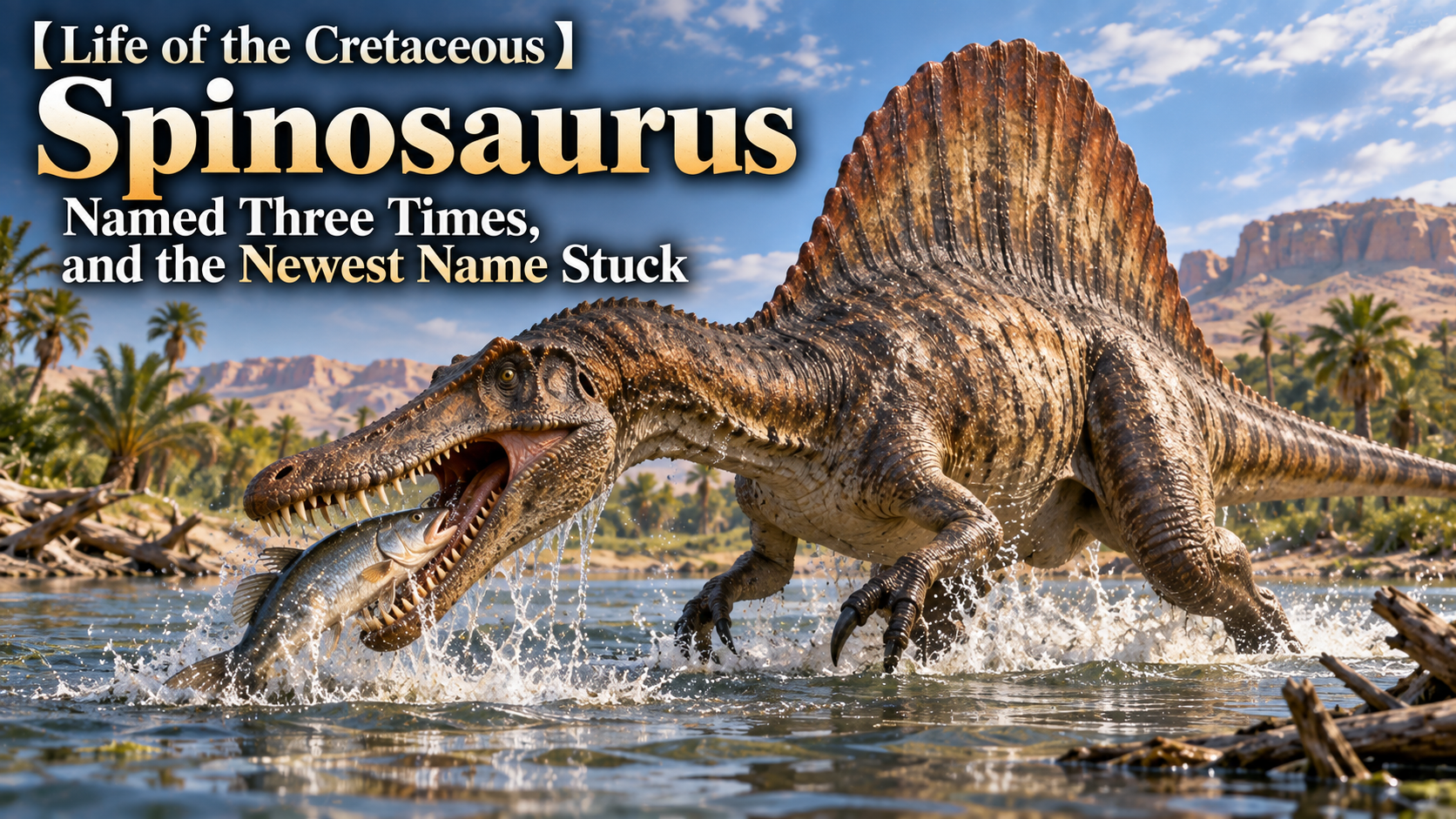
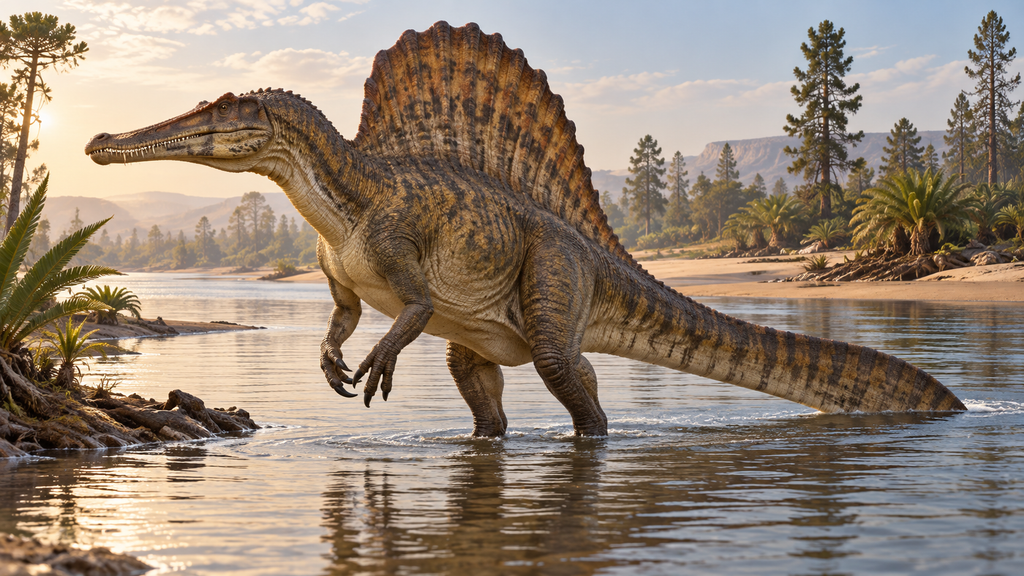
| Name | Spinosaurus (Spinosaurus aegyptiacus). The name means “spine lizard from Egypt” |
| Group | Theropod, family Spinosauridae |
| Age | Early Late Cretaceous (Cenomanian, about 99 to 94 million years ago) |
| Found in | Egypt (Bahariya), Morocco (Kem Kem Group), Niger |
| Length | About 14 m (estimates range from roughly 14 to 16 m depending on the study) |
| Weight | About 7.4 t (estimates range from roughly 6 to 9 t depending on the study) |
| Sail height | The spines rising from the backbone exceed 1.65 m |
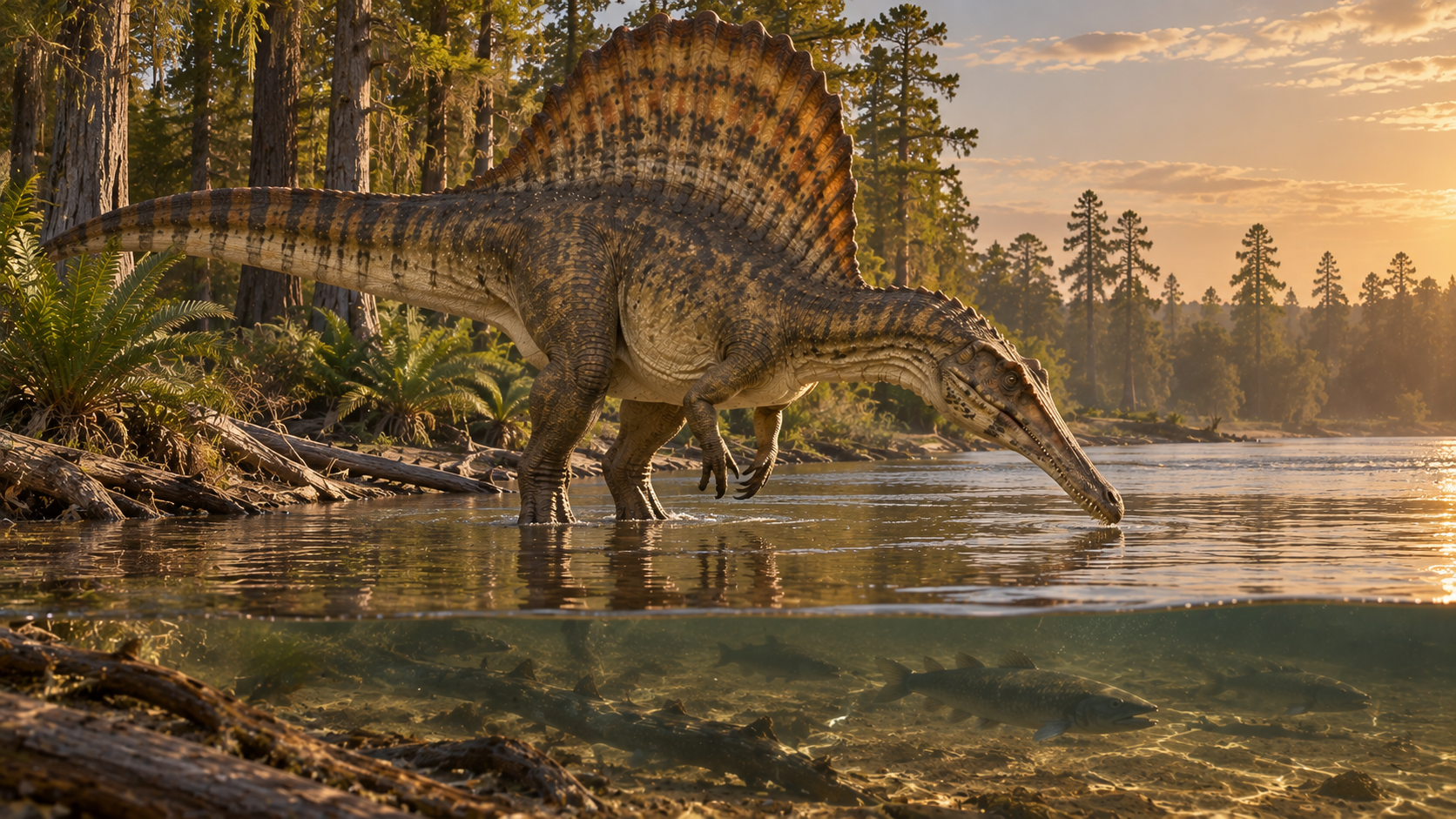
Spinosaurus was a large carnivorous dinosaur that lived along the waterways of North Africa at the start of the Late Cretaceous. It carried a sail more than 1.6 m tall on its back and caught fish with a long, narrow, crocodile-like snout. At an estimated length of around 14 m, it is known as a theropod longer than Tyrannosaurus.
Since it was described in 1915, only one set of bones has ever shown the animal’s body as a coherent whole, and those bones were lost in 1944. Every reconstruction since then has been assembled from the surviving drawings and from partial bones found elsewhere. This is why the way Spinosaurus is depicted has changed so drastically from one study to the next.
Appearance and Way of Life
The skull was more than 1.5 m long, with a slightly flared tip to the snout. The teeth were conical, without serrated edges, and the upper and lower rows interlocked when the jaws closed. This is an arrangement for gripping fish so they cannot slip away, and it is also seen in fish-eating ichthyosaurs and crocodilians. The nostrils were set well back toward the eyes rather than at the tip of the snout. The upper jaw bones carry rows of small openings for nerves, which has been taken as a sign of sense organs that could detect slight movements at the water’s surface.
Its most striking feature is the sail on its back. Spines rising straight up from the vertebrae of the trunk were joined by a membrane of skin, forming a large plate-like structure. The sail’s function has not been settled; proposals include temperature regulation, display to others of its kind, and a hump for storing fat. Among living lizards and chameleons, species with a similar sail supported by the backbone use it for display rather than for propulsion in water.
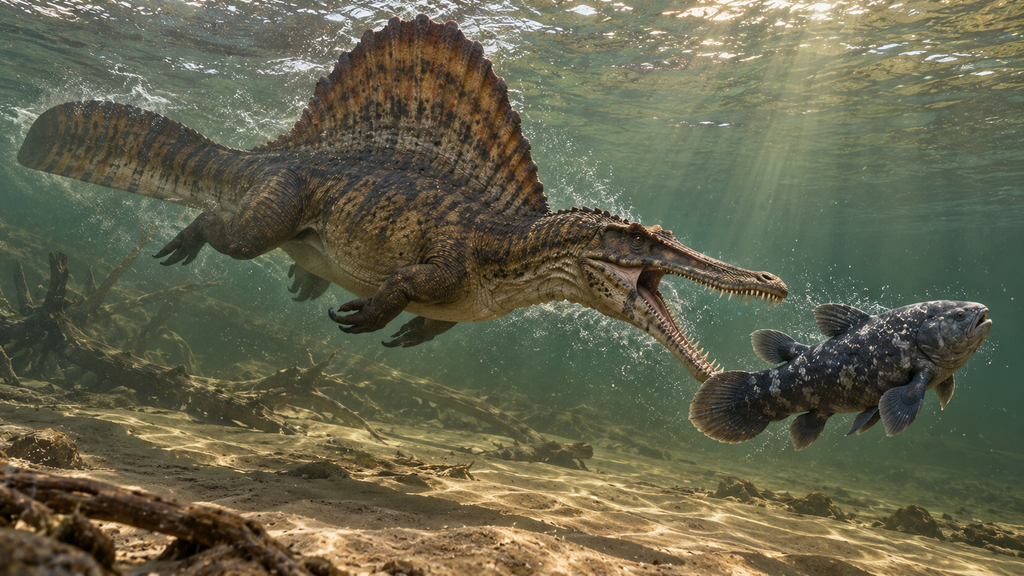
Its home was the system of great rivers and estuaries that then spread across northern Africa. The same rock layers have yielded relatives of the coelacanth as big as a car, giant sawfish, crocodilians, pterosaurs, and the carnivorous dinosaur Carcharodontosaurus. Fish were extremely abundant, and several kinds of large predatory dinosaur lived side by side; Spinosaurus is thought to have avoided competing with them by feeding mainly on fish.
Burned Bones and Seventy Years of Drawings
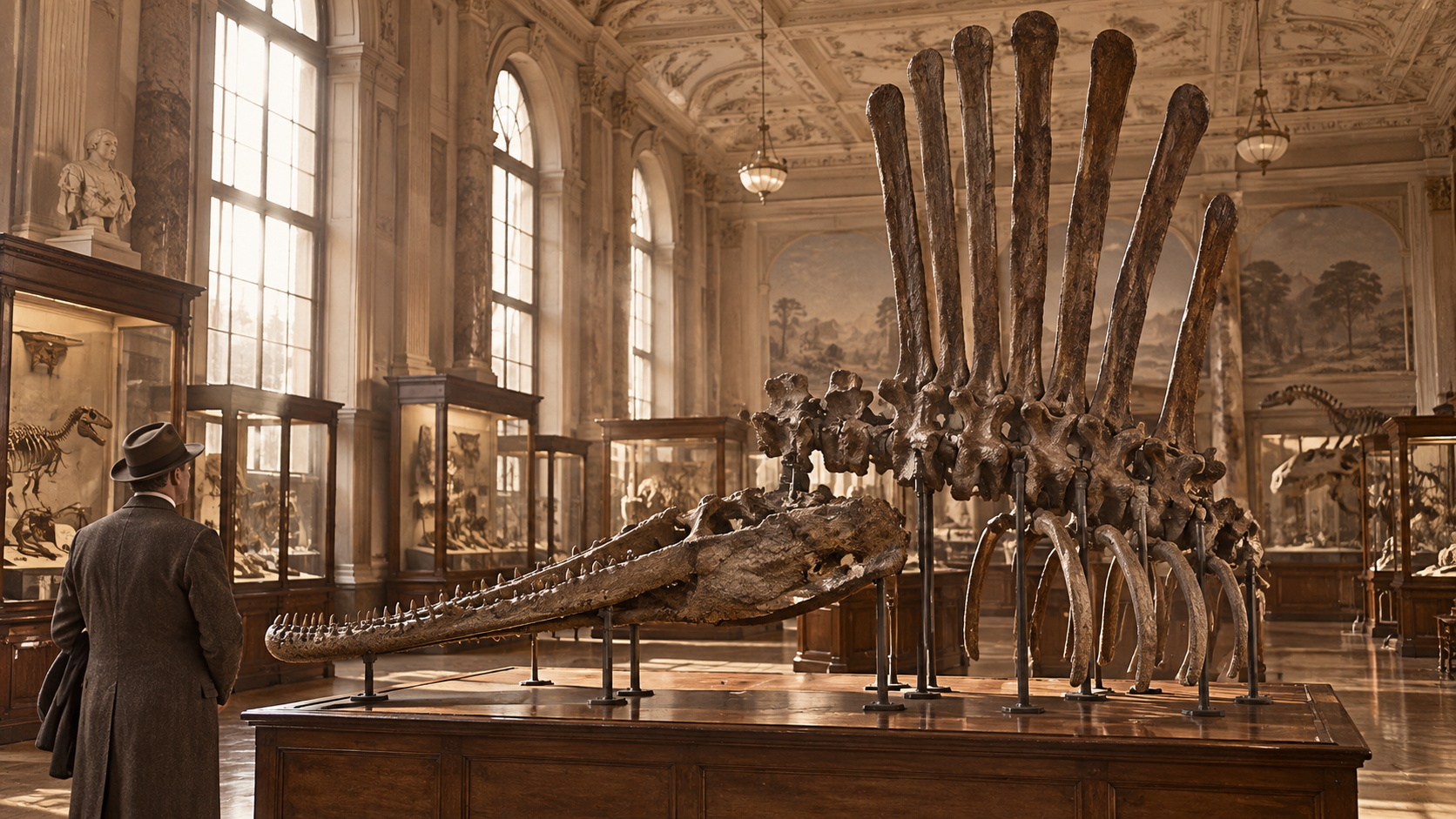
The first Spinosaurus fossils were dug up in 1912 at Bahariya in Egypt’s Western Desert by the fossil collector Richard Markgraf, and described in 1915 by the German paleontologist Ernst Stromer. The find consisted of a lower jaw, several vertebrae with their spines, some ribs, and other fragments, far short of a whole skeleton. Even so, from these pieces Stromer reconstructed a two-legged dinosaur with a long, narrow snout and a sail on its back. The specimen was housed in the Bavarian State Collection for Paleontology in Munich.
On the night of 24 to 25 April 1944, during the Second World War, a Royal Air Force bombing raid set the museum building on fire, and the Spinosaurus specimen was destroyed in its entirety. Stromer had asked the museum’s director to move the specimens to safety even before the war began, but his request was refused. All that remained were the figures and photographs in Stromer’s papers and his written descriptions.
For nearly seventy years after that, almost no bones that could be securely assigned to Spinosaurus came to light, and the animal continued to be drawn on the strength of the 1915 figures. The Spinosaurus that appears in encyclopedias and films up through the 2000s is essentially a large theropod body with a long snout and a sail attached. Because no bones existed to show the real proportions of the body, most of it was inferred from other dinosaurs.
The Moroccan Bones and the “Swimming Dinosaur”
In 2014, a team led by Nizar Ibrahim reported a new partial skeleton from the Kem Kem Group of southeastern Morocco. Many of the bones had been scattered through the fossil trade, and the researchers are known to have tracked down local miners in order to pin down where they had come from. This specimen was designated the neotype, the replacement reference specimen standing in for the lost original.
The body proportions these bones revealed were very different from earlier reconstructions. The hind legs were extremely short for the size of the body, and the pelvis was small. The leg bones were dense, with almost no internal cavity, a feature seen in animals that submerge. The team interpreted Spinosaurus as a semiaquatic dinosaur that walked on all fours on land and spent much of its time in the water. In 2020, the tail of the same specimen was reported. Tall spines rose from the tail vertebrae as well, giving the whole tail a deep, paddle-like shape, and the team proposed that the animal swept it from side to side like a newt to move through the water. Spinosaurus was widely introduced as the first swimming dinosaur ever found. In 2022, a study comparing bone cross-section density across many animals reported that Spinosaurus fell within the range of animals that pursue prey underwater.
This interpretation has met with strong objections. In 2022, a team led by Paul Sereno built a full-body digital model from CT scans, including the skeleton, the muscles, and the air in the lungs, and calculated how it would behave in water. The results showed an animal that was unstable at the surface, could swim at less than 1 m per second, and was too buoyant to dive. The bone and muscle structure of the tail, they found, was not suited to flexing smoothly through the water like the tail of a fish or a whale. The sail, in their assessment, only destabilized the animal’s balance in water and contributed nothing to propulsion. This study reconstructed Spinosaurus as an animal that walked the shoreline on two legs and waded into shallow water to ambush fish, a way of life close to that of a very large heron. In 2024, further criticism appeared, arguing that the method of judging aquatic habits from bone density is itself flawed.
The Moroccan bones, which were supposed to fill the gap left by the lost specimen, ended up widening the debate instead. Even with bones in hand, the animal looks completely different depending on whether they are read as the body of a swimmer or the body of a wader.
A New Species from Deep in the Sahara
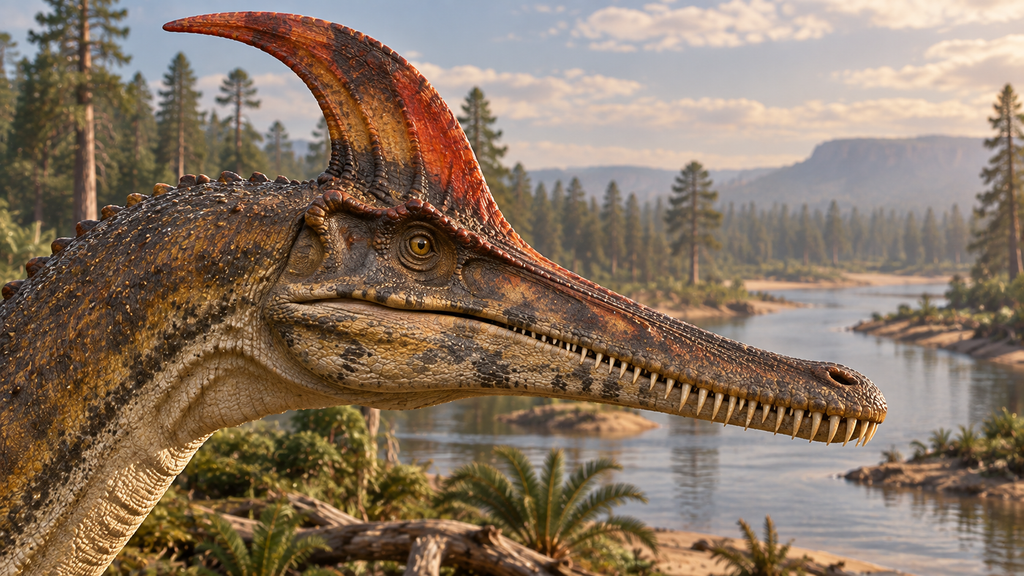
In February 2026, Sereno’s team reported a new species of Spinosaurus found in the central Sahara in Niger. Named Spinosaurus mirabilis, it is the first new species in the genus since 1915, more than a century later. On top of its head sits a bony crest that arcs high upward and backward like a scimitar. Judging from the surface texture and the traces of blood vessels inside, the crest was probably sheathed in keratin in life and may have been brightly colored.
What this discovery brought to the reconstruction debate lies in where the fossils were found. Until then, spinosaurid fossils had come almost exclusively from rock layers laid down near the coast. The site in Niger lay 500 to 1,000 km inland from the shoreline of the time, and the bones were recovered from river sediments alongside the skeletons of long-necked dinosaurs. The team pictures the animal living along rivers that ran through forest, able to wade into water about 2 m deep on its sturdy legs, but spending most of its time stalking large fish in the shallows.
Also in 2026, a study reported traces inside the skull of bird-like salt glands, organs that excrete excess salt, and work on the details of its waterside life continues. More than eighty years after the first bones burned, the appearance of Spinosaurus has still not settled into a single picture. There is hardly any other dinosaur that continues to be drawn both swimming and walking at the same time.
Sources
The new Moroccan specimen and the semiaquatic hypothesis: Ibrahim et al., Semiaquatic adaptations in a giant predatory dinosaur (Science, 2014)
The tail fossil and the “swimming dinosaur” hypothesis: Ibrahim et al., Tail-propelled aquatic locomotion in a theropod dinosaur (Nature, 2020)
Bone density and underwater foraging: Fabbri et al., Subaqueous foraging among carnivorous dinosaurs (Nature, 2022)
The rebuttal arguing it could not swim underwater: Sereno et al., Spinosaurus is not an aquatic dinosaur (eLife, 2022, open access)
Criticism of the bone-density method: Myhrvold et al., Diving dinosaurs? Caveats on the use of bone compactness and pFDA for inferring lifestyle (PLOS ONE, 2024)
The new species Spinosaurus mirabilis: Sereno et al., Scimitar-crested Spinosaurus species from the Sahara caps stepwise spinosaurid radiation (Science, 2026)
Press release on the new species: New ‘scimitar-crested’ Spinosaurus species discovered in the central Sahara (University of Chicago, February 19, 2026)
The salt gland study: Avian-like salt glands in Spinosauridae (Historical Biology, 2026)
コメント