This article contains affiliate links. As an Amazon Associate I earn from qualifying purchases.
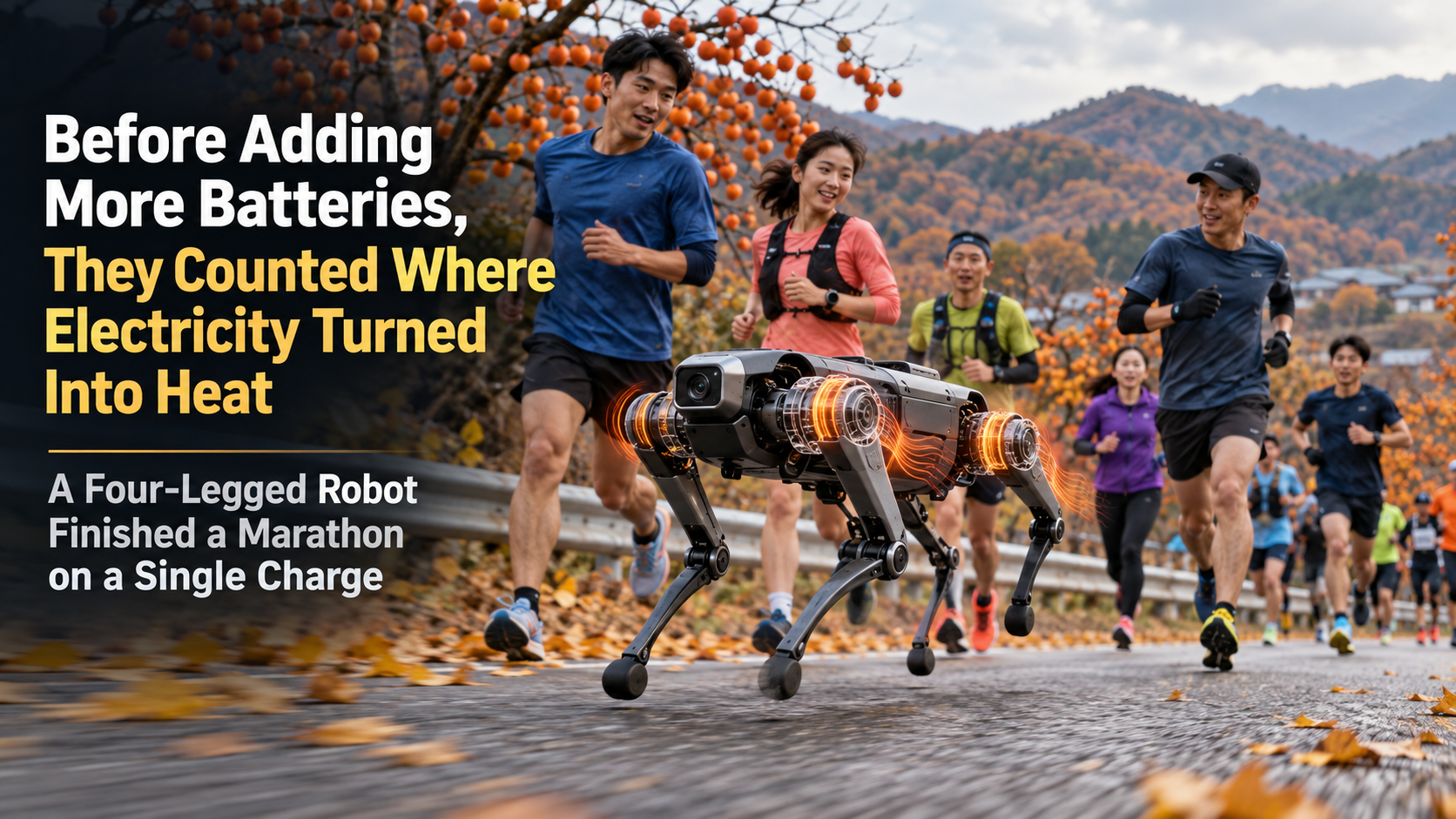
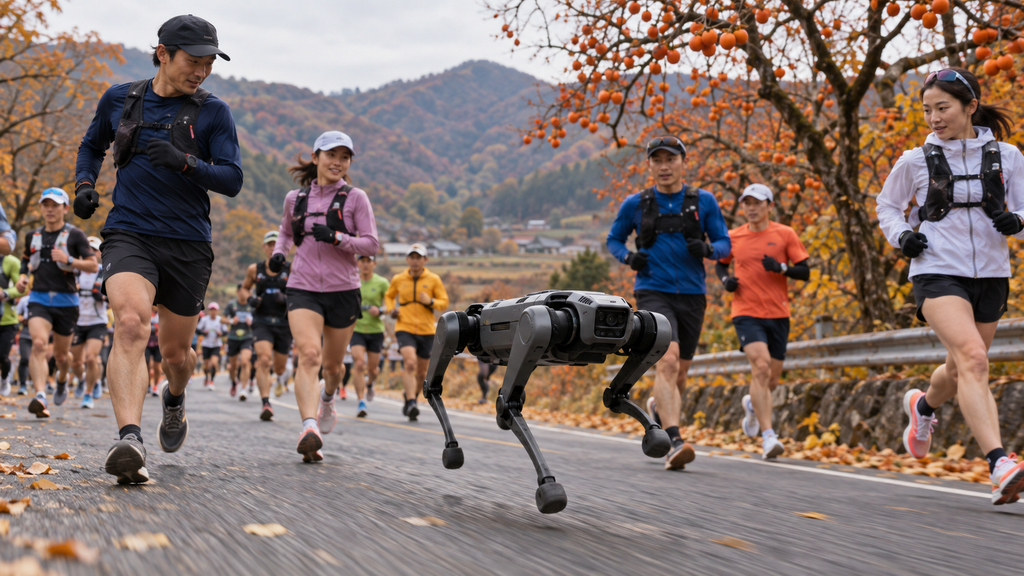
On 17 November 2024, at the Dried Persimmon Marathon in Sangju, in South Korea’s North Gyeongsang Province, a four-legged robot ran the full 42.195 km alongside human runners and crossed the finish line in 4 hours, 19 minutes and 52 seconds. Its battery was never swapped. When it finished, about a third of the charge was still left.
The robot is RAIBO2, built in the laboratory of Professor Jemin Hwangbo at the Korea Advanced Institute of Science and Technology (KAIST). According to KAIST, this was the first time a quadruped robot had completed the full course of a real marathon event. The design and the measurements behind that run were published in Nature on 23 September 2026, with Choongin Lee, Donghoon Youm and Jeongsoo Park as co-first authors.
Range as the Weak Point of Legged Robots
Four-legged robots can go where wheels cannot: up stairs, along mountain trails, over rubble. That is why they are expected to be useful at disaster sites and in mountainous terrain. They have one weakness, though. They cannot travel far on a single charge. According to the paper, existing quadruped robots have had a range of roughly 20 km.
The reason lies in how the body is built. A rolling wheel spends almost no energy holding up the vehicle’s weight. Legs are different. Even when the robot is just standing, the motors at its joints keep working to support the body. On top of that, every footfall loses energy to impact. The farther the robot runs, the more footfalls it pays for.
Two Months Earlier, a Battery That Died at 37 km
Sangju was the team’s second attempt. KAIST reported that in September of the same year, at the marathon held during the Geumsan Insam Festival, the robot’s battery ran out at the 37 km mark. It drained about 10 km earlier than expected because the robot kept speeding up and slowing down to match the runners around it. A battery that would have lasted at a steady pace was eaten up by repeated acceleration and braking.
In the two months that followed, the team moved joint stiffness control onto the motor actuators to cut control losses, and reworked the battery’s internal structure to raise its capacity by 33 percent. Before the race, they had the robot walk 43 km in 4 hours and 40 minutes around the university’s athletic field.
Where the Electricity Went
Still, the heart of the paper is not “we added battery.” What the team did was account for where every bit of the robot’s electricity was going, component by component.
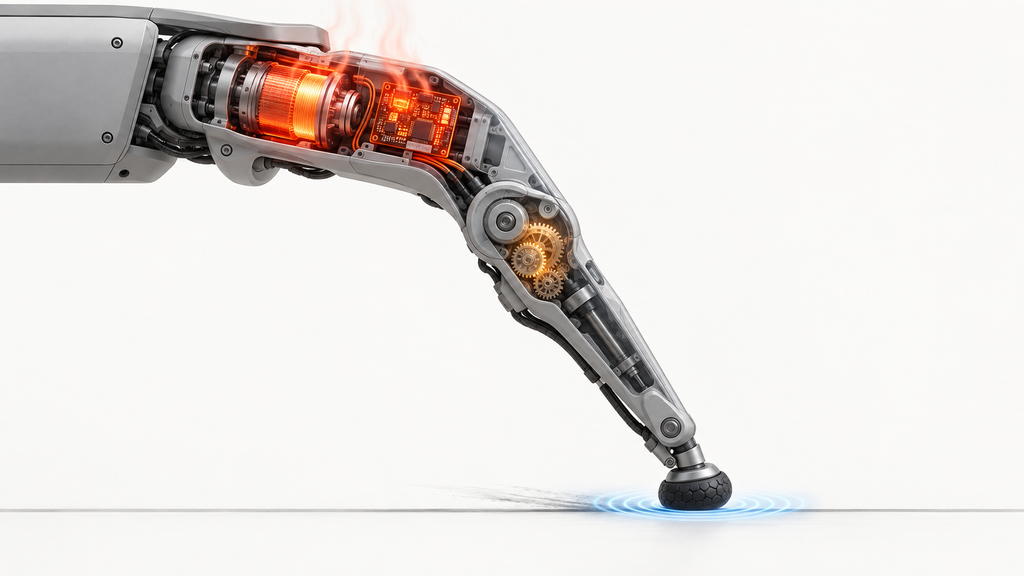
Here is what they found. About two thirds of the energy leaving the battery never became forward motion. It turned into heat inside the motors and the circuits that drive them. The remaining third was lost to gear friction, slipping feet and the jolt of each footfall. In other words, before refining how the legs move, the parts that turn electricity into heat had to be dealt with, or the range would not grow.
Cutting Heat Instead of Adding Battery
To reduce that heat, the team changed both the mechanics and the electronics.
First, they redesigned the circuit that feeds current to the motors so that it has lower electrical resistance. Motor heating grows with current, so they also chose motors that deliver the same torque with less current.
Next came the legs. They removed unneeded material from the hip and the lower leg to make each limb lighter. A lighter leg takes less energy to swing up and set down, and it hits the ground with less impact. The mass saved there went into battery capacity. The battery described in the paper holds 2,016 watt-hours.
On descents, the motors act as generators, slowing the robot and feeding energy back into the battery through regenerative braking.
Learning an Energy-Saving Gait
Hardware alone is not enough. With the same body, the energy lost depends on how it runs. In simulation, the team used reinforcement learning to teach the robot a way of walking that loses as little energy as possible.
In reinforcement learning, the robot earns reward points for desirable behavior and searches for movements that score higher. Here, the rewards went to placing the feet down softly, not letting them slip, and not letting the motors heat up. Reducing loss was given priority over running fast. The gait that emerged lands gently and wastes little joint motion.
Less Energy Than a Human Runner
The record RAIBO2 set in Sangju with that design is the central data of the paper. The course had a total elevation change of 286 m and included stretches made slippery by fallen leaves, with climbs of about 50 m at the 14 km and 28 km marks. The robot averaged 2.64 m per second and used 1,280 watt-hours. By the team’s estimate, the remaining charge would have carried it another 25 km or so.
To compare how efficiently things move, robotics researchers use a figure called the cost of transport: the energy used, divided by body weight times distance traveled. The smaller the number, the farther you get on a given amount of energy. Over the whole marathon, RAIBO2’s cost of transport was 0.25. The benchmark value used for humans is 0.37, so per unit of weight and distance, RAIBO2 ran on less energy than a human runner. The paper states this is the first quadruped robot to come in below the human figure. Its range per charge is also more than three times that of previous quadrupeds.
Still Borrowing Human Eyes
What it cannot do deserves a mention too. RAIBO2 did not read the course on its own. It carried a camera on its head, but it had no software to interpret the road and choose a path, so its direction was steered remotely by people. The lab reported that a three-person operating team accompanied it. In Scientific American, another researcher described this as running essentially blind. The stamina to finish is there. The ability to pick its own way is still to come.
The team’s next goals are to add autonomous navigation and to improve walking on rough ground such as mountains and disaster sites. First author Lee has said that finishing the marathon showed RAIBO2 has the walking performance to handle urban services such as delivery and patrol reliably.
Before adding battery, count where the electricity turns into heat. It is unglamorous work, but that is what tripled the range.
Related products
You can find books and products related to this article on Amazon.
If you buy through the links above, this blog may earn a commission.
Sources
- Lee, C., Youm, D., Park, J. et al. A quadruped robot designed to complete a marathon on a single battery charge. Nature (2026). https://doi.org/10.1038/s41586-026-11102-5
- Nature Asia press release, “Robotics: Robot runs a marathon” (24 September 2026). https://www.natureasia.com/en/info/press-releases/detail/9447
- KAIST News, “KAIST’s RAIBO2 becomes the World’s First Robo-dog to Successfully Complete a Full-course Marathon” (November 2024). https://news.kaist.ac.kr/newsen/html/news/?mode=V&mng_no=41590
- Scientific American, “Watch a robot dog run a marathon faster than the average human” (23 September 2026). https://www.scientificamerican.com/article/watch-a-robot-dog-run-a-marathon-faster-than-the-average-human/

コメント