This article contains affiliate links. As an Amazon Associate I earn from qualifying purchases.
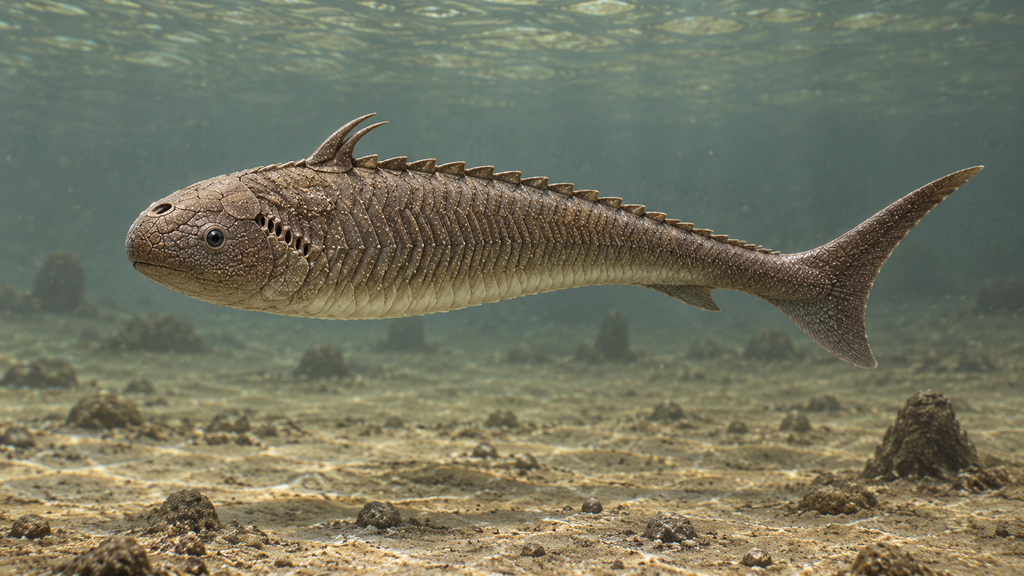
| Name | Birkenia (Birkenia elegans). The genus is named after Birkenhead Burn, a stream in southern Scotland where the fossils were found. The species name is Latin for “elegant” |
| Group | Jawless fish (agnathan), anaspid. Type genus of the family Birkeniidae |
| Age | Middle Silurian (Wenlock, about 430 million years ago). Related species continue into the late Silurian and the earliest Devonian |
| Found in | Southern Scotland (the Lesmahagow, Hagshaw Hills and Pentland Hills inliers). Scales assigned to the same genus are known from Norway, Estonia and Arctic Canada |
| Length | 2 to 10 cm. Individuals longer than 10 cm are very rare |
| Weight | A few grams (a rough figure based on living fish of the same size) |
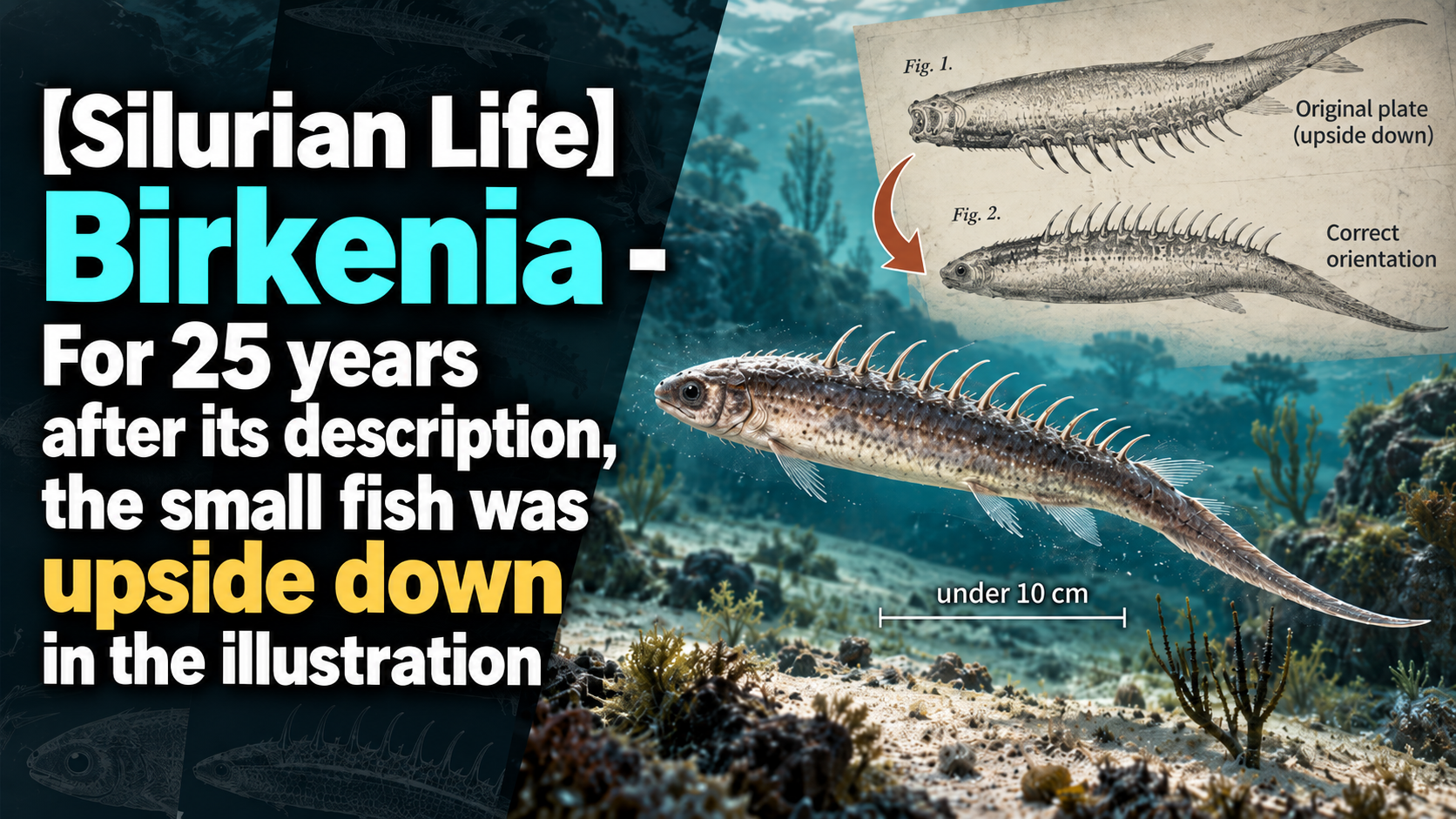
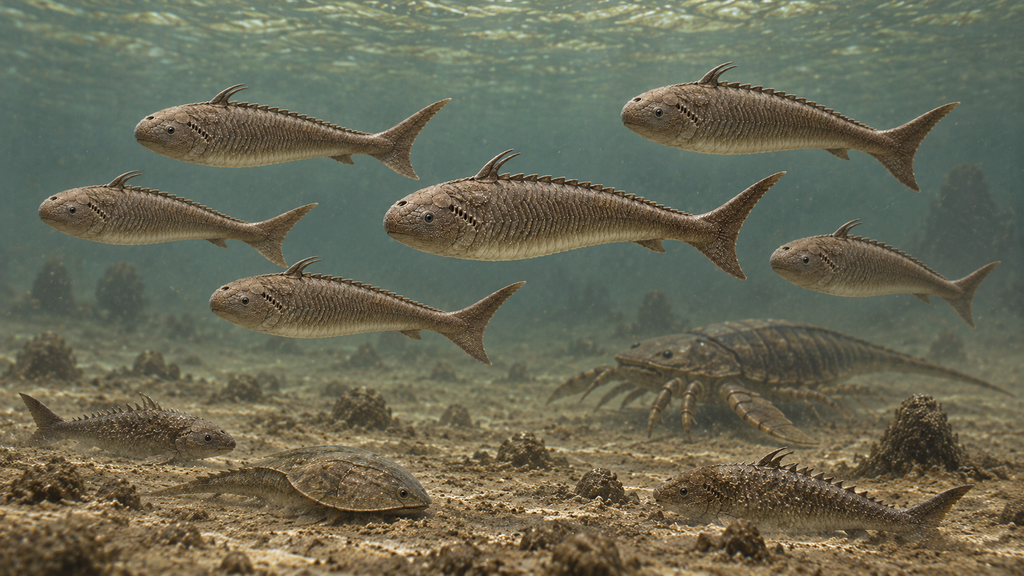
Birkenia is a small jawless fish that lived in the waters of Silurian Scotland. Its slender body was covered in small scales, a row of two-pronged hooked spines ran along its back, and the lower lobe of its tail fin was longer than the upper. For a quarter of a century after it was described in 1898, this fish was drawn upside down.
Appearance and way of life
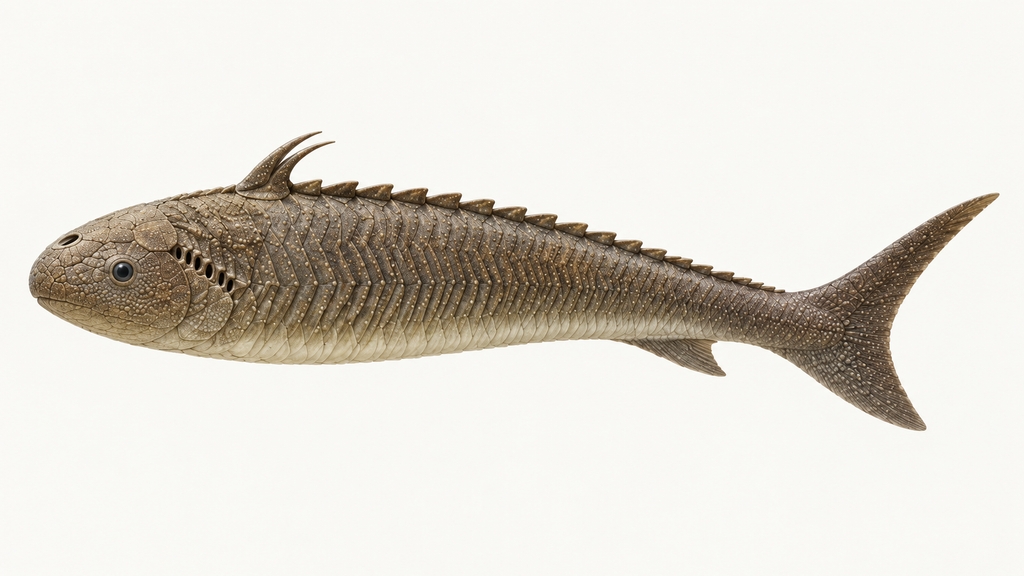
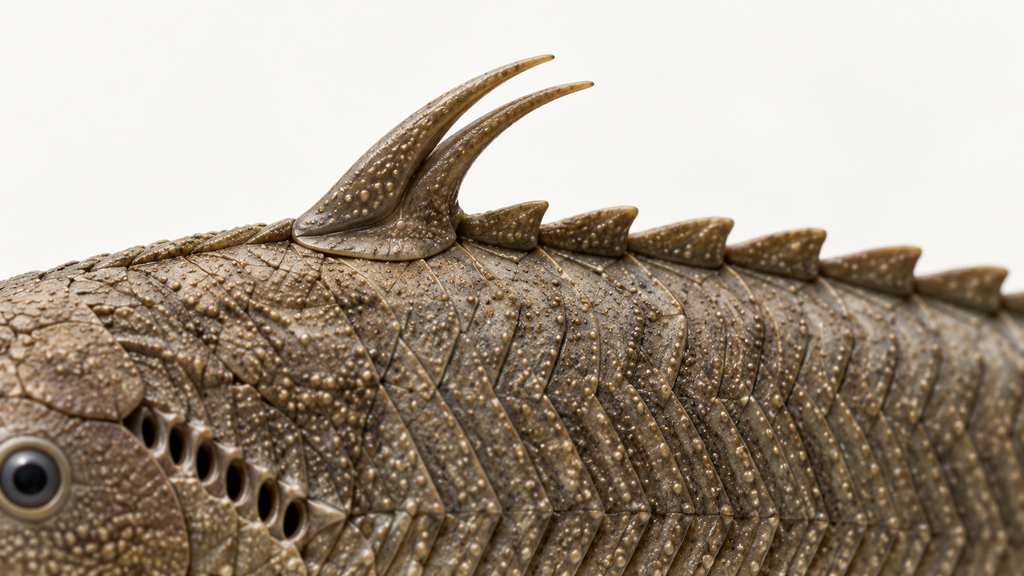
Birkenia was a slim fish, and most individuals were under 10 centimeters long. The head was covered in small bony plates and scales. On top of the head sat a large Y-shaped plate containing the pineal opening, with a single nostril in front of it. The eyes were on the sides of the head, and behind each eye ran a short oblique row of gill openings. The trunk was covered in narrow, vertically elongated rod-shaped scales whose surface was finely studded with tiny bumps. In the rear half of the body the scales slope downward and backward, the opposite direction to that seen in other scaled anaspids.
Along the midline of the back ran a row of plates. The fifth plate from the front, together with the one next to it, was drawn out into a two-pronged hook curving backward, and these hooks are the easiest way to recognize Birkenia. The tail fin was hypocercal: the body axis continued into the lower lobe, which was larger than the upper lobe. This is the reverse of a shark’s tail, where the upper lobe is the larger one. The fin membrane extended beyond the scale-covered part, and there may also have been membranous fins along the sides of the body.
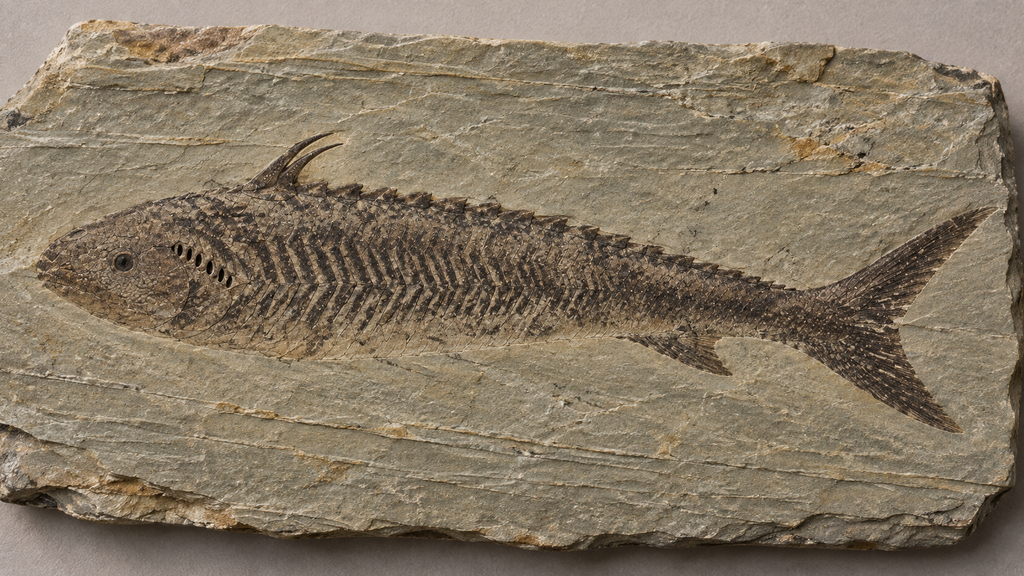
The fossils come from Silurian outcrops scattered through the Lesmahagow and Hagshaw Hills inliers of southern Scotland. The rock is a finely laminated muddy siltstone that settled in still, stagnant water. The lower part of the local succession is marine, and it passes upward into river and delta deposits. Birkenia comes from the upper “fish beds”, and it is thought to have lived in low-salinity water during the shift from sea to fresh water. The same beds yield the spine-covered thelodont Lanarkia, the scaleless anaspid Lasanius, the early osteostracan Ateleaspis, and the eurypterid Lanarkopterus.
The shape of the mouth is not known. As far as the fossils show, there was a vertical opening at the rounded front end of the head. One view is that the mouth was a sucker like that of a lamprey; another is that it strained small food particles from the water in the manner of a lancelet. The question is unresolved. Because a hypocercal tail tends to lift the head while swimming, the prevailing interpretation today is that Birkenia was not a bottom feeder sucking up mud but an active swimmer that ranged anywhere between the surface and the bottom.
Twenty-five years upside down
The fossils of Birkenia were collected in the 1890s by field staff of the Geological Survey of Scotland from streams around Lesmahagow. They were described by Ramsay Traquair, the keeper of fossil fishes at the museum in Edinburgh. He named the fish in 1898 and described it in detail, with plates, in a report published in 1899.
Traquair took the tail of Birkenia to be heterocercal, the shark type with the larger upper lobe. The fossils are flattened on their sides, so which side is the back and which the belly has to be worked out from features such as the shape of the tail. Having read the tail the wrong way round, Traquair drew Birkenia with back and belly swapped, so that the hooked spines ran along the underside. His plates do not identify the eye sockets or settle where the mouth opened. He kept the same orientation in a supplementary report of 1905, and the other anaspids from the same Scottish beds were all figured the same way.
The orientation was corrected in 1924. The Norwegian palaeontologist Johan Kiær studied well-preserved late Silurian anaspids from Ringerike, near Oslo, and identified the surface of the head that carried the pineal opening and the nostril. Those openings lie only on the dorsal side, so they fix which way up the animal goes. The result was that anaspids have a hypocercal tail with the larger lower lobe, and that the hooked spines sit on the back. In 1928 the American palaeontologist Henry Stetson redescribed Birkenia from newly collected specimens and turned the reconstruction the right way up to match Kiær’s Norwegian material. The familiar picture in today’s reference books, with spines along the back and the tail trailing downward, dates from these corrections of the 1920s.
Birkenia’s place in the family tree has moved once more since then. Anaspids were long regarded as close to the ancestry of living lampreys. In 2016 Joseph Keating and Philip Donoghue of the University of Bristol examined the microscopic structure of the scales and plates of anaspids including Birkenia, and showed that a layer of dentine and enameloid overlies a basal layer of bone without cells. Their phylogenetic analysis placed anaspids not on the lamprey line but at the base of the lineage leading to jawed vertebrates.
Related products
You can find books and products related to this article on Amazon.
If you buy through the links above, this blog may earn a commission.
Sources
- Traquair, R. H. (1899). Report on Fossil Fishes collected by the Geological Survey of Scotland in the Silurian Rocks of the South of Scotland. Transactions of the Royal Society of Edinburgh 39, 827–864. https://doi.org/10.1017/S0080456800035237
- Traquair, R. H. (1905). Supplementary Report on Fossil Fishes collected by the Geological Survey of Scotland in the Silurian Rocks of the South of Scotland. Transactions of the Royal Society of Edinburgh 40, 879–888. https://doi.org/10.1017/S0080456800034827
- Blom, H., Märss, T. & Miller, C. G. (2002). Silurian and earliest Devonian birkeniid anaspids from the Northern Hemisphere. Transactions of the Royal Society of Edinburgh: Earth Sciences 92, 263–323. https://doi.org/10.1017/S0263593300000250
- Keating, J. N. & Donoghue, P. C. J. (2016). Histology and affinity of anaspids, and the early evolution of the vertebrate dermal skeleton. Proceedings of the Royal Society B 283, 20152917. https://doi.org/10.1098/rspb.2015.2917
- JNCC, Geological Conservation Review Volume 16: Fossil Fishes of Great Britain, Chapter 2, “Slot Burn” (the Scottish Silurian fish beds and the history of research on Birkenia) https://jncc.gov.uk/jncc-assets/GCR/gcr-site-account-392.pdf

コメント