This article contains affiliate links. As an Amazon Associate I earn from qualifying purchases.
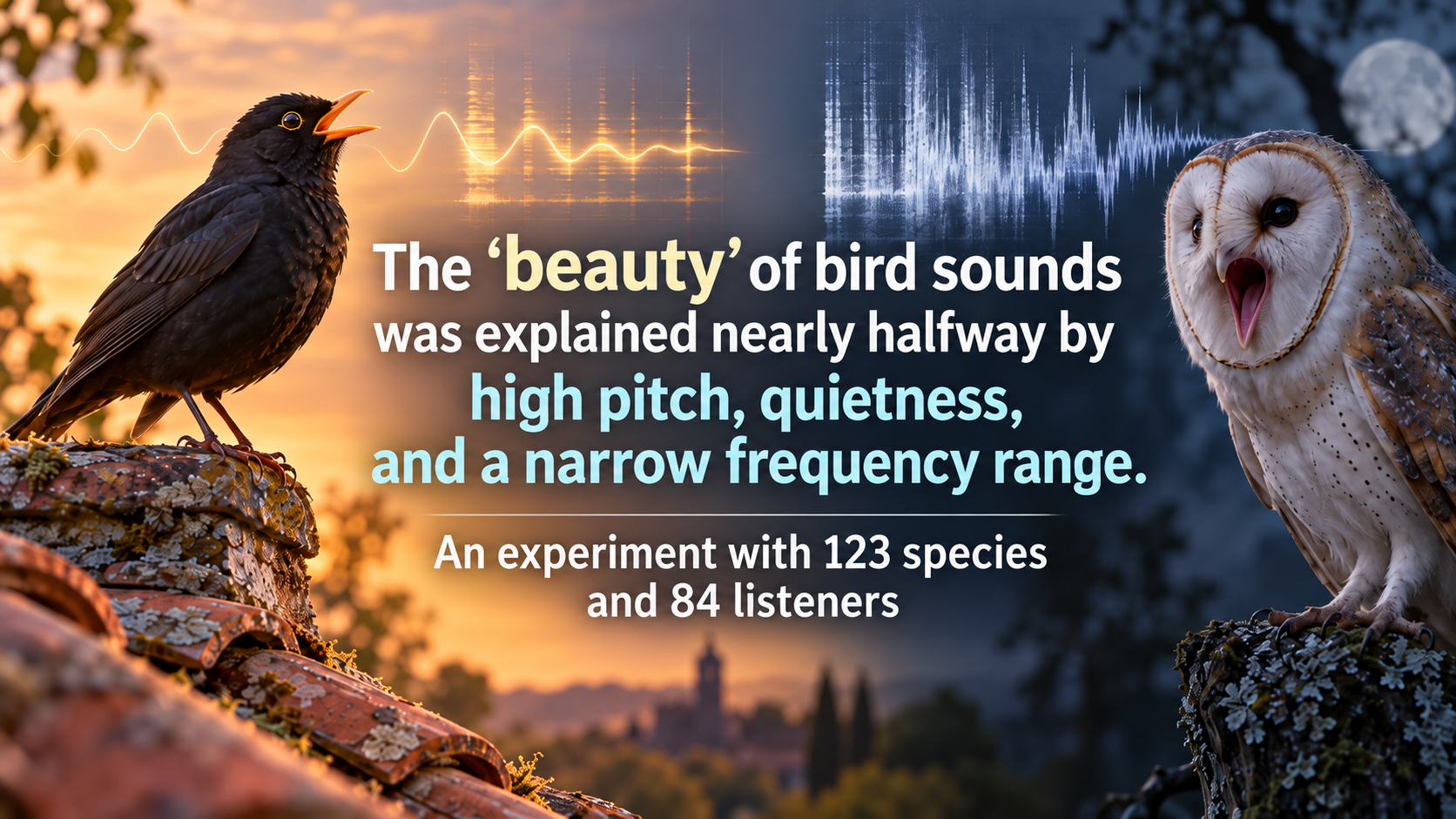
On an early spring evening, a blackbird singing from a rooftop will stop people who have never cared about birds. The rasping shriek of a barn owl from a dark barn, on the other hand, is rarely called beautiful. Both are bird sounds, so why do they land so differently? Is it because we know the bird, or because we like birds in general? Or does the sound itself carry the conditions for sounding pleasant?
A team at the University of Tübingen in Germany turned that simple question into an experiment. They played the vocalizations of 123 European bird species to 84 people, asked them to rate pleasantness on a five-point scale, and then matched the scores against the physical properties of each sound. The paper appeared in Frontiers in Bird Science on 2 September 2026. The first author is Nadine Kalb and the last author is Christoph Randler.

Rating 123 species with the names hidden
The experiment took place in a quiet seminar room at the university. Participants came in groups of four to six, sat apart from one another, and answered on tablets while wearing headphones. The sounds were 15-second clips of 123 wild bird species that are widespread in Germany, taken from a commercial DVD of European bird voices. Wingbeats and woodpecker drumming were excluded, leaving only the calls and songs of adult birds.
The key point is that no species names were shown. The clips played in random order, and participants rated each one from 1 (“not very pleasant”) to 5 (“very pleasant”) without knowing what they were hearing. They could replay a clip as often as they liked, with no time limit. The 84 participants ranged from 19 to 81 years old, with an average age of about 34, and roughly seven in ten were women.
Participants also filled in a questionnaire. One part measured bird knowledge: how many species they could identify by sight or by sound, and how they rated their own skill. Another part measured how much they liked birds. Keeping these two apart turned out to matter later.
Each recording was measured in acoustic analysis software. The team recorded the pitch (the lower and upper bounds and the peak of the sound’s energy), the bandwidth, the amplitude, and the number of element types. An element is a single unbroken trace on a spectrogram, the chart that plots a sound by time and frequency, and traces that looked alike were counted as the same type. More types means a more varied, complex song.
Blackbird first, barn owl last
Across the 123 species, the average score was 3.13 out of 5. The common blackbird came out on top with 4.52. The barn owl came last with 1.32. According to Smithsonian Magazine’s report, accomplished singers such as the willow warbler, blackcap, and mistle thrush filled the upper ranks, while the Egyptian goose, grey heron, and peregrine falcon sat near the bottom. Familiar garden birds like the great tit, blue tit, and greenfinch also scored well.
So far, anyone who likes birds would say this is about what they expected. The substance of the study starts here.
High, quiet, and narrow sounds win
The team grouped the acoustic measurements into three bundles: pitch, bandwidth (together with the upper frequency bound), and amplitude. When they tested how well these three explained the species averages, the answer was about 47 percent of the variation between species. Nearly half of the difference came down to physical properties of the sound.
The direction was clear. Higher-pitched sounds scored better, wider bandwidth scored worse, and louder sounds scored worse. In other words, people preferred voices that are high, quiet, and confined to a narrow range of pitches. The blackbird’s song fits that description well, the team notes.
Hearing research had already shown that low frequencies tend to be judged unpleasant and that loud sounds are often linked with unease or aggression. The team also cites earlier work finding that sounds in the 2.4 to 5.5 kilohertz band, where human hearing is most sensitive, seem louder and more intense than they are and tend to be rated unpleasant. Many of the best-rated voices, they write, fell outside that band.

The expectation that simple repetition sounds nicer was wrong
The other axis was complexity. The team had assumed that simple, repetitive sounds would be easier to follow and therefore more pleasant. The result went the other way. Songs with more element types, that is, more varied songs, scored higher. Meanwhile, the total number of elements in the 15-second clip had no relationship with the score. What counted was not how much a bird sang but how many different sounds it used.
The complexity effect held up when analyzed together with pitch, bandwidth, and amplitude. Its share of the explanation was small, though, accounting for under a tenth of the variation on its own. Pitch and quietness remain the lead actors, with complexity as a bonus on top.
Knowing birds made no difference
What about differences among listeners? Bird knowledge, measured as how many species a person could identify, had no relationship with pleasantness scores. Expert birders and complete novices rated the same voices the same way. Age and gender made no difference either.
What did matter was how much people liked birds. Those who said they liked birds tended to give higher scores across the board. Knowledge did not change the ratings; fondness lifted them. Kalb told Smithsonian Magazine that you do not have to be a “bird person” to find bird sounds beautiful.
The team ran one more comparison. A 2016 study in the United Kingdom had asked people how restorative they found various bird sounds. For the 21 species the two studies shared, species rated more pleasant in the new experiment also tended to score higher for restoration, a moderate correlation. Two studies with different countries and different participants pointed the same way.
What the study can and cannot say
The limitations are spelled out. The participants were 84 people in Germany, and the birds were German species, so there is no guarantee the ranking would hold in another culture. The recordings came from a commercial DVD with no standardized recording conditions, which makes the amplitude results in particular something to read with care. Complexity was measured simply by counting element types, and calling rate was not examined.
Even so, the fact stands that with species names hidden, sound properties alone explained nearly half of the scores. The team suggests that when assessing the soundscape of urban green space, it may be worth looking at the character of the voices present, not just how many species and individuals there are. They also write that when conservation programs choose a flagship species, the appeal of its voice might be considered alongside its visual charisma.
That last point has a counterview. Olga Feher of the University of Warwick, interviewed by Smithsonian Magazine, raised the concern that favoring pleasant-sounding birds could push species with less appealing voices down the conservation list. The barn owl’s shriek may score last, but it is an essential voice in the night-time ecology of farmland.
The team itself writes that whether hearing pleasant bird sounds actually improves mood or health is a separate question that still needs testing. Measuring the beauty of birdsong in numbers has only just reached the doorway.
Related products
You can find books and products related to this article on Amazon.
If you buy through the links above, this blog may earn a commission.
Sources
- Kalb, N., von Lücken, G., Lukanowski, J., Dechant, F. & Randler, C. (2026). Analyzing the acoustic parameters of bird vocalizations and their perceived pleasantness by humans. Frontiers in Bird Science, 5. https://doi.org/10.3389/fbirs.2026.1794594
- Smithsonian Magazine (24 September 2026, Sara Hashemi): Some Birdsongs Are More Pleasing to Human Ears Than Others


コメント