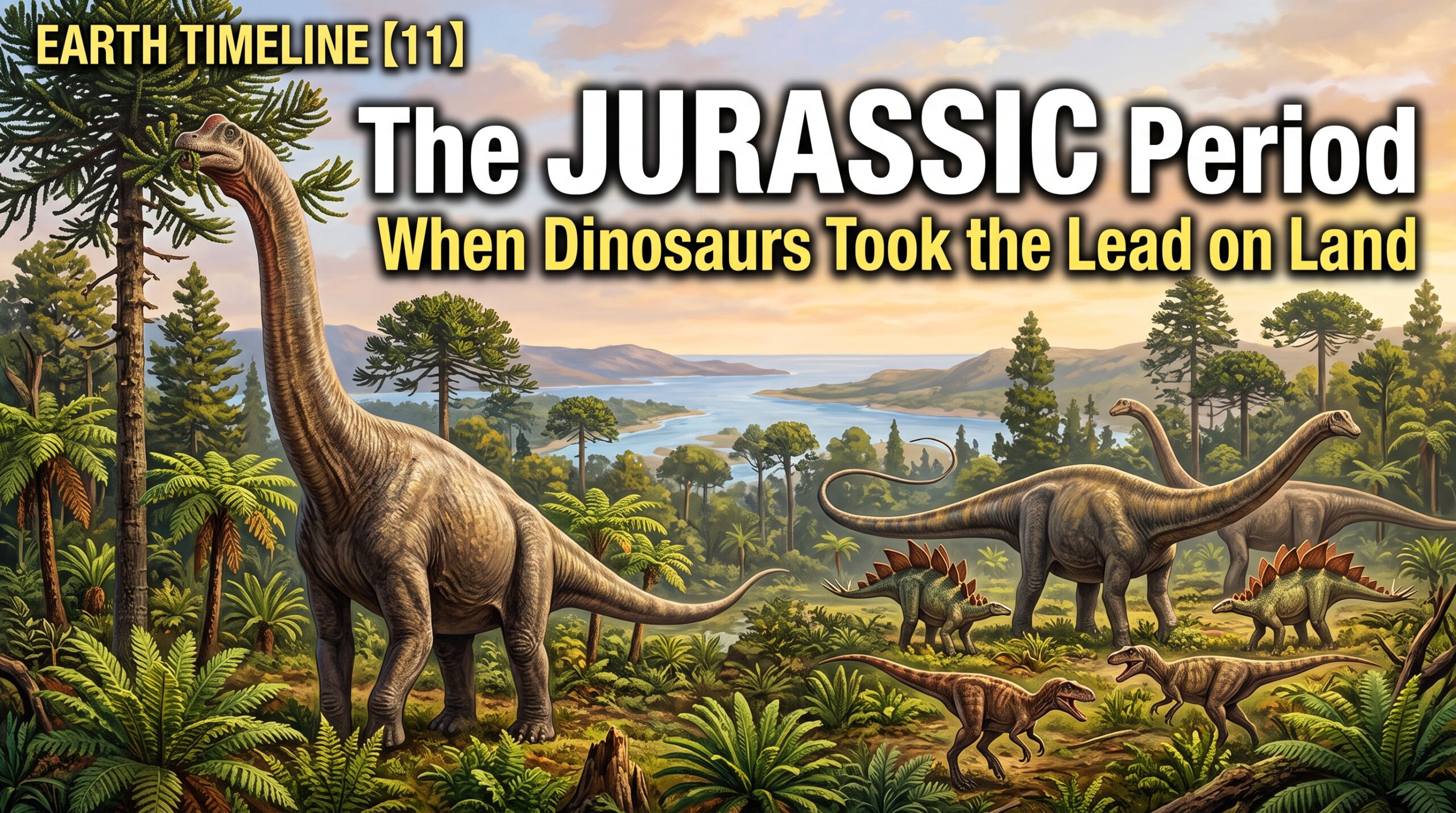
The Jurassic ran from about 201.4 million to about 143 million years ago, lasting some 58 million years. It is the middle of the three periods making up the Mesozoic Era, with the Triassic before it and the Cretaceous after.
The single mass of the supercontinent Pangaea began breaking apart in earnest during this period. A narrow sea, the beginning of today’s Atlantic, started pushing in between the continents.
And on Jurassic land, animal body size entered a stage entirely unlike anything before it. Herbivores weighing tens of tons — as much as several African elephants combined — were simply walking around.
A supercontinent begins to split
The breakup of Pangaea began between the Americas and Africa. The continent was stretched, the crust thinned, a long narrow valley formed, and seawater flowed in. That is the beginning of the central Atlantic. Around the same time, the Tethys Sea, cutting in between the continents from the east, spread westward, and a passage opened between North and South America, connecting oceans that had been separated.
This change in arrangement moved the climate substantially. In the supercontinent era, interior deserts too far from the sea for rain to reach had occupied the middle of the landmass. As the continents divided and coastline increased, that condition eased. There were no polar ice sheets, and the temperature difference between north and south was far smaller than today. Overall, it was a warm and humid period.
Not that all 58 million years were placid. Near the end of the Early Jurassic, about 183 million years ago, came the Toarcian Oceanic Anoxic Event. Enormous volumes of lava erupted in the Karoo–Ferrar region of the Southern Hemisphere, carbon dioxide was added to the atmosphere, and temperatures at mid-latitudes are estimated to have risen by as much as 7°C. Oxygen-poor water spread through the oceans and black mud accumulated; on land, the plant cast was replaced. Diverse forests mixing conifers, ferns and seed ferns gave way to forests of drought-tolerant conifers and cycads alone.
There is no sign, however, that this warming checked the dinosaurs. It was a painful event for marine life, but on land, body size actually accelerated afterward.

Forests without flowers
When picturing a Jurassic forest, two things need removing first: flowers and grass.
Flowering plants — angiosperms — had not yet spread in this period. Fossils that look like angiosperms have been reported several times from Jurassic strata, but the interpretations remain unsettled, and the reliable record begins only in the Cretaceous. The same goes for grasses: a landscape of grassland covering the ground did not exist.
What made up the forests instead were conifers, beginning with the araucarias, along with ginkgoes, cycads, tree-sized ferns and horsetails at the water’s edge. Tough, fibrous leaves, all of them. This was the menu for the sauropods — the long-necked giant herbivorous dinosaurs.
What they ate and how has become readable from fine scratches left on their teeth. In July 2025, a German team led by Daniela Winkler published a study in Nature Ecology & Evolution comparing 3D scans of 322 tooth surfaces from 39 individuals collected at three famous Late Jurassic localities — the Morrison Formation in the United States, the Lourinhã Formation in Portugal and the Tendaguru Formation in Tanzania, all about 150 million years old.
The results split cleanly by lineage. Camarasaurid teeth show almost the same wear pattern even between localities with different climates. Both the United States and Portugal had strong seasonal contrasts at the time, making it unlikely the same plants were available year-round, so the team suggests these animals moved with the seasons, following the same food. Diplodocid teeth, by contrast, show scattered wear, suggesting they did not move much and ate whatever was available in that season. The Tendaguru specimens differed again, with markedly heavy wear — the team’s interpretation being that a desert region nearby sent wind-blown quartz sand onto the leaves.

A neck fifteen meters long
By the Middle Jurassic, sauropods had become the leading herbivores on land. The group had already appeared in the Late Triassic, but after rival lineages disappeared it grew large rapidly.
The name that comes up for neck length is Mamenchisaurus sinocanadorum. Found in 1987 in strata about 162 million years old in Xinjiang, China, it was named in 1993. In 2023, Andrew Moore of Stony Brook University and colleagues re-examined it against a complete skeleton of a close relative and estimated the neck at about 15.1 meters — more than six times that of the giraffe, the longest-necked animal alive today.
That specimen, however, preserved only three neck vertebrae, one rib and part of the skull. The longest specimen with a complete set of neck vertebrae is Xinjiangtitan, about 1.5 meters shorter. Since the estimate is built up from fragments, the research team themselves note that the ranking could change at any time.
The weights are in another register too. Giraffatitan, the tall skeleton standing in Berlin’s Natural History Museum — the one from the Tendaguru Formation in Tanzania — is estimated at about 35.8 tons when calculated from limb bone thickness and about 23.2 tons when calculated from volume. That the two methods differ by a factor of 1.5 says something about how awkward this animal is to handle.
On the same land walked large carnivores of the Allosaurus group, and pterosaurs flew overhead. And near the end of the Late Jurassic, in fine lime mud accumulating in a lagoon in southern Germany, Archaeopteryx was sealed in.

A weight mammals never reached
How abnormal a weight of tens of tons really is becomes clear when set against later periods.
The largest land animal today is the African elephant, at around six tons for a large male and a little over ten tons for the biggest individuals on record. Including fossils, the maximum for a land mammal is Paraceratherium, the giant hornless rhino of Oligocene Asia, estimated at 15 to 20 tons. Some extinct elephant relatives are said to have exceeded 16 tons, but either way the ceiling sits around 20 tons.
After the dinosaurs went, mammals had 66 million years. Even with all that time, they came nowhere near the sauropod level.
So was the Jurassic environment exceptionally favorable? That line does not work well. Values such as oxygen concentration, carbon dioxide concentration and temperature at the time are known not to correspond neatly to shifts in dinosaur body size. A statistical analysis tracking terrestrial vertebrate body size from the late Paleozoic through the Jurassic likewise concluded that the pattern can be explained by biological factors alone, without invoking environmental ones.
The answer, in other words, lies not in the environment but in how the animals’ bodies were built.
The answer was: they did not chew
P. Martin Sander of the University of Bonn and colleagues set out a framework in Biological Reviews in 2011 and updated it in PLOS ONE in 2013. It explains sauropod gigantism not as one decisive factor but as a chain in which each condition permits the next.
At the very root of that chain sits a point so plain it is almost deflating: they did not chew.
Sauropod teeth are shaped like pegs or rakes for stripping leaves, not for grinding. Whatever entered the mouth was swallowed whole and broken down slowly in a long digestive tract. Why does not chewing matter for body size?
One reason is time. In living mammals, the time spent chewing food increases as body size increases. Extend that relationship and, at around 18 tons, the animal would have to eat 24 hours a day to keep up. There is a ceiling on body weight for herbivores that use chewing. That the actual maximum for mammals stops around 20 tons aligns well with the calculation — though estimates of fossil body weight carry enough range that the match cannot be called precise.
The other reason is head size. Chewing force is determined by area: the area of the tooth grinding surfaces and the cross-sectional area of the jaw muscles. Area grows with the square of body length, while weight grows with the cube. So a chewing animal has to make its head larger relative to its body as it grows larger, just to keep up. Trace horse evolution or hadrosaur growth and you can see the head enlarging faster than the body.
Sauropods were free of that constraint. Since they did not chew, the head only needed room for taking food in, for eyes and nostrils, and for a small brain. However large the body grew, the head could stay small.
A small head opens the next door: the neck. The base of the neck bears a moment equal to the weight at the tip multiplied by the length, so a light head allows a longer neck. And with a long neck, the mouth reaches a wide area without the body having to move. A model comparison between Brachiosaurus, with its nine-meter neck, and a hypothetical animal of the same build with almost no neck found that foraging required about 80 percent less energy. Given the cost of moving a body of tens of tons a single step, that is a decisive difference.
More energy extracted from the environment means room to grow larger. Grow larger and the digestive tract grows too, making it easier to compensate for not chewing with longer residence time. The chain comes full circle and pushes body size up again.

There was another mechanism at work in lengthening the neck: air inside the bones.
Bird bones are invaded by air sacs (diverticula) extending from the lungs, leaving the interior hollow. Sauropod neck vertebrae were the same. The important point is that the bone itself did not become thin. The space normally filled by marrow, a water-rich tissue, was replaced by air. The quantity of bone stays the same while the weight drops.
CT scans of the neck vertebrae of Mamenchisaurus sinocanadorum found 69 to 77 percent of the volume was air. The specific gravity of a sauropod neck as a whole is estimated to have been below 0.5. A small head sat at the end of a neck lighter than water.
The starting point that made the largest land animals in history possible was neither sturdy bones nor an oxygen-rich atmosphere, but not chewing their food. No chewing meant a small head; a small head allowed a long neck; a long neck allowed feeding without moving; feeding without moving left room to grow larger. One plain feature opened each next door in turn.

Eggs as a condition
There was another entrance to this chain: laying eggs.
Every known sauropod egg comes in under five liters in volume — about two and a half two-liter bottles. Startlingly small for something produced by a parent weighing tens of tons. A hard-shelled egg has an upper size limit at which it can still pass oxygen inward while holding its shape, and they could not be made any larger.
Estimates converted from data on living birds suggest medium to large sauropods laid 200 to 400 eggs a year, in several clutches. Many eggs were dug into the ground and buried, with almost no sign of parental care. The hatchlings were so small compared with the adults that they could almost count as a different animal, and are thought to have changed both diet and habitat as they grew.
This is not a way of life available to mammals. When young are raised inside the body, the burden of each birth grows heavier as the body grows larger, and the number that can be produced falls. Fewer offspring means slower recovery when numbers drop for any reason. A large body, on its own, carries a built-in vulnerability to extinction.
Laying many eggs means a population recovers quickly once reduced. Being less prone to extinction left room to grow larger — a second condition working independently of not chewing.

Wings from the same mechanism
The mechanism of running air through bone was not invented by the sauropods. Trace the evidence of hollow bone back and it reaches the common ancestor of sauropods and carnivorous dinosaurs, and on some readings back to the archosaurs, the group ancestral to both crocodilians and dinosaurs. It was not a mechanism that arose for gigantism; it was something already present that gigantism could use.
And in the same Jurassic, the same mechanism was put to use in the opposite direction.
That is Archaeopteryx, buried in the limestone of Solnhofen in southern Germany about 150 million years ago. In May 2025, Jingmai O’Connor of the Field Museum in Chicago and colleagues published a description of the fourteenth specimen, the Chicago Archaeopteryx, in Nature. High-resolution CT scanning and ultraviolet illumination confirmed feathers not visible in previous specimens.
These were the tertials, long feathers growing along the upper arm bone. Their job is to fill the gap between the wing and the body. If that gap is open, air escapes through it and lift is not generated properly. Look at the feathered dinosaurs closest to birds and the wing feathers stop at the elbow, with these feathers absent. Archaeopteryx had them — that is what this study made clear.
By the end of the Jurassic, lineages inheriting the same mechanism of air-filled bone had produced, on one side, long-necked giants weighing tens of tons, and on the other, small bodies that flapped and flew. Given the same design, one side pushed as far as possible toward heaviness, the other toward lightness and leaving the ground. The breadth of the Jurassic shows up right there.

Caveats on interpretation
The cascade model of gigantism is not a settled causal chain but a framework for testing items one by one. Indeed, Sander himself removed “lacking a gizzard for grinding with stones in the stomach” from the list of necessary conditions in the 2013 update, having judged, after reviewing bird data, that the pattern could be explained without it.
The premise that food residence time in the gut lengthens with body weight has also drawn objections. Assembled data from living animals indicate residence time has little relation to body weight, which may make the explanation that time compensates for not chewing weaker than originally thought.
Sauropod metabolic level is unsettled too. Bone tissue indicates rapid growth, while growth modeling produces lower values, leaving a discrepancy. How freely the neck could move is also still under discussion; a study of ostrich necks raised the possibility that the actual range was narrower than bone alone suggests. If so, the advantage of feeding without moving shrinks accordingly.
The weight figures themselves carry range as well: 23.2 tons and 35.8 tons for the same Berlin Giraffatitan specimen, and estimates for Paraceratherium scattered from 15 tons to somewhat over 20 depending on the report. The “how many times” comparisons in this article are safest read as statements about orders of magnitude.
One point on dates: no international reference section (GSSP) has yet been fixed for the Jurassic–Cretaceous boundary. The figure of about 143 million years is provisional for now.
Sources
Sander et al. (2011) “Biology of the sauropod dinosaurs: the evolution of gigantism,” Biological Reviews 86: 117–155. DOI:10.1111/j.1469-185X.2010.00137.x
Sander, P. M. (2013) “An Evolutionary Cascade Model for Sauropod Dinosaur Gigantism – Overview, Update and Tests,” PLOS ONE 8(10): e78573. DOI:10.1371/journal.pone.0078573 (full text free)
Winkler et al. (2025) “Dental microwear texture analysis reveals behavioural, ecological and habitat signals in Late Jurassic sauropod dinosaur faunas,” Nature Ecology & Evolution. DOI:10.1038/s41559-025-02794-5
O’Connor et al. (2025) “Chicago Archaeopteryx informs on the early evolution of the avian bauplan,” Nature 641: 1201–1207. DOI:10.1038/s41586-025-08912-4
On the neck length of Mamenchisaurus, this article draws on the Stony Brook University press release (Moore et al., Journal of Systematic Palaeontology, 2023).
Boundary dates in this article follow the International Chronostratigraphic Chart of the International Commission on Stratigraphy (ICS).
コメント