This article contains affiliate links. As an Amazon Associate I earn from qualifying purchases.
| Name | Compsognathus (Compsognathus longipes; Greek for “elegant jaw,” and the species name is Latin for “long foot”) |
| Classification | Dinosauria, Theropoda, Compsognathidae |
| Period | Late Jurassic, Tithonian stage (about 150 million years ago) |
| Found in | Bavaria, Germany (Solnhofen limestone, probably somewhere between Riedenburg and Kelheim); Canjuers, Var, southeastern France |
| Length | About 70 to 75 cm for the German specimen (1978 estimate). The bones of the French specimen are roughly 40 to 75 percent larger |
| Size guide | The German specimen was about the size of a partridge (in the words of the 1978 paper) |
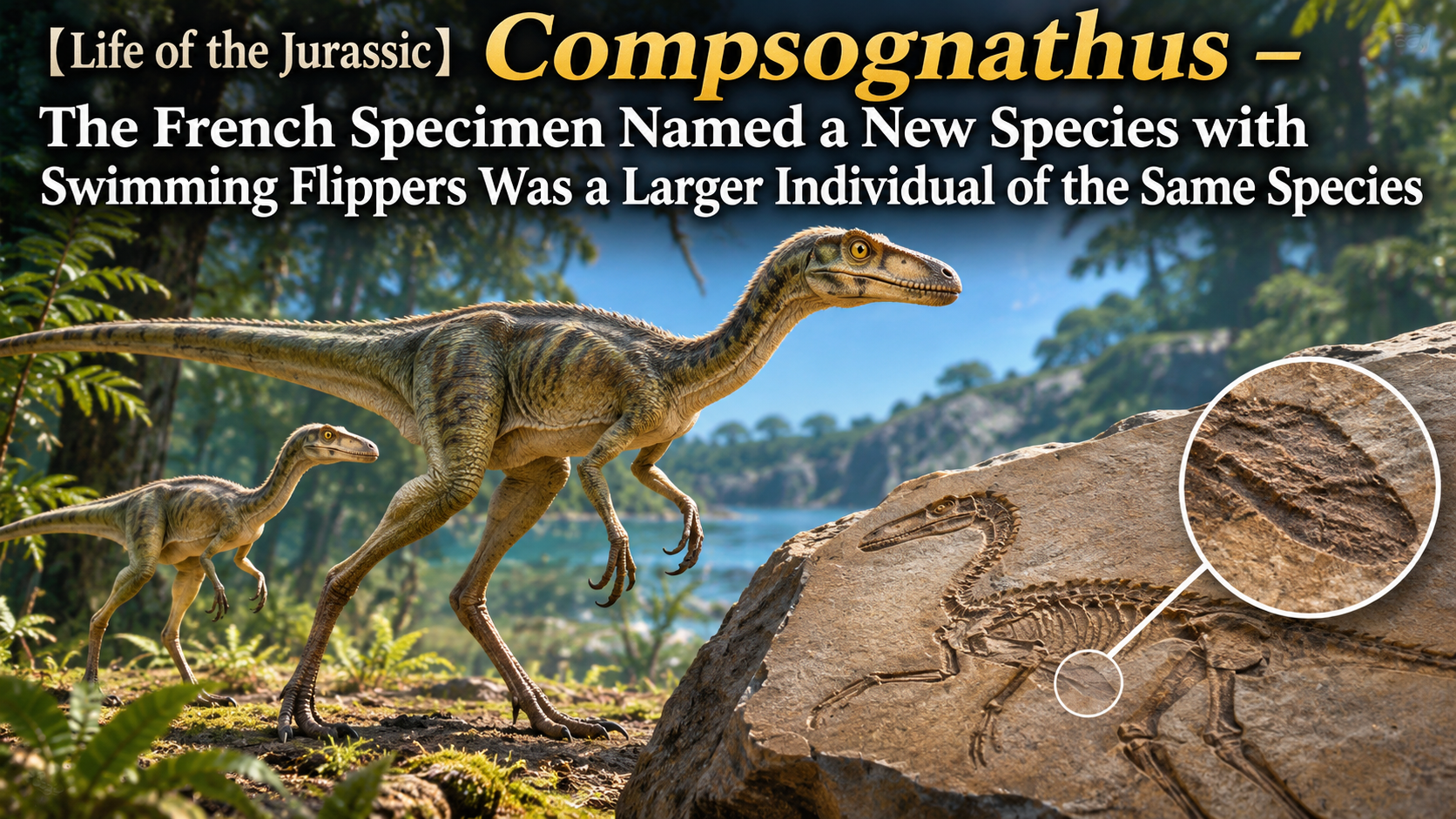
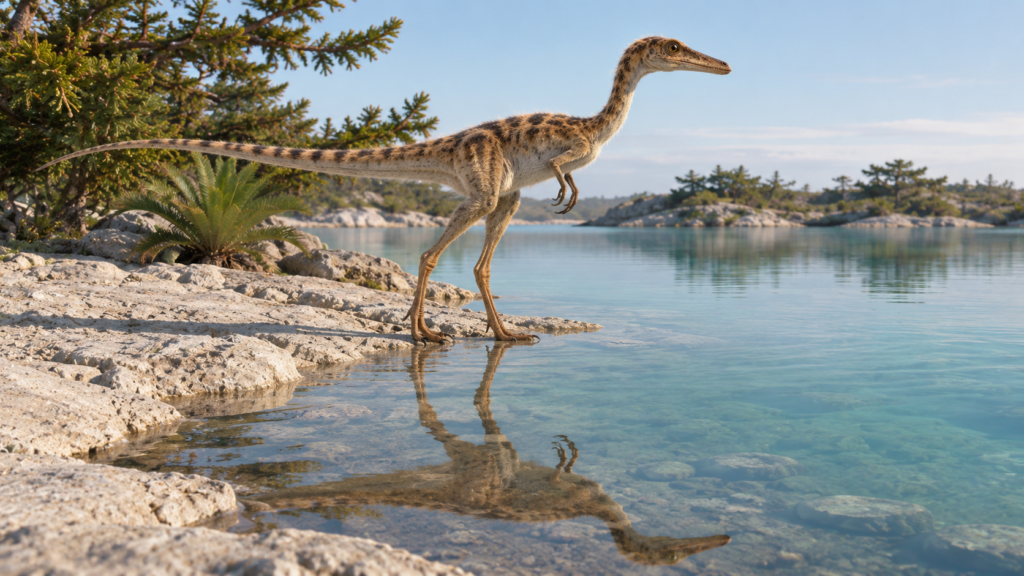
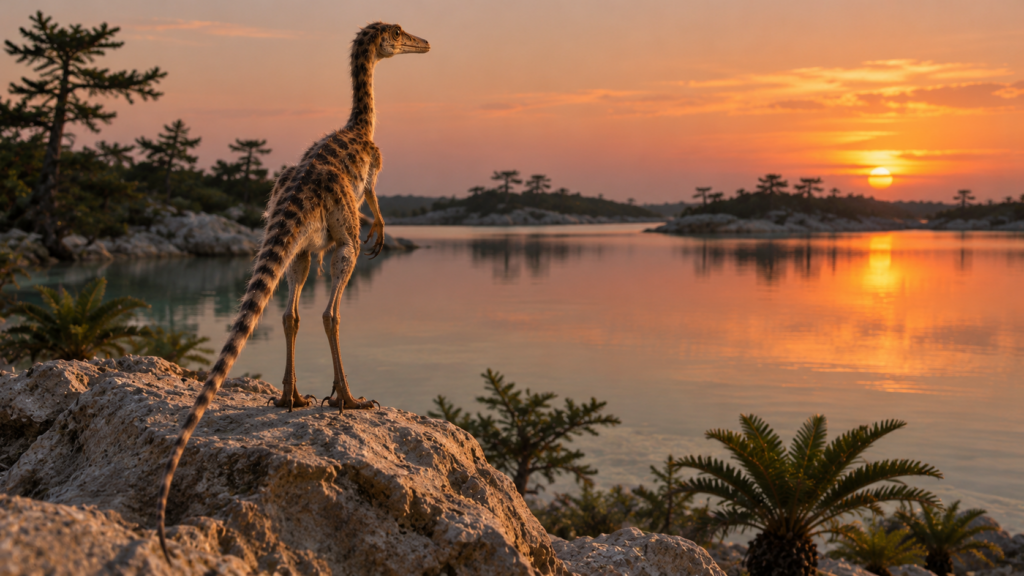
Compsognathus was a small meat-eating dinosaur that lived in Europe near the end of the Jurassic. It had a slender body, long hind legs and a long tail, and it ate small animals such as lizards. A second specimen found in France was named in 1972 as a separate species with flipper-like hands for swimming, but later studies concluded that it is simply a larger individual of the same species.
Appearance and Way of Life
Two specimens of Compsognathus are known. The first comes from the Solnhofen limestone of Bavaria, Germany; Johann Andreas Wagner of Munich named it in 1859 and described it in detail in 1861. The specimen was part of the collection of the physician Oberndorfer, which the Bavarian State Collection of Palaeontology and Geology bought in 1866, and it is still in Munich. Labels on the specimen give its origin as “the Altmühl valley near Kelheim” and as “Jachenhausen,” but when John Ostrom of Yale University studied it closely in 1978, he found no matching rock in the Jachenhausen quarries. Ostrom concluded that it probably came from limestone somewhere between Riedenburg and Kelheim.
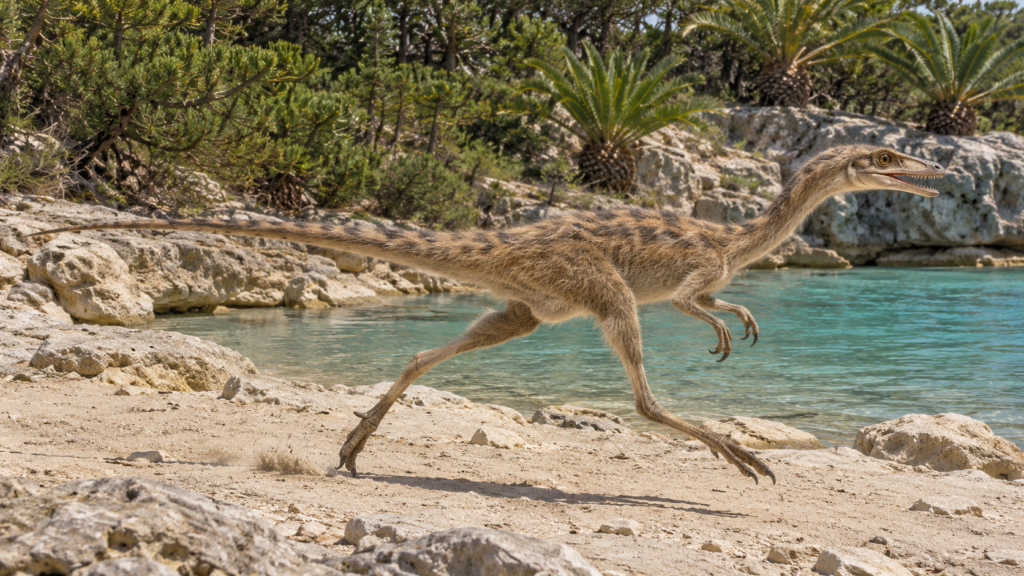
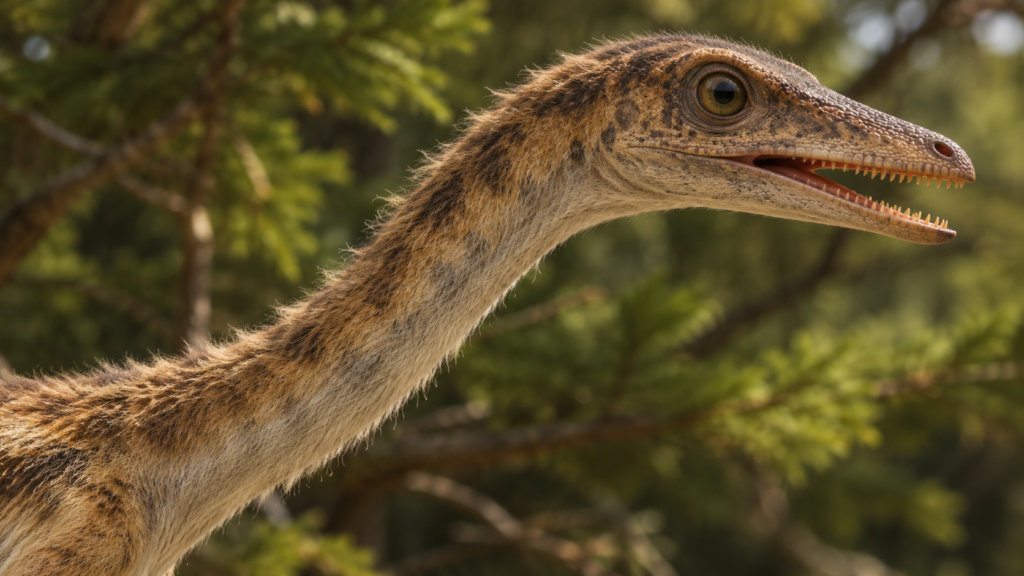
The head was small, with large eye sockets, and the jaws were lined with slender, pointed teeth. The neck and tail were long, the hind legs were long and thin, and the animal is thought to have been a fast runner. The arms were short, with two well-developed fingers. Whether it had two or three fingers was debated for a long time; a 2007 study concluded that besides the two well-developed fingers there was a small, reduced third finger.
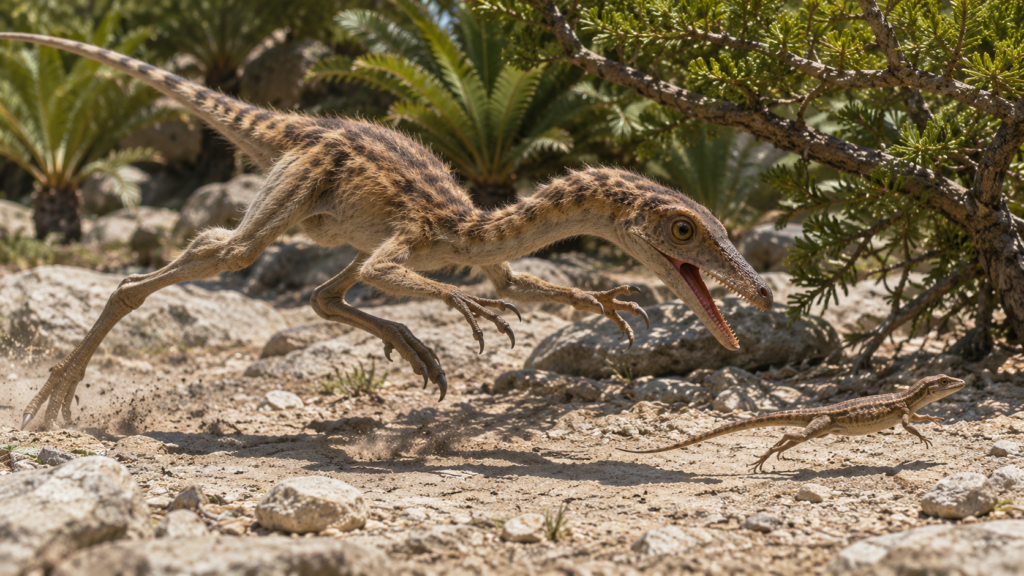
The belly region of the German specimen holds the skeleton of a small animal. In the 1880s it was even taken for an embryo, but it was later recognized as a lizard. Ostrom identified it as the fast, ground-running lizard Bavarisaurus and concluded that Compsognathus chased and caught swift lizards. In 2017, Jack Conrad of the New York Institute of Technology showed that the lizard’s skull differs from that of Bavarisaurus and named it as a new genus and species, Schoenesmahl dyspepsia. The species name dyspepsia is Greek for “indigestion.”
The Solnhofen limestone formed from fine mud that settled on the floor of a shallow sea surrounded by reefs and islands. The same limestone has yielded Archaeopteryx, the pterosaurs Rhamphorhynchus and Pterodactylus, fish, shrimps and crabs. The slab holding the German specimen also preserves about six specimens of Saccocoma, a crinoid that drifted in the sea.
Ostrom opened his 1978 paper with the sentence “Compsognathus is the smallest of all known dinosaurs.” Because the German specimen has large eye sockets and is smaller than the French one, however, Ostrom regarded it as not yet fully grown. A 1984 study went further and argued that the German specimen is a juvenile.
The Hands Taken for Swimming Flippers
The second specimen came from a quarry on the Canjuers plateau in the Var department of southeastern France. In 1972, Alain Bidar and his colleagues described it as a new species, Compsognathus corallestris. Its bones were larger than those of the German specimen; the thighbone was 110 mm long, compared with 70 mm in the German one.
The arms of this specimen were poorly preserved, and the hand showed little more than impressions of three palm bones. What caught Bidar’s attention was a faint raised impression, about 135 mm long, running along the forearm and hand. Bidar and his colleagues read it as the trace of a swimming flipper formed by thickened skin. They proposed that the wrist bones were fused and immobile and that the forelimb was used like a stiff paddle. Canjuers is thought to have been a lagoon ringed by coral reefs at the time, and they pictured this dinosaur living a semi-aquatic life on the beaches of atolls and on the small islands around the lagoon. The species name corallestris was chosen to reflect this supposed life on coral atolls.
In 1978, Ostrom rejected that interpretation. The supposed flipper is a set of fine, wrinkle-like undulations running along the forearm. Ostrom pointed out that the same pattern continues higher up the slab, near the neck and jaw, beyond the edges of the skeleton. A pattern that extends outside the skeleton cannot be part of the animal. Ostrom wrote that the flipper interpretation was poorly founded and highly improbable. He added that, apart from the flipper, the skeleton of the French specimen is nearly identical to the German one, and he placed C. corallestris in the same species as C. longipes.
In 2006, Karin Peyer redescribed the French specimen. It is nearly complete, lacking only the tip of the tail and some finger bones. Peyer also concluded that C. corallestris is the same species as C. longipes, and that the differences between the two specimens can be explained by growth stage, individual variation and the way the fossils were preserved. Today C. longipes is the only recognized species of Compsognathus, and the French specimen is regarded as a larger, more fully grown individual of the same species.
Related products
You can find books and products related to this article on Amazon.
If you buy through the links above, this blog may earn a commission.
About the images
The images in this article are illustrations created with AI (ChatGPT), and you are welcome to use them. If you do, we would appreciate a link back to this article as the source.
Sources
Ostrom, J. H. (1978). The osteology of Compsognathus longipes Wagner. Zitteliana 4, 73–118. https://archive.org/details/biostor-238219
Bidar, A., Demay, L. & Thomel, G. (1972). Compsognathus corallestris, nouvelle espèce de dinosaurien théropode du Portlandien de Canjuers (Sud-est de la France). Annales du Muséum d’Histoire Naturelle de Nice 1, 1–34. (English translation: Smithsonian) https://naturalhistory.si.edu/sites/default/files/media/translated_publications/Bidar%26amp%3B%25201972.pdf (PDF)
Peyer, K. (2006). A reconsideration of Compsognathus from the upper Tithonian of Canjuers, southeastern France. Journal of Vertebrate Paleontology 26, 879–896. https://doi.org/10.1671/0272-4634(2006)26[879:AROCFT]2.0.CO;2
Gishlick, A. D. & Gauthier, J. A. (2007). On the manual morphology of Compsognathus longipes and its bearing on the diagnosis of Compsognathidae. Zoological Journal of the Linnean Society 149, 569–581. https://doi.org/10.1111/j.1096-3642.2007.00269.x
Conrad, J. L. (2018). A new lizard (Squamata) was the last meal of Compsognathus (Theropoda: Dinosauria) and is a holotype in a holotype. Zoological Journal of the Linnean Society 183, 584–634. https://doi.org/10.1093/zoolinnean/zlx055
Callison, G. & Quimby, H. M. (1984). Tiny dinosaurs: are they fully grown? Journal of Vertebrate Paleontology 3, 200–209. https://doi.org/10.1080/02724634.1984.10011975

コメント