This article contains affiliate links. As an Amazon Associate I earn from qualifying purchases.
| Name | Ichthyostega (Ichthyostega; the name is said to combine the Greek for “fish” and “roof.” Three species are recognized: I. stensioei, I. eigili and I. watsoni) |
| Classification | Sarcopterygii, tetrapods (one of the earliest four-limbed vertebrates) |
| Period | Late Devonian, Famennian stage (about 365 million years ago; sources range from 360 to 370 million years) |
| Found in | East Greenland (Celsius Bjerg on Ymer Ø, Gauss Halvø and other sites) |
| Length | About 1 to 1.5 m (figures given in encyclopedias and popular references) |
| Hind-foot toes | Seven |
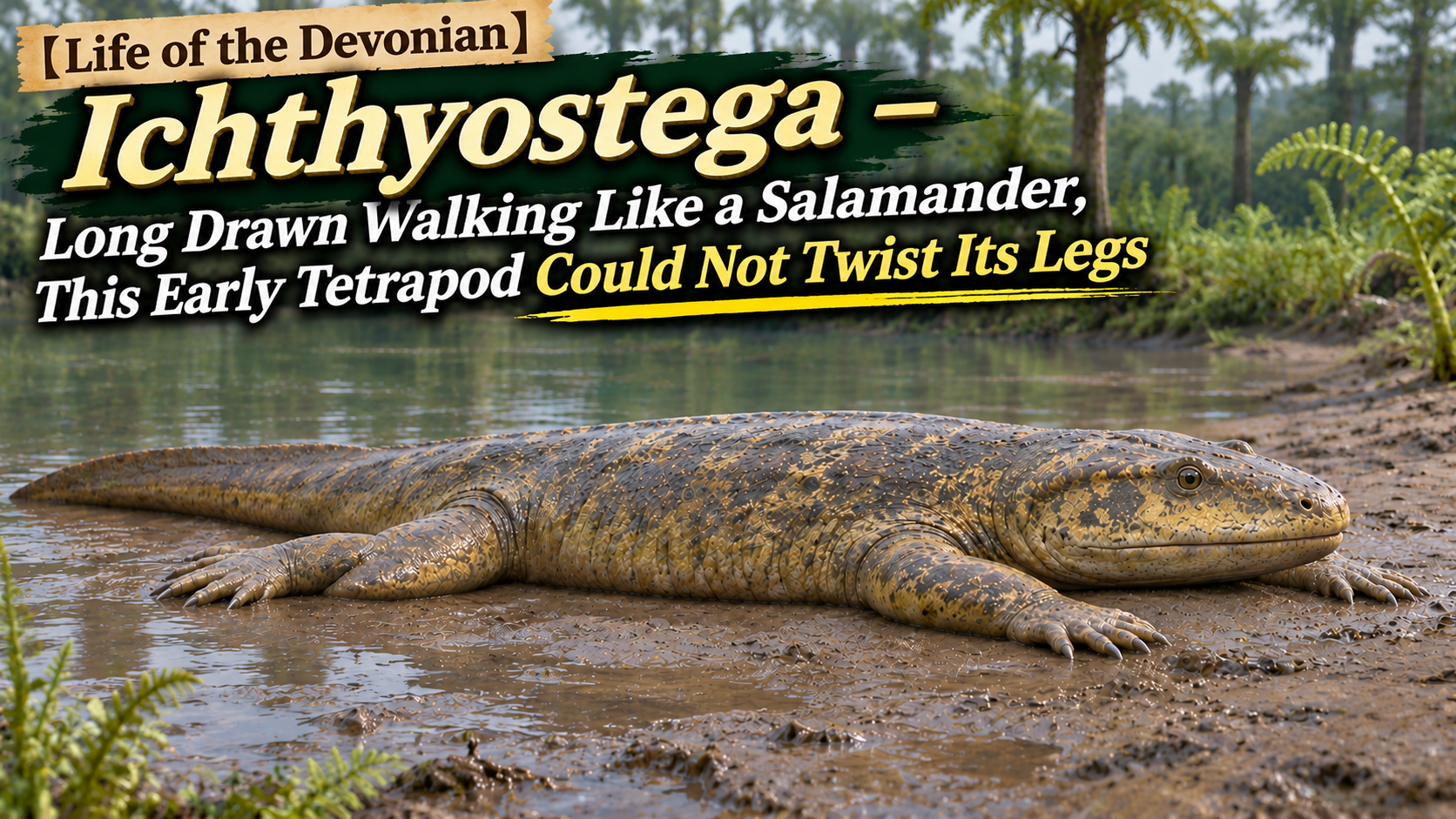
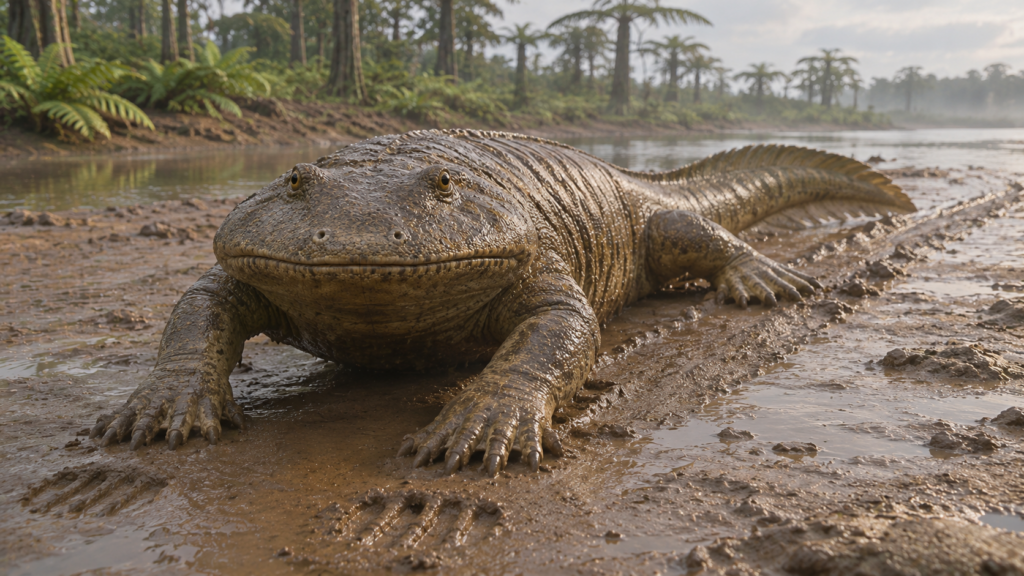
Ichthyostega was one of the earliest four-limbed vertebrates, living in Greenland near the end of the Devonian. Its body was partway between that of a fish and that of a land vertebrate, and for decades it was the oldest tetrapod known. It was long pictured walking on all fours like a salamander, but a 2012 study that rebuilt its skeleton in three dimensions concluded that it could not have walked that way.
Appearance and Way of Life
Fossils of Ichthyostega come from Late Devonian rocks in East Greenland. A Danish expedition to East Greenland collected the first specimens in 1931, and the Swedish palaeontologist Gunnar Säve-Söderbergh named the animal in 1932. Collecting continued, and Erik Jarvik of the Swedish Museum of Natural History studied the material for many years before publishing a monograph of more than 200 pages in 1996. From 1987 onward, expeditions from the universities of Cambridge and Copenhagen recovered new specimens, bringing the total to around 300.
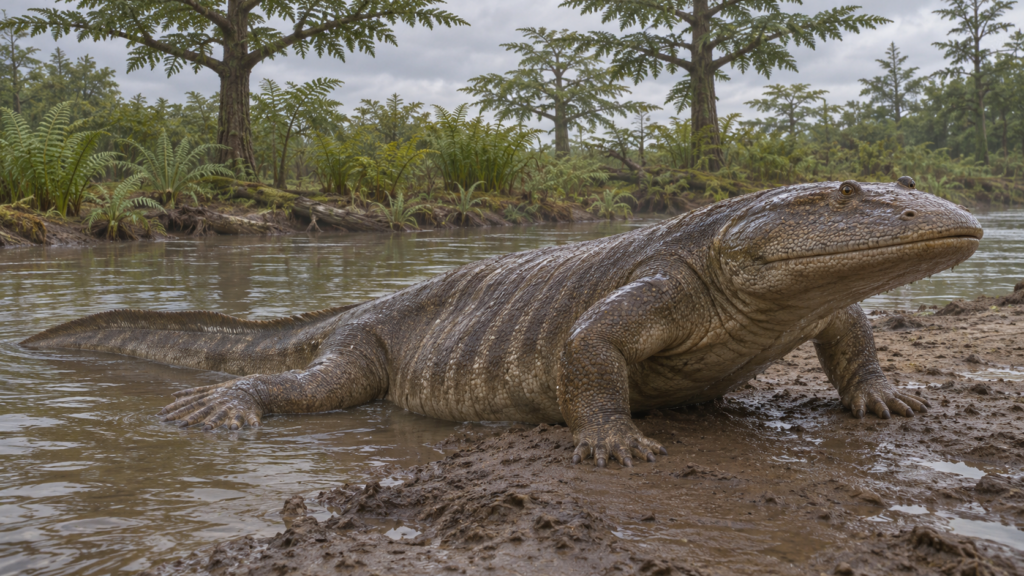
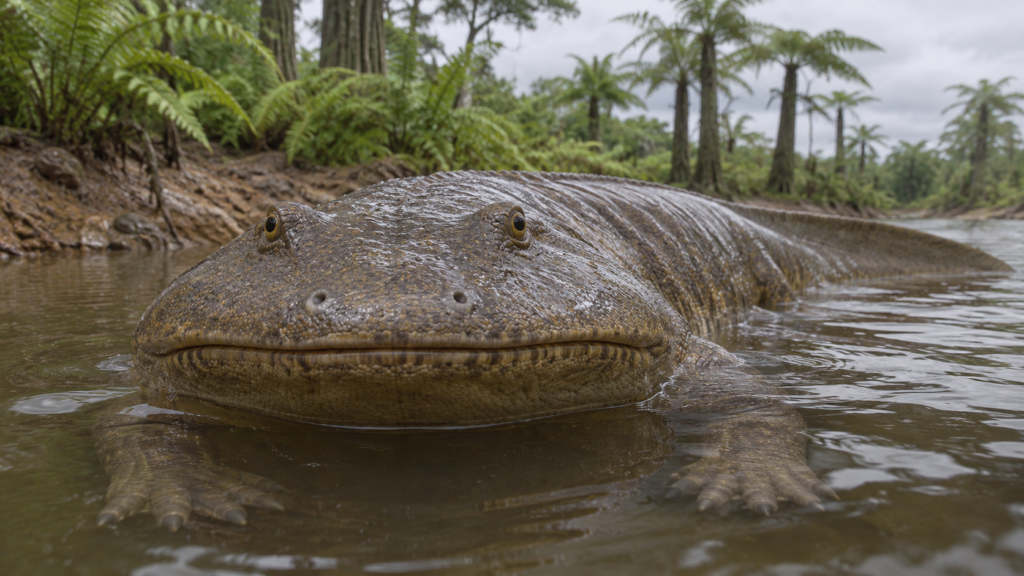
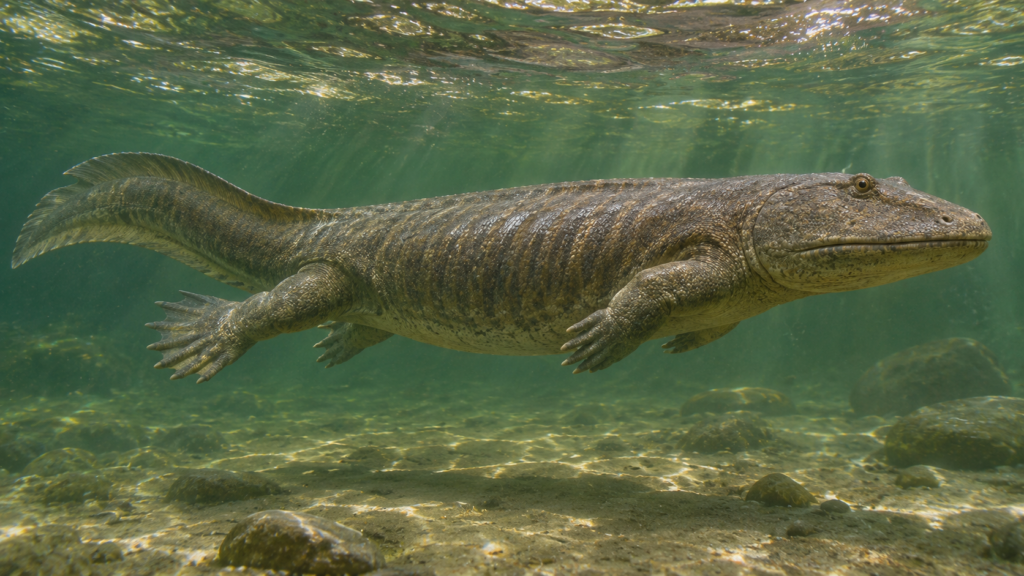
The head was broad and flat, and the body bore small scales. The tail was supported by bony rods like a fish’s, with a small fin along its edge. It had no gills, four limbs built of stout bones, and broad ribs. The ribs overlapped one another and are thought to have stiffened the trunk.
The hind foot had seven toes. In 1990, Michael Coates and Jennifer Clack of the University of Cambridge reported, using a specimen found in 1987 among others, that the hind foot of Ichthyostega had seven digits and the front foot of its contemporary Acanthostega had eight. Until then, tetrapod limbs had been thought to have had five digits from the start. The bones at the end of Ichthyostega’s front foot have not yet been found.
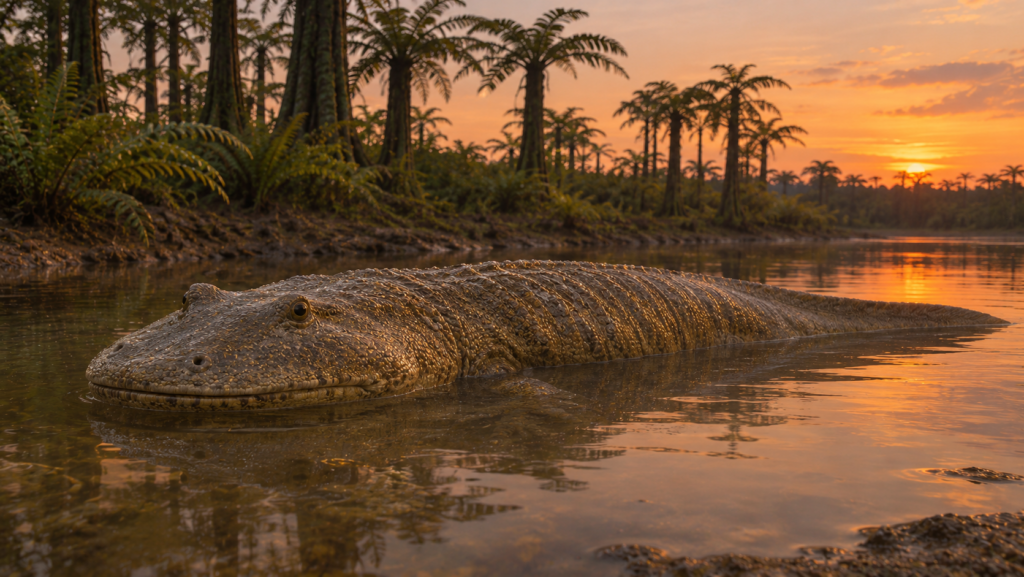
Its ear was also unlike that of later tetrapods. A 2003 study that examined the skull with CT scans showed air-filled chambers on both sides of the ear region, into which a spoon-shaped bone projected. The team concluded that this was probably a device for hearing under water. Together with deep grooves on the bones that supported the gills, this led to the view that Ichthyostega spent more time in the water than had been supposed.
Ichthyostega lived on a floodplain built up by rivers. Slightly higher rocks in the same area have yielded many fossils of Acanthostega, which was more primitive than Ichthyostega, lived mainly in water, and is thought to have swum by bending its body from side to side.
Ichthyostega was long called the oldest tetrapod, but older tetrapod fossils and footprints have since been found. In 2010, tetrapod trackways tens of millions of years older than Ichthyostega were reported from Middle Devonian rocks in Poland.
It Could Not Walk Like a Salamander
In Jarvik’s reconstruction from the 1950s, Ichthyostega stood on four sturdy legs and looked like a crocodile or a salamander. Its backbone was shown as a row of identical vertebrae from head to tail, and this image appeared in textbooks and museum displays for many years.
In 2005, Per Ahlberg of Uppsala University and his colleagues reconstructed the whole body again from new specimens. The vertebrae differed in shape along the body, and the trunk was built to bend up and down rather than side to side. This was the first time such a backbone had been found in an early tetrapod. The team described Ichthyostega as the earliest vertebrate to show clear adaptations for moving other than by swimming.
In 2012, Stephanie Pierce of the Royal Veterinary College, together with Clack and John Hutchinson, published a three-dimensional study of how far its limb joints could move. They scanned dozens of specimens with micro-CT, reassembled the bones on a computer as if freed from the rock, and moved each joint to its limits. The front half of the body was built mainly from a well-preserved specimen nicknamed “Mr Magic.” They compared the results with five living animals: a salamander, a crocodile, a platypus, a seal and an otter.
The shoulder and hip joints of Ichthyostega could swing forward and back and up and down about as far as those of the living animals, but they could barely rotate the limb about its long axis. To walk like a salamander or a crocodile, moving the left and right legs alternately, an animal needs that rotation to push its body up off the ground. The paper concluded that Ichthyostega could not have walked that way. Its hind feet were never planted flat to carry the body’s weight.
The team proposed that on land it moved both front legs at the same time, pulling the body forward, with the hind legs barely touching the ground. Pierce compared this with the living mudskipper, a fish that uses its fins like crutches to move across mud. Clack said that the salamander-like walker often seen in popular books and museum displays should be set aside.
The paper said this leaves two possibilities: either the earliest tetrapods went through a stage in which the shoulders and hips could hardly rotate, or Ichthyostega was unusual. The fins of the fish-like relatives from which tetrapods arose could rotate about their axis. Some Middle Devonian trackways show alternating steps, and the paper judged it unlikely that an animal like Ichthyostega made them.
Related products
You can find books and products related to this article on Amazon.
If you buy through the links above, this blog may earn a commission.
About the images
The images in this article are illustrations created with AI (ChatGPT), and you are welcome to use them. If you do, we would appreciate a link back to this article as the source.
Sources
Pierce, S. E., Clack, J. A. & Hutchinson, J. R. (2012). Three-dimensional limb joint mobility in the early tetrapod Ichthyostega. Nature 486, 523–526. https://doi.org/10.1038/nature11124
Ahlberg, P. E., Clack, J. A. & Blom, H. (2005). The axial skeleton of the Devonian tetrapod Ichthyostega. Nature 437, 137–140. https://doi.org/10.1038/nature03893
Clack, J. A., Ahlberg, P. E., Finney, S. M., Dominguez Alonso, P., Robinson, J. & Ketcham, R. A. (2003). A uniquely specialized ear in a very early tetrapod. Nature 425, 65–69. https://doi.org/10.1038/nature01904
Coates, M. I. & Clack, J. A. (1990). Polydactyly in the earliest known tetrapod limbs. Nature 347, 66–69. https://doi.org/10.1038/347066a0
Blom, H. (2005). Taxonomic revision of the Late Devonian tetrapod Ichthyostega from East Greenland. Palaeontology 48, 111–134. https://doi.org/10.1111/j.1475-4983.2004.00435.x
Niedźwiedzki, G., Szrek, P., Narkiewicz, K., Narkiewicz, M. & Ahlberg, P. E. (2010). Tetrapod trackways from the early Middle Devonian period of Poland. Nature 463, 43–48. https://doi.org/10.1038/nature08623
University of Cambridge, Department of Zoology. The 2012 announcement (methods of the 3D reconstruction and the five comparison animals). https://www.zoo.cam.ac.uk/news/novel-3d-reconstruction-of-fossil-reveals-how-limb-movement-evolved-in-the-first-land-animals
National Geographic (2012). Number of specimens and “Mr Magic.” https://www.nationalgeographic.com/science/article/virtual-resurrection-shows-that-early-four-legged-animal-couldnt-walk-very-well
Britannica. Ichthyostega (body length). https://www.britannica.com/animal/Ichthyostega

コメント