This article contains affiliate links. As an Amazon Associate I earn from qualifying purchases.
| Name | Gastornis (Gastornis; the name joins that of Gaston Planté, who found the first bones, with the Greek for “bird.” The type species is G. parisiensis) |
| Classification | Aves, Gastornithiformes (most researchers place it close to ducks and geese) |
| Period | Paleogene, Paleocene to Eocene (one announcement gives about 55 to 40 million years ago for Europe) |
| Found in | France, Germany, England, United States (Wyoming, New Mexico), Canada (Ellesmere Island), China |
| Height | About 2 m |
| Weight | About 135 to 156 kg (estimated from the size of its eggs) |
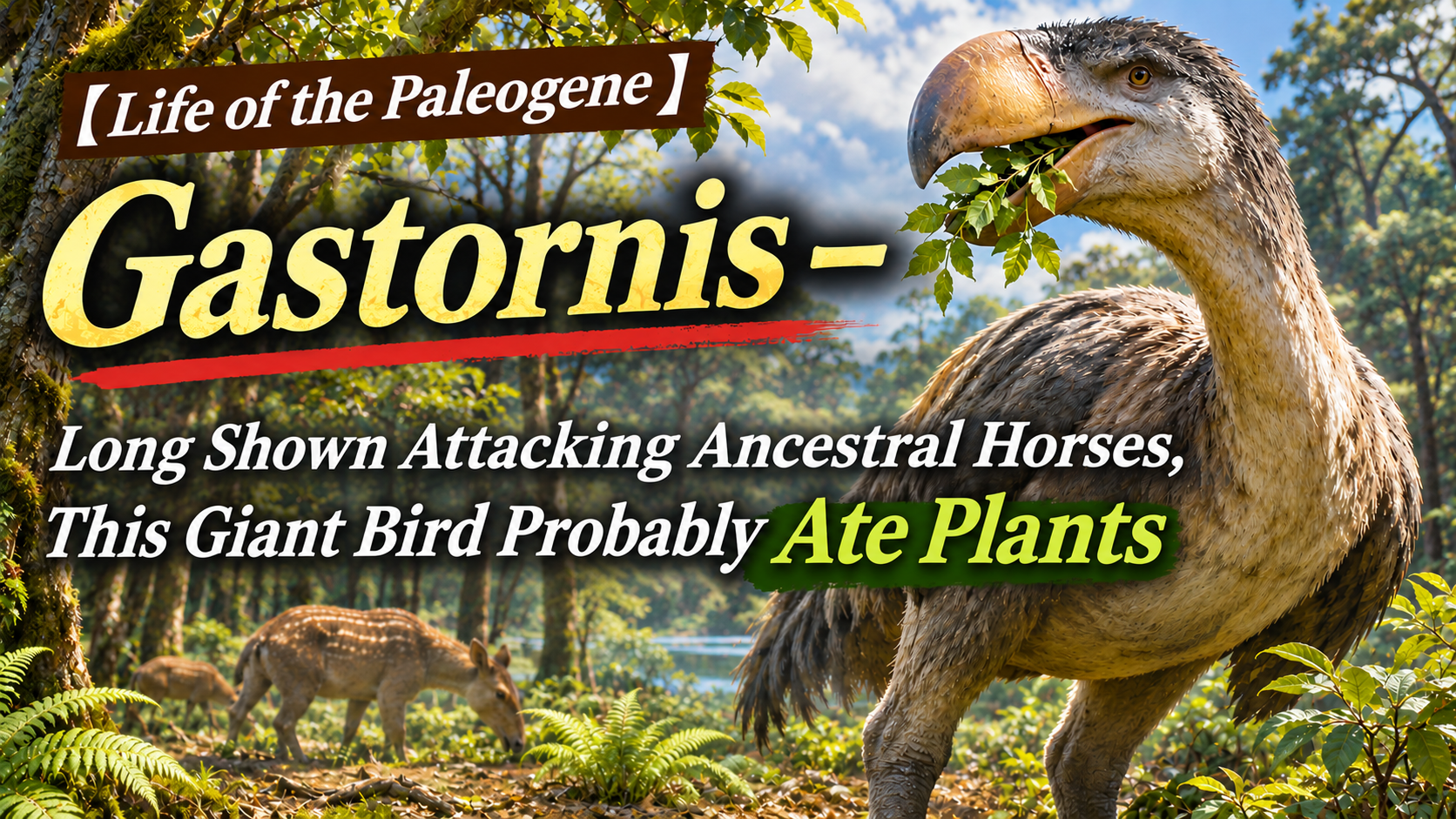
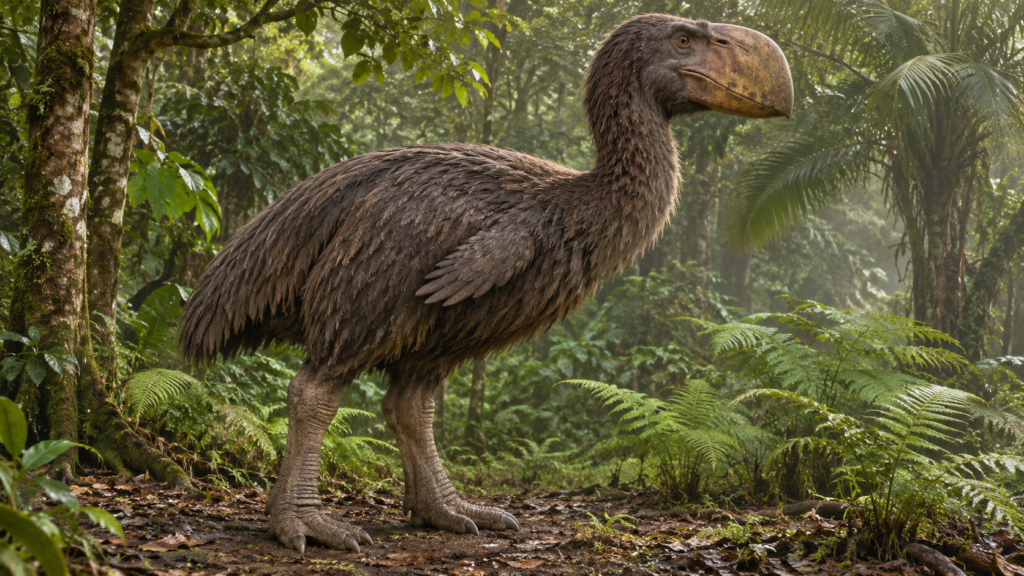
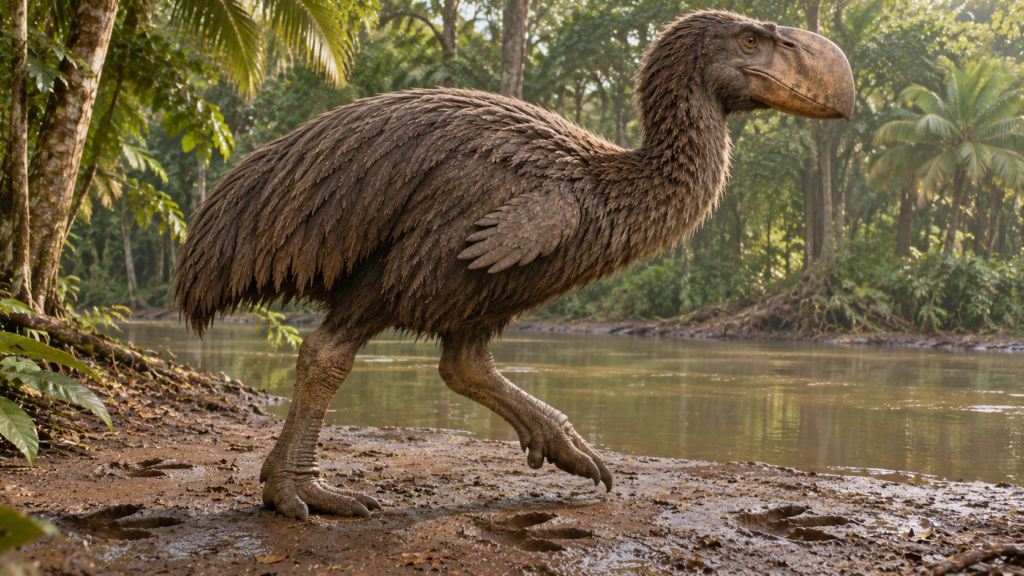
Gastornis was a flightless bird about 2 m tall that lived in Europe and North America after the dinosaurs had gone. It had a big head and a huge, deep beak. Because of its looks it was long regarded as a meat-eating top predator and was often shown attacking small ancestral horses, but chemical analyses of its bones and other evidence now suggest that it most likely ate plants.
Appearance and Way of Life
The first bones were found in clay at Meudon, near Paris, by Gaston Planté, later known as the inventor of the lead-acid battery, and the bird was named in 1855. In 1876 the American palaeontologist Edward Cope gave the name Diatryma to bones found in New Mexico. The two were later found to be so alike that they were merged into one genus under the name Gastornis. In 2024, Gerald Mayr of the Senckenberg Research Institute and his colleagues proposed separating the North American and some other species again as Diatryma.
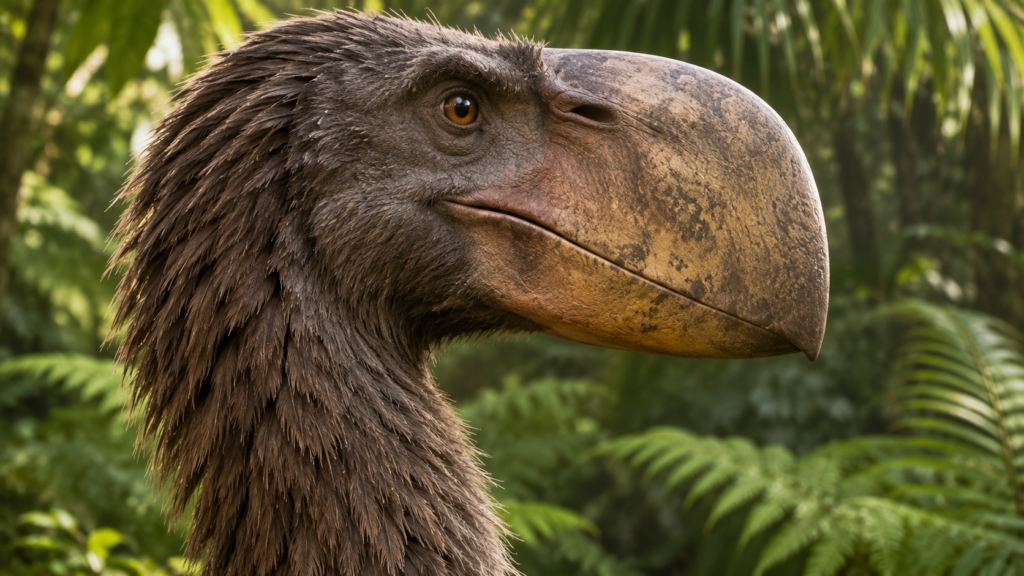
The body was heavily built, the wings were tiny, and it walked on thick legs. The skull was large for the body, and the deep beak was not curved into a hook. A toe bone has also been found on Ellesmere Island in northern Canada, showing that it lived in the Arctic, which was warm at the time.
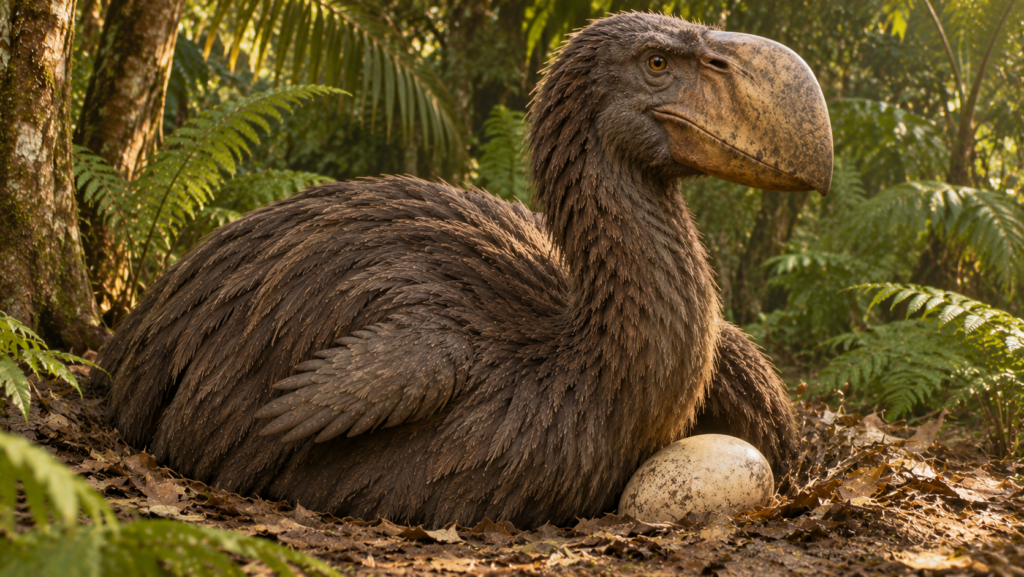
Fragments of large, thick-shelled eggs are found in Paleogene rocks in southern France. In 2014, Delphine Angst of France and her colleagues reconstructed the original shape from many fragments and found the eggs were 17.8 cm long and 12.0 cm across, a little bigger than an ostrich egg. Each egg weighed about 1.4 kg, and the parent bird was estimated to weigh about 135 to 156 kg. Among large birds in Europe at that time, only the gastornithids could have laid such eggs, and the team attributed them to Gastornis.
Footprints of a large bird have been found in the Chuckanut Formation in Washington State. A 2012 paper concluded that a member of the Gastornis group made them and gave the tracks a new name. The prints show no marks of sharp, raptor-like claws.
From Fearsome Predator to Plant-Eating Giant
Its large head and huge beak led researchers to treat Gastornis as a meat-eater for a long time. A 2013 announcement from the Max Planck Society noted that it was often depicted eating Eohippus, an early ancestor of the horse. In 1991, Lawrence Witmer and Kenneth Rose studied the mechanics of the beak and jaws using specimens from Wyoming. They found the jaws were built to deliver great force from top to bottom, and argued that a plant diet would make the skull stronger than necessary, so the traditional view of a meat-eater fitted the data better.
In 2013, on the other hand, a team including Thomas Tütken of the University of Bonn announced the results of measuring calcium isotopes in bones from the Geiseltal in Germany. Calcium has isotopes of different weights, and the proportion of the lighter ones rises at each step up a food chain. The values in Gastornis bones fell in the same range as those of plant-eating mammals and were far from what would be expected for a meat-eater.
In 2014, Angst and her colleagues examined carbon isotopes in bones from four Paleocene and Eocene sites in France. They compared them with plant-eating mammals of the same age and with living meat-eating and plant-eating birds. The values for Gastornis pointed to a plant diet, and the attachment areas of its jaw-closing muscles resembled those of living plant-eating birds. The team concluded that the largest land animal of Paleocene Europe was not a top predator but a plant-eating bird.
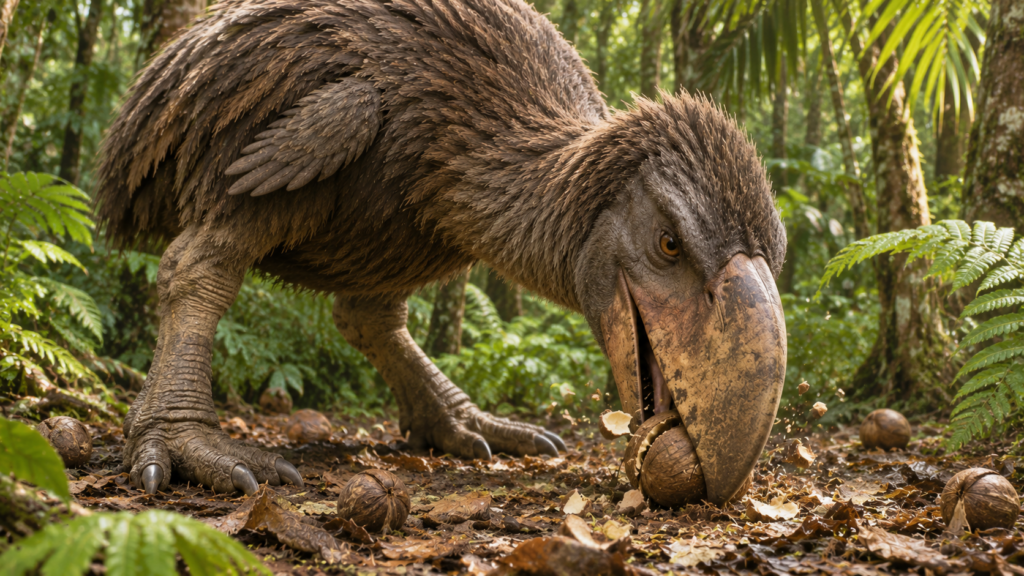
The leading view today is that the huge beak was used not to catch prey but to crush tough plant matter, seeds and nuts. The 2012 footprint paper also cites the lack of claw marks as support for the plant-eating idea. Still, no fossil has been found that directly shows what Gastornis ate.
Related products
You can find books and products related to this article on Amazon.
If you buy through the links above, this blog may earn a commission.
About the images
The images in this article are illustrations created with AI (ChatGPT), and you are welcome to use them. If you do, we would appreciate a link back to this article as the source.
Sources
Angst, D., Lécuyer, C., Amiot, R., Buffetaut, E., Fourel, F., Martineau, F., Legendre, S., Abourachid, A. & Herrel, A. (2014). Isotopic and anatomical evidence of an herbivorous diet in the Early Tertiary giant bird Gastornis. Implications for the structure of Paleocene terrestrial ecosystems. Naturwissenschaften 101, 313–322. https://doi.org/10.1007/s00114-014-1158-2
Witmer, L. M. & Rose, K. D. (1991). Biomechanics of the jaw apparatus of the gigantic Eocene bird Diatryma: implications for diet and mode of life. Paleobiology 17, 95–120. https://doi.org/10.1017/S0094837300010435
Angst, D. et al. (2014). Fossil avian eggs from the Palaeogene of southern France: new size estimates and a possible taxonomic identification of the egg-layer. Geological Magazine 152, 70–79. https://doi.org/10.1017/S0016756814000077
Mustoe, G. E., Tucker, D. S. & Kemplin, K. L. (2012). Giant Eocene bird footprints from Northwest Washington, USA. Palaeontology 55, 1293–1305. https://doi.org/10.1111/j.1475-4983.2012.01195.x
Stidham, T. A. & Eberle, J. J. (2016). The palaeobiology of high latitude birds from the early Eocene greenhouse of Ellesmere Island, Arctic Canada. Scientific Reports 6, 20912. https://doi.org/10.1038/srep20912
Mayr, G., Mourer-Chauviré, C., Bourdon, E. & Stache, M. (2024). Resurrecting the taxon Diatryma: a review of the giant flightless Eocene Gastornithiformes (Aves). Palaeontologia Electronica. https://doi.org/10.26879/1438
Max-Planck-Gesellschaft (2013). Terror bird was frightening but harmless (announcement of the calcium isotope study). https://www.mpg.de/7518305/terrorbird-gastornis-herbivore

コメント