This article contains affiliate links. As an Amazon Associate I earn from qualifying purchases.
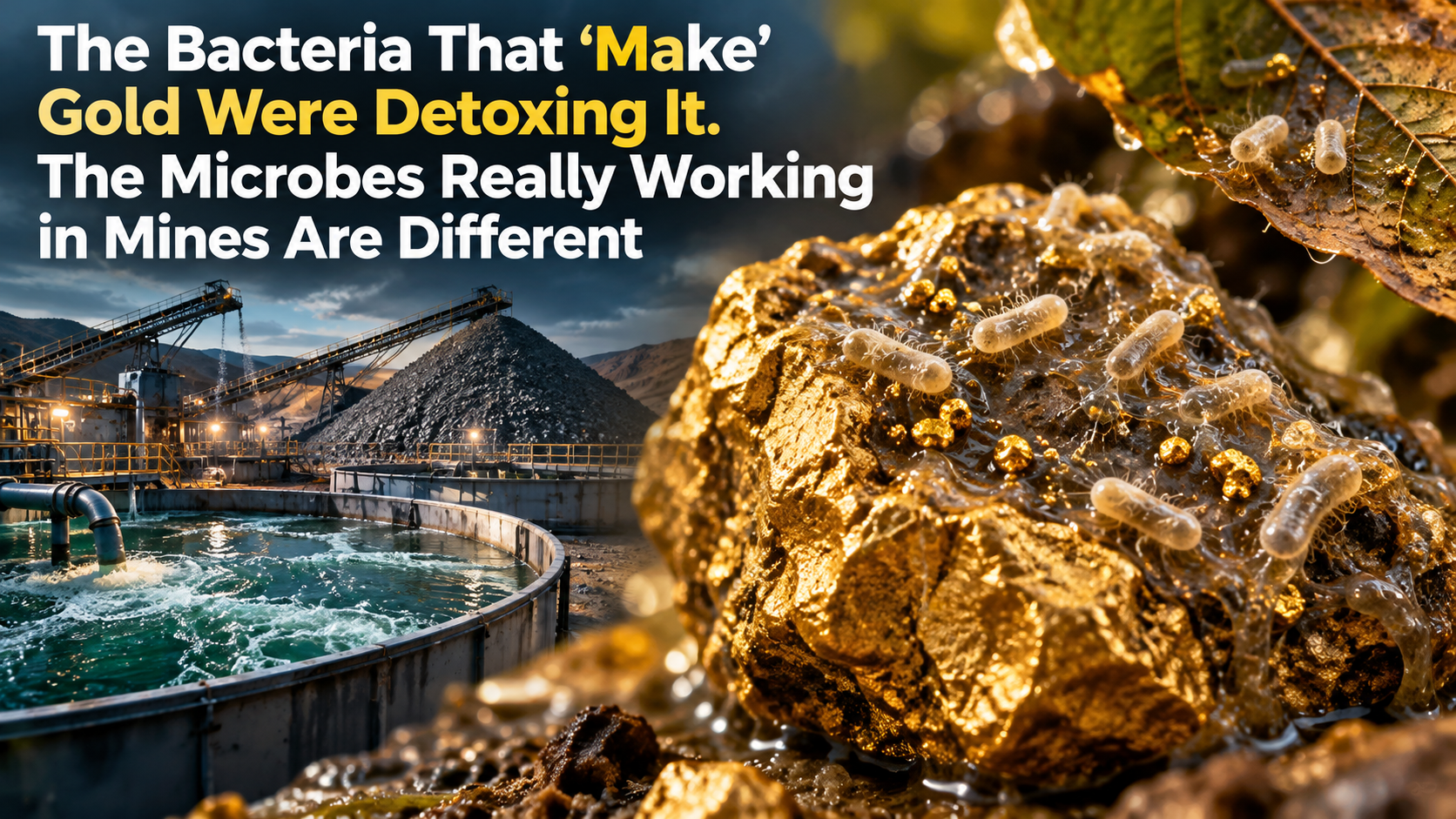
Bacteria crowding the surface of a gold grain. Fungal threads studded with specks of gold. Gold nanoparticles turning up inside tree needles. Over the past twenty years or so, research on so-called “gold-making organisms” has built up one discovery like this after another.
No living thing can create the element gold, though. What makes an atom gold is having 79 protons in its nucleus, and the chemistry that goes on inside cells never touches the nucleus. What these organisms do is take gold that has dissolved invisibly into water and turn it back into solid metal. Why would they bother? And is that ability being put to work in gold mining?
Dissolved gold is toxic to microbes
A lump of gold barely reacts with air or water, which is why it keeps its shine for thousands of years.
Underground, however, tiny amounts of gold combine with chlorine or sulfur and dissolve into groundwater. In that form, as ions or complexes (a metal bound to other molecules), gold can slip into cells and wreck proteins. The same metal that sits quietly as a nugget becomes a poison once it dissolves.
Microbes living around gold deposits share their home with that poison. Some have evolved ways to protect themselves by turning it back into something inert: solid gold. That detoxification is what “making gold” really means.
Bacteria living on gold grains
In 2006, Australian geochemist Frank Reith and colleagues reported in Science that gold grains collected at two sites, in New South Wales and Queensland, were coated with living bacterial films (biofilms). DNA analysis showed that the bacteria on the grains differed from those in the surrounding soil, and one species turned up on every grain that yielded DNA. It was a very close match to Cupriavidus metallidurans (then called Ralstonia metallidurans).
This bacterium was already known for thriving in environments loaded with heavy metals. In a 2009 paper in PNAS, the same group showed that when it is exposed to dissolved gold, it switches on a set of gold-responsive genes and spends energy reducing the gold into nanoscale particles. It pumps some of the gold back out and locks the rest away as harmless metal. Similar particles appeared in the biofilms on the gold grains, raising the possibility that bacteria help gold grains grow near the Earth’s surface.
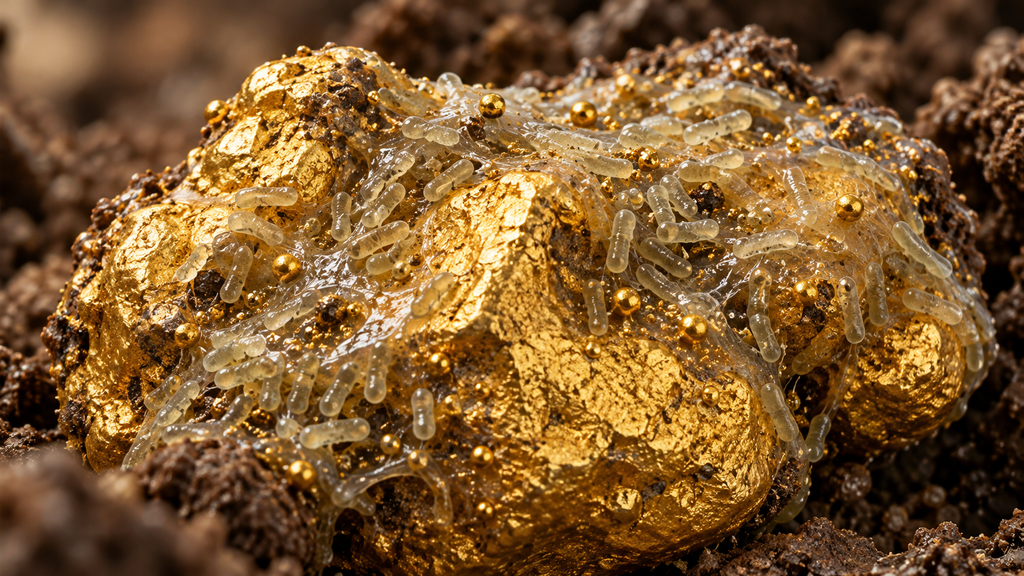
In 2013, a team at McMaster University in Canada found a different strategy in Delftia acidovorans, another bacterium that lives on gold grains (Nature Chemical Biology). It releases a molecule called delftibactin, which turns dissolved gold into solid particles outside the cell before the gold can get in. Grown on a medium containing gold, its colonies become surrounded by dark halos of gold nanoparticles. Strains with the delftibactin genes knocked out formed no halos and grew poorly in the presence of gold. Where Cupriavidus neutralizes the poison after it gets inside, Delftia neutralizes it before it arrives.
A fungus that dissolves gold and deposits it again
Most bacterial studies focused on organisms that precipitate gold. In 2019, Tsing Bohu and colleagues at CSIRO, Australia’s national science agency, reported a fungus that also does the opposite (Nature Communications).
The fungus, a strain of Fusarium oxysporum, came from soil above a gold deposit near Boddington, Western Australia. It oxidized gold in the soil, dissolving it, and then deposited it again as tiny gold particles on the surface of its own threads. Finding an organism that both dissolves and precipitates gold was a surprise.
Gold-coated strains grew larger and spread faster than those without gold, and places with more gold in the soil hosted a wider variety of fungi. What the fungus gains from the gold is still unknown.
Gold particles inside leaves
Gold doesn’t only show up in microbes. In 2013, Melvyn Lintern and colleagues at CSIRO reported gold particles in the leaves of eucalyptus trees growing over a gold deposit in Western Australia. Eucalyptus roots reach deep for water, and the trees appear to draw up dissolved gold along with it and carry it all the way to their leaves.
In 2025, Kaisa Lehosmaa of the University of Oulu and colleagues, including researchers at the Geological Survey of Finland, examined 138 needles from 23 Norway spruce trees growing over a gold deposit in northern Finland (Environmental Microbiome). Needles from four of the trees contained gold nanoparticles, each one wrapped in a bacterial film, and certain groups of bacteria were more common in the gold-bearing needles. The bacteria living inside the needles may be solidifying gold that the tree has drawn up. That cause and effect has not been demonstrated yet, and the authors themselves describe the findings as preliminary.

Both studies point toward exploration rather than mining. The gold in leaves is minuscule, nowhere near enough to collect and sell. But testing leaves or soil microbes might reveal whether gold lies underground without digging up the land.
The microbes at work in mines don’t make gold particles
So are any of these microbes used in gold mining? Yes, but they are a different kind.
In some gold ores, the gold is locked inside minerals such as pyrite (an iron sulfide), where the usual chemicals can’t reach it. For these ores, miners use bacteria that feed on iron and sulfur. Powdered ore is stirred into large tanks of bacteria, which break down the sulfide minerals and expose the gold trapped inside. The gold itself is then dissolved with cyanide and recovered in the conventional way.
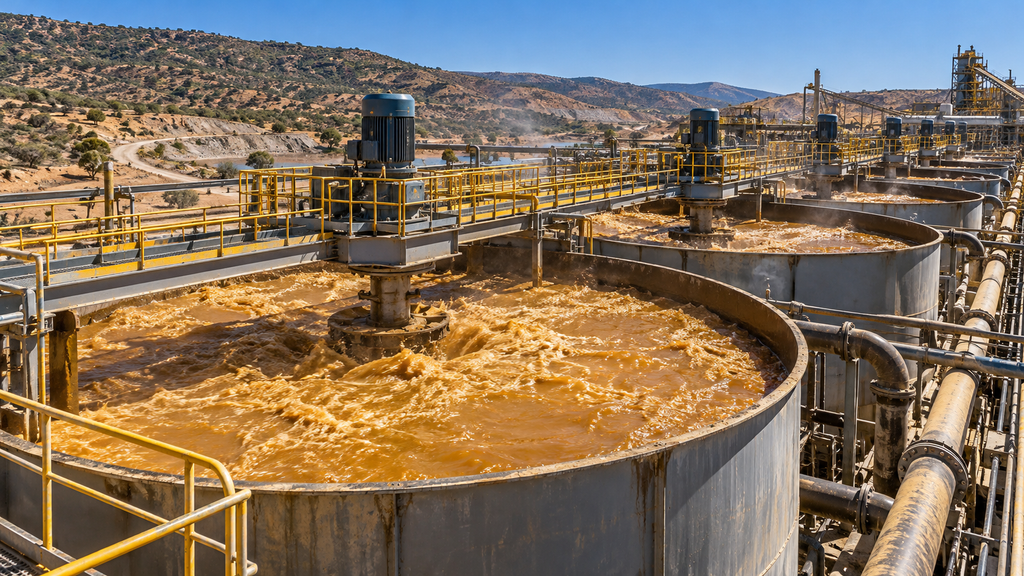
Known as the BIOX process, this method went into service at the world’s first commercial plant at the Fairview mine in South Africa in 1986. It has since been installed at more than a dozen mines worldwide, and construction of another plant began at a mine in Senegal in 2022. Unlike the traditional method of roasting the ore at high temperatures, it doesn’t release toxic gases.
For close to forty years, the microbes producing gold in real operations haven’t been the ones that make gold particles. They are bacteria that break down rock. They never touch the gold; they just do the groundwork that makes it possible to extract.
Recovering gold from electronic waste
After mines, attention has turned to the circuit boards in phones and computers. Gold is used in their contacts and plating, and discarded boards can hold more gold per tonne than ore does.
Mint Innovation, a company founded in New Zealand, runs a plant in western Sydney that recovers gold and copper from shredded circuit boards using microbe-derived materials and inexpensive chemicals. According to a 2023 report, the plant can process about 3,000 tonnes of circuit-board waste a year and recover up to about half a tonne of gold.
Still in the research stage is Chromobacterium violaceum, a bacterium that makes its own cyanide. In 2013, a team at the National University of Singapore reported in Scientific Reports that a genetically engineered strain producing 70% more cyanide dissolved more than twice as much gold from electronic waste as the original strain. Across most studies with this bacterium, though, gold recovery has stayed at roughly 10 to 30%.
Gold-making bacteria are not gold mines yet
Put side by side, these stories form a slightly odd picture. The bacteria and fungi described as “making gold” are only solidifying it to avoid being poisoned, and they produce nothing bigger than nanoparticles. Meanwhile, the microbes that actually support gold production ignore the gold entirely and eat rock.
That doesn’t make the research on gold-making bacteria a dead end. Knowing which genes respond to gold and which molecules solidify it could lead to reagents that detect dissolved gold or materials that capture gold from wastewater. A molecule like delftibactin, which works outside the cell, might even be used on its own without growing the bacteria at all.
About twenty years after bacteria were found living on gold grains, research on gold-making organisms is developing less as a way to mine gold and more as a way to find it and gather up gold that has been scattered.
Related products
You can find books and products related to this article on Amazon.
If you buy through the links above, this blog may earn a commission.
Sources
- Reith, F. et al. (2006) Biomineralization of Gold: Biofilms on Bacterioform Gold. Science 313, 233–236. https://doi.org/10.1126/science.1125878
- Reith, F. et al. (2009) Mechanisms of gold biomineralization in the bacterium Cupriavidus metallidurans. PNAS 106, 17757–17762. https://doi.org/10.1073/pnas.0904583106
- Johnston, C. W. et al. (2013) Gold biomineralization by a metallophore from a gold-associated microbe. Nature Chemical Biology. https://doi.org/10.1038/nchembio.1179
- Bohu, T. et al. (2019) Evidence for fungi and gold redox interaction under Earth surface conditions. Nature Communications. https://doi.org/10.1038/s41467-019-10006-5
- CSIRO (2019) Gold-coated fungi are the new gold diggers. https://www.csiro.au/en/news/All/News/2019/May/Gold-coated-fungi-are-the-new-gold-diggers
- Lintern, M. et al. (2013) Natural gold particles in Eucalyptus leaves and their relevance to exploration for buried gold deposits. Nature Communications. https://doi.org/10.1038/ncomms3614
- Lehosmaa, K. et al. (2025) Biomineralized gold nanoparticles along with endophytic bacterial taxa in needles of Norway spruce (Picea abies). Environmental Microbiome 20, 113. https://doi.org/10.1186/s40793-025-00770-x
- University of Oulu (2025) Golden spruce trees: Gold forms nanoparticles in the needles – bacteria show the way. https://www.oulu.fi/en/news/golden-spruce-trees-gold-forms-nanoparticles-needles-bacteria-show-way
- Tay, S. B. et al. (2013) Enhancing gold recovery from electronic waste via lixiviant metabolic engineering in Chromobacterium violaceum. Scientific Reports 3, 2236. https://doi.org/10.1038/srep02236
- The Northern Miner: The Fairview flow. https://northernminer.com/news/the-fairview-flow-a-gold-mine-in-eastern-transvaal-represents-a/1000155107
- Planet Ark: New e-waste recycling technology accelerating the circular supply of precious metals. https://planetark.org/newsroom/news/new-e-waste-recycling-technology-accelerating-the-circular-supply-of


コメント