This article contains affiliate links. As an Amazon Associate I earn from qualifying purchases.
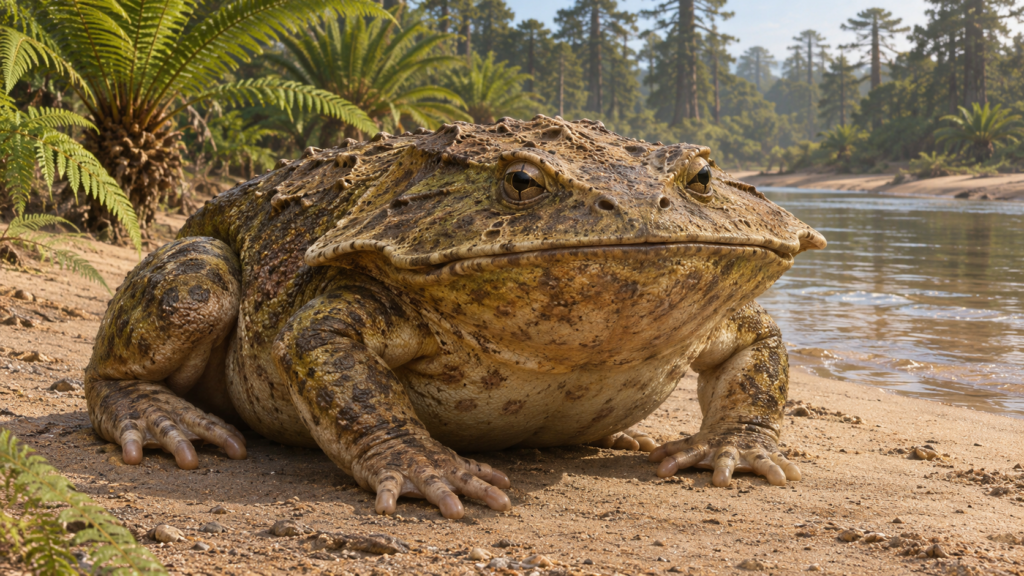
| Name | Beelzebufo (Beelzebufo ampinga; the genus joins “Beelzebul,” a name for the Devil, with the Latin for “toad,” and the species name is Malagasy for “shield”) |
| Classification | Amphibia, Anura (analyses place it in the South American family Ceratophryidae, but this is still debated) |
| Period | Late Cretaceous (about 70 to 66 million years ago) |
| Found in | Mahajanga Basin, northwestern Madagascar (Maevarano Formation) |
| Body length | Estimated at about 19 to 23 cm (2014; the 2008 announcement gave more than 40 cm for the largest) |
| Head width | About 13 to 15 cm |
| Weight | About 4.5 kg (the figure from the 2008 announcement; no estimate has been published since the body length was revised) |
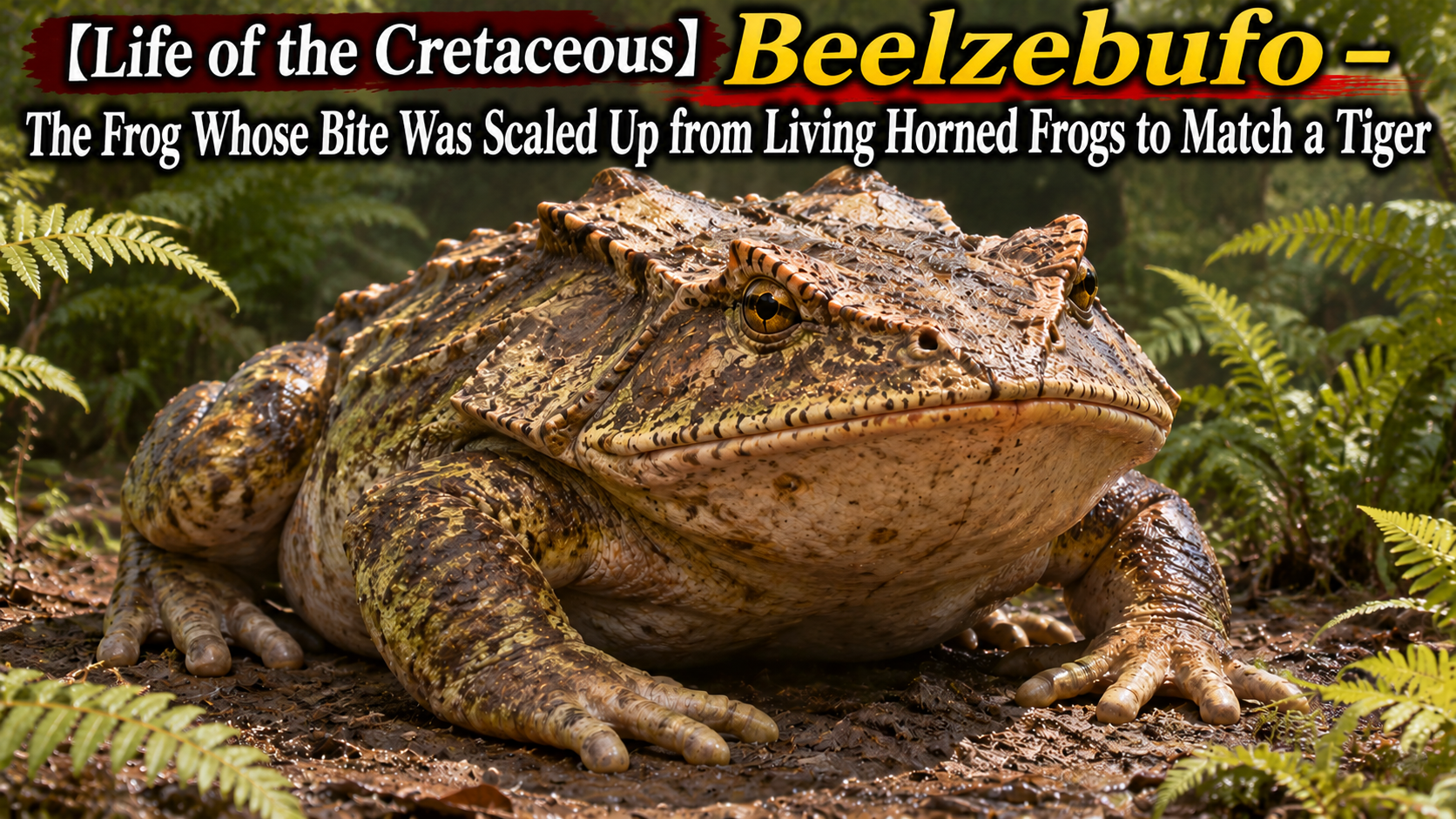
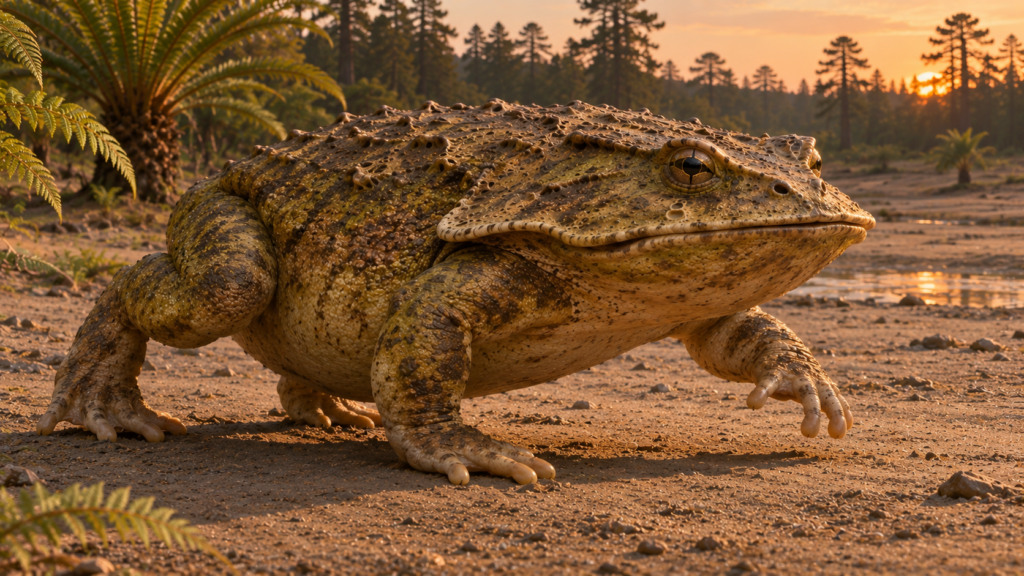
Beelzebufo was a big-headed frog that lived in Madagascar near the end of the Cretaceous. Its skull was thick and covered with rough, pitted bone. A study that measured the bite of living South American horned frogs estimated that a large Beelzebufo could bite about as hard as a tiger or a lion.
Appearance and Way of Life
The fossils of Beelzebufo come from the Maevarano Formation in the Mahajanga Basin of northwestern Madagascar. The first bones were found in 1993, and in 2008 Susan Evans of University College London and her colleagues named the animal as a new genus and species. Nearly all the finds are isolated fragments of skull bones; by 2014, 64 specimens were known from 27 localities. In 2010 a specimen turned up with part of the skull and several vertebrae together, and it showed the shape of the body in more detail than before.
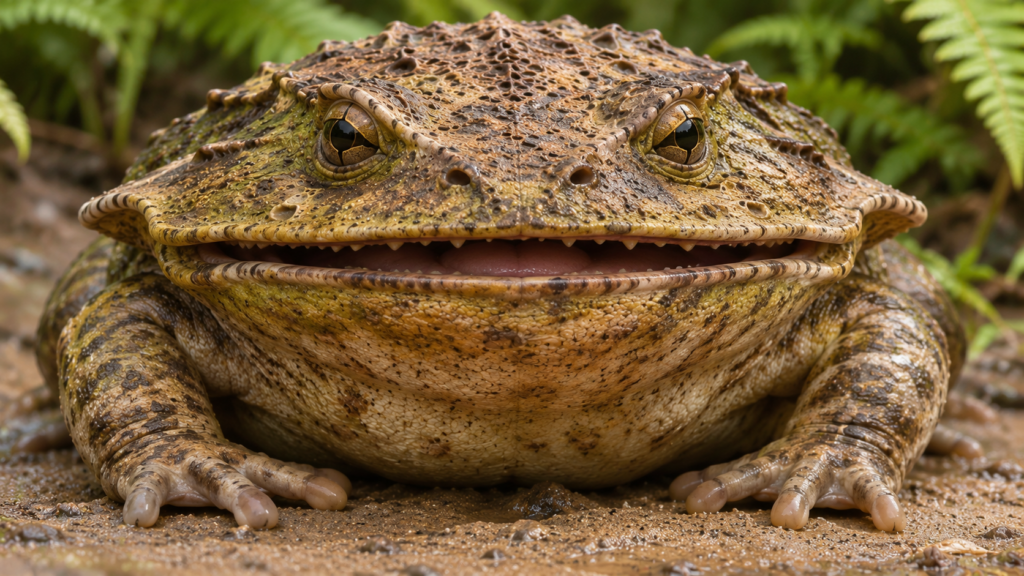
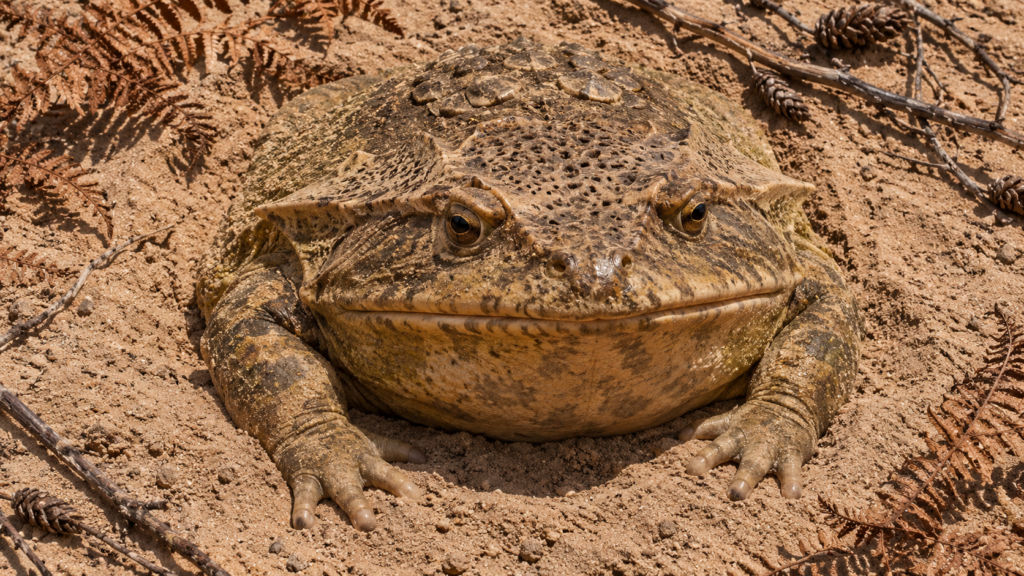
The head was short and broad, and the mouth opened across its full width. The surface of the skull bones carries a coarse pattern of deep pits and ridges. At the back of the head, a bony flange on each side extended out behind the jaw joint. Pointed teeth lined the upper jaw. The vertebrae toward the front had tall spines capped with bony plates sculptured like the skull, and these are thought to have covered the front of the back like a shield. The species name, “shield,” refers to this heavy bone.
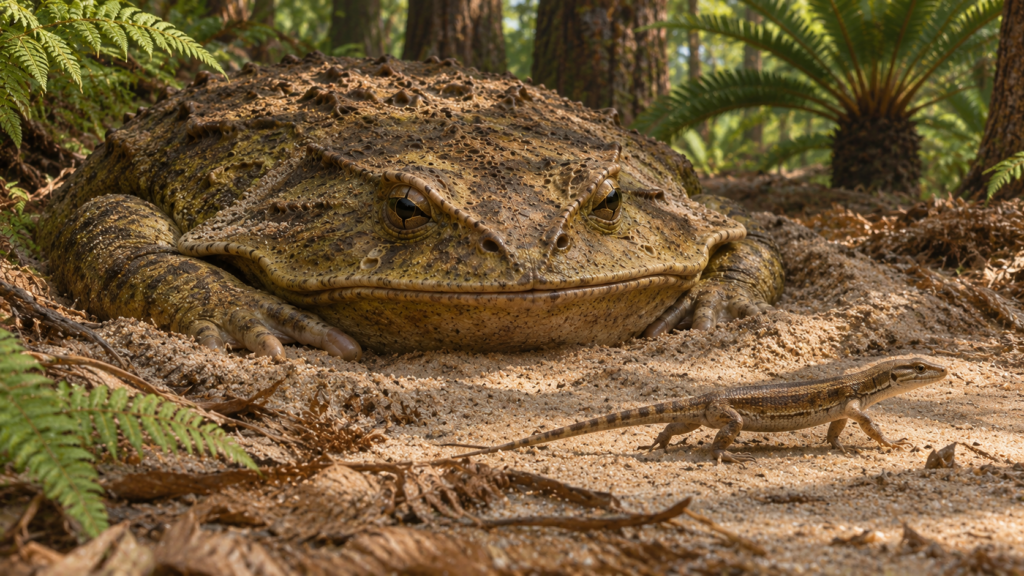
The shin bones were short for the size of the body, and Beelzebufo is thought to have walked more than it hopped. It appears to have had no eardrum, and that, together with the thick skull and the form of the vertebrae, has led to the suggestion that it burrowed into the ground during dry seasons. The Maevarano Formation was laid down on a semi-arid floodplain with wet and dry seasons. The same rocks have yielded the meat-eating dinosaur Majungasaurus, the sauropod Rapetosaurus, and fossils of crocodile relatives, snakes, lizards, turtles, birds and mammals.
Estimates of its size have changed from one publication to the next. The 2008 paper put most specimens at 16 to 27 cm in body length and the owners of the largest bones at more than 40 cm, and the reconstruction was drawn at 42.5 cm. The announcement at the time described a frog about 41 cm long and weighing about 4.5 kg, possibly the heaviest frog that ever lived. The largest living frog, the goliath frog of West Africa, reaches about 32 cm and about 3.3 kg.
In 2014 the same team redid the reconstruction using the new material. They estimated the body length of the associated specimen at about 19 cm, and that of the largest individual at about 23 cm. That is smaller than first thought, but among heavily built living frogs it matches the largest African bullfrogs and cane toads. Because the skull sutures had not closed in some individuals, the animals may have been able to grow larger still.
Its classification is not settled either. The analyses of 2008 and 2014 both placed Beelzebufo with the horned frogs of South America. Dates for the origin of the horned frog group estimated from genes, however, are younger than Beelzebufo, and they are hard to square with the time when Madagascar and South America were connected by land. The team itself accepts that Beelzebufo may belong to a different lineage of frogs that lived in a similar way and came to look the same.
A Bite Force Estimated from Living Horned Frogs
The 2008 paper said that Beelzebufo was probably an ambush predator like the horned frogs of today and would have eaten small vertebrates. The announcement added that it might even have taken hatchling dinosaurs. This was an inference from the resemblance, though, and nobody knew how much force its jaws could deliver. No one had measured the bite force of any frog.
In 2017, Kristopher Lappin of California State Polytechnic University, Pomona, and his colleagues measured bite force in the Cranwell horned frog of South America. Horned frogs catch prey with a very sticky tongue and then clamp it in their jaws. They are known to eat animals about as large as themselves, including frogs, lizards, snakes, birds and rodents.
The team used a force sensor fitted with two stainless steel plates, with leather on the part the frogs bit. Eight frogs that had completed metamorphosis were raised for a year and made to bite the plates repeatedly as they grew. They ranged from about 4 to 10 cm in body length and from about 2.2 to 4.6 cm in head width, and the bite forces recorded ran from 2.7 to 32.9 newtons. Bite force rose with head width faster than would be expected from the change in body size alone.
Applied to bigger frogs, this relationship gives a bite of almost 500 newtons for a large horned frog with a head about 10 cm wide. For Beelzebufo, the team used the head sizes from the 2014 revision. Biting at the middle of the jaw, the associated specimen (with a head width of about 11 cm in the calculation) was estimated at about 750 newtons, and the largest individual (head width about 15 cm) at about 2,200 newtons.
The paper describes this top figure as similar to the estimated bite forces of lions and tigers (about 2,000 to 2,200 newtons). Even at the tip of the jaws the estimate is about 1,100 newtons, which is more than the estimate for a wolf (about 770 newtons). The team concluded that a large Beelzebufo could have preyed on the small dinosaurs, young dinosaurs and small crocodile relatives that lived alongside it.
These figures come from measurements of eight horned frogs with heads less than 5 cm wide, extended to an animal more than three times that size. The paper itself says the estimates should be treated with caution. The skull of Beelzebufo was longer and flatter than that of a horned frog, so its jaw-closing muscles may have been arranged differently. No fossil directly shows that it ate dinosaurs; no stomach contents or bite marks have been found.
Related products
You can find books and products related to this article on Amazon.
If you buy through the links above, this blog may earn a commission.
About the images
The images in this article are illustrations created with AI (ChatGPT), and you are welcome to use them. If you do, we would appreciate a link back to this article as the source.
Sources
Evans, S. E., Jones, M. E. H. & Krause, D. W. (2008). A giant frog with South American affinities from the Late Cretaceous of Madagascar. PNAS 105, 2951–2956. https://doi.org/10.1073/pnas.0707599105
Evans, S. E., Groenke, J. R., Jones, M. E. H., Turner, A. H. & Krause, D. W. (2014). New material of Beelzebufo, a hyperossified frog (Amphibia: Anura) from the Late Cretaceous of Madagascar. PLOS ONE 9, e87236. https://doi.org/10.1371/journal.pone.0087236
Lappin, A. K., Wilcox, S. C., Moriarty, D. J., Stoeppler, S. A. R., Evans, S. E. & Jones, M. E. H. (2017). Bite force in the horned frog (Ceratophrys cranwelli) with implications for extinct giant frogs. Scientific Reports 7, 11963. https://doi.org/10.1038/s41598-017-11968-6
U.S. National Science Foundation (2008). News release on the 2008 description (length, weight, year the first bones were found). https://www.eurekalert.org/news-releases/592343
University of Adelaide (2017). News release on the bite force study. https://www.eurekalert.org/news-releases/801722

コメント