This article contains affiliate links. As an Amazon Associate I earn from qualifying purchases.
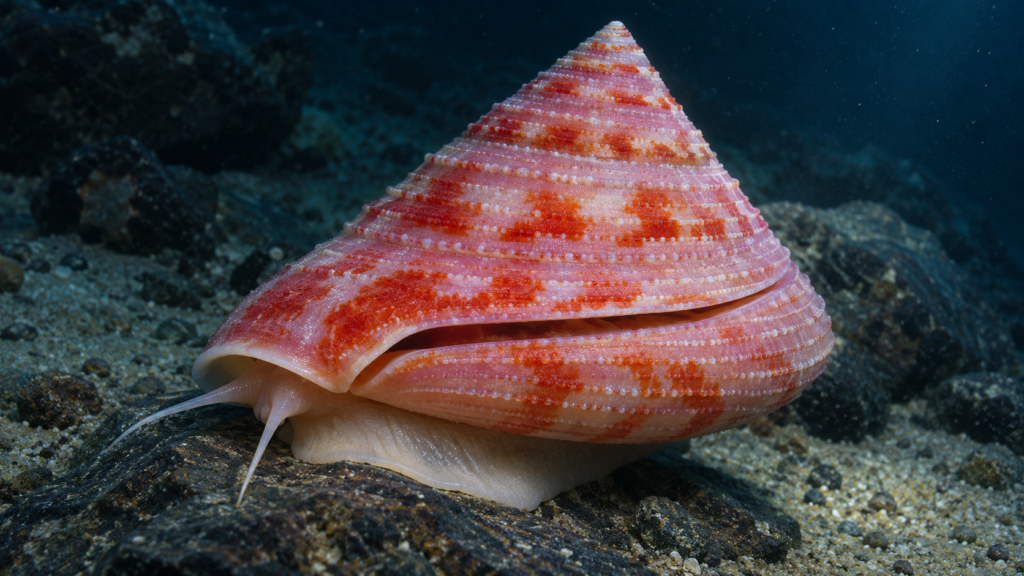
| Name | Beyrich’s slit shell (Mikadotrochus beyrichii), called okina-ebisu in Japanese. It is figured under that name in Mokuhachifu, a Japanese shell book of 1843. Also known as choja-gai, “the rich man’s shell”. Described in 1877 as Pleurotomaria beyrichii |
| Classification | Mollusca, Gastropoda, Vetigastropoda, Pleurotomariida, Pleurotomariidae |
| Age | Living today. The oldest fossils of the order Pleurotomariida date from the late Cambrian to the Early Ordovician |
| Range | Seas around Japan, including Sagami-nada, the entrance to Tokyo Bay and the waters off the Boso Peninsula |
| Depth | 113–118 m in a submersible survey in Sagami-nada |
| Shell size | About 7–9 cm across and 6.5–8 cm high (two specimens measured in the 19th century) |
| Slit | About 3 cm long and 3 mm wide (from the same specimens) |
Beyrich’s slit shell is a sea snail that lives on fairly deep seafloors around Japan. Its conical shell has a single long, narrow slit in the lip of the opening. Fossils of snails with the same slit are found in Paleozoic rocks, and the group has long been called “living fossils”. At the end of the 19th century only a handful of specimens existed anywhere in the world. A collector at Misaki is said to have been paid 40 yen for one, which is how the snail came to be called choja-gai, “the rich man’s shell”.
Appearance and Way of Life
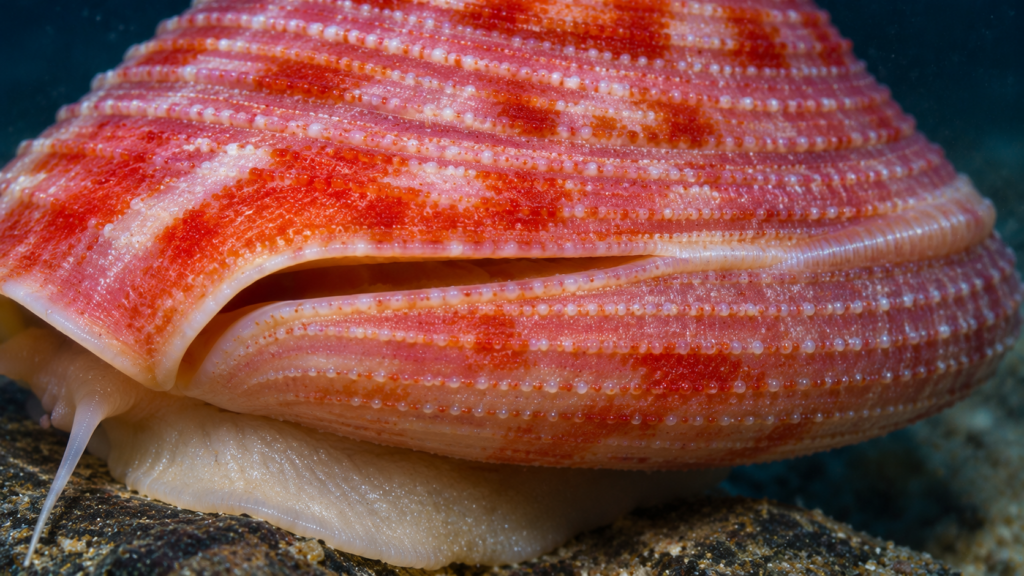
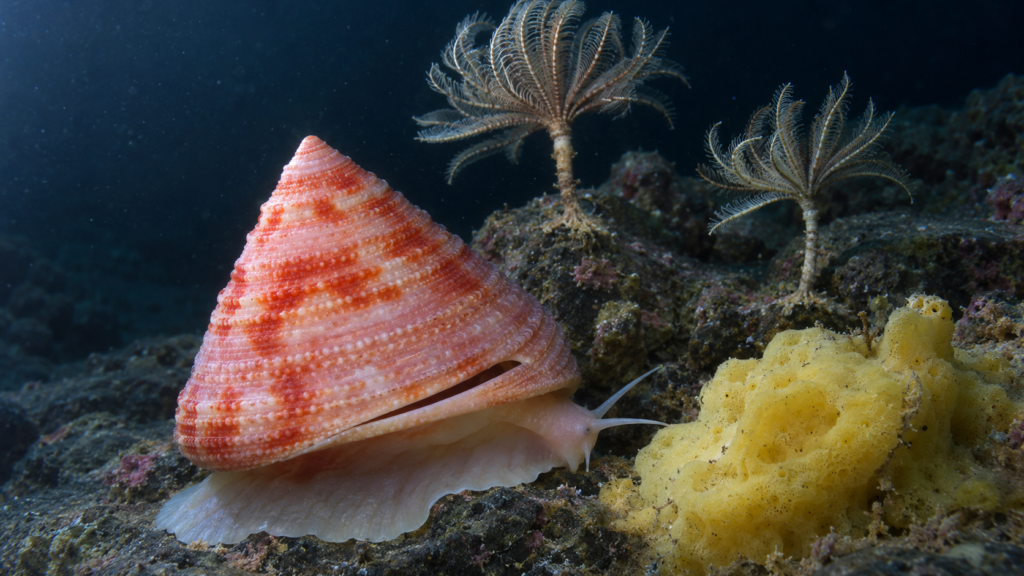
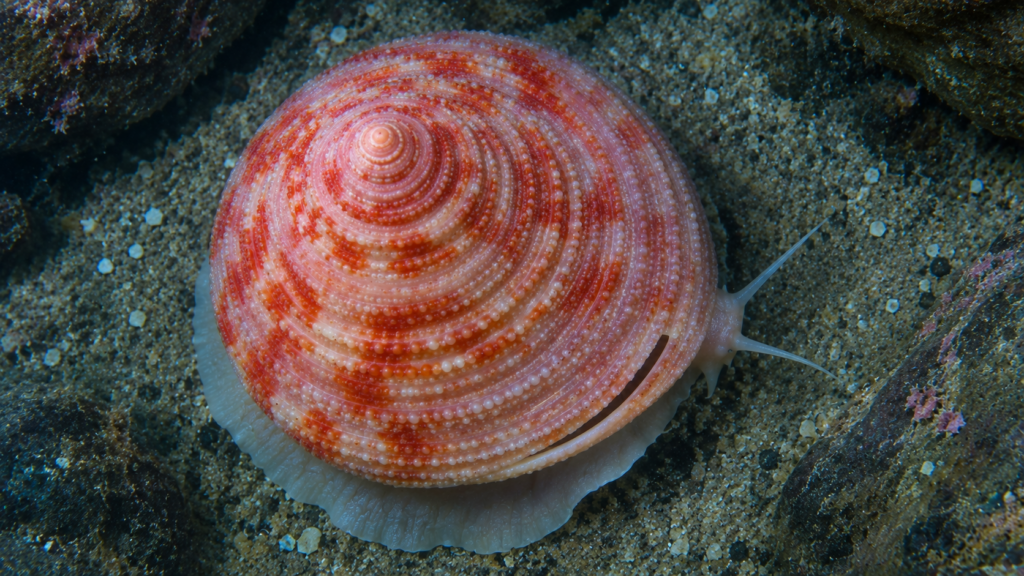
The shell is shaped like a spinning top turned point up. It is pale flesh-coloured, crossed by irregular bands of orange to vermilion, and its surface carries fine ribs that follow the spiral. A long, narrow slit runs back along the whorl from the outer lip of the opening. In a specimen reported in 1898, the shell was 71 mm across and 65 mm high, and the slit was 31 mm long and 3 mm wide.
The animal’s excretory opening sits at the slit, and the slit is also used in breathing: it serves as a passage for exchanging the water in the space inside the shell where the gills lie. As the snail grows and the lip of the shell advances, the older part of the slit is sealed bit by bit, leaving a band on the surface of the shell. Most snails living today have no such slit.
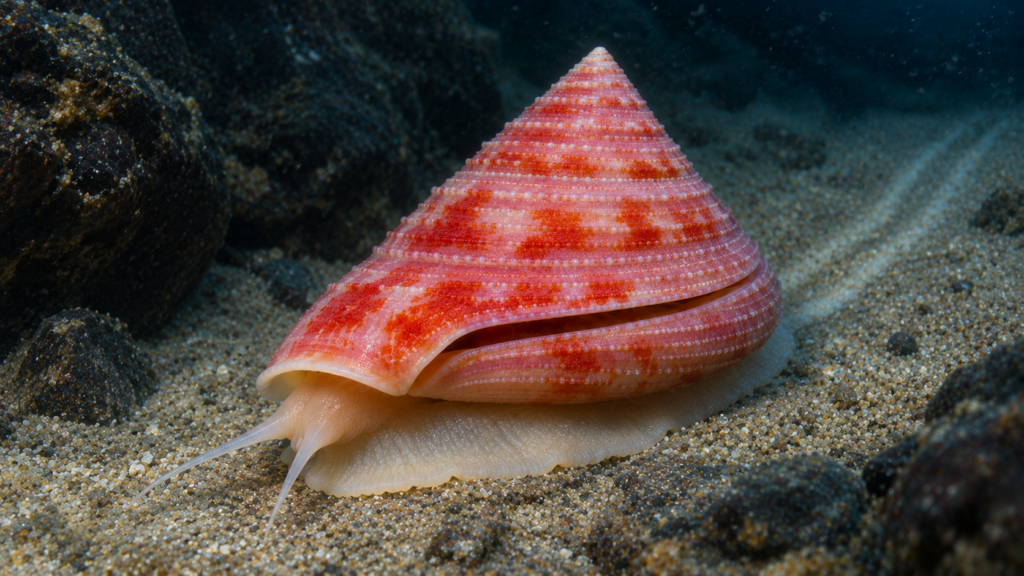
Living animals were observed in the 1980s from the research submersible Shinkai 2000. On the seafloor at the edge of the continental shelf in Sagami-nada, 113–118 m down, more than 13 slit shells were seen and two specimens of this species were collected. They were on patches of sand among rocks, in a place with a fast current, with sea lilies and sponges nearby. The water temperature was 12.7–13.5°C. Taking these observations together with observations in captivity, the report concluded that this snail is sensitive to light and is not an inhabitant of the deep-sea floor. In Sagami-nada and at the entrance to Tokyo Bay, it is sometimes caught from winter to spring in gillnets set for flatfish, and in captivity it survived for about 30 days without feeding. The Geological Museum of Japan’s National Institute of Advanced Industrial Science and Technology lists the food of a close relative, Mikadotrochus hirasei, as sponges along with sea lilies and corals.
Of all the groups of snails still alive, the order Pleurotomariida has the fossil record that reaches back furthest. Its oldest fossils date from the late Cambrian to the Early Ordovician. In the middle and late Paleozoic it grew to more than 50 genera living at the same time and was among the most diverse groups of snails. Its diversity fell sharply in the mass extinction at the end of the Permian, and from the Middle Jurassic onward almost the only family left was the Pleurotomariidae. A mollusc database lists 44 living species. In Japan, a fossil slit shell has been found in rocks about 6 million years old (late Miocene) at Kyonan in Chiba Prefecture.
The Snail Called “the Rich Man’s Shell”
The species was named on 20 March 1877, when the German zoologist Franz Hilgendorf showed a specimen from Japan at a scientific society meeting in Berlin. Hilgendorf had taught at a medical school in Tokyo, and according to the Geological Museum, he bought the specimen in 1875 at a souvenir shop on Enoshima. Hilgendorf himself wrote that it came to him with an older collection that had no labels, so its exact origin could not be traced. In Japan the snail had already been figured in 1843 by the naturalist Musashi Sekiju in Mokuhachifu.
At the time, only four living species of slit shells were known in the world. A record compiled in 1898 by the French malacologists Dautzenberg and Fischer counts the known specimens: 5, 6 and 4 for the other three species, and 9 for this one. Many of those nine had been bought from shops or fishermen on Enoshima. A complete specimen obtained there in 1881 was later sold for 950 marks and went to the museum in Berlin, and another obtained on Enoshima in 1882 or 1883 was bought for 500 marks by a man in Weymouth, England.
According to the Geological Museum, requests for specimens came from many countries after Hilgendorf’s announcement, and the British Museum asked the University of Tokyo to collect one. Aoki Kumakichi, the collector at the university’s marine biological station at Misaki in Kanagawa Prefecture, collected the snail and brought it to professors Iijima and Mitsukuri, and was paid 40 yen. A night’s lodging then cost 2 sen, a fiftieth of a yen. Kumakichi remarked that he felt as if he had become a rich man, a choja, and this is said to be the origin of the name choja-gai. The 1898 record also notes that a specimen taken in 1897 on the Okinose bank off Boso was observed alive by Mitsukuri and went to the British Museum.
Related products
You can find books and products related to this article on Amazon.
If you buy through the links above, this blog may earn a commission.
About the images
The images in this article are illustrations created with AI (ChatGPT), and you are welcome to use them. If you do, we would appreciate a link back to this article as the source.
Sources
Geological Museum, National Institute of Advanced Industrial Science and Technology (AIST). Recommended specimen stories: the living fossil okina-ebisu (in Japanese). https://www.gsj.jp/Muse/story/src/story_027.pdf
Dautzenberg, Ph. & Fischer, H. (1898). Note sur le Pleurotomaria Beyrichi. Journal de Conchyliologie 46, 218–224. https://www.vliz.be/imisdocs/publications/ocrd/303323.pdf
Kanie, Y., Sugiura, A. & Egawa, K. (1986). Submarine observations on Mikadotrochus beyrichii (Archaeogastropoda) in Sagami-Nada, central Honshu, Japan. Venus (Japanese Journal of Malacology) 45(3), 203–209. https://doi.org/10.18941/venusjjm.45.3_203
Karapunar, B., Höhna, S. & Nützel, A. (2024). Phylogeny of the longest existing gastropod clade (Pleurotomariida) reconstructed with Bayesian and parsimony methods and its implications on gastropod shell characters. Journal of Systematic Palaeontology 22(1), 2384141. https://doi.org/10.1080/14772019.2024.2384141
World Register of Marine Species, Mikadotrochus beyrichii (Hilgendorf, 1877) https://www.marinespecies.org/aphia.php?p=taxdetails&id=413451
コメント