This article contains affiliate links. As an Amazon Associate I earn from qualifying purchases.
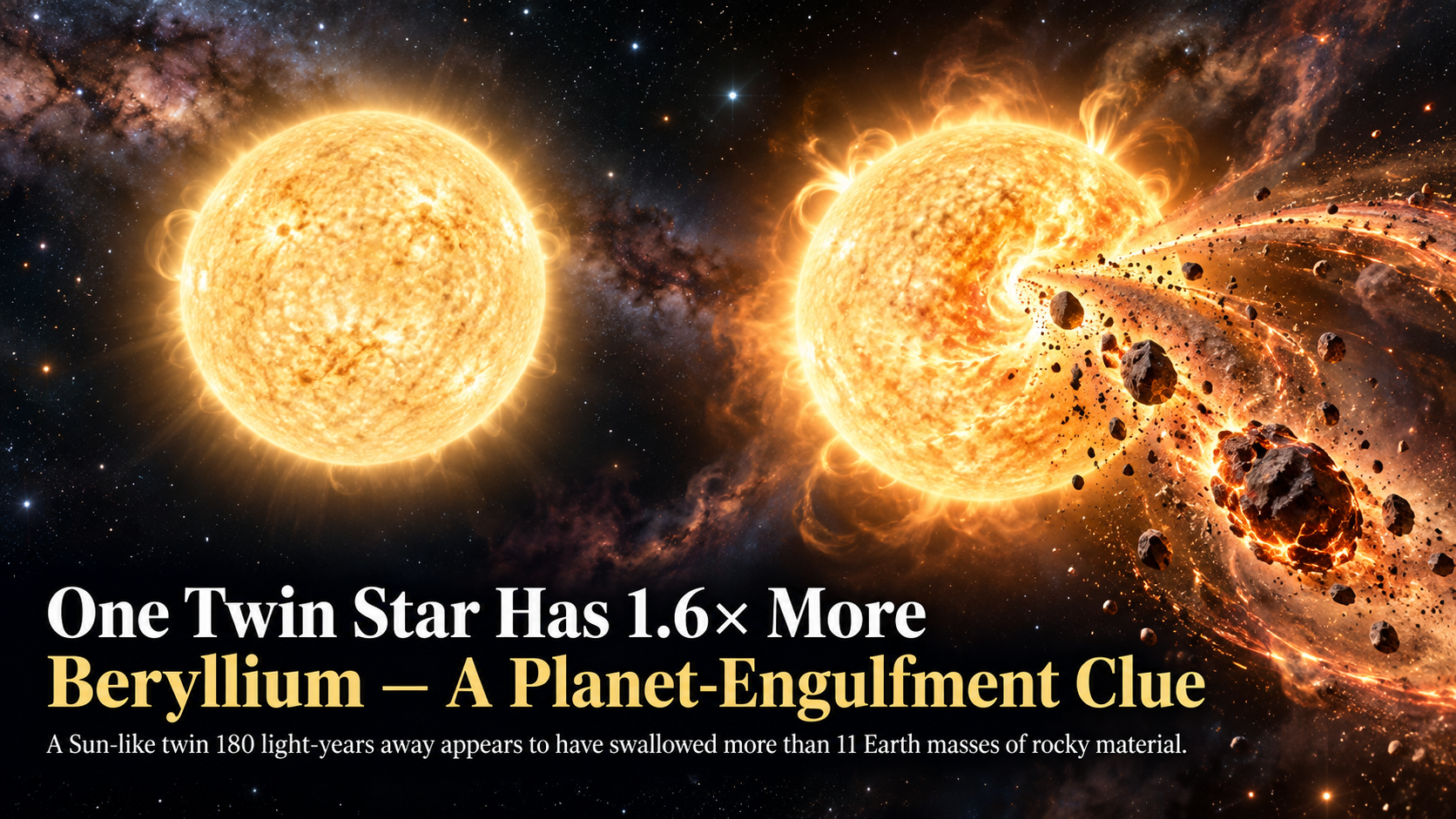
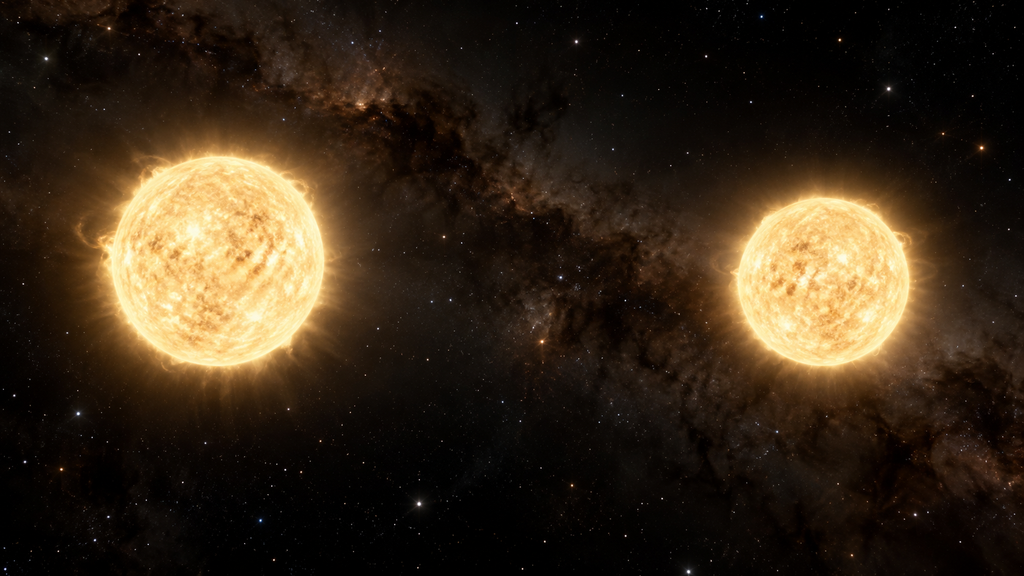
Two stars were born from the same cloud of gas at the same time. They are HD 129171 and HD 129209, a binary pair about 180 light-years away in the direction of the constellation Boötes. Their surface temperatures differ by just 24 degrees, each has about 1.1 times the mass of the Sun, and both are roughly five billion years old. With the same raw material, they should contain the same mix of elements.
They do not. One of them, HD 129171, holds about 1.3 times as much iron, and a full ten times as much lithium. A 2021 study examined this mismatch in detail and proposed that one star had swallowed one of its own planets.
In June 2026, a paper in the journal Astronomy & Astrophysics reported new measurements of the pair made with a more capable spectrograph. The first author is Anne Rathsam, a doctoral student at the University of São Paulo. The decisive clue turned out to be neither iron nor lithium, but an element that stars cannot make for themselves: beryllium.
Twin Stars With Different Insides
The two members of a binary form when the same cloud collapses, so they are expected to start out with identical proportions of elements. When astronomers measure closely matched pairs with care, the compositions usually do agree.
Over the past decade or so, however, a growing number of pairs have turned up that look like twins but differ slightly inside. The differences always show up in the same group of elements: iron, magnesium, silicon, calcium, and others that readily condense into solids even at high temperatures. These are also the main ingredients of rocky planets.
Two explanations are on the table. One is that the parent cloud was not uniform to begin with, so the proportions of elements varied from place to place. The other is that, after birth, one star swallowed a rocky planet and its material dissolved into the star’s surface layers.
Which one is right matters beyond this single pair. If clouds are patchy, it weakens the assumption behind efforts to trace the Galaxy’s history by reading a star’s composition to learn which cloud it came from. If engulfment is the cause, it means that planetary systems violent enough to drop a planet into its star are more common than expected.
The Bigger the Rock-Forming Element, the Bigger the Gap
HD 129171 and HD 129209 are one of the best-known examples of these mismatched twins. The 2021 study measured 28 elements and showed that HD 129171 is richer specifically in the elements that build rock. The more readily an element condenses into a solid, the larger the gap between the two stars, a clean trend.
Rathsam and her colleagues re-observed the pair with UVES, a spectrograph on the European Southern Observatory’s Very Large Telescope in Chile. The instrument spreads starlight into a fine rainbow, and the depth of the dark lines that each element leaves at its own wavelengths reveals how much of that element is present.
The key technique was to compare the two stars directly against each other. Trying to pin down absolute amounts of an element in a star drags in errors from the estimates of surface temperature and gravity. But when two nearly identical stars are compared line by line, most of those errors cancel out. This approach confirmed the 2021 results with higher precision: about 1.3 times more iron and ten times more lithium in HD 129171.
And this time, the team measured something new: beryllium.
An Element Stars Cannot Make
Beryllium is the fourth element in the periodic table, right next to lithium. Most elements in the universe are forged by nuclear fusion inside stars, but beryllium is an exception. Stars do not produce it. A tiny amount was made just after the Big Bang, and the rest is created bit by bit when cosmic rays smash atoms in interstellar space.
What is more, in stars of about the Sun’s mass, beryllium does not get destroyed either. Lithium burns away at around 2.5 million degrees, so whenever surface material is carried down to hotter layers, it dwindles. That is why the Sun’s surface holds less than a hundredth of the lithium it was born with. Beryllium needs about 3.5 million degrees to be destroyed, and the surface material of a Sun-like star is never carried that deep. In the Sun and in heavier Sun-like stars, no decline in beryllium with age has been found.
So the amount of beryllium at the surface of a Sun-like star stays essentially fixed from birth. The star neither makes it nor destroys it. If one twin born from the same cloud has more beryllium than the other, the only explanation left is that it arrived from outside later on.
This is the big difference from lithium. Lithium is also not produced inside stars, so an excess does hint at material from outside. But lithium keeps declining over the billions of years that a star spends on the main sequence, so there is no precise way to know how much there should have been originally. Studies have used excess lithium as evidence of planet engulfment before, such as in TOI-5882, 1,357 light-years away. In that case, though, the star had to be shown to stand far above many other stars of similar age and mass.
The beryllium lines sit at a wavelength of 313 nanometers, in the near-ultraviolet. That region is crowded with lines from other elements, which makes it hard to decide where the baseline brightness, the level with no lines at all, should be. The team built twelve versions of the processed spectrum for each star, each with a slightly different baseline, and chose the one that best matched a theoretical model of the light.
The result: HD 129171 has about 1.6 times as much beryllium as its companion HD 129209. The gap is five times the measurement uncertainty, a clear detection. Extra iron or magnesium alone might have been explained by a patchy cloud, but a beryllium difference is not expected to arise that way. With this, the engulfment scenario became considerably stronger.
Eleven Earths’ Worth of Rock
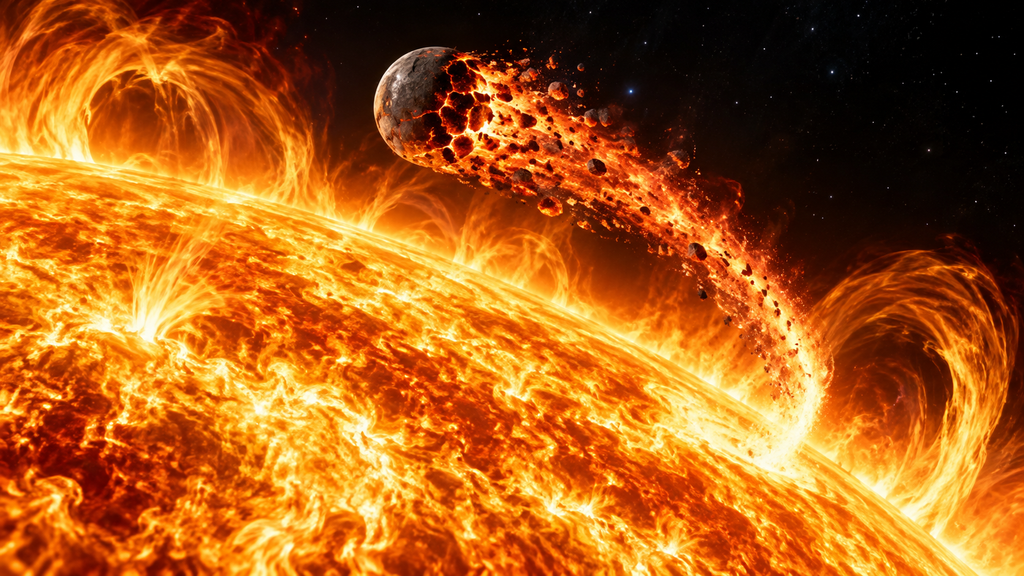
How much rock did HD 129171 swallow? The team used a program that calculates how much each element rises when rocky material dissolves into a star’s outer convective layer, and tried to reproduce the observed element-by-element differences.
The best match came from 11.2 Earth masses of rock. The composition that fit was a blend of 0.1 Earth masses of Earth-like material and 11.1 Earth masses of material resembling a primitive meteorite type from the early Solar System, a kind of carbonaceous chondrite. Almost every element landed within the error bars. The figure is not far from the roughly 9.8 Earth masses estimated in the 2021 study.
That number is a lower limit, though. The calculation assumes the engulfed material affects only the outer layers and ignores what happens afterward. In reality, a surface layer suddenly enriched in heavy elements becomes unstable and begins mixing with the interior, so the surface excess thins out over time. The difference seen today is therefore smaller than it was right after the event, and the original amount may have been larger.
Another open question is whether this was a single large planet or several smaller bodies adding up to the same total. Stars of about the Sun’s mass have deep convective layers, and anything that falls in, large or small, is torn apart, melted, and mixed before it can reach the interior. The leftover proportions of elements carry no record of how many objects fell or what they looked like.
The lithium line held one more intriguing hint. Lithium comes in two forms of different mass, lithium-6 and lithium-7, and the fragile lithium-6 should be completely gone by the time a star settles onto the main sequence. The lithium line of HD 129171 is slightly asymmetric, which is consistent with some lithium-6 still being present. But convection in the star’s surface gas can produce the same asymmetry, so the team drew no conclusion from it in this analysis.
Are Calm Systems Like Ours Rare?
The paper’s other main point is that beryllium can serve as a tool for telling whether a Sun-like star has swallowed a planet. If one twin in a pair has more beryllium, that is a trace of engulfment. Unlike lithium, there is no need to estimate an original amount, and the signal does not fade easily with time. One more clue has been added to the toolkit.
And if these twin mismatches really are caused by engulfment, the picture of planetary systems shifts a little. A separate 2021 study of 107 closely matched binaries found that the hotter the stars, the larger the fraction of pairs with mismatched compositions. Hotter stars have thinner convective layers, so swallowed material is diluted less, and the trend fits the engulfment scenario. A 2025 calculation estimated that about half of Sun-like stars swallow a planet at some point in their lives, but that only about a fifth of those would leave a detectable chemical trace.
Co-author Jorge Meléndez of the University of São Paulo says that, taken together, this evidence suggests that systems like the Solar System, where the planets stayed in their original orbits, may be less common than we imagined. Rathsam adds that for a planet to be habitable, the right environment is not enough: it also has to sit in an orbit stable enough to survive being jostled by other bodies without falling into its star.
Of course, this is a result from a single binary. The claim that beryllium works as an engulfment indicator applies only to Sun-like stars, not to lower-mass stars with deep convective layers. Even so, the idea of using an element that stars neither make nor destroy as a yardstick can be tested every time another pair of look-alike twins is found. The method of reading a star’s dining record from its surface is gaining precision, one pair at a time.
Related products
You can find books and products related to this article on Amazon.
If you buy through the links above, this blog may earn a commission.
Sources
Links open in a new tab.
- A. Rathsam, J. Meléndez, R. Smiljanic, F. Liu, L. Spina, “Planet engulfment in the chemically anomalous HD 129171/HD 129209 pair,” Astronomy & Astrophysics 710, A236 (June 2026). DOI: 10.1051/0004-6361/202659556 / arXiv:2606.05934 (free manuscript)
- Universe Today (2026-09-16): When Stars Engulf Rocky Planets, Beryllium Gives it Away


コメント