This article contains affiliate links. As an Amazon Associate I earn from qualifying purchases.
| Name | Deinosuchus (Deinosuchus; from the Greek for “terrible” and “crocodile.” Three species are currently recognised: D. riograndensis, D. hatcheri and D. schwimmeri) |
| Classification | Reptilia, Crocodylia in the broad sense (regarded either as a relative of alligators or as lying outside the common ancestor of all living crocodylians) |
| Period | Late Cretaceous, Campanian (about 82 to 75 million years ago) |
| Found in | United States (Montana, Texas, New Mexico, Utah, New Jersey, North Carolina, Georgia, Alabama, Mississippi), Mexico (Coahuila) |
| Length | About 8 to 10 m (1999 estimate). A 2025 study puts large individuals at about 7.7 m |
| Weight | About 2.5 to 5 tonnes (1999 estimate) |
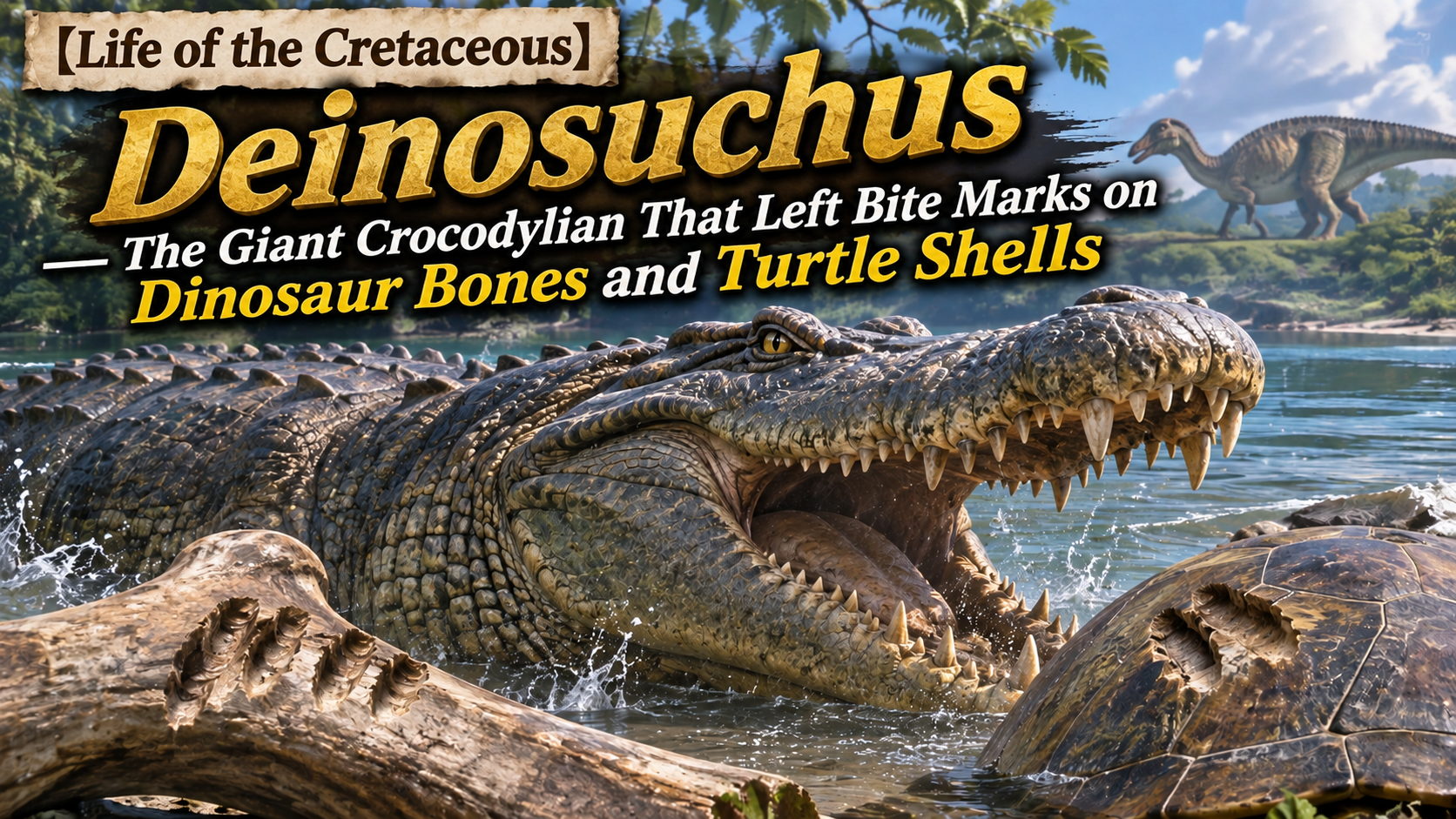
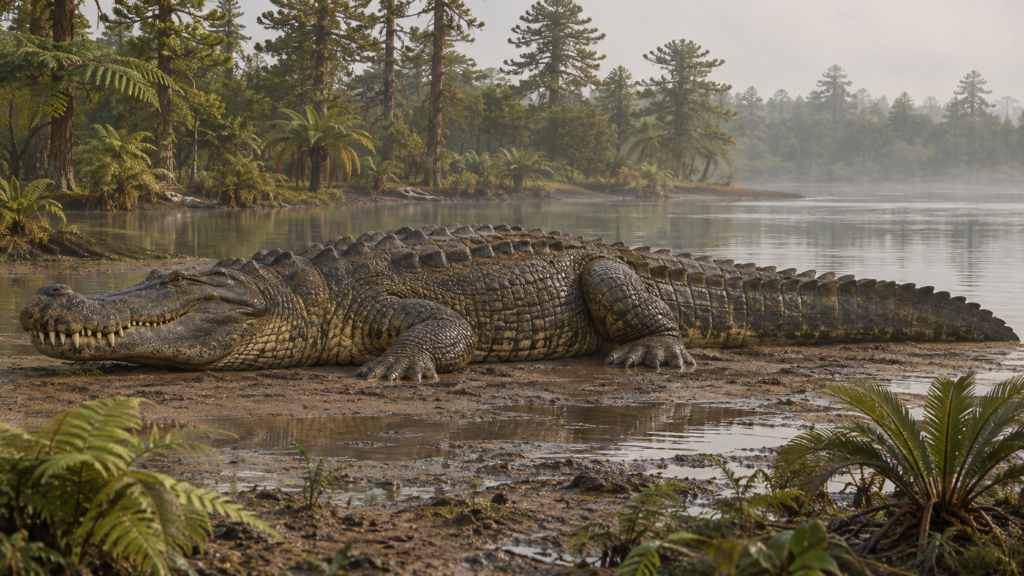
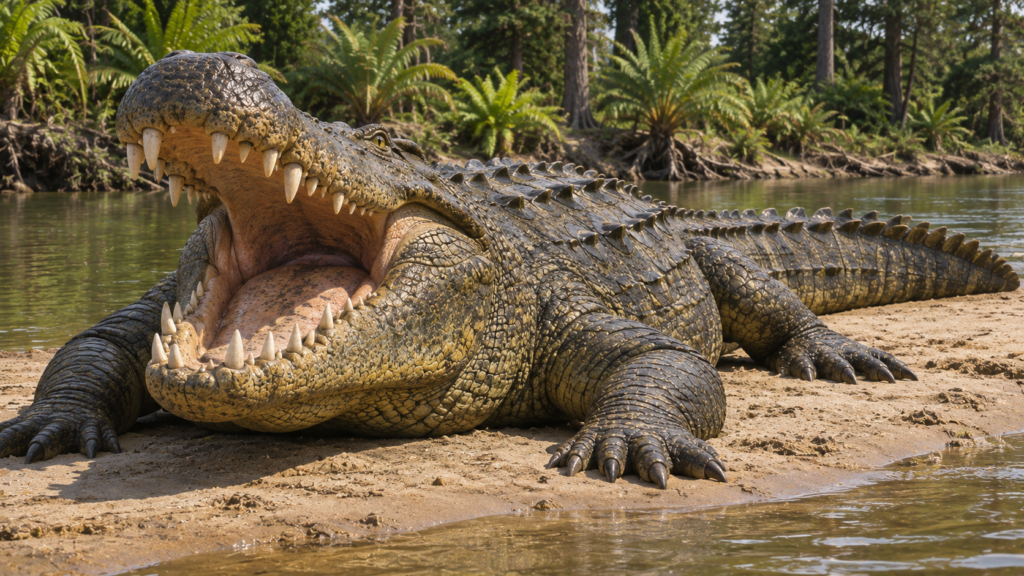
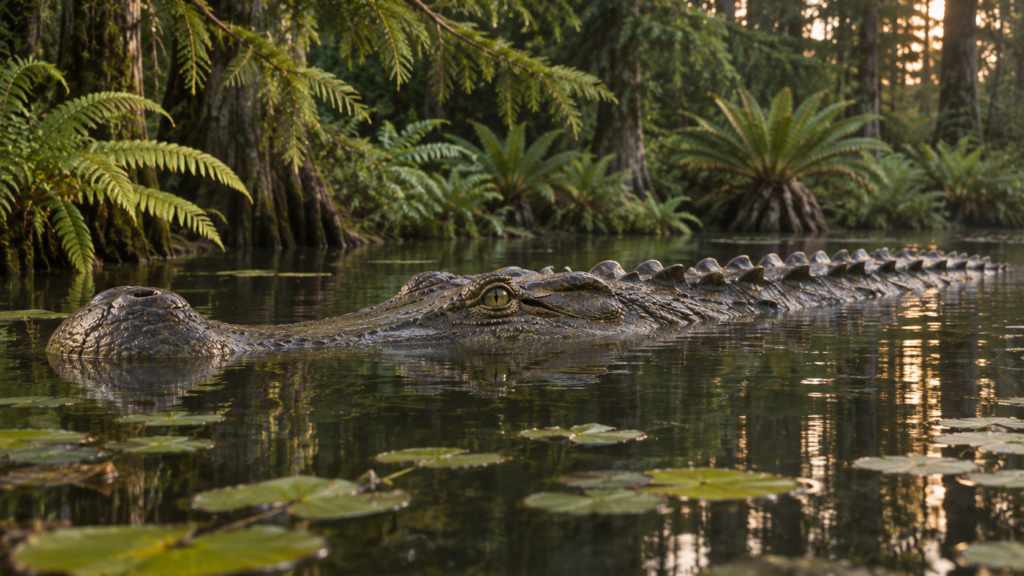
Deinosuchus was a giant crocodylian of Late Cretaceous North America. It lived along the shores on both sides of the inland sea that split the continent from east to west. Its bite marks survive on dinosaur bones and sea turtle shells.
Appearance and Way of Life
The first fossils came from the Judith River Formation of Montana, and in 1909 William Holland of the Carnegie Museum named them Deinosuchus hatcheri. The specimen consists of only a few bones, and some of them have since been lost. In 1940 an American Museum of Natural History expedition led by Barnum Brown dug up a large skull and jaws at Big Bend in Texas, and in 1954 Edwin Colbert and Roland Bird described them as a separate genus, Phobosuchus riograndensis.
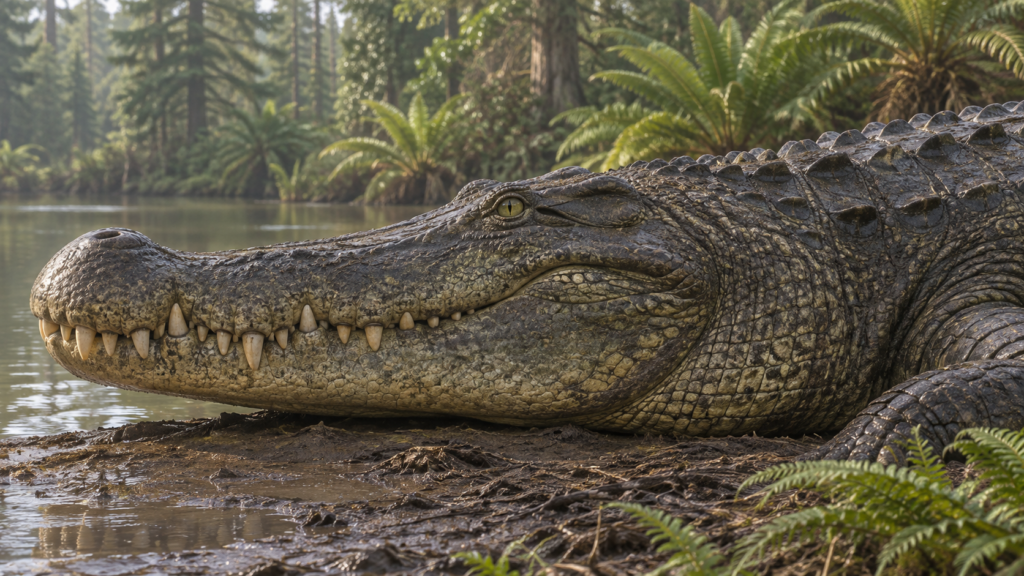
In 2020 Adam Cossette and Christopher Brochu of the University of Iowa reviewed the Deinosuchus fossils and sorted them into three species: D. riograndensis and D. hatcheri in the west, and a new species, D. schwimmeri, in the east. The western D. riograndensis was on average much larger than the eastern species, and one specimen has a lower jaw about 1.8 m long. The tip of the snout swells upward into a rounded dome, and large openings on either side of the nostril are unlike anything seen in other crocodylians. What these openings were for is unknown.
In the Late Cretaceous, a shallow sea called the Western Interior Seaway divided North America into Appalachia in the east and Laramidia in the west. Deinosuchus fossils are found on both sides of it.
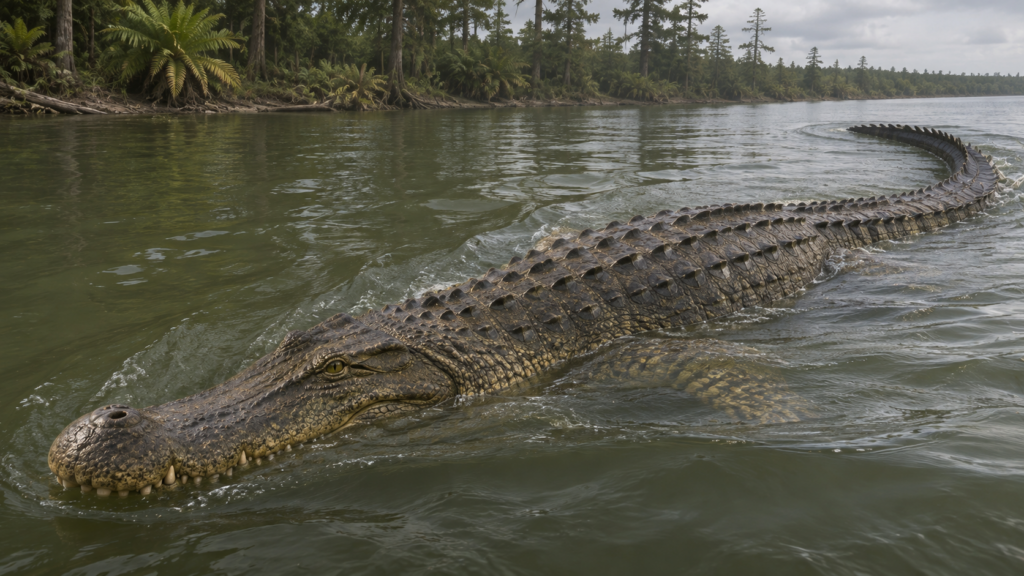
As for size, in 1999 Gregory Erickson of Florida State University and Brochu counted growth lines in the bony scutes of its skin and estimated a length of 8 to 10 m and a weight of 2.5 to 5 tonnes. They concluded that Deinosuchus did not grow faster than living crocodiles but became giant by continuing to grow for many years. In 2025, however, a team including researchers at the University of Tübingen recalculated its length from the width of the skull and found that even large individuals of D. riograndensis reached about 7.7 m, and D. schwimmeri about 6.4 m. They suggest the earlier estimates were probably too high.
Its place in the family tree is also debated. Cossette and Brochu placed Deinosuchus among the relatives of alligators in 2020. The 2025 study put it outside the common ancestor of all living crocodylians and inferred that its ancestors could tolerate seawater. The team suggests that it is found on both sides of the inland sea because it spread by crossing the water.
Bite Marks on Dinosaur Bones and Turtle Shells
In 2009 Héctor Rivera-Sylva of Mexico and his colleagues reported a bite mark on a tail bone of a hadrosaur from the Aguja Formation of Coahuila. The 85 mm bone has a hole about 7.9 mm across and 5.7 mm deep. The team concluded that it was most likely made by D. riograndensis.
In 2010 David Schwimmer of Columbus State University reviewed bones bearing Deinosuchus bite marks from Campanian rocks in the United States and northern Mexico. Large, blunt bite marks appear on many sea turtle shells and on several dinosaur bones, and some go right through the shell. The back teeth of Deinosuchus were low and rounded, suited to crushing hard objects. Big Bend National Park also notes that dinosaur bones from the Aguja Formation carry crocodile bite marks.
In 2012 Erickson and his colleagues measured the bite force of all 23 living crocodylian species and, from that relationship, estimated that an 11 m, 3,450 kg Deinosuchus could have bitten with a force of up to about 102,800 newtons. The highest bite force measured in a living animal is 16,414 newtons, from a saltwater crocodile. The estimate, though, extends well beyond the range of living species, and the authors themselves regard it as uncertain.
The 2025 study found from isotopes in its tooth enamel that Deinosuchus was linked to seawater or marine prey, which fits the idea that it ate sea turtles. The bite marks on dinosaur bones and turtle shells show that Deinosuchus took large animals at the water’s edge.
Related products
You can find books and products related to this article on Amazon.
If you buy through the links above, this blog may earn a commission.
About the images
The images in this article are illustrations created with AI (ChatGPT), and you are welcome to use them. If you do, we would appreciate a link back to this article as the source.
Sources
Holland, W. J. (1909). Deinosuchus hatcheri, a new genus and species of crocodile from the Judith River beds of Montana. Annals of the Carnegie Museum 6, 281–294. https://doi.org/10.5962/p.214851
Erickson, G. M. & Brochu, C. A. (1999). How the ‘terror crocodile’ grew so big. Nature 398, 205–206. https://doi.org/10.1038/18343
Rivera-Sylva, H. E., Frey, E. & Guzmán-Gutiérrez, J. R. (2009). Evidence of predation on the vertebra of a hadrosaurid dinosaur from the Upper Cretaceous (Campanian) of Coahuila, Mexico. Carnets de Géologie, Letter 2009/02. https://doi.org/10.4267/2042/28152
Schwimmer, D. R. (2010). Bite marks of the giant crocodylian Deinosuchus on Late Cretaceous (Campanian) bones. New Mexico Museum of Natural History and Science Bulletin 51.
Erickson, G. M. et al. (2012). Insights into the ecology and evolutionary success of crocodilians revealed through bite-force and tooth-pressure experimentation. PLoS ONE 7(3), e31781. https://doi.org/10.1371/journal.pone.0031781
Cossette, A. P. & Brochu, C. A. (2020). A systematic review of the giant alligatoroid Deinosuchus from the Campanian of North America and its implications for the relationships at the root of Crocodylia. Journal of Vertebrate Paleontology 40(1), e1767638. https://doi.org/10.1080/02724634.2020.1767638
Walter, J. D., Massonne, T., Paiva, A. L. S., Martin, J. E., Delfino, M. & Rabi, M. (2025). Expanded phylogeny elucidates Deinosuchus relationships, crocodylian osmoregulation and body-size evolution. Communications Biology 8. https://doi.org/10.1038/s42003-025-07653-4
Big Bend National Park, “Deinosuchus.” https://www.nps.gov/bibe/learn/nature/deinosuchus.htm

コメント