This article contains affiliate links. As an Amazon Associate I earn from qualifying purchases.
In September 2025, a proposal for a “neutrino laser” appeared in a physics journal. The calculation went like this: cool a cloud of radioactive atoms until they settle into a single quantum state, and a decay that normally takes 86 days would be over in about a minute, with the neutrinos emerging as a beam pointed in one direction. Neutrinos pass straight through the Earth, so if this worked, it might lead to communication with the far side of the planet or to a new kind of detector. That was the hope.
Exactly one year later, on September 2, 2026, two papers appeared side by side in the same journal. Both reach the same conclusion: it cannot work. And they were written by the physicist who, thirty years earlier, first achieved the very technique the proposal rested on, cooling atoms into one shared quantum state, and who received a Nobel Prize for it.
Cooling Radioactive Atoms to Make Them Decay Together
The proposal came from Ben Jones of the University of Texas at Arlington and Joseph Formaggio of the Massachusetts Institute of Technology (MIT). It was published in Physical Review Letters on September 8, 2025.
The material they chose was rubidium-83, a radioactive isotope of rubidium. It decays by a process called electron capture: the nucleus absorbs one of the atom’s own electrons, turns into krypton-83, and releases a single neutrino. Its half-life is about 86 days, so left alone, it takes close to three months for half of a million atoms to decay.
According to the two authors’ calculation, if about a million of these atoms were gathered and cooled to within a hair of absolute zero, into a Bose-Einstein condensate, the decays would happen all at once and the half-life would shrink to about a minute.
A Bose-Einstein condensate is a state in which many atoms occupy the same single quantum state and the whole cloud behaves like one large wave. It was first created in the laboratory in 1995 and was recognized with the 2001 Nobel Prize in Physics. One of the laureates was Wolfgang Ketterle, who appears later in this story.
The condensate itself, however, is not what speeds up the decay. Formaggio originally thought that simply cooling the atoms into a condensate would accelerate it, but the math did not hold up, and he has described that early idea as a red herring. What Jones brought in instead was the concept of superradiance.
Applying Superradiance, Proven With Light, to Neutrinos
Superradiance was predicted in 1954 and has since been confirmed experimentally with light. When atoms that can emit light are lined up in the same quantum state, the first atom’s emission leaves a record of itself in the collective. That record encourages the next atom to emit, and the emission snowballs. With N atoms, the rate of independent emission is proportional to N, but under superradiance it scales with N squared. For a million atoms, that is a difference of up to a million times.
Jones and Formaggio took the equations that describe optical superradiance and applied them directly to the decay of rubidium-83. A neutrino comes out instead of a photon. The atoms are condensed into the same state. So the emission should snowball, and the neutrinos should come out aligned in one direction. That was the argument.
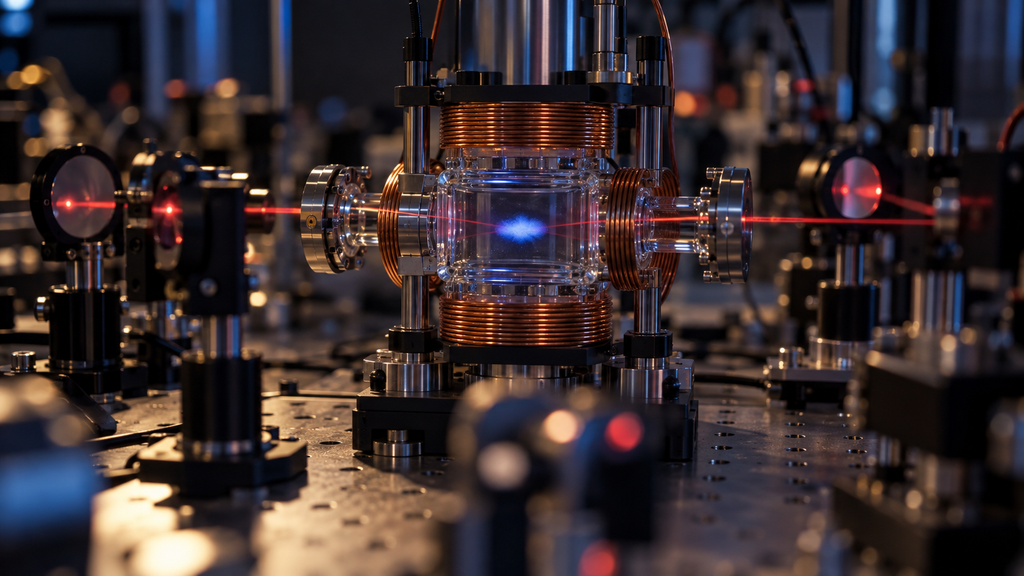
No one has yet made a Bose-Einstein condensate out of radioactive atoms, because they tend to decay before they can be cooled enough. Still, it was considered within reach technically by trapping the radioactive atoms together with stable rubidium and cooling them as a mixture, and the two authors spoke of testing it in a small tabletop experiment.
The Person Who Made the Condensate Redid the Math
The two rebuttal papers were written by Wolfgang Ketterle of MIT together with two postdoctoral researchers in his group, Yu-Kun Lu and Hanzhen Lin. Ketterle was one of the physicists who first realized Bose-Einstein condensation in 1995 and shared the 2001 Nobel Prize in Physics. The rebuttal, in other words, came from inside the same institution as Formaggio, the proposal’s co-author.
The two papers were posted as preprints (manuscripts not yet peer reviewed) in October 2025 and, after peer review, were published together in Physical Review Letters on September 2, 2026. The first is titled “Fundamental Impossibility of a Superradiant Neutrino Laser,” the second “Can Bose-Einstein Condensates Enhance Radioactive Decay?”
They deal with separate problems. And as Ketterle puts it, either paper on its own would have killed the proposal.
Problem One: The Atom Flies Out at Mach 10
The first problem is a matter of scale. A photon of visible light carries roughly one electronvolt of energy. The neutrino released in the decay carries about a million times more, around one million electronvolts.
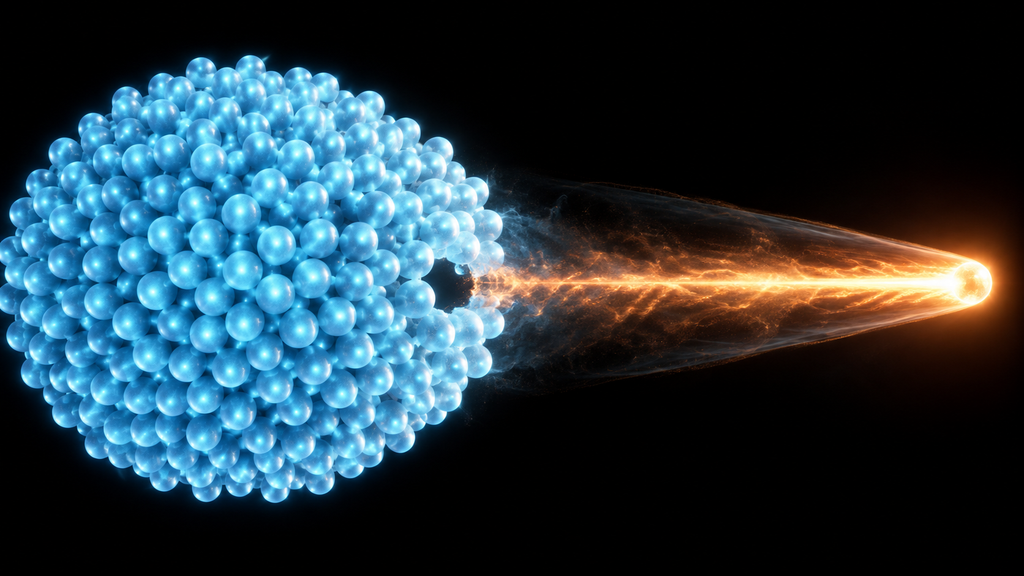
An atom that emits a particle recoils in the opposite direction. For a photon, the recoil is tiny and the atom stays inside the condensate. The recoil from a neutrino is in a different league: the atom shoots out of the condensate at several kilometers per second, about ten times the speed of sound. For a condensate one millimeter long, it is gone in well under a microsecond.
Superradiance needs the record of the first emission to stay in the collective. If the recoil removes the atom, no record remains. On top of that, by Lin and colleagues’ estimate, the electron vacancy left in the decayed atom fills in about a femtosecond (a quadrillionth of a second), so the collective loses step even before the neutrino has crossed the condensate, which takes about three picoseconds (three trillionths of a second).
The neutrino’s wavelength adds another problem. It is on the order of a picometer (a trillionth of a meter), about a millionth of the wavelength of light. Such a short wavelength opens up an enormous number of possible emission directions, and instead of lining up in one direction, the emission is spread across something like a trillion of them. Fold all of this together and the amplification gain comes out at ten to the minus sixteenth power or less. For the rubidium-83 neutrino specifically, it is around ten to the minus twenty-third, nowhere near enough to shorten a half-life by five orders of magnitude.
Problem Two: Even With Zero Recoil, Neutrinos Block the Next Emission
The second paper goes deeper. Set aside the recoil and the wavelength entirely, assume the atoms are perfectly still, and run the calculation under ideal conditions. Superradiance still does not happen. That is what the paper proves.
The reason lies in what a neutrino is. Particles come in two kinds: bosons, any number of which can pile into the same state, and fermions, no two of which can occupy the same state. Photons are bosons. Neutrinos are fermions.
In optical superradiance, the record of the first photon stays in the collective and encourages a second emission in the same direction. When Lu and colleagues rewrote the equations for fermion emission, the sign flipped. After the first neutrino is emitted, the atoms are left in a state that blocks a second emission in the same direction. The emission waves from different atoms cancel each other instead of adding up. In the calculation, the collective drops into a “dark state” as soon as one neutrino is out, and cannot emit another in that direction.
As a result, the emission rate never scales with N squared. It tops out at a rate proportional to N, which is no better than the atoms decaying independently. The proposal’s equations were still the ones for photons, Lu and colleagues point out, and the fact that neutrinos are fermions had never entered them.
The proof is generalized so that it holds regardless of how the atoms are arranged or how they interact. Superradiance still works when the emitting atoms are fermions. It fails when the emitted particles are. That single point, not any engineering hurdle, is where the neutrino laser runs aground.
“Nature Is the Final Arbiter”
Formaggio, on the proposing side, has taken the rebuttal as typical of neutrino physics. Every past prediction about neutrinos has turned out wrong, he notes, and neutrinos have never once failed to surprise physicists. Whatever the theory concludes, he expects someone will eventually test it in an experiment.
Ketterle, for his part, has not dismissed the proposal as a bad idea. Finding nature’s surprises takes creative ideas and open discussion, he says. In the case of the neutrino laser, the surprise was simply too good to be true.
The two papers draw a clear line between the road that is closed and the ones that remain open. Superradiance with visible light, in the electronvolt range, is readily achievable with today’s technology. Carrying the same idea into the million-electronvolt range, on the other hand, looks out of reach with current technology, and that verdict covers not only neutrinos but also proposals for gamma-ray lasers based on condensates of positronium. The dream of talking to the other side of the Earth with neutrinos will not arrive by this road. On paper, at least, that is now settled.
The same property that makes neutrinos pass through the Earth is a strength on the observing side. The story of IceCube, which turned a cubic kilometer of Antarctic ice into a detector, is told in this article on the 2026 Nobel Prize in Physics.
Related products
You can find books and products related to this article on Amazon.
If you buy through the links above, this blog may earn a commission.
Sources
- Y.-K. Lu, H. Lin, W. Ketterle, “Fundamental Impossibility of a Superradiant Neutrino Laser,” Physical Review Letters 137, 101804 (September 2, 2026). DOI: 10.1103/8x7k-rwx2 / arXiv:2510.21705 (free preprint)
- H. Lin, Y.-K. Lu, W. Ketterle, “Can Bose-Einstein Condensates Enhance Radioactive Decay?” Physical Review Letters 137, 101805 (September 2, 2026). DOI: 10.1103/rnx6-wqpf / arXiv:2510.21692 (free preprint)
- B. J. P. Jones, J. A. Formaggio, “Superradiant Neutrino Lasers from Radioactive Condensates,” Physical Review Letters 135, 111801 (September 8, 2025). DOI: 10.1103/l3c1-yg2l
- MIT News (September 2, 2026): New research shows a neutrino laser is impossible
- MIT News (September 8, 2025): Physicists devise an idea for lasers that shoot beams of neutrinos
- Hackaday (September 21, 2026): New Research Suggests That A Neutrino Laser Is Impossible

コメント