This article contains affiliate links. As an Amazon Associate I earn from qualifying purchases.
| Name | Argentavis (Argentavis magnificens; the genus name combines the Latin for “silver” and “bird” and refers to Argentina; the species name means “magnificent”) |
| Classification | Aves, Teratornithidae |
| Period | Neogene, late Miocene (about 6 million years ago) |
| Found in | Argentina (Salinas Grandes de Hidalgo in La Pampa Province, and other sites) |
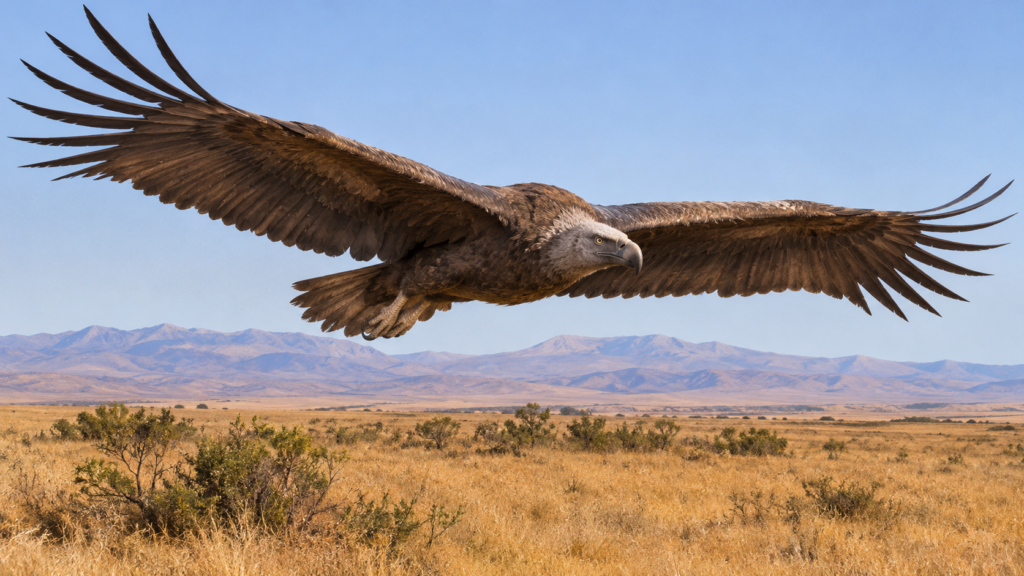
| Wingspan | Estimated at about 7 m (6.5–7.5 m); a recalculation gives 5.1–6.1 m |
| Weight | Estimated at 70–72 kg (65–120 kg depending on the study) |
| Standing height | Estimated at about 1.5 m |
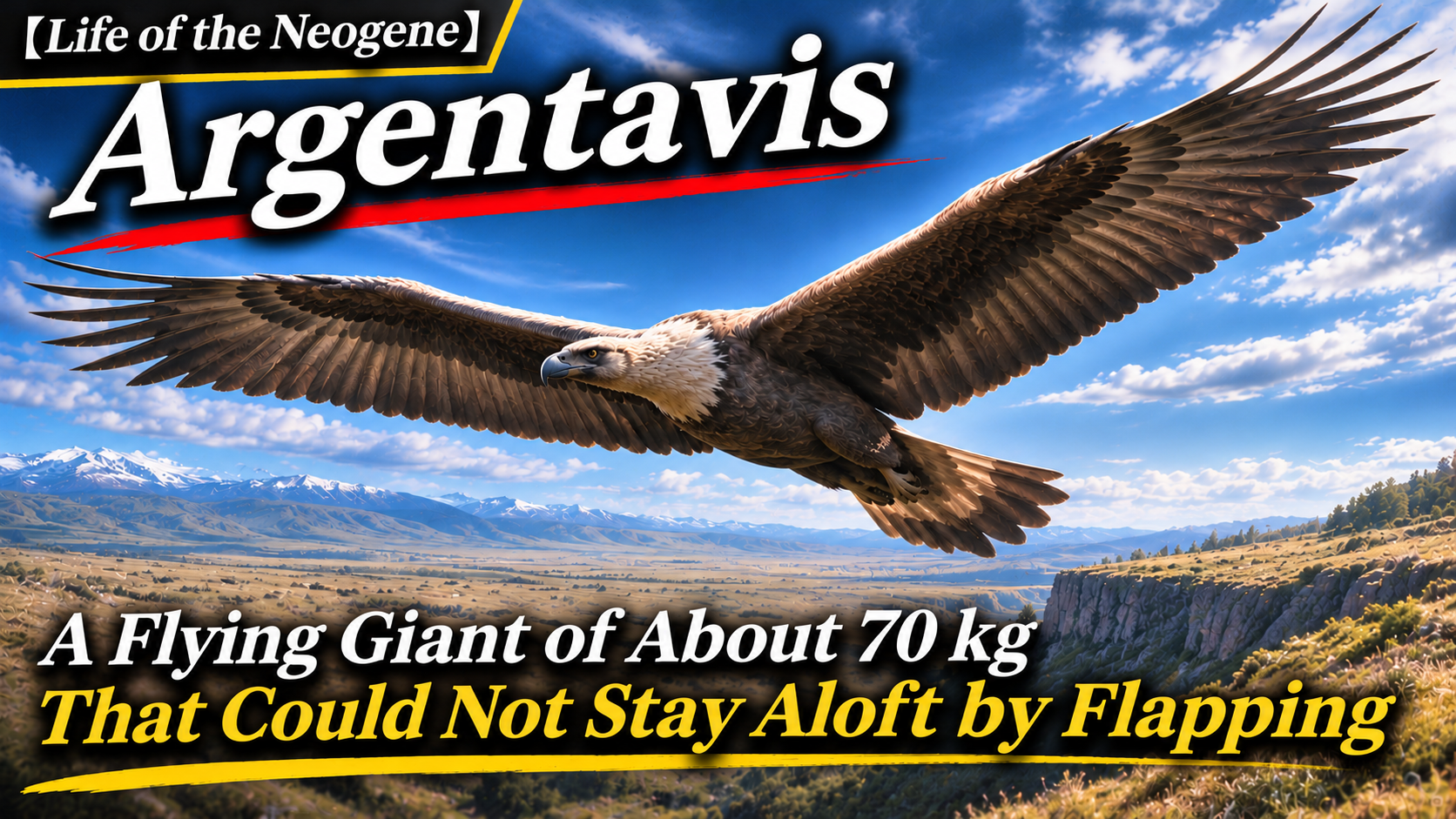
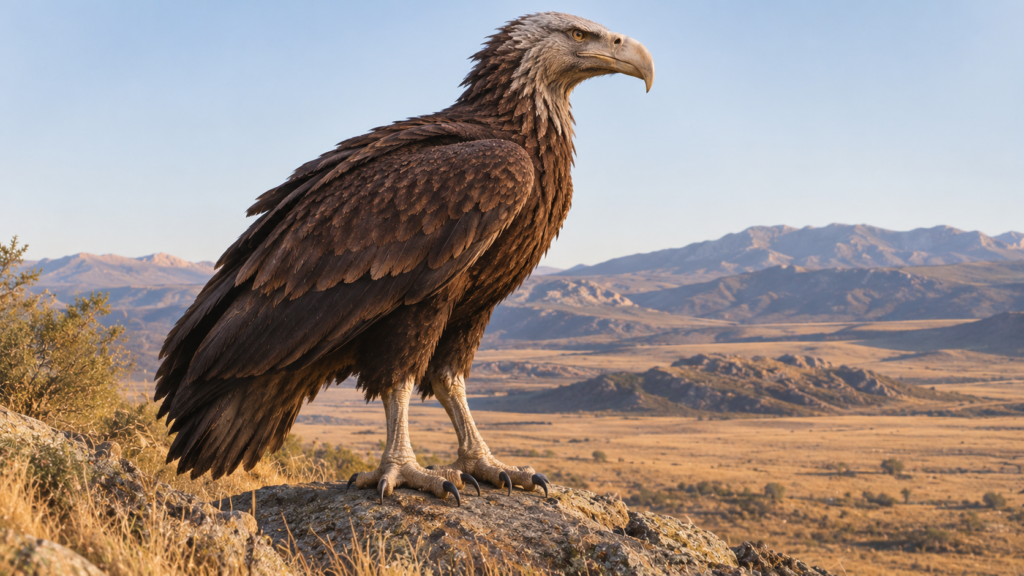
Argentavis was a giant flying bird that lived in Argentina about 6 million years ago. It belonged to the extinct family Teratornithidae and is estimated to have weighed about 70 kg. A 2007 study concluded that its muscles could not supply enough power for it to stay in the air by flapping.
Appearance and Life
Argentavis was described as a new genus and species in 1980 by Kenneth Campbell of the Natural History Museum of Los Angeles County and Eduardo Tonni of the Museo de La Plata in Argentina. The description rests on a partial skeleton of one individual collected at Salinas Grandes de Hidalgo, a salt flat in La Pampa Province. It consists of parts of the skull, the humerus, the coracoid of the shoulder, and fragments of the forearm, hand and leg bones, all of them badly fractured. The lower jaw has not been found. The humerus is about 57 cm long.
Its size has been estimated from close relatives known from complete skeletons, such as Teratornis merriami. In the original description, Campbell and Tonni gave a wingspan of 6.5–7.5 m and a standing height of about 1.5 m. Their 1983 paper used the thickness of the leg bones to estimate a weight of about 80 kg, with a wingspan of 6–8 m. The 2007 flight study worked with a weight of 70–72 kg, a wingspan of about 7 m and a wing area of about 8 square meters, and estimated that the primary feathers at the wingtips were 140–150 cm long and 12–14 cm wide. Among living flying birds, the largest wingspan is the roughly 3.5 m of the wandering albatross, and the heaviest are the bustards at about 19 kg.
There is also a smaller estimate of the wingspan. In 2014, Daniel Ksepka recalculated the wings of Argentavis in the paper that reported Pelagornis sandersi, a seabird with an estimated wingspan of 6.1–7.4 m. Working from bone lengths, he obtained a wingspan of 5.1–6.1 m for Argentavis and pointed out that the earlier figures of 7 m or more were extrapolated from body mass. In weight, the estimates for Argentavis are about twice the 22–40 kg estimated for Pelagornis sandersi.
The teratorns were a group of large birds of the Americas. They were long thought to be close to the condors (the New World vultures), but Campbell and Tonni wrote that the skull has almost no points of similarity with them, and their closest relatives remain unsettled. More than 100 individuals of the Ice Age Teratornis merriami have been recovered from the La Brea Tar Pits in California. It had a wingspan of 3.5–3.8 m and weighed about 15 kg. Argentavis weighed more than four times as much.
The beds that yielded Argentavis have also produced the saber-toothed marsupial relative Thylacosmilus, a glyptodont, a ground sloth, hoofed mammals found only in South America, and rodents related to the capybara. Argentina at the time was warmer and drier than today, with open, treeless plains.
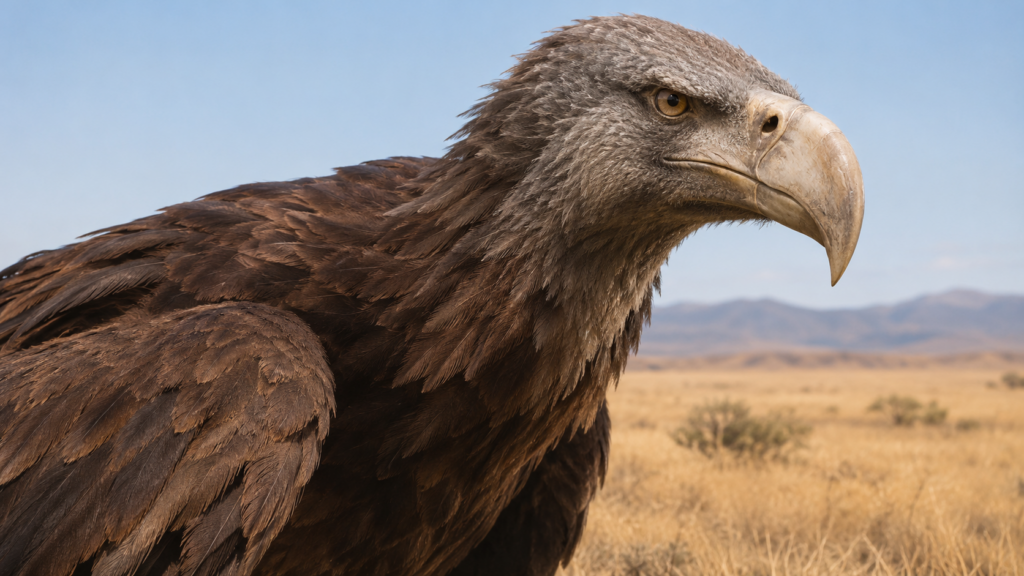
What it ate is disputed. Campbell and Tonni noted that the skull had a mechanism for opening the mouth wide, concluded that it fed differently from eagles and condors, and saw it as a predator that caught its own prey and swallowed it whole. In 2003, Paul Palmqvist and Sergio Vizcaíno calculated its ecology from its body size and regarded it as a scavenger that ranged widely in search of carcasses. By their calculation, one bird needed a range of about 540 square kilometers, ate 5–10 kg of meat a day, and raised about one chick every two years.
Not Enough Power to Stay Aloft by Flapping
The larger a bird is, the more power it needs to keep flying by flapping. The flight muscles make up about 17 percent of body weight regardless of the size of the bird. The Andean condor, among the heaviest living flying birds, reaches almost 16 kg. In a 2020 study, condors fitted with recorders flapped for about 1 percent of their time in the air.
How Argentavis, more than four times as heavy, could have flown was calculated in 2007 by Sankar Chatterjee of Texas Tech University, R. J. Templin of Canada, and Campbell, who had described the bird. They used a flight model originally developed for helicopter design. A 70 kg bird needs at least 600 watts to sustain level flapping flight. The flight muscle of Argentavis was estimated at about 11 kg, and the power it could deliver continuously was 170 watts, less than a third of what was required. Chatterjee and his colleagues concluded that continuous flapping flight was almost certainly not possible.
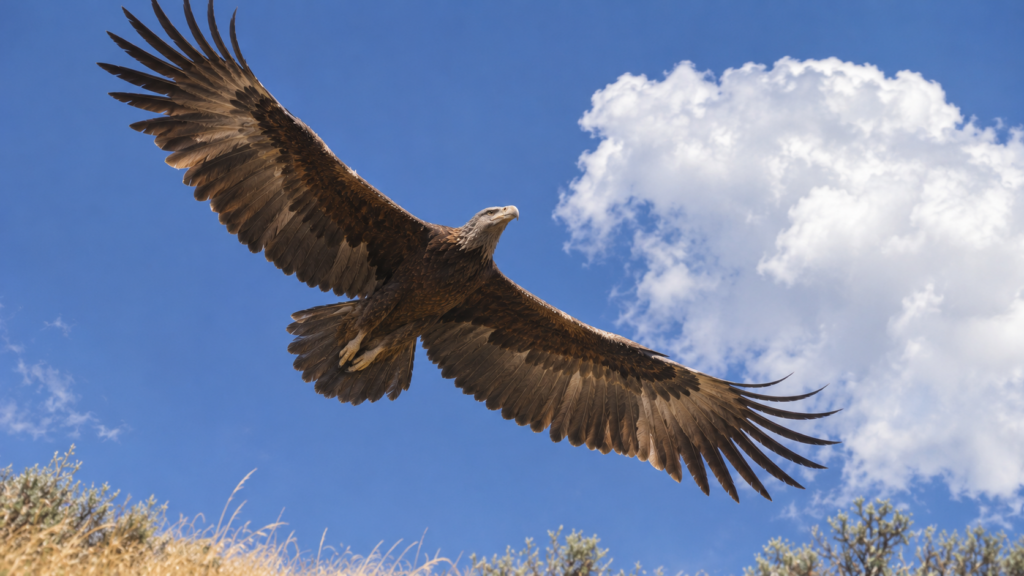
The same calculation showed that it was an efficient glider. With its wings spread, its shallowest glide angle was about 3 degrees, at a speed of 67 km/h. It lost only about 1 m of height per second. Wherever the air was rising faster than 1 m per second, it could hold its altitude without flapping.
Chatterjee and his colleagues proposed that Argentavis used two kinds of rising air. One was the thermals that rise from plains heated during the day. Argentavis could circle with a radius of 30 m, and in a thermal about 100 m across it could gain height as it turned. The other was the updraft formed when wind strikes the slopes at the foot of the Andes. A 20 km/h wind blowing onto a 10-degree slope produces an updraft of about 1 m per second. The fossil sites lie both in the Andean foothills and on the plains.
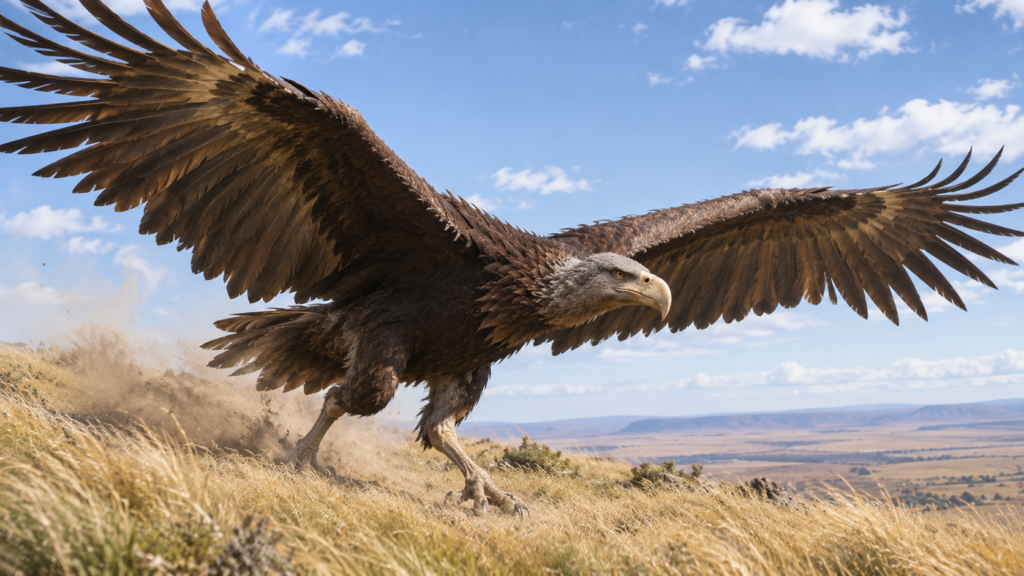
Takeoff also had conditions. According to the calculation, it could not take off by running on level ground. It could take off by running down a slope of about 10 degrees into a headwind of 5 m per second. Launching from a height, it reached gliding speed after dropping about 20 m in still air, or about 12 m with a headwind of 5 m per second. Landing, too, required a headwind to bring its speed down far enough.
Chatterjee and his colleagues describe Argentavis as a diurnal predator that depended on daytime thermals to fly over the plains in search of prey.
Related products
You can find books and products related to this article on Amazon.
If you buy through the links above, this blog may earn a commission.
About the images
The images in this article are illustrations created with AI (ChatGPT), and you are welcome to use them. If you do, we would appreciate a link back to this article as the source.
Sources
Campbell, K. E., Jr. & Tonni, E. P. (1980). A new genus of teratorn from the Huayquerian of Argentina (Aves: Teratornithidae). Contributions in Science, Natural History Museum of Los Angeles County 330, 59–68. https://www.biodiversitylibrary.org/part/208145
Campbell, K. E. & Tonni, E. P. (1983). Size and locomotion in teratorns (Aves: Teratornithidae). The Auk 100, 390–403. https://doi.org/10.1093/auk/100.2.390
Palmqvist, P. & Vizcaíno, S. F. (2003). Ecological and reproductive constraints of body size in the gigantic Argentavis magnificens (Aves, Theratornithidae) from the Miocene of Argentina. Ameghiniana 40, 379–385. https://ameghiniana.org.ar/index.php/ameghiniana/article/view/966
Chatterjee, S., Templin, R. J. & Campbell, K. E., Jr. (2007). The aerodynamics of Argentavis, the world’s largest flying bird from the Miocene of Argentina. Proceedings of the National Academy of Sciences 104, 12398–12403. https://doi.org/10.1073/pnas.0702040104
Ksepka, D. T. (2014). Flight performance of the largest volant bird. Proceedings of the National Academy of Sciences 111, 10624–10629. https://doi.org/10.1073/pnas.1320297111
Williams, H. J. et al. (2020). Physical limits of flight performance in the heaviest soaring bird. Proceedings of the National Academy of Sciences 117, 17884–17890. https://doi.org/10.1073/pnas.1907360117


コメント