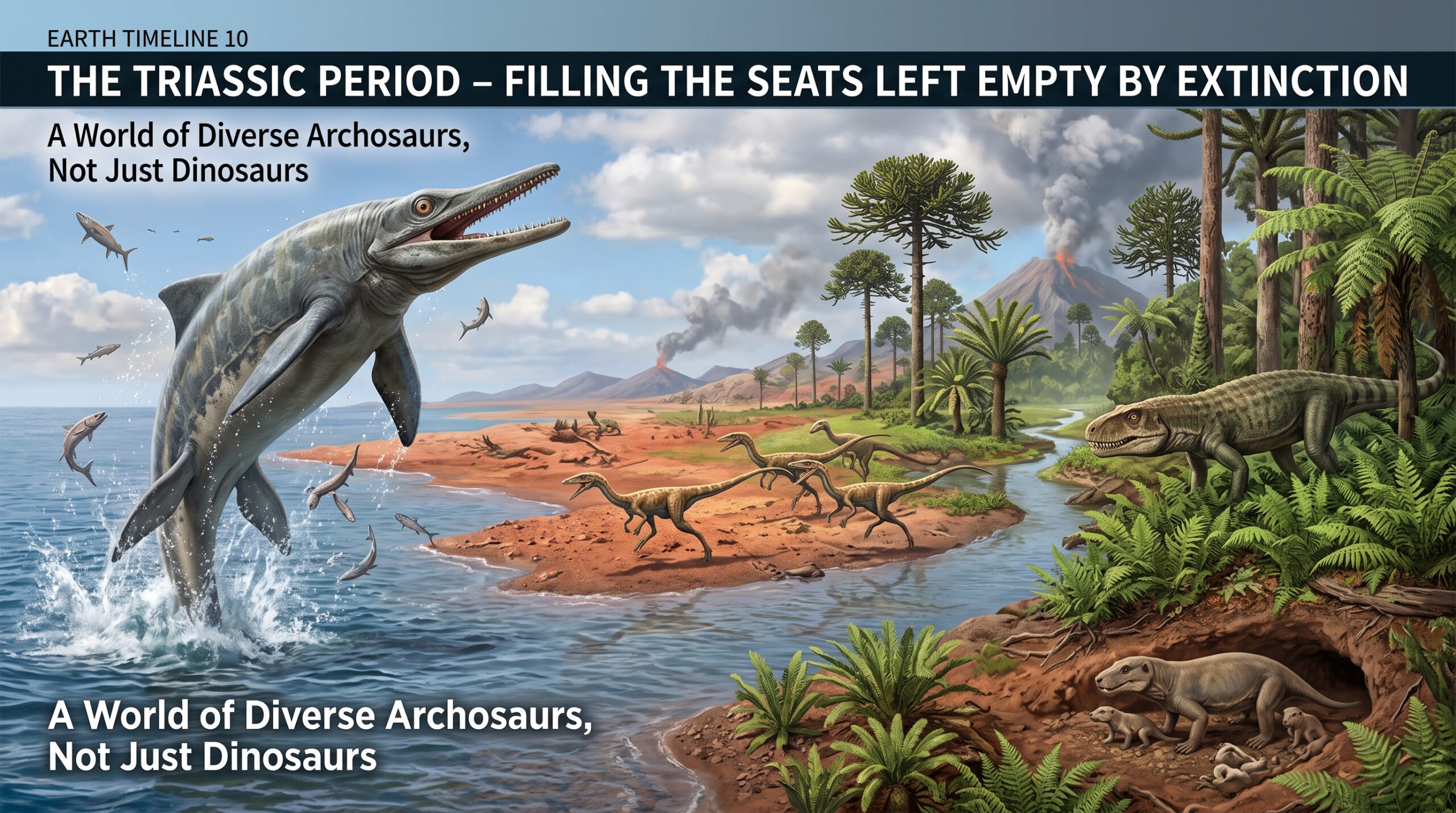
The Triassic ran from about 251.9 million to about 201.4 million years ago, lasting some 50 million years. It is the first of the three periods making up the Mesozoic Era, with the Permian of the Paleozoic before it and the Jurassic after.
The name comes from German strata. In 1834, Friedrich von Alberti, a mining engineer from Württemberg, grouped three superimposed units in southwestern Germany — the red sandstone (Buntsandstein), the shell-bearing limestone (Muschelkalk), and the mud- and sand-dominated Keuper — into a single division he called the Trias, meaning a set of three. The Japanese name for the period is a direct translation of that three-layer structure.
The cast that came to fill the empty seats
The Triassic opens with the cleanup after the largest mass extinction in history. At the end of the Paleozoic most marine life vanished and terrestrial ecosystems collapsed as well. Early Triassic Earth was hot and dry, and ecosystems took millions of years to recover their former complexity.
But empty seats also mean room to move in.
In the sea, a group of reptiles that had been living on land returned to the water: the ichthyosaurs. Their growth in size proceeded remarkably fast. Cymbospondylus youngorum, reported in Science in 2021, is an ichthyosaur from Middle Triassic strata in Nevada, with a skull two meters long and an estimated total length of over 17 meters — the build of a large sperm whale. According to the research team, this was at most eight million years after ichthyosaurs first appeared. Compared with the time the whale lineage took to reach the same size, that is an order of magnitude different.

On land, the group gaining momentum was the archosaurs — in modern terms, the radiation stemming from the common ancestor of crocodilians and birds. By the start of the Triassic, archosaurs had already split into two major lineages. One leads to birds, and produces the dinosaurs and pterosaurs. The other leads to crocodilians.
The cynodonts, leading to mammals, were also living through this period. A study reported in Frontiers in Mammal Science in August 2026 makes an unexpected point about one of them. Thin-sectioning and microscopy of the femur and ulna of Chiniquodon theotonicus, a cynodont about 236 million years old from northwestern Argentina, revealed a neonatal line near the center of the bone — a tissue transition corresponding to the moment of birth, well known in living mammals. Working back from bone thickness at that position gives a birth weight of about 1.68 kilograms, or 10 to 20 percent of the adult weight of nearly 12 kilograms.
That ratio is closer to placental mammals than to egg-laying reptiles and birds, and closer even than marsupials or monotremes. The research team regards this as the oldest evidence of live birth in the mammalian lineage, suggesting its origin may reach 90 to 95 million years further back than previously thought. The basis, however, currently rests on the bone tissue of a single species. Whether this was exceptional among cynodonts or widespread is not yet known.
Rain that kept falling on a dry continent
Triassic land was essentially a single mass: the supercontinent Pangaea. The interior lay far from the sea, and dry country extended across most of the period.
Partway through, though, there is an interval when the rain kept coming. Called the Carnian Pluvial Episode, it spans roughly two million years, from about 234 to 232 million years ago. In the strata, soils that form only in humid conditions and layers of coarse sand and gravel carried by rivers are sandwiched between dry deposits.

A review published in Science Advances in 2020 by Jacopo Dal Corso of the China University of Geosciences (Wuhan), Mike Benton of the University of Bristol and colleagues organized what happened during this interval from both the geology and the fossils. The cause given is large-scale volcanism in Wrangellia, in what is now western Canada. The eruptive peak coincides with the Carnian; the carbon dioxide released pushed temperatures up, and water vapor rising from the warmed ocean reached into the continental interior.
According to the review, 33 percent of marine genera disappeared at this point. The cast that appeared in their place, meanwhile, is strikingly modern: the scleractinian corals that build today’s reefs, tiny plankton with calcareous shells, and on land turtles, crocodylomorphs, lizard relatives, mammaliaforms and pterosaurs. This is also when amber begins to be preserved in quantity. Conifer forests spread, and for the first time since the Carboniferous, substantial coal beds formed.
Dinosaurs belong here too. A study reported in Nature Communications in 2018 matched the bone and footprint records against each other, anchored on well-dated track assemblages from the Dolomites in Italy. The time when dinosaur footprints appear coincides precisely with the Carnian Pluvial Episode. Dinosaurs themselves are thought to have existed some 20 million years earlier, but they only begin leaving a conspicuous mark in the strata after this rain.
An ostrich-like animal on the crocodile line
In 1947, at Ghost Ranch in New Mexico, the paleontologist Edwin Colbert excavated blocks of rock packed with bone. The quarry is famous for producing dense accumulations of Coelophysis, a small carnivorous dinosaur. The plaster-jacketed blocks were shipped to the American Museum of Natural History in New York, and several of them sat on shelves unopened.
Fifty-nine years later, in 2006, a graduate student named Sterling Nesbitt opened one of those jackets looking for new Coelophysis material. What came out was a nearly complete skeleton: an animal about two meters long, bipedal, with a long neck, small arms and not a single tooth in its jaws, which in life were presumably covered by a beak. It looks exactly like the ornithomimids of the Cretaceous — the so-called ostrich dinosaurs.
The ankle structure, however, was entirely different. The animal Nesbitt described in 2007, Effigia okeeffeae, is not a dinosaur. It belongs to the pseudosuchians, the lineage leading to crocodilians. The ostrich-like body plan had appeared independently in a completely different lineage, long before dinosaurs acquired it.

Effigia was no exception. Triassic land held a remarkable diversity of animals on the crocodilian line. Phytosaurs lurked in rivers looking much like modern crocodiles. Aetosaurs, covered in bony plates on the back, ate plants. Postosuchus, over four meters long, walked on four legs as an apex predator. At the water’s edge and on dry plains alike, there were pseudosuchians shaped for the job.

Thirty million years as a minority
In 2008, Stephen Brusatte, then at the University of Bristol, along with Michael Benton and colleagues, compared the archosaurs of this period numerically in Science. For dinosaurs and pseudosuchians separately, they calculated how widely skeletal characters varied (morphological disparity) and how fast those characters changed (rate of evolution).
The long-told story ran like this: dinosaurs had superior design — hind legs held directly beneath the body, efficient respiration — and through the Triassic they gradually pushed their competitors aside, finally taking the land.
The numbers did not support it. Morphological disparity was significantly greater in pseudosuchians throughout the Triassic. Rates of evolution showed no distinguishable difference between the two. Dinosaurs remained a minority within the ecosystem for something like 30 million years.
Why could they not increase? A study reported in PNAS in 2015 offers one answer for low-latitude regions. From the Chinle Formation of the American Southwest — a location near the equator on Triassic Pangaea — the team extracted pollen and spores, charcoal produced by wildfires, organic carbon isotopes and proxies for the carbon dioxide concentration of the time, all together.
What emerged was an extremely unstable environment. Carbon dioxide stood at four to six times present levels. Wet years and drought years alternated violently, and wildfires reaching 600 degrees burned repeatedly, fueled by dead vegetation. The team concluded that such conditions could not supply the stable food supply required by large, fast-growing herbivorous dinosaurs. At the same sites, faunas dominated by pseudosuchians held on until the end of the Triassic.

Not winners, survivors
The Triassic ends about 201.4 million years ago. Pangaea began to split, and enormous volcanism started across what is now North America, South America, Africa and Europe. Known as the Central Atlantic Magmatic Province (CAMP), its preserved extent exceeds 10 million square kilometers. It ranks among the largest igneous events in Earth’s history, and estimates put the loss at around three-quarters of species in the sea and on land combined. A scenario resembling the end-Permian has also been proposed: magma intruding into organic-rich sedimentary basins, cooking them and driving off gas.

The pseudosuchians barely made it through this extinction. What remained was only part of the crocodylomorphs, leading to later crocodilians. Phytosaurs, aetosaurs and the relatives of Postosuchus all end here. The dinosaurs came through. And they spread into the vacated seats.
This is where Brusatte and colleagues’ conclusion lands. Dinosaurs became the leading animals on land not because they won a long competition but because they happened to survive a single event, a mass extinction. Had superiority been decided over the 30 million years of the Triassic, the winners would have been the pseudosuchians.
What luck actually consisted of, still unexplained
That said, “they were lucky” is not an explanation in itself. Why did dinosaurs get through and pseudosuchians not? The substance of that remains unresolved.
Even saying “the dinosaurs survived” may be a little careless. In April 2026, Simba Srivastava and Sterling Nesbitt of Virginia Tech described a new dinosaur in Papers in Palaeontology. Named Ptychoterates bucculentus, it comes from a skull about 22 centimeters long, collected in 1982 at the same Ghost Ranch quarry that produced Effigia and stored in a drawer ever since.
Taxonomically it belongs to the herrerasaurs, an early-branching carnivorous group within the dinosaurs. This lineage had been thought to have disappeared by the later Triassic, but the strata producing the fossil may date to just before the end-Triassic extinction. And the group is not found anywhere after that. Srivastava notes that the end-Triassic extinction removed not only the dinosaurs’ competitors but also older lineages of dinosaurs themselves.
The scene of the extinction is also coming into focus. A study reported in Nature Geoscience in July 2026 measured the color of 15,000 pollen grains and spores from boreholes in Germany, Luxembourg, Denmark and the United Kingdom, showing that the fossils are uniformly darkened across the extinction interval — evidence of heating. Carbon dioxide from CAMP raised temperatures by 5 to 10 degrees, the tree forests fell, and ferns spread across the ground in their place. Those ferns themselves became fuel, regenerating repeatedly from underground roots and burning again. Bas van de Schootbrugge of Utrecht University and colleagues suggest this cycle may have prolonged the fern-dominated interval by tens of thousands to about 300,000 years.

When the oldest dinosaur appeared is also unsettled. Nyasasaurus, collected in Tanzania in the 1930s and described in 2012, is dated to about 243 million years, but all that survives is a humerus and a few vertebrae. Its describers themselves used the cautious phrasing that it is either the oldest dinosaur or, failing that, the closest relative currently known.
The Triassic often gets summed up in a single line as the beginning of the age of dinosaurs. But had you walked across the land in the second half of this period, the large animals catching your eye would usually not have been dinosaurs but reptiles close to the crocodilian line. Dinosaurs look like the leads of this period because we know what happened afterward.
コメント