This article contains affiliate links. As an Amazon Associate I earn from qualifying purchases.
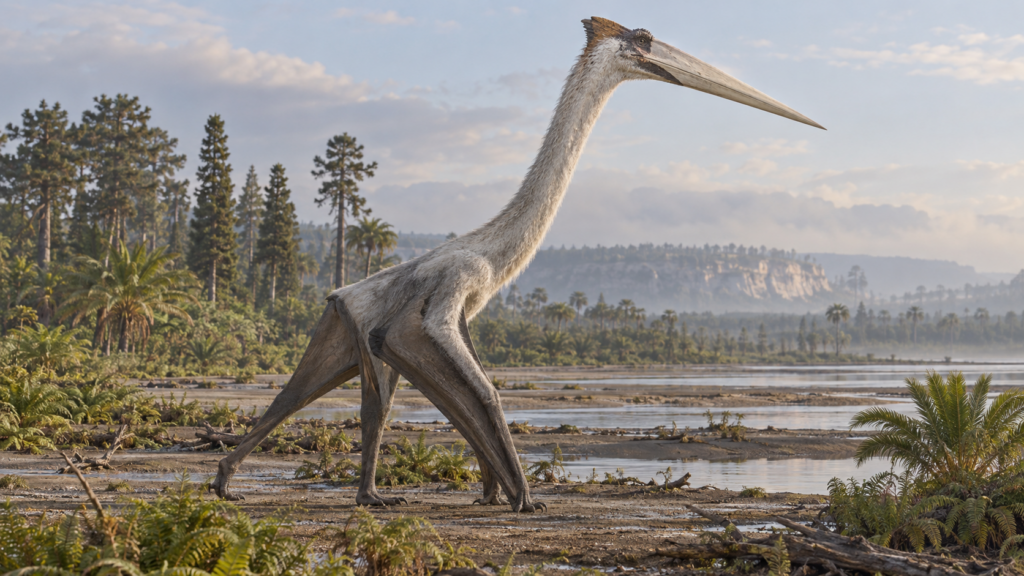
| Name | Quetzalcoatlus northropi. The genus is named after Quetzalcoatl, the feathered serpent god of Aztec mythology |
| Classification | Reptilia, Pterosauria, Azhdarchidae. Not a dinosaur, but a separate lineage closely related to dinosaurs |
| Age | Very end of the Cretaceous (Maastrichtian, about 70 to 66 million years ago) |
| Where found | Big Bend National Park, Texas, USA (Javelina Formation) |
| Wingspan | About 10 to 11 m by current estimates (15.5 m when it was named) |
| Weight | About 200 to 250 kg by current estimates |
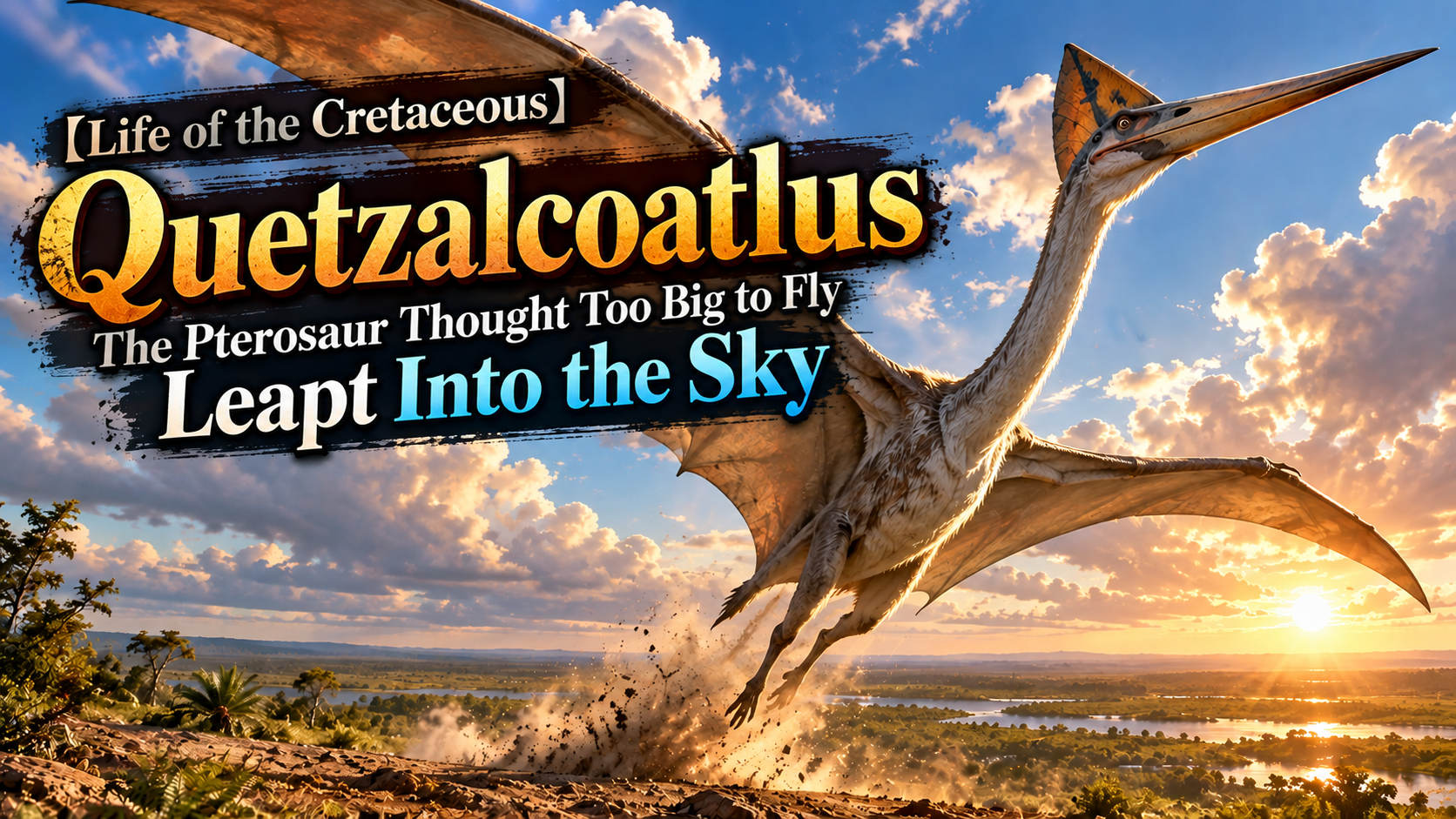
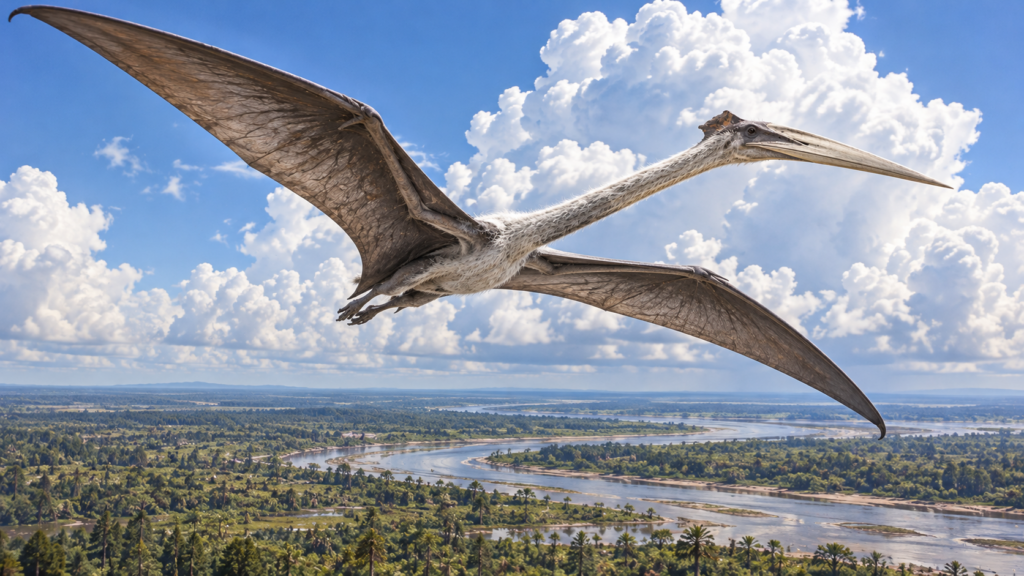
Quetzalcoatlus was a pterosaur that lived in North America at the very end of the Cretaceous. Its wings spanned about 10 to 11 m, comparable to a small aircraft, making it one of the largest flying animals known. In the 2000s, a series of studies argued that an animal this heavy could not have taken off from the ground. Today it is thought to have pushed off with its legs and arms, leaping into the air before beginning to flap.
Form and Life
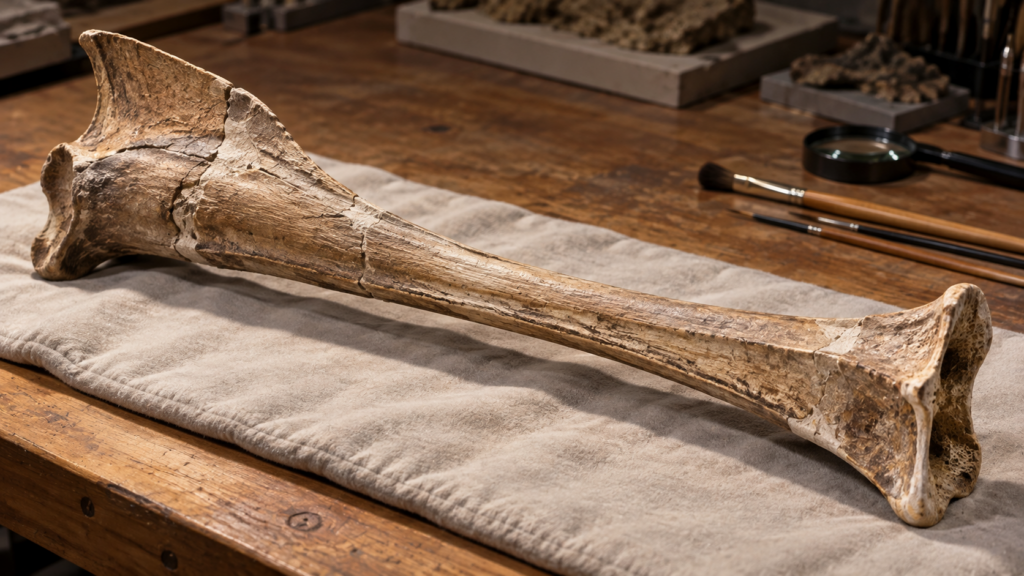
Quetzalcoatlus carried its head, with a long, slender, toothless beak, at the end of a long and stiff neck. Each wing was a membrane supported by a single, enormously elongated fourth finger. On the ground the wings were folded, and the animal walked on all fours, on the fingers of its hands and on its hind feet. The fossils of Q. northropi consist of a nearly complete upper arm bone and mostly fragmentary wing bones, so its overall body plan has been reconstructed from a smaller relative known from more than 300 bones from the same area. In 2021 this smaller species was named Quetzalcoatlus lawsoni after the genus’s discoverer. Its wingspan is estimated at about 4.5 to 4.8 m.
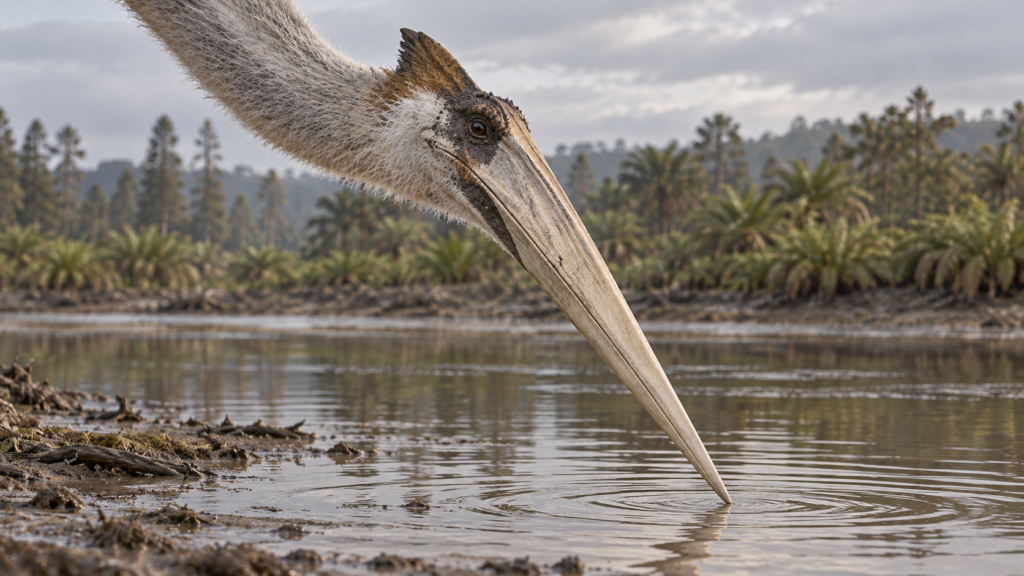
The Javelina Formation, where the fossils are found, was laid down on river floodplains far inland from the sea. The same rocks have also produced the sauropod dinosaur Alamosaurus. Quetzalcoatlus is thought to have lived differently from pterosaurs that flew over the sea to catch fish. A 2021 study of its functional morphology concluded that, like modern herons and storks, it walked through shallow water and across open ground, plucking small fish, small animals and invertebrates with its beak and swallowing them whole. Because it had no teeth and a narrow beak, the study concluded it was poorly suited to tearing flesh from carcasses.
The fossils were found at Big Bend in the early 1970s by Douglas Lawson, then a graduate student at the University of Texas. Lawson reported the pterosaur in the journal Science in 1975 and gave it the name Quetzalcoatlus. The species name northropi honors Jack Northrop, founder of the aircraft company that built flying-wing airplanes.
Too Big to Fly, Until It Leapt Into the Air
In his 1975 report, Lawson estimated the wingspan at 15.5 m. Later estimates based on the proportions of azhdarchid wing bones brought the figure down, and 10 to 11 m is now the standard value. Alongside the revisions of its size, a long-running question was whether such a huge animal could really fly, and, if it could, how it left the ground.
In the 2000s, several studies argued that giant pterosaurs could not fly, or could fly only if they were extremely light. One study used the wingbeat frequency of living birds to set an upper weight limit for flight at about 41 kg. Another estimated the weight of Quetzalcoatlus at 544 kg and concluded that it was flightless. Most of these studies applied the flight and body structure of birds to pterosaurs. Many birds take off by kicking off with their hind legs and running to build up speed, a method that makes it hard for an animal as heavy as Quetzalcoatlus to leave the ground.
In 2010, Mark Witton of the UK and Michael Habib of the US published a paper re-examining these studies. They found that the 544 kg estimate made the torso about 2.77 times too large, that correcting it gave about 240 kg, and that the most reliable upper estimates were 200 to 250 kg. They also emphasized that, unlike birds, pterosaurs stood on four limbs. In 2008, Habib had proposed that pterosaurs took off not with their hind legs but by vaulting their bodies off the ground with their strong forelimbs, like a pole vaulter. Because the powerful arm muscles that drove the wings could also be used at the moment of takeoff, even a heavy body could get airborne without a running start.
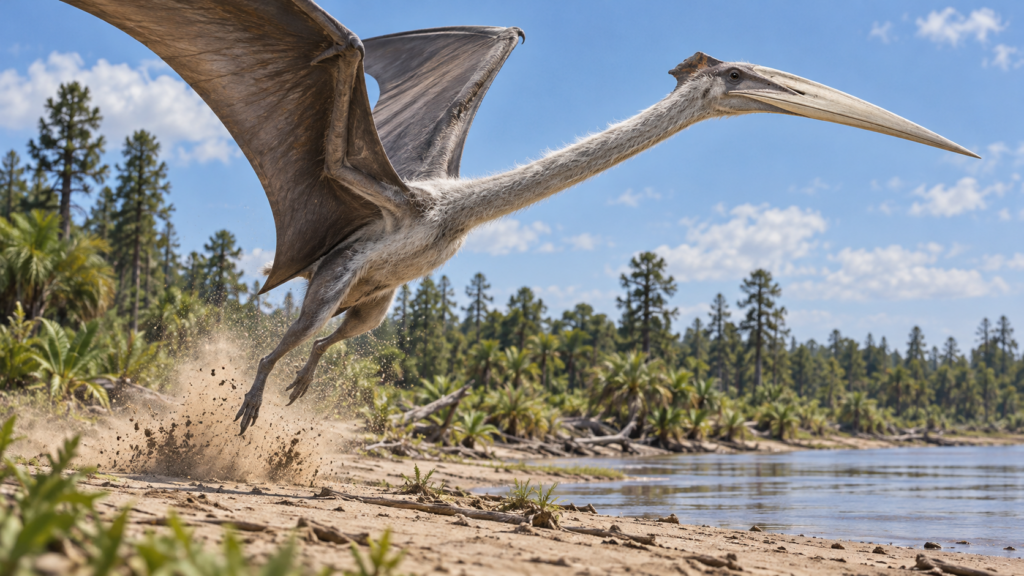
In 2021, Kevin Padian of the University of California, Berkeley, and colleagues published a study of the bones long kept at the University of Texas, as part of a memoir series of the Society of Vertebrate Paleontology. The team concluded that a running takeoff does not work: if the animal tried to flap while running, its wings would hit the ground after dropping only about 40 degrees below horizontal. Instead, they proposed that it leapt powerfully from a crouch, raising its body high enough for the wings to clear the ground before it began flapping. Quetzalcoatlus has the largest ratio of hind limb to torso length of any known pterosaur, and the team considered both a leap with the hind legs alone and a four-limbed leap with help from the forelimbs to be plausible. Padian explained that if it could jump to twice its hip height, about 2.4 m, its wings could clear the ground and it could flap.
Whether the forelimbs were involved or the hind legs did the work alone has not been settled. But the image of a bird-like running takeoff has been rejected, and leaping into the air is now the leading explanation. The question of whether it could fly has given way to the question of how it took off.
Related products
You can find books and products related to this article on Amazon.
If you buy through the links above, this blog may earn a commission.
About the images
The images in this article are illustrations created with AI (ChatGPT), and you are welcome to use them. If you do, we would appreciate a link back to this article as the source.
Sources
Lawson, D. A. (1975). Pterosaur from the Latest Cretaceous of West Texas: Discovery of the Largest Flying Creature. Science 187, 947–948. https://doi.org/10.1126/science.187.4180.947
Witton, M. P. & Habib, M. B. (2010). On the Size and Flight Diversity of Giant Pterosaurs, the Use of Birds as Pterosaur Analogues and Comments on Pterosaur Flightlessness. PLoS ONE 5, e13982. https://doi.org/10.1371/journal.pone.0013982
Padian, K., Cunningham, J. R., Langston, W. & Conway, J. (2021). Functional morphology of Quetzalcoatlus Lawson 1975 (Pterodactyloidea: Azhdarchoidea). Journal of Vertebrate Paleontology 41 (sup1), 218–251. https://doi.org/10.1080/02724634.2020.1780247
Andres, B. & Langston, W. (2021). Morphology and taxonomy of Quetzalcoatlus Lawson 1975 (Pterodactyloidea: Azhdarchoidea). Journal of Vertebrate Paleontology 41 (sup1). https://doi.org/10.1080/02724634.2021.1907587
Witton, M. P. & Naish, D. (2008). A Reappraisal of Azhdarchid Pterosaur Functional Morphology and Paleoecology. PLoS ONE 3, e2271. https://doi.org/10.1371/journal.pone.0002271
UC Berkeley News (2021). Fleshing out the bones of Quetzalcoatlus, Earth’s largest flier ever. https://news.berkeley.edu/2021/12/07/fleshing-out-the-bones-of-quetzalcoatlus-earths-largest-flier-ever/

コメント