This article contains affiliate links. As an Amazon Associate I earn from qualifying purchases.
| Name | Helicoprion. Greek for “spiral saw” |
| Classification | Chondrichthyes, Eugeneodontida. Not a shark, but part of the holocephalan lineage that leads to modern ratfish |
| Age | Permian (about 290 to 270 million years ago) |
| Where found | Ural Mountains, Russia (first description). Also Idaho in the USA, Kazakhstan, Australia and elsewhere |
| Length | About 5 to 8 m by one estimate (scaled from the size of the tooth whorl) |
| Tooth whorl | One specimen is 23 cm across with 117 teeth. Some whorls have more than 150 teeth |
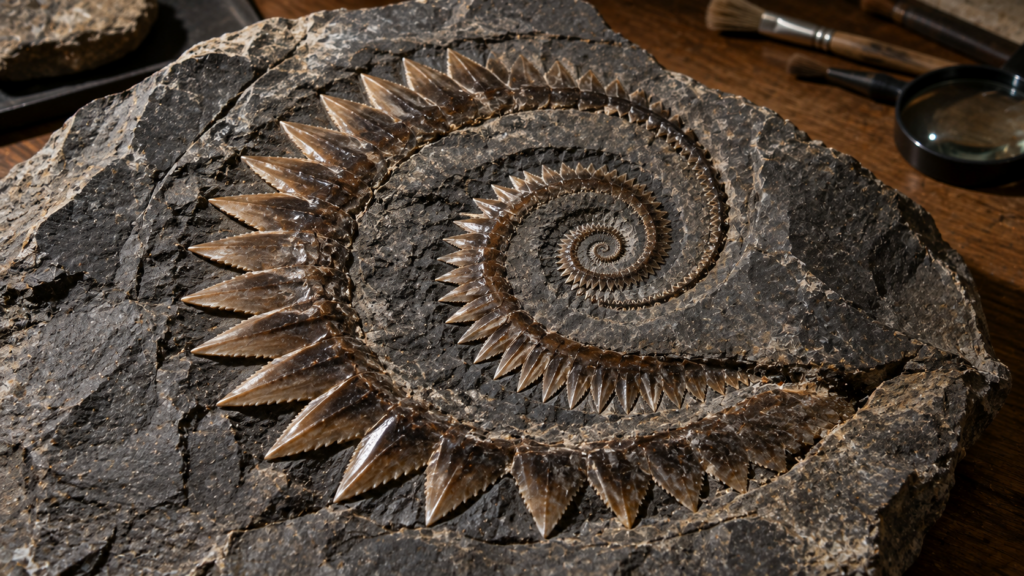
Helicoprion was a large cartilaginous fish of the Permian seas. All that survives as fossils is its “tooth whorl,” a spiral of saw-like teeth, and almost nothing of the rest of its body has been found. For more than a century after it was named in 1899, no one could agree where on the body the whorl belonged. In 2013, CT scans of a fossil showed that it sat inside the lower jaw.
Form and Life
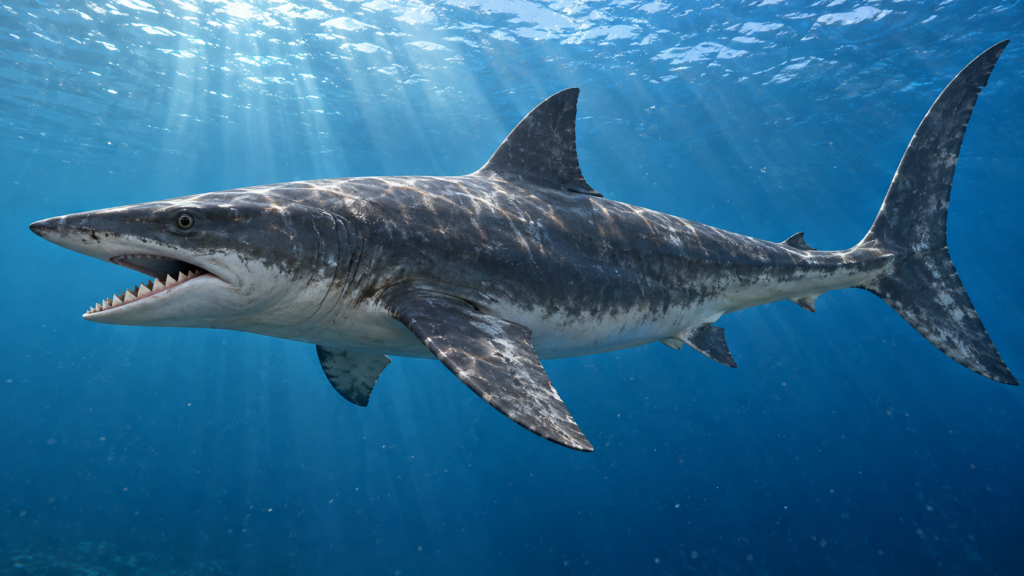
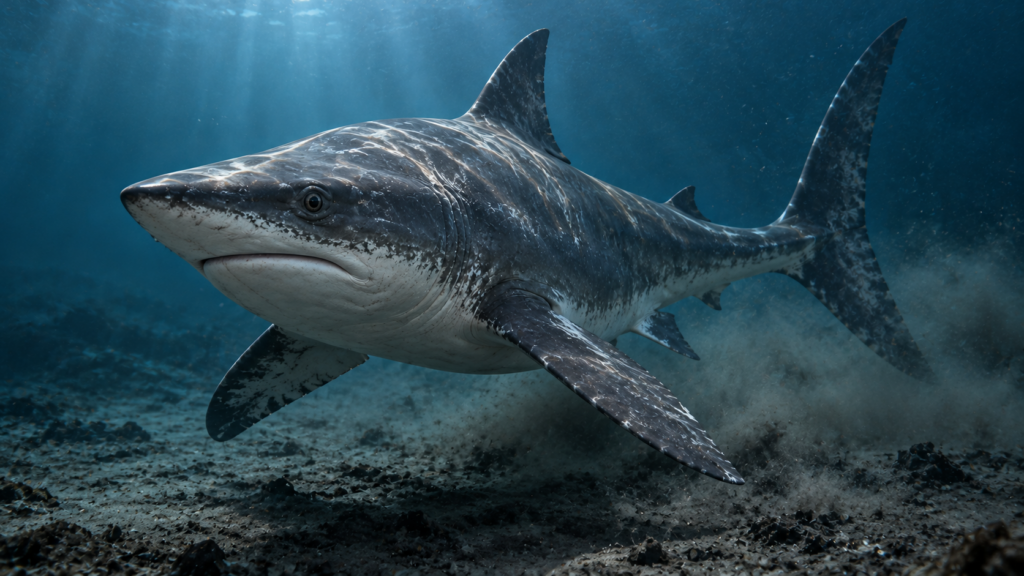
Like a shark, Helicoprion had a skeleton made of cartilage rather than bone, and it almost never survived after death. Estimates of its length scale the size of the body from the diameter of the whorl, and one estimate puts individuals with whorls 35 to 40 cm across at 5 to 8 m long. Because the fossils say nothing about its body shape, it is usually drawn with a streamlined, shark-like body. In classification, it is placed closer to the holocephalans, the lineage leading to modern ratfish, than to sharks.
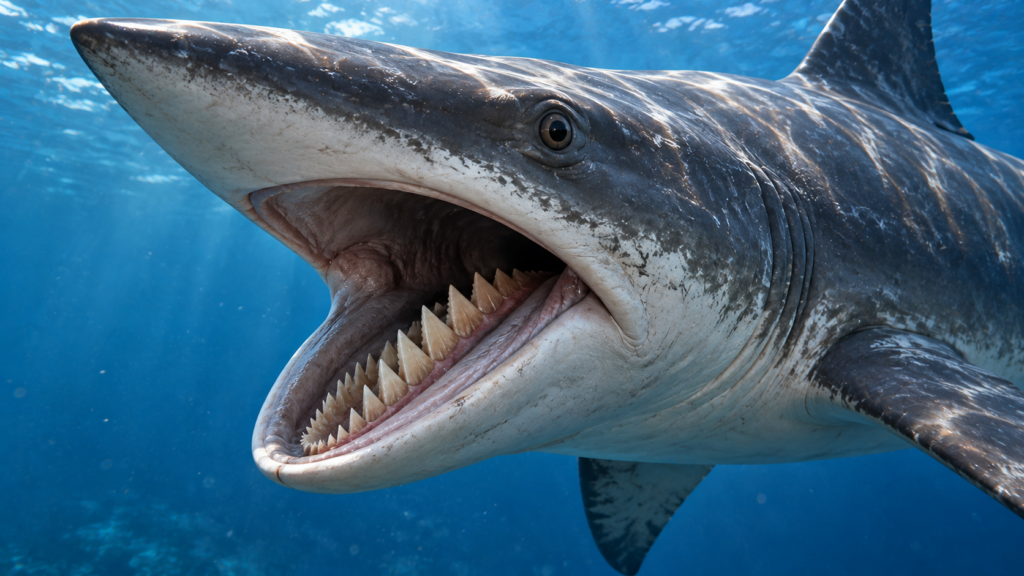
The tooth whorl is a single row of triangular teeth, each with a serrated edge, joined together and coiled into a spiral. New teeth formed at the back of the mouth, and older teeth were pushed forward and rolled into the inside of the spiral without falling out. The oldest teeth are the smallest, at the center of the whorl. Rather than shedding and replacing its teeth one after another the way sharks do, Helicoprion kept a lifetime of teeth in one spiral.
Helicoprion fossils come from a wide area that bordered the Permian seas, including Russia, Kazakhstan, western North America and Australia. An especially large number of specimens have come from phosphate mines in Idaho, USA, where mining in the phosphate-rich Phosphoria Formation has turned up many whorls. The seas of the time were also home to shelled ammonoids and nautiloids.
A Spiral of Teeth Without a Home for More Than a Century
Alexander Karpinsky, the Russian geologist who described Helicoprion in 1899, thought the whorl from the Ural Mountains grew from the tip of the upper jaw and curled up over the snout, like the saw of a sawfish rolled upward. In 1900, the American Charles Eastman doubted that it could fit in the face and suggested it stuck out of the back as a defensive or display structure. Karpinsky himself later proposed placing it on the tail or the dorsal fin.
In 1907, Oliver Perry Hay examined a fossil in which the whorl was preserved close to its natural position and concluded that it belonged to the jaws, though he could not tell whether it was the upper or lower jaw. Over the following decades, other proposals had it hanging from the lower lip under the chin, sitting where the tongue would be, or lying farther back toward the throat. In 1966, the Danish researcher Svend Bendix-Almgreen reconstructed the whorl at the front tip of an elongated lower jaw, and a 2009 Russian study used the same position. All of these proposals were built without a fossil that showed how the whorl connected to the rest of the body.
In 2013, Leif Tapanila of Idaho State University and colleagues CT-scanned a specimen found in 1950 in a phosphate mine near Montpelier, Idaho, and held at the Idaho Museum of Natural History. The whorl was 23 cm across, with 117 teeth wound about three and a quarter turns, and traces of jaw cartilage were preserved in the rock around it. The three-dimensional images revealed the shapes of the upper and lower jaws and the position of the whorl within them. There was a single whorl at the midline of the lower jaw, and rather than sitting at the tip, it filled the entire length of the lower jaw, embedded inside it. It did not stick out of the mouth; only the upper row of teeth on the whorl would have been visible inside the mouth. The upper jaw had no pointed teeth facing the whorl.
In 2015, the same group reconstructed the jaw muscles from the shape of the jaws and built a model of how Helicoprion fed. As the mouth closed, the whorl rotated backward and upward: the front teeth hooked prey and dragged it into the mouth, the middle teeth pierced and cut, and the back teeth cut while pushing the food deeper. Because hard-shelled prey would tend to slip forward out of the closing jaws, the team concluded that this system was suited to soft-bodied prey such as squid-like animals. Once the position of the whorl was settled, more than a century of debate moved on to a new question: what Helicoprion ate.
Related products
You can find books and products related to this article on Amazon.
If you buy through the links above, this blog may earn a commission.
About the images
The images in this article are illustrations created with AI (ChatGPT), and you are welcome to use them. If you do, we would appreciate a link back to this article as the source.
Sources
Tapanila, L., Pruitt, J., Pradel, A., Wilga, C. D., Ramsay, J. B., Schlader, R. & Didier, D. A. (2013). Jaws for a spiral-tooth whorl: CT images reveal novel adaptation and phylogeny in fossil Helicoprion. Biology Letters 9, 20130057. https://doi.org/10.1098/rsbl.2013.0057
Ramsay, J. B., Wilga, C. D., Tapanila, L., Pruitt, J., Pradel, A., Schlader, R. & Didier, D. A. (2015). Eating with a saw for a jaw: Functional morphology of the jaws and tooth-whorl in Helicoprion davisii. Journal of Morphology 276, 47–64. https://doi.org/10.1002/jmor.20319
Lebedev, O. A. (2009). A new specimen of Helicoprion Karpinsky, 1899 from Kazakhstanian Cisurals and a new reconstruction of its tooth whorl position and function. Acta Zoologica 90 (s1), 171–182. https://doi.org/10.1111/j.1463-6395.2008.00353.x
Scientific American (2013). Prehistoric Ghost Shark Helicoprion‘s Spiral-Toothed Jaw Explained. https://www.scientificamerican.com/blog/running-ponies/prehistoric-ghost-shark-helicoprions-spiral-toothed-jaw-explained/


コメント