This article contains affiliate links. As an Amazon Associate I earn from qualifying purchases.
| Name | Pteranodon (Pteranodon; named for having no teeth) |
| Classification | Reptilia, Pterosauria, Pterodactyloidea, Pteranodontidae |
| Period | Late Cretaceous (late Coniacian to early Campanian, roughly 88 to 83 million years ago) |
| Found in | Western Kansas, USA (Niobrara Formation), South Dakota, Wyoming |
| Wingspan | About 3.5 m in most individuals, more than 6 m in larger ones (up to about 7.25 m) |
| Weight | Estimates range from 15 kg to more than 90 kg; recent work mostly puts individuals with 6 to 7 m wingspans at around 30 to 50 kg |
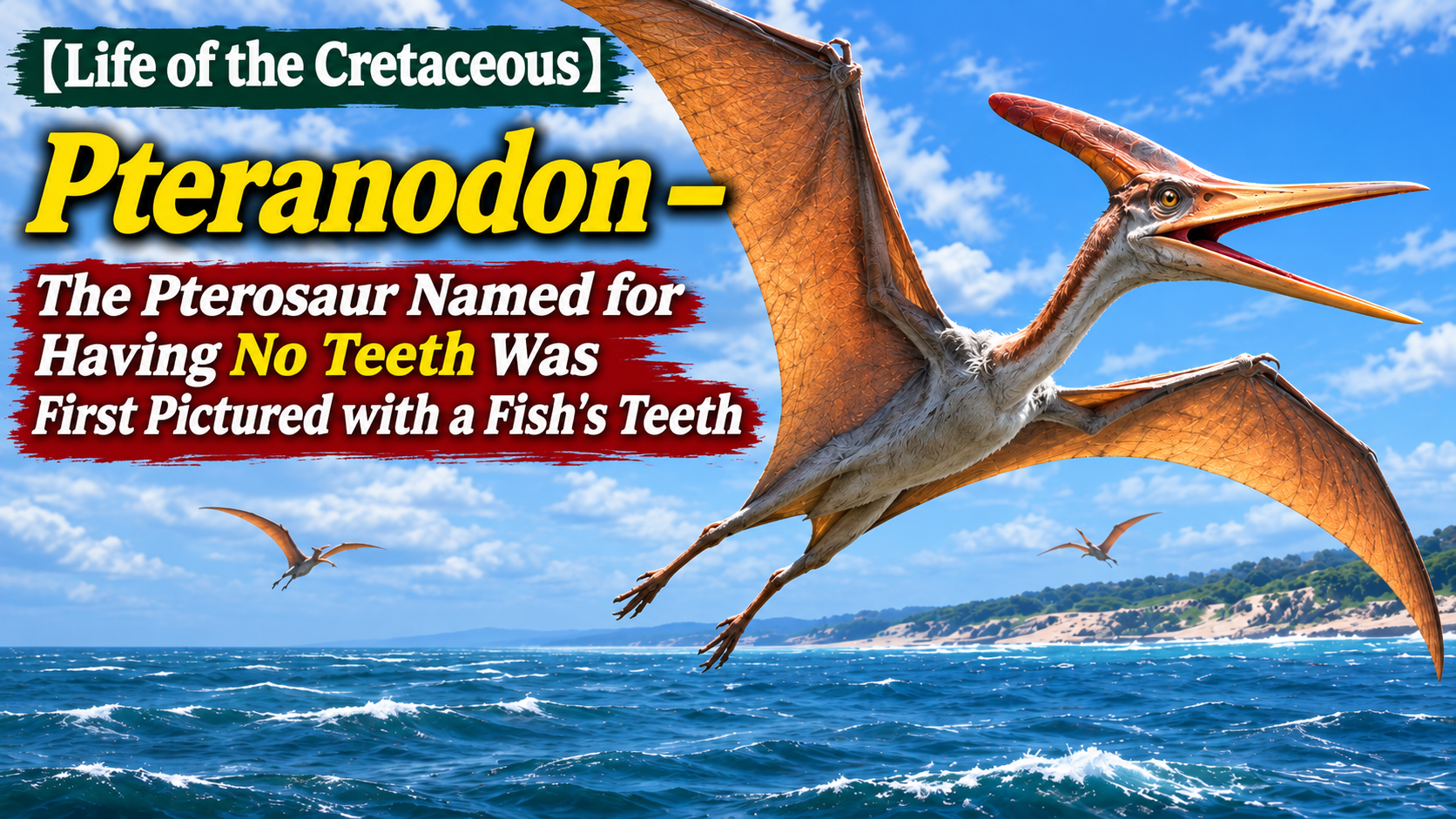
Pteranodon was a large pterosaur that flew over the seas of North America in the Late Cretaceous. Its beak had no teeth at all, and that absence gave the animal its name. Yet the scientist who first described it believed it had teeth.
Appearance and Way of Life
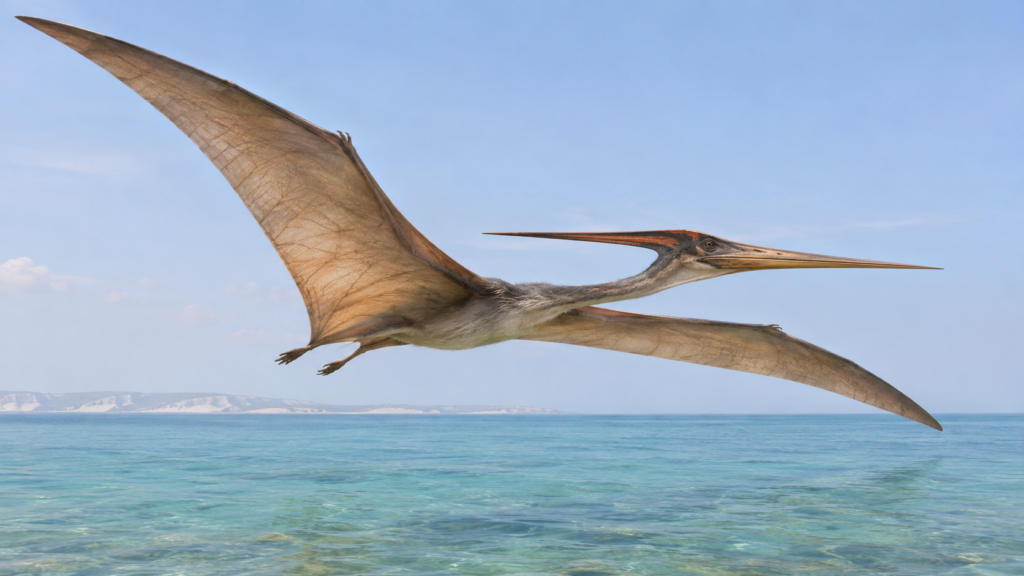
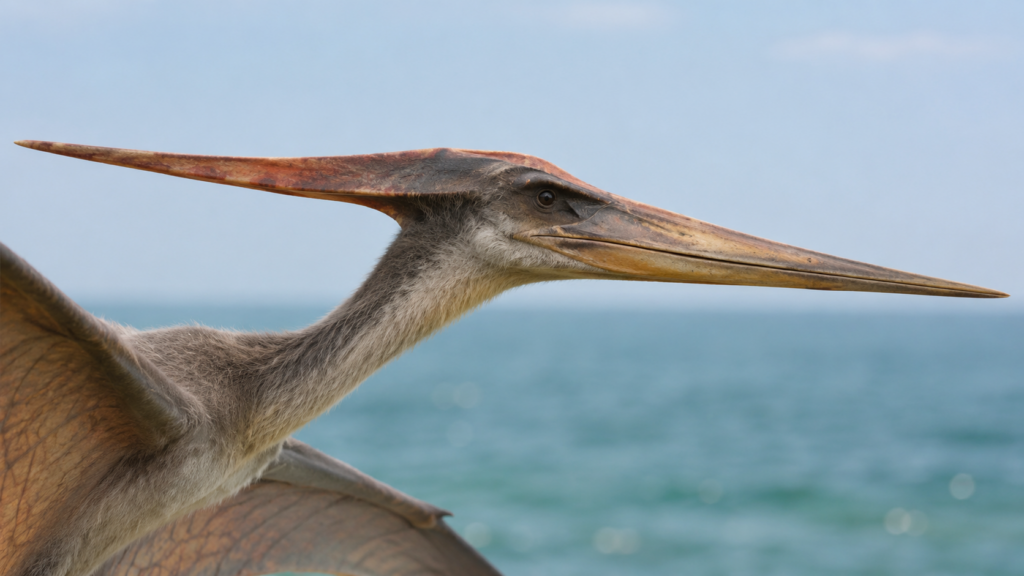
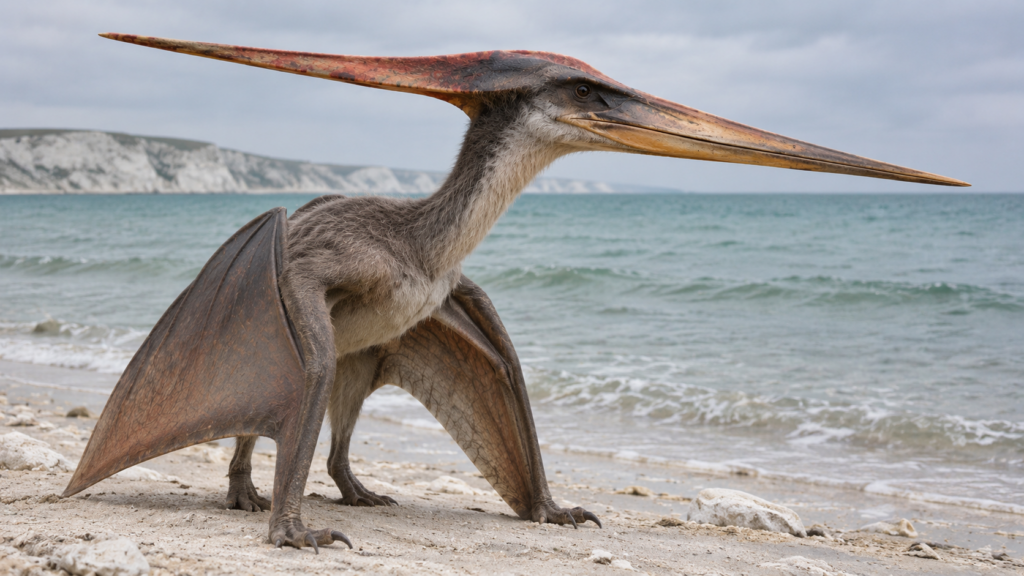
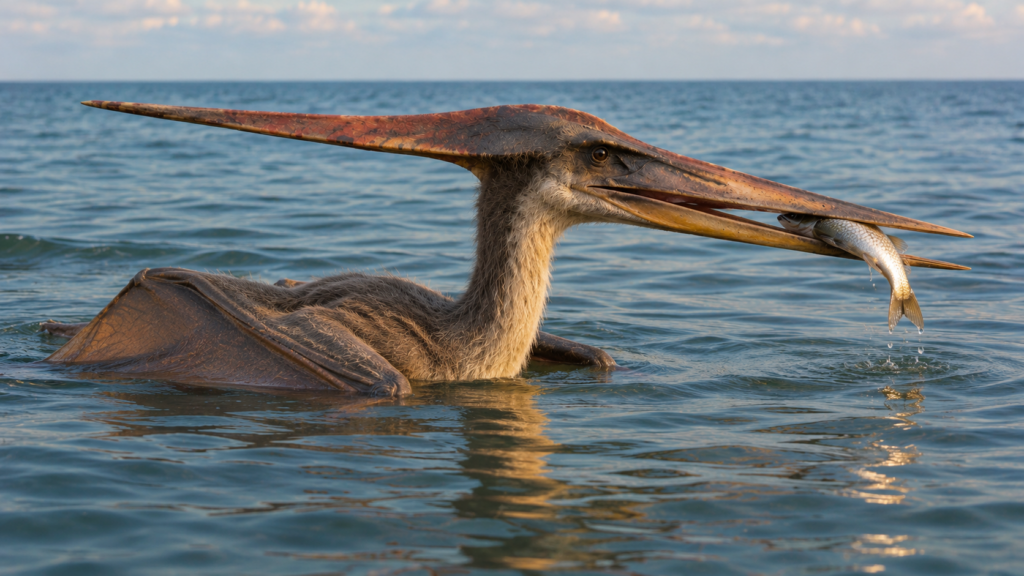
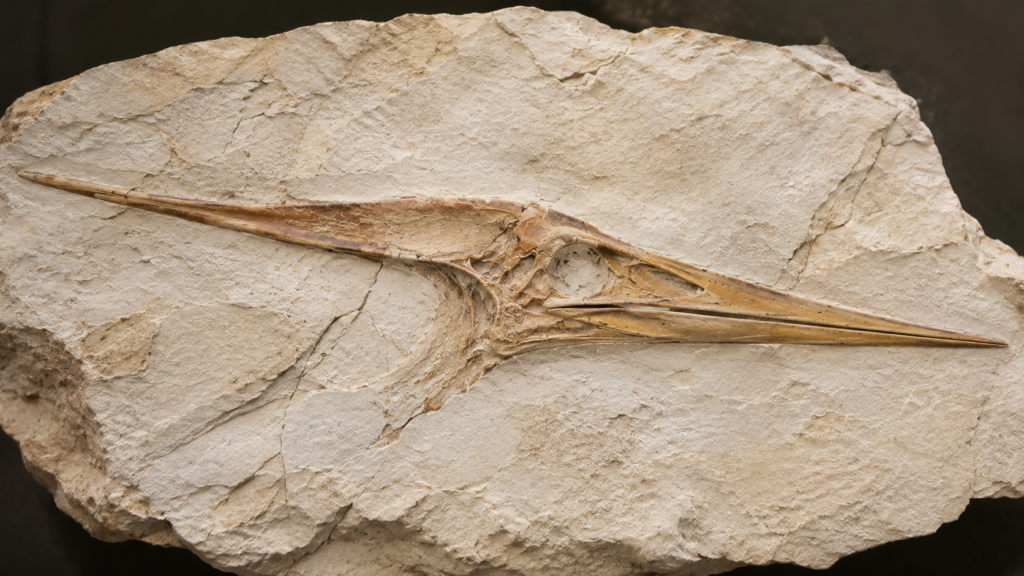
Pteranodon flew on wings of skin stretched from a greatly lengthened finger of each forelimb. Its head was long and narrow, ending in a pointed, toothless beak, and a bony crest swept far backward from the back of the skull. Its body was small compared with its beak and wings, and its legs were fairly short.
Its fossils are extremely common: more than 1,100 specimens from the Niobrara Formation of western Kansas alone are held in museums. These rocks are chalk laid down on the floor of the Western Interior Seaway, a shallow sea that ran north to south through the middle of North America in the Late Cretaceous. Pteranodon accounts for about 97 percent of the pterosaur fossils from the formation.
When the specimens are measured, they fall into two groups. The more numerous group has wingspans of about 3.5 m, small crests and a wide opening through the pelvis. The less numerous group has wingspans of more than 6 m, big crests and a narrow pelvic opening. In 1992 Chris Bennett concluded from the difference in the pelvis that the small animals were egg-laying females and the large ones males. He argued that the big crests were for display among males, since no other proposed function could explain why males and females differed so much. Both groups include young and mature individuals, so the difference is not one of age.
Pteranodon fed mainly on fish. One specimen preserves regurgitated fish in the throat region, and small fish bones are often found with the skeletons. Researchers disagree on whether it snatched fish from the surface in flight, fed while floating on the water, or dived. Pteranodon also ended up as food: in 2018 researchers reported a neck vertebra with a tooth of the large shark Cretoxyrhina still lodged in it. Whether the shark attacked a living animal or scavenged a carcass is unknown.
The Toothless Pterosaur First Pictured as a Toothed Predator
The first Pteranodon fossils were wing bones found in western Kansas in 1870 by an expedition led by Othniel Marsh of Yale. They were the first pterosaur remains found outside Europe. In 1871 Marsh named them as a new species of Pterodactylus, the same genus as the European pterosaurs, and in 1872 he renamed the species because its name was already taken and described an even larger species. He estimated their wingspans at around 6 m.
In the 1872 paper Marsh attributed large, fang-like teeth found with the fossils to the pterosaur. From the shape of the teeth he wrote that it was a carnivore that attacked its prey, that it ate fish, and that it caught them by plunging into the water like a pelican. Around the same time his rival Edward Cope published names for pterosaurs from the same rocks, and the two men argued over who had named them first.
In May 1876 Samuel Williston, working for Marsh, dug up a skull near the Smoky Hill River in Kansas. Measuring about 76 cm from the back of the crest to the tip of the beak, it had no teeth in either jaw and no sockets where teeth had been. That same year Marsh made the lack of teeth the defining feature of the group and coined the genus name Pteranodon and the family name Pteranodontidae.
So what were the teeth of 1872? A 1994 review by Bennett found that they belonged to Xiphactinus, a large bony fish from the same sea. Marsh had the teeth wrong, but his guess that the animal ate fish was later borne out by the specimen with fish preserved in its throat.
Related products
You can find books and products related to this article on Amazon.
If you buy through the links above, this blog may earn a commission.
About the images
The images in this article are illustrations created with AI (ChatGPT), and you are welcome to use them. If you do, we would appreciate a link back to this article as the source.
Sources
Marsh, O. C. (1872). Discovery of additional remains of Pterosauria, with descriptions of two new species. American Journal of Science s3-3, 241–248. https://doi.org/10.2475/ajs.s3-3.16.241
Marsh, O. C. (1876). Notice of a new suborder of Pterosauria. American Journal of Science s3-11, 507–509. https://doi.org/10.2475/ajs.s3-11.66.507
Bennett, S. C. (1992). Sexual dimorphism of Pteranodon and other pterosaurs, with comments on cranial crests. Journal of Vertebrate Paleontology 12, 422–434. https://doi.org/10.1080/02724634.1992.10011472
Bennett, S. C. (1994). Taxonomy and systematics of the Late Cretaceous pterosaur Pteranodon (Pterosauria, Pterodactyloidea). Occasional Papers of the Natural History Museum, The University of Kansas 169, 1–70. https://biostor.org/reference/227
Hone, D. W. E., Witton, M. P. & Habib, M. B. (2018). Evidence for the Cretaceous shark Cretoxyrhina mantelli feeding on the pterosaur Pteranodon from the Niobrara Formation. PeerJ 6, e6031. https://doi.org/10.7717/peerj.6031
Witton, M. P. & Habib, M. B. (2010). On the size and flight diversity of giant pterosaurs, the use of birds as pterosaur analogues and comments on pterosaur flightlessness. PLoS ONE 5, e13982. https://doi.org/10.1371/journal.pone.0013982
Sageman, B. B. et al. (2014). Integrating 40Ar/39Ar, U-Pb, and astronomical clocks in the Cretaceous Niobrara Formation, Western Interior Basin, USA. GSA Bulletin 126, 956–973. https://doi.org/10.1130/B30929.1
Yale News (2024). Winged reptile family nests in renewed Peabody Museum’s main lobby. https://news.yale.edu/2024/03/21/winged-reptile-family-nests-renewed-peabody-museums-main-lobby
コメント