| Name | Aysheaia pedunculata. The genus name comes from Aysha Peak (now Ayesha Peak) near the fossil locality; the species name is Latin for “footed” |
| Classification | Lobopodian. A lineage close to the common ancestor of arthropods, velvet worms and tardigrades |
| Age | Middle Cambrian (about 508 million years ago) |
| Found in | The Burgess Shale (Walcott Quarry), British Columbia, Canada |
| Length | 1 to 6 cm |
| Body width | About 5 mm |
| Legs | Ten pairs, each ending in multiple claws |
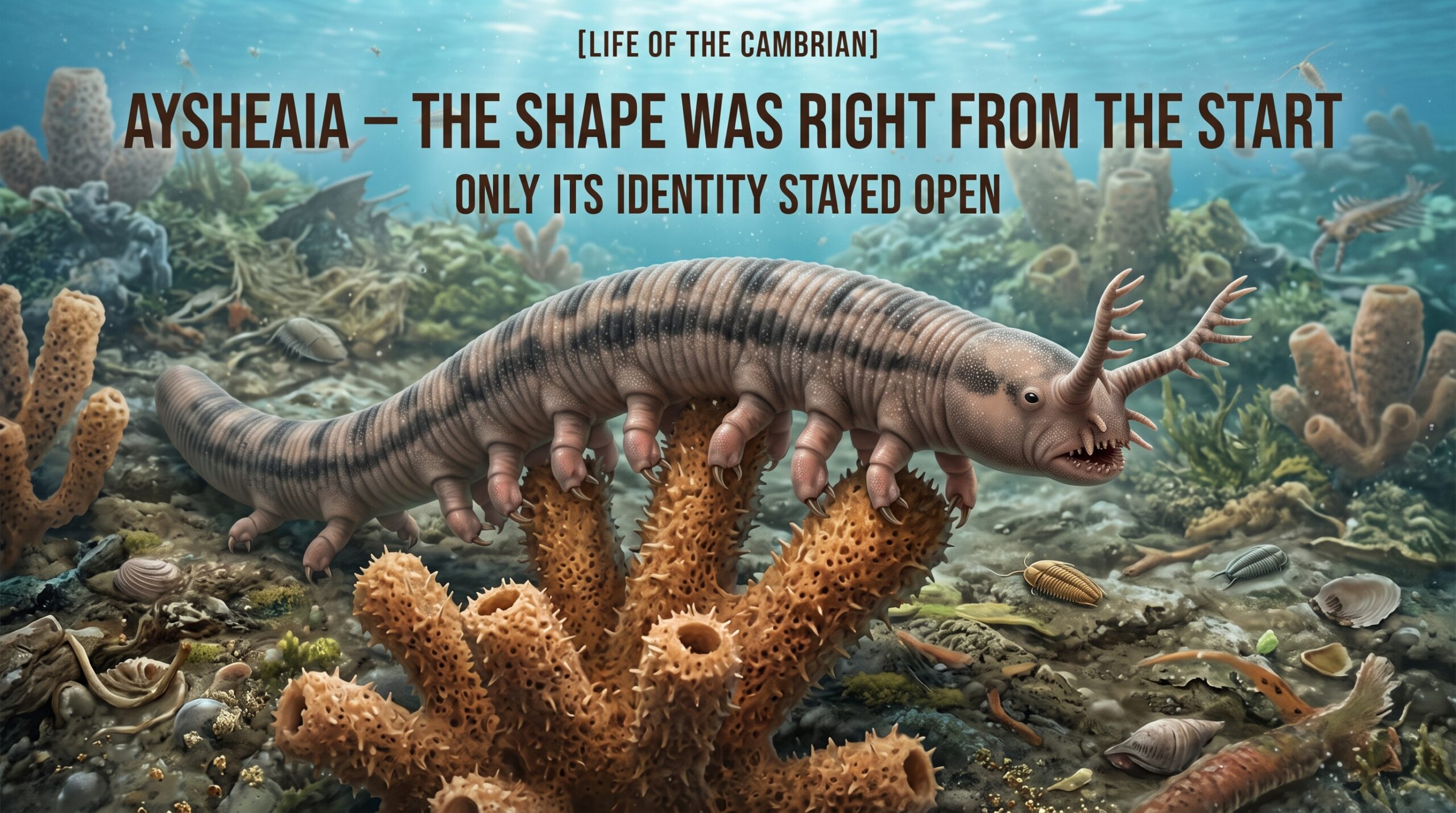
Aysheaia was a lobopodian living in the Cambrian sea. Ten pairs of soft, unjointed legs lined its long tubular body, each ending in claws. There is no region that can be called a head; the front end of the body is simply the mouth. It is a scarce animal even in the Burgess Shale, and its fossils are often found together with fragments of sponges. Since its description in 1911, the orientation of its reconstruction has never once changed. What has kept changing is what group it belongs to.
Form and way of life
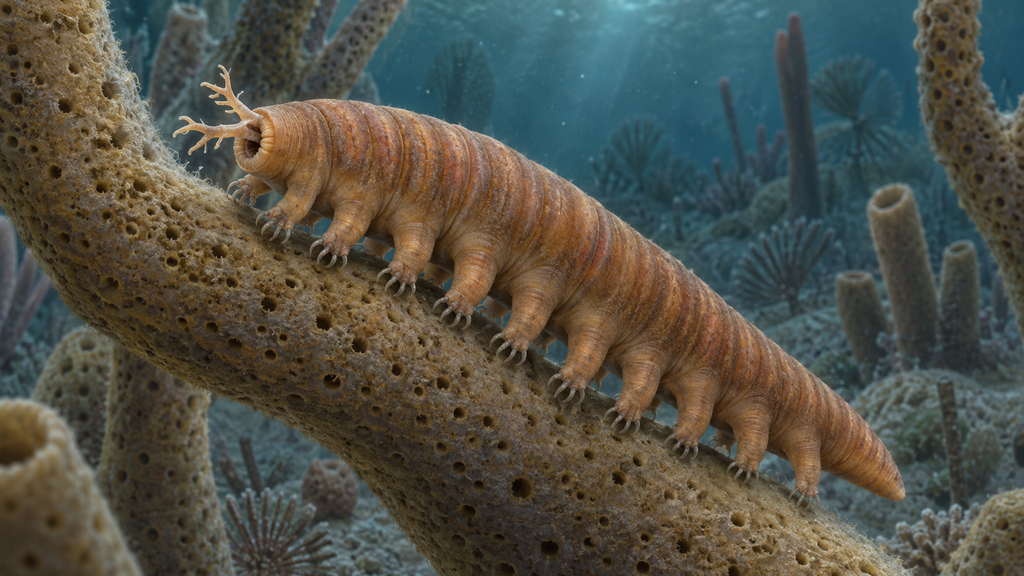
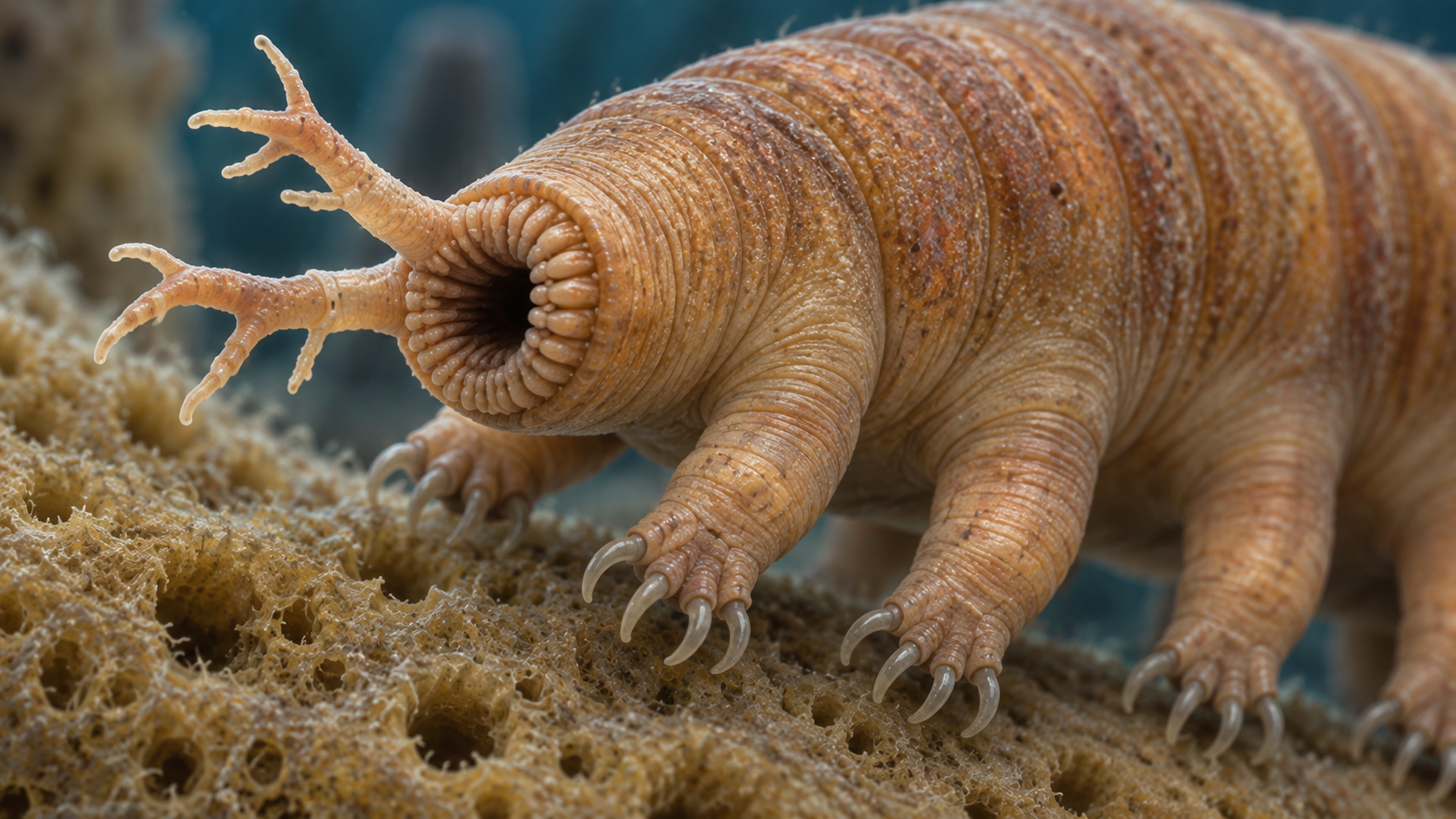
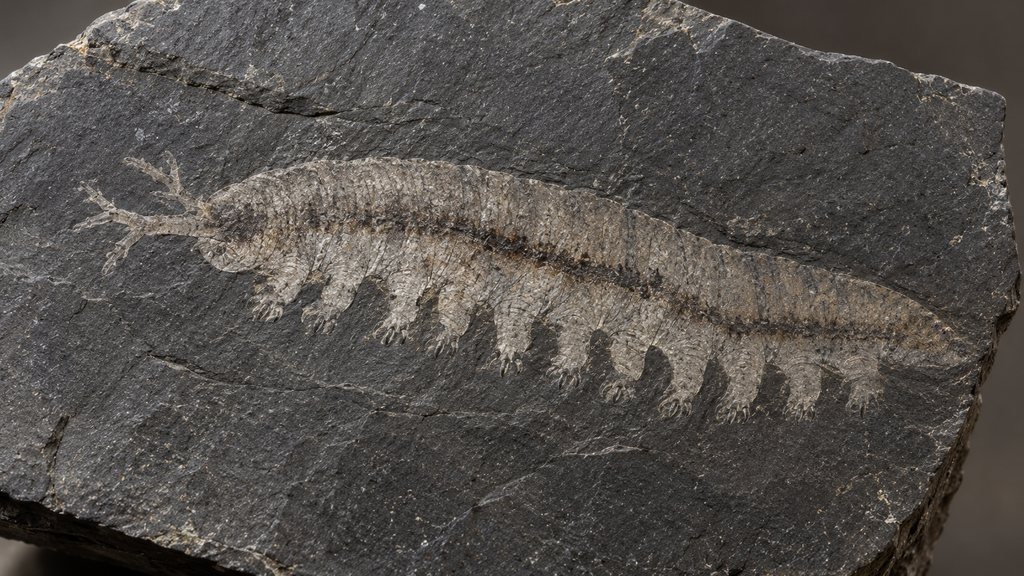
The body is a long tube, with fine wrinkle-like annulations running along its whole length. It was a soft animal with neither bone nor carapace. Ten pairs of short legs line the underside; each leg is annulated too, with small spines in places. Multiple claws are clustered at the tip of each leg. The last pair of legs points forward rather than backward.
The mouth opens at the front end of the body, ringed by small projections (papillae). Just beside the mouth, a pair of branched appendages projects obliquely forward. Different in form from the other legs, they are thought to have served to grip objects or to hold the body in place. A fine line running down the center of the body is preserved in the fossils and is interpreted as the trace of the gut.
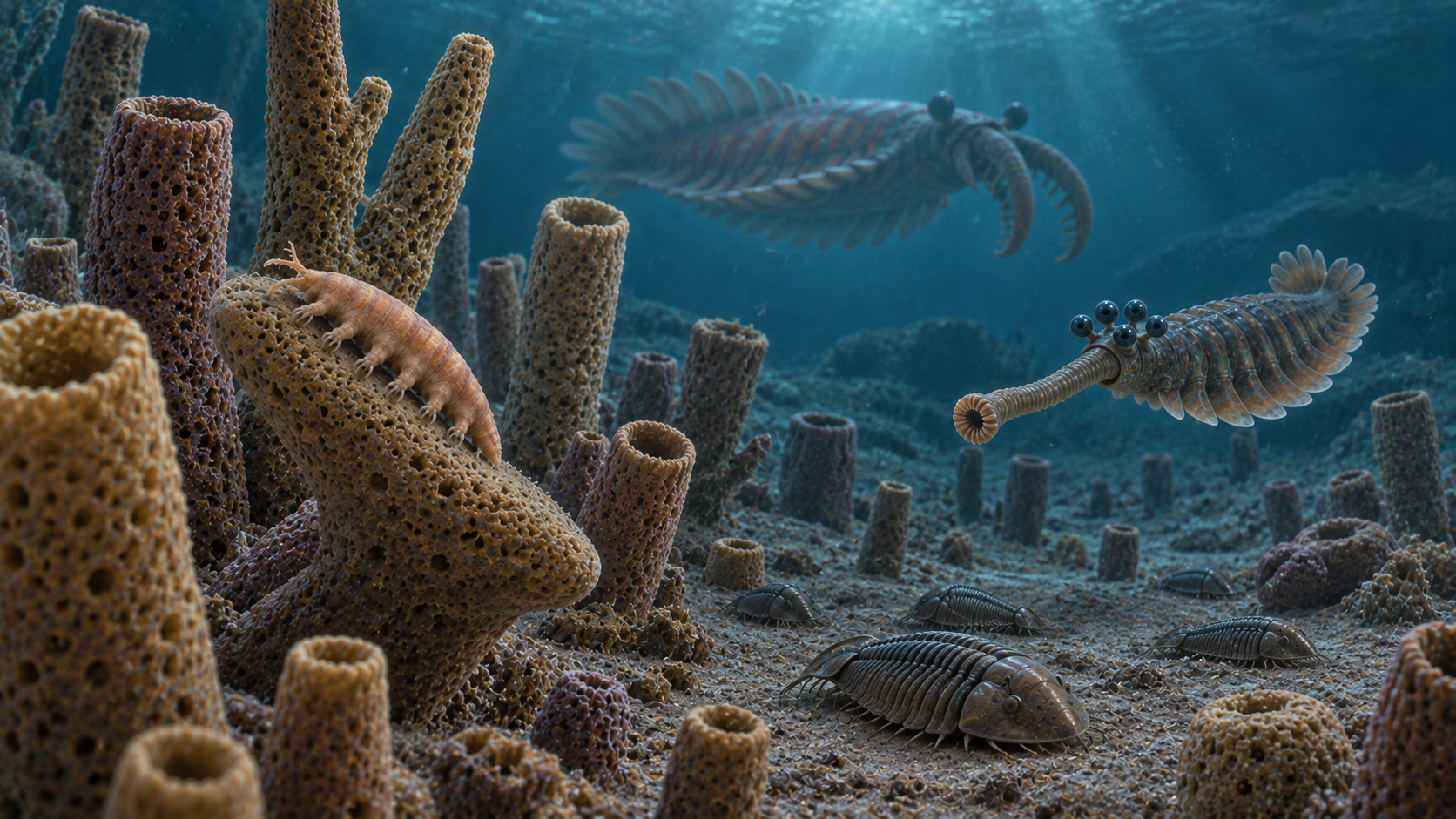
Most of this picture was drawn out by Harry Whittington in 1978, from a fresh study of fifteen specimens. In that work Whittington noted that Aysheaia was not an animal that burrowed and ate mud, and that its fossils occur together with sponge fragments more readily than those of any other organism. From this, a picture of its life was proposed: gripping sponge colonies with its claws, bracing itself with the front appendages, and pressing its mouth against the sponge to feed. On this view it was also sheltered from predators such as Anomalocaris by hiding within the sponges. Suspension feeding — clinging to a sponge and straining food from the water — was also considered, but the body shows no specialization for it, so walking over the sponge surface and browsing, or taking small animals, is regarded as more likely.
The Burgess Shale seafloor of about 508 million years ago, where Aysheaia lived, held the familiar Cambrian cast: Anomalocaris, Opabinia, Marrella and trilobites. Among fellow lobopodians, Hallucigenia, with its row of dorsal spines, comes from the same strata. Aysheaia itself, however, is very scarce — under 0.04 percent of the specimens counted at the Walcott Quarry.
As a genus, only the single Burgess Shale species is currently recognized. A second species, Aysheaia prolata, had been described in 1985 from strata in Utah, but a 2017 re-study concluded that the specimen was not a lobopodian at all but a single detached frontal appendage of Stanleycaris, a radiodont relative of Anomalocaris. The cause of the mix-up was its resemblance to the outline of an Aysheaia flattened on its side.
The shape held still; only the identity kept moving
The first to describe Aysheaia fossils was Charles Walcott, who discovered the Burgess Shale. In 1911 he published the animal as a polychaete relative, in a paper titled for Middle Cambrian annelids. The same paper also carried the fossils that would later be called Hallucigenia, as a polychaete species named Canadia sparsa. Aysheaia and Hallucigenia, in other words, were described in the same year, in the same paper, as the same kind of worm.
Their fates afterward were opposite. When Simon Conway Morris redescribed Hallucigenia in 1977, he read the dorsal spines as legs and the legs as dorsal tentacles, reconstructing it upside down; it was flipped back in 1991 on the basis of Chinese fossils. Then in 2015, electron microscopy established that the rounded swelling long taken for the head was a stain of body fluid that had leaked out after death, and that the head was at the other end. It is a fossil whose top-to-bottom and front-to-back orientations were both reversed, each decades after the fact.
The reconstruction of Aysheaia, by contrast, has never been turned over since the orientation Walcott drew in 1911. Legs below, the end with the frontal appendages in front. Whittington’s 1978 re-study added a great deal of anatomical detail but did not move the orientation itself. Among Burgess Shale animals, most of which have been through reconstruction from scratch, Aysheaia is exceptional in this respect.
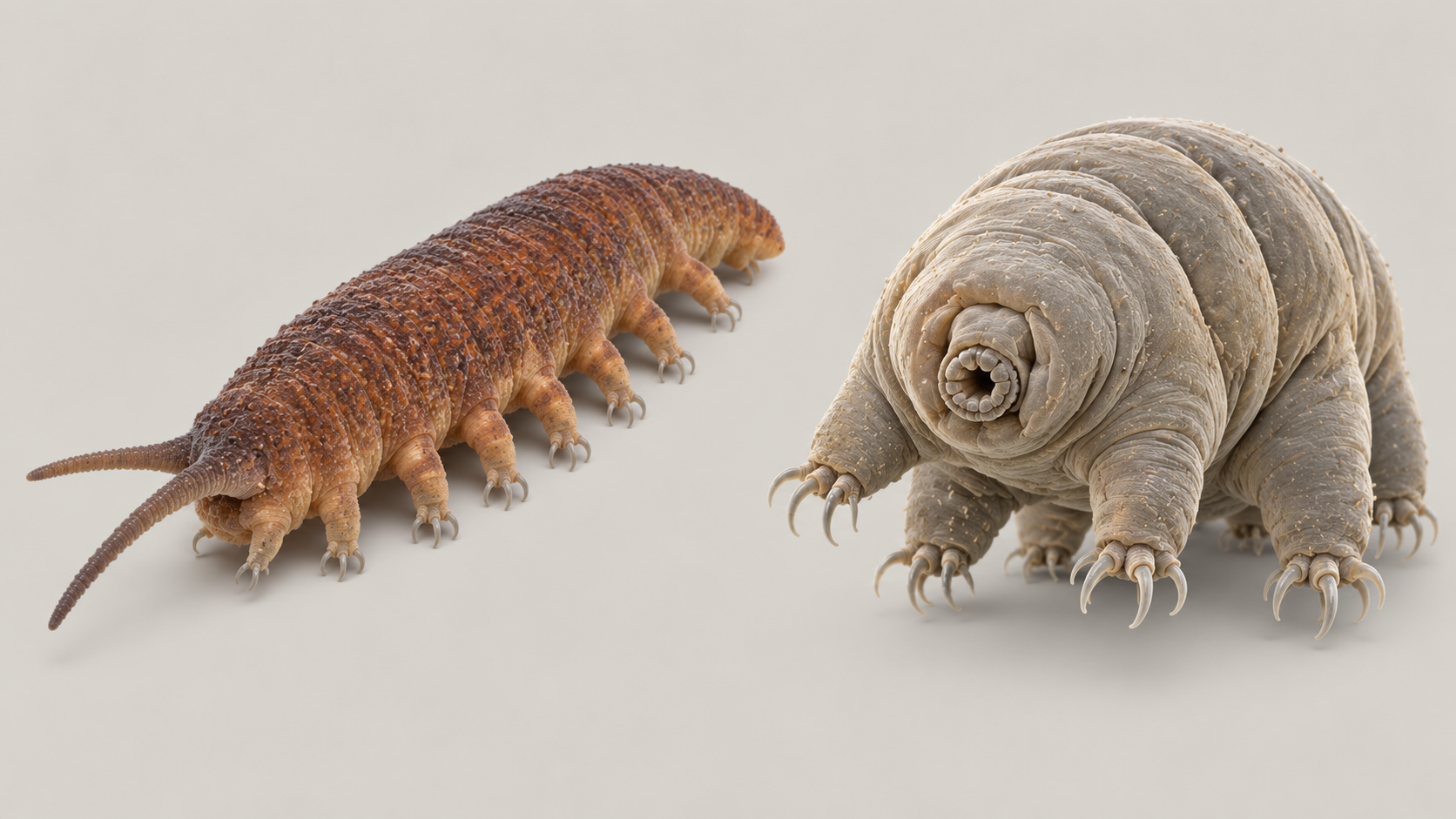
What did keep moving was its place in the family tree. Twelve years after being described as a worm, in 1923, it was noted to resemble living velvet worms (onychophorans), and in 1931 Walcott himself revised his view to “close to the velvet worms.” From there Aysheaia appeared for a long time in field guides and textbooks as a Cambrian ancestor of the velvet worms. But the jaws and slime-producing organs of living velvet worms have not been found, and in 1958 it was argued that it should be given a phylum of its own. In his 1978 redescription, Whittington noted points of resemblance to both velvet worms and tardigrades, yet placed it in neither, treating it as an independent family.
In the 2010s, as computational phylogenetic analysis was applied to lobopodians as a whole, Aysheaia came to be placed near the very base of the lobopodian tree. Analyses in 2014 and 2015 both supported that position. Then in 2017, Jean-Bernard Caron and Cédric Aria of the Royal Ontario Museum described new lobopodians from the Burgess Shale and, in the same work, suggested that Aysheaia might belong to a lineage close to living tardigrades. Their grounds were the forward-pointing last pair of legs and the cluster of multiple claws at each leg tip, both features seen in living tardigrades. The same researchers supported this view again in a 2020 paper.
At present there is no settled view on where Aysheaia belongs. Analyses placing it at the base of the lobopodians and analyses making it an earliest member of the tardigrade lineage stand side by side, and the Royal Ontario Museum’s own account notes that the tardigrade hypothesis has not reached consensus. While the shape drawn in 1911 still stands, which branch — arthropod, velvet worm or tardigrade — that shape sits at the base of remains undecided more than a century after its description.
Sources
Whittington, H. B. (1978). The lobopod animal Aysheaia pedunculata Walcott, Middle Cambrian, Burgess Shale, British Columbia. Philosophical Transactions of the Royal Society B, 284, 165–197.
https://doi.org/10.1098/rstb.1978.0061
Royal Ontario Museum, The Burgess Shale: Aysheaia pedunculata (an account of its classification, description history and ecology)
https://burgess-shale.rom.on.ca/fossils/aysheaia-pedunculata/
Caron, J.-B. & Aria, C. (2017). Cambrian suspension-feeding lobopodians and the early radiation of panarthropods. BMC Evolutionary Biology, 17, 29.
https://doi.org/10.1186/s12862-016-0858-y
Pates, S., Daley, A. C. & Ortega-Hernández, J. (2017). Aysheaia prolata from the Utah Wheeler Formation (Drumian, Cambrian) is a frontal appendage of the radiodontan Stanleycaris. Acta Palaeontologica Polonica, 62(3), 619–625.
https://doi.org/10.4202/app.00361.2017
Smith, M. R. & Caron, J.-B. (2015). Hallucigenia‘s head and the pharyngeal armature of early ecdysozoans. Nature, 523, 75–78.
https://doi.org/10.1038/nature14573
コメント