This article contains affiliate links. As an Amazon Associate I earn from qualifying purchases.
| Name | Megalania (Varanus priscus; named Megalania prisca in 1859 and now generally placed in the monitor lizard genus Varanus, with Megalania kept as a common name. Priscus is Latin for “ancient”) |
| Classification | Reptilia, Squamata, Varanidae, Varanus (close to the Komodo dragon) |
| Period | Quaternary, Pleistocene (the youngest possible record is about 50,000 years old) |
| Found in | Australia (Queensland, New South Wales, Victoria, South Australia) |
| Length | About 3.5 to 5 m (Australian Museum). Estimates range widely between studies, from more than 7 m to about 2.1 m excluding the tail |
| Weight | Varies widely between studies (a 2009 study estimated at least 575 kg even on conservative assumptions) |
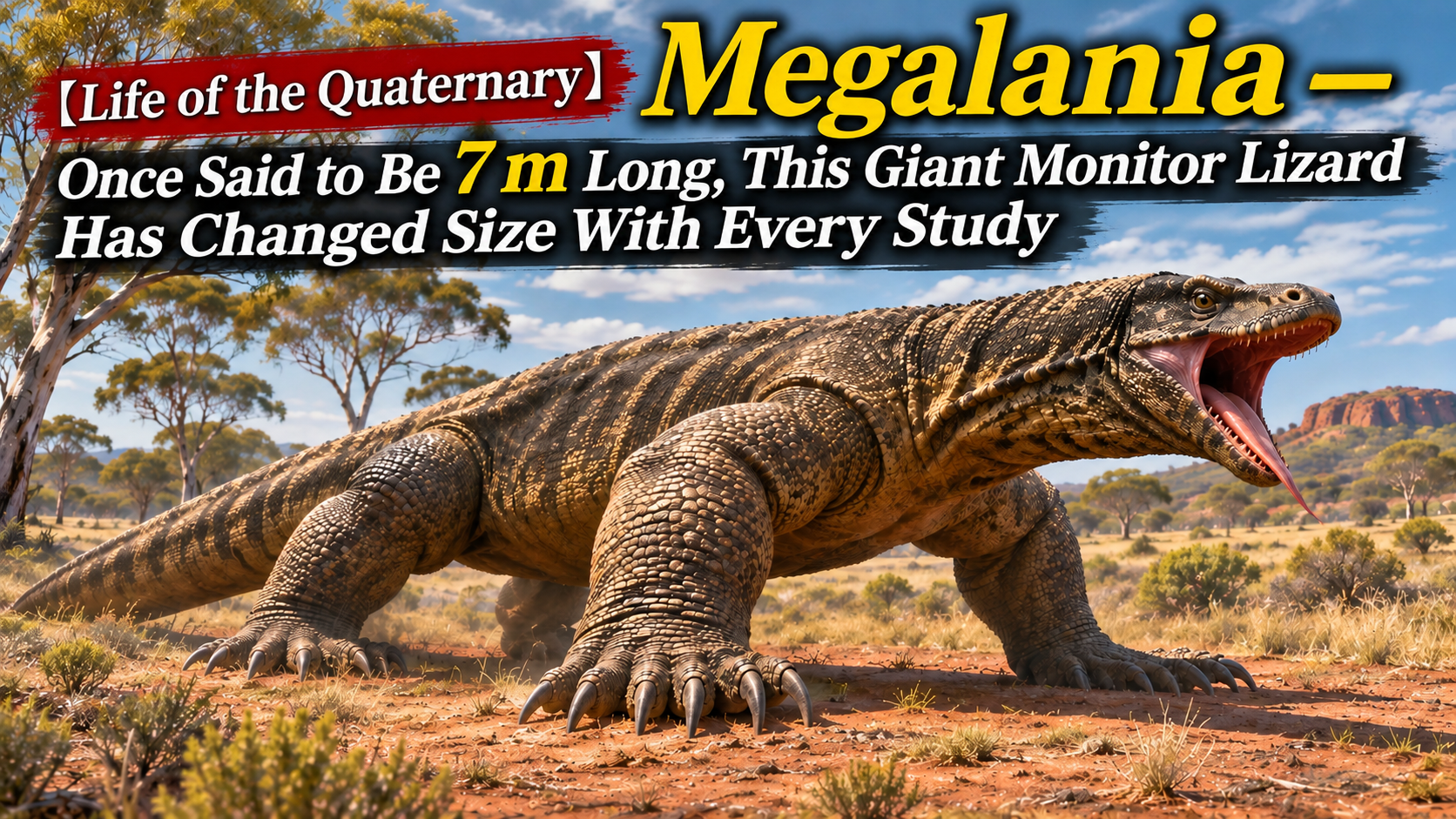
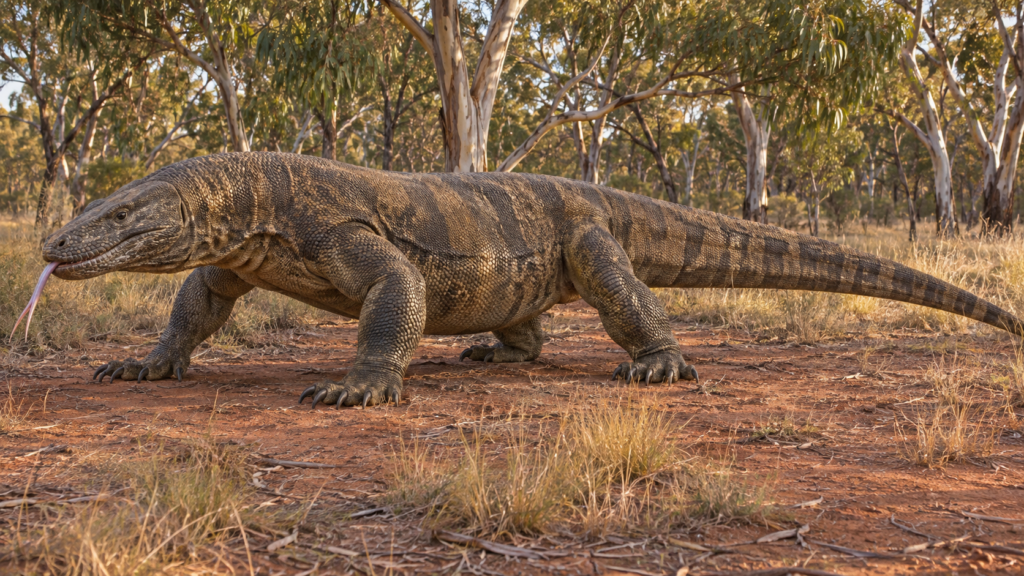
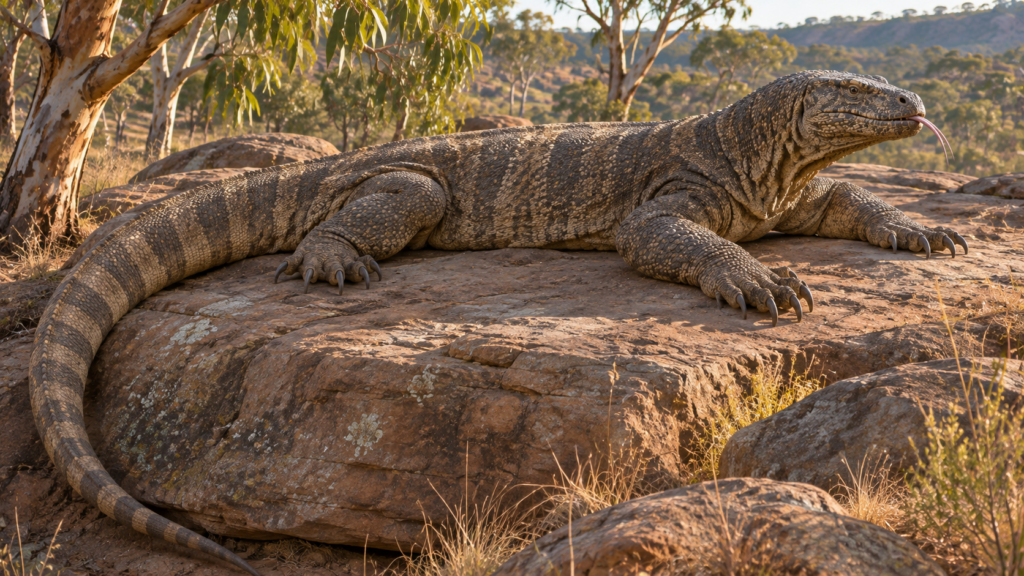
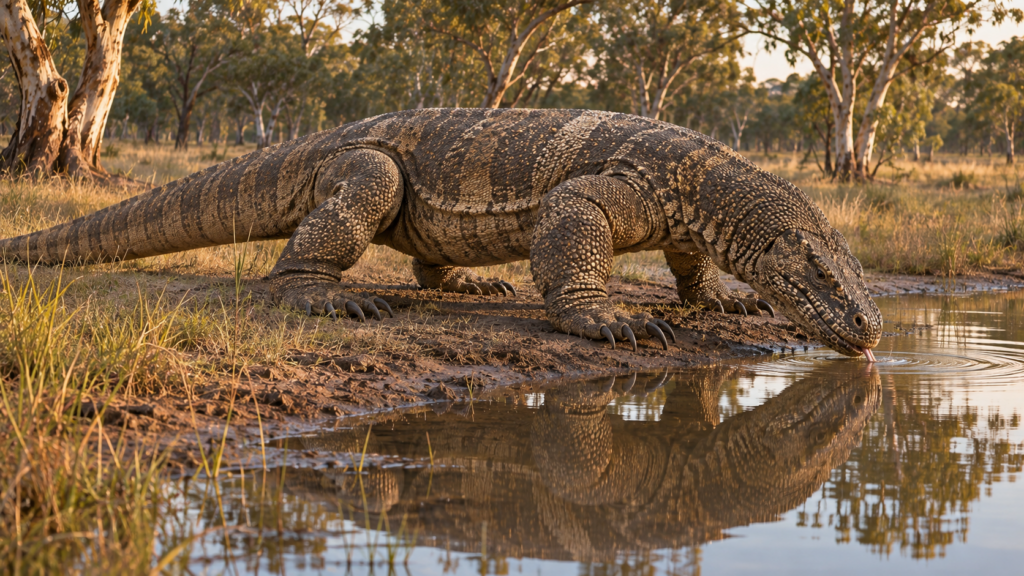
Megalania was a giant monitor lizard of Pleistocene Australia and the largest land lizard known. A close relative of Indonesia’s Komodo dragon, it had teeth with saw-like edges. It was once said to have exceeded 7 m in length, but estimates of its size have risen and fallen from one study to the next.
Appearance and Way of Life
Megalania was named in 1859 by the British anatomist Richard Owen, from bones found on the Darling Downs in Queensland. It was later moved into Varanus, the genus of living monitor lizards, and is now usually known by the scientific name Varanus priscus.
Its fossils have been found across eastern and southern Australia, including the Darling Downs and Bluff Downs in Queensland, Wellington Caves in New South Wales and Naracoorte in South Australia. It is not known from Tasmania, Western Australia or New Guinea.
In 2009 Scott Hocknull of the Queensland Museum and his colleagues examined fossils of Australia’s giant monitor lizards. They concluded that giant monitors reached Australia from Asia and diversified there, and that the Komodo dragon itself arose in Australia before spreading west. Fossils of the Komodo dragon have been found in Queensland from more than 3.8 million years ago to the middle Pleistocene, and Megalania had reached its giant size by the later part of the middle Pleistocene.
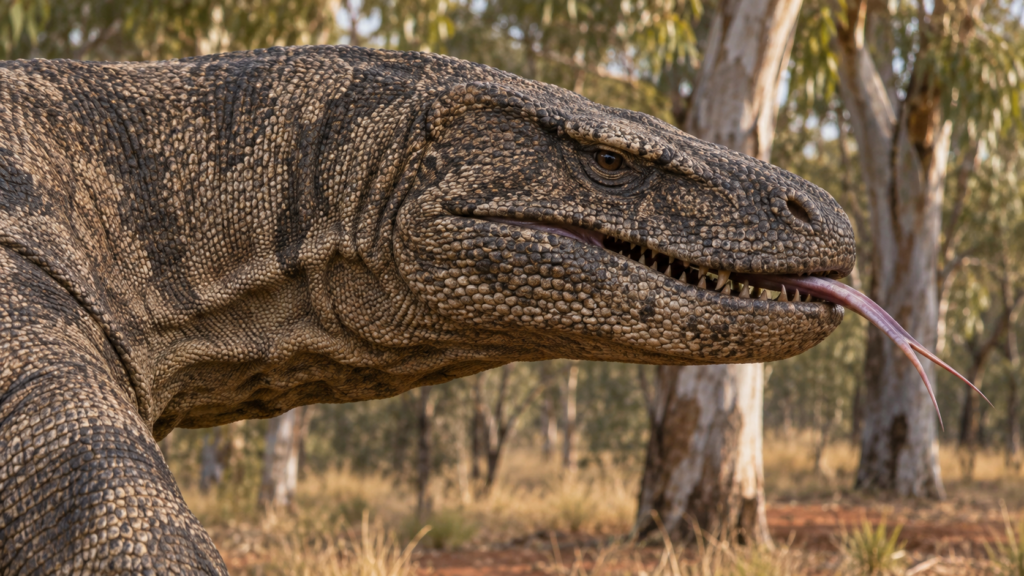
The edges of its upper teeth were finely serrated. In 2009 Bryan Fry of the University of Melbourne and his colleagues, in a study showing that the Komodo dragon has venom glands in its mouth, concluded that its relative Megalania was very likely venomous too. The venom glands themselves do not fossilise, however, so this conclusion is inferred from living relatives.
A Size That Kept Changing
The size of Megalania is calculated from isolated bones such as vertebrae, using the body proportions of living monitor lizards. The answer changes a great deal depending on which species is used as the model and how long the tail is assumed to be.
Owen thought it was about 6 m long. Later estimates of more than 7 m and over 2 tonnes appeared and spread as the image of “the largest lizard ever.”
In 2002 Stephen Wroe of Australia reviewed the earlier estimates and gave an average total length of about 3.45 m. His study challenged what it called the “myth” that reptiles dominated Australia’s top predators.
The 2009 study by Fry and his colleagues pointed out that figures of 7 m and 2,000 kg rely on extrapolation far beyond the range of living lizards. Even so, scaling conservatively from the Komodo dragon, they estimated a length of more than 5.5 m and a weight of at least 575 kg.
In 2012 Jack Conrad of the American Museum of Natural History and his colleagues used the largest known vertebra, about 53 mm long, to estimate a body length of about 2.1 m excluding the tail. They suggested that exceptionally large individuals may have exceeded 3 m without the tail, which is still far smaller than many earlier estimates. The Australian Museum gives its total length as 3.5 to 5 m.
Living Alongside Humans
In 2015 Gilbert Price of the University of Queensland and his colleagues reported a single bony scale (osteoderm) of a giant monitor lizard from cave deposits in the Mount Etna area near Rockhampton, Queensland. The bone is about 1 cm long and was dated to about 50,000 years ago, making it the youngest known record of a giant lizard. This overlaps with the time when people arrived in Australia.
It is not possible to tell, however, whether the bone came from Megalania or from a Komodo dragon. The team said humans can now be considered as possible contributors to the extinction of giant monitor lizards, but no evidence directly shows that people caused it.
Related products
You can find books and products related to this article on Amazon.
If you buy through the links above, this blog may earn a commission.
About the images
The images in this article are illustrations created with AI (ChatGPT), and you are welcome to use them. If you do, we would appreciate a link back to this article as the source.
Sources
Owen, R. (1859). Description of some remains of a gigantic land-lizard (Megalania prisca, Owen) from Australia. Philosophical Transactions of the Royal Society of London 149, 43–48. https://doi.org/10.1098/rstl.1859.0002
Hocknull, S. A., Piper, P. J., van den Bergh, G. D., Due, R. A., Morwood, M. J. & Kurniawan, I. (2009). Dragon’s Paradise Lost: Palaeobiogeography, Evolution and Extinction of the Largest-Ever Terrestrial Lizards (Varanidae). PLoS ONE 4(9), e7241. https://doi.org/10.1371/journal.pone.0007241
Wroe, S. (2002). A review of terrestrial mammalian and reptilian carnivore ecology in Australian fossil faunas, and factors influencing their diversity: the myth of reptilian domination and its broader ramifications. Australian Journal of Zoology 50, 1–24. https://doi.org/10.1071/ZO01053
Fry, B. G. et al. (2009). A central role for venom in predation by Varanus komodoensis (Komodo Dragon) and the extinct giant Varanus (Megalania) priscus. PNAS 106, 8969–8974. https://doi.org/10.1073/pnas.0810883106
Conrad, J. L., Balcarcel, A. M. & Mehling, C. M. (2012). Earliest Example of a Giant Monitor Lizard (Varanus, Varanidae, Squamata). PLoS ONE 7(8), e41767. https://doi.org/10.1371/journal.pone.0041767
Price, G. J., Louys, J., Cramb, J., Feng, Y., Zhao, J., Hocknull, S. A., Webb, G. E., Nguyen, A. D. & Joannes-Boyau, R. (2015). Temporal overlap of humans and giant lizards (Varanidae; Squamata) in Pleistocene Australia. Quaternary Science Reviews 125, 98–105. https://doi.org/10.1016/j.quascirev.2015.08.013
Australian Museum, “Megalania prisca.” https://australian.museum/learn/australia-over-time/extinct-animals/megalania-prisca/
University of Queensland news release (24 September 2015). https://news.uq.edu.au/2015-09-24-giant-killer-lizard-fossil-shines-new-light-early-australians
National Geographic (2014). https://www.nationalgeographic.com/science/article/australias-giant-venomous-lizard-gets-downsized

コメント