This article contains affiliate links. As an Amazon Associate I earn from qualifying purchases.
| Name | Metasequoia (dawn redwood). The name adds the Greek prefix meta-, meaning “after” or “changed,” to Sequoia |
| Classification | Gymnosperm, conifer, cypress family (Cupressaceae), genus Metasequoia. Only one living species, Metasequoia glyptostroboides |
| Age | Late Cretaceous to the present. In Japan, fossils occur up to the Early Pleistocene |
| Where found | Fossils across the Northern Hemisphere, including Axel Heiberg and Ellesmere Islands in the Canadian Arctic. In Japan, in Neogene to Quaternary strata such as the Osaka Group. Wild trees survive only in valleys in Lichuan (Hubei), Shizhu (Chongqing) and Hunan, China |
| Height | About 45 m for large wild trees, with trunks up to about 2.5 m across. Some valleys have trees around 50 m tall |
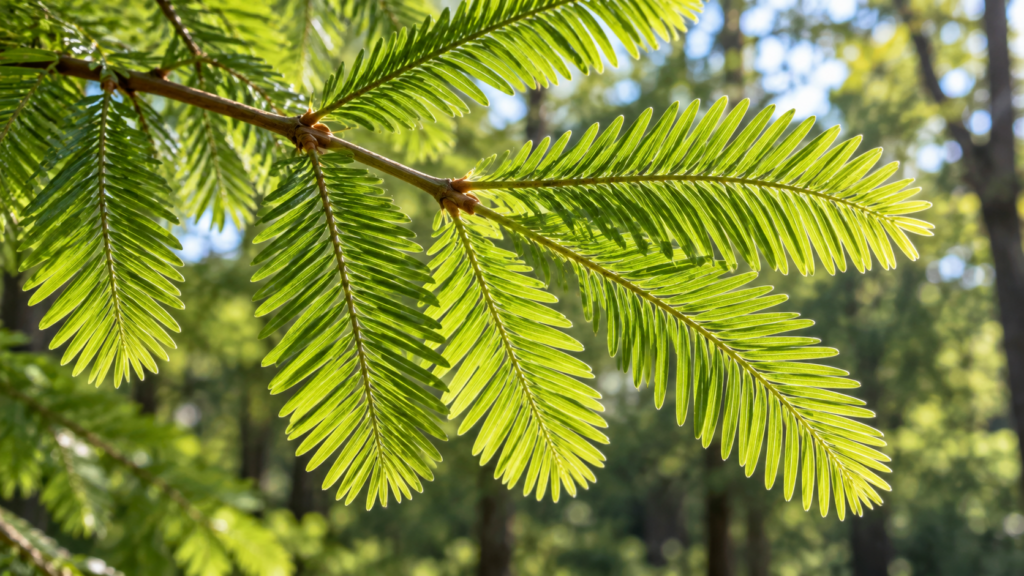
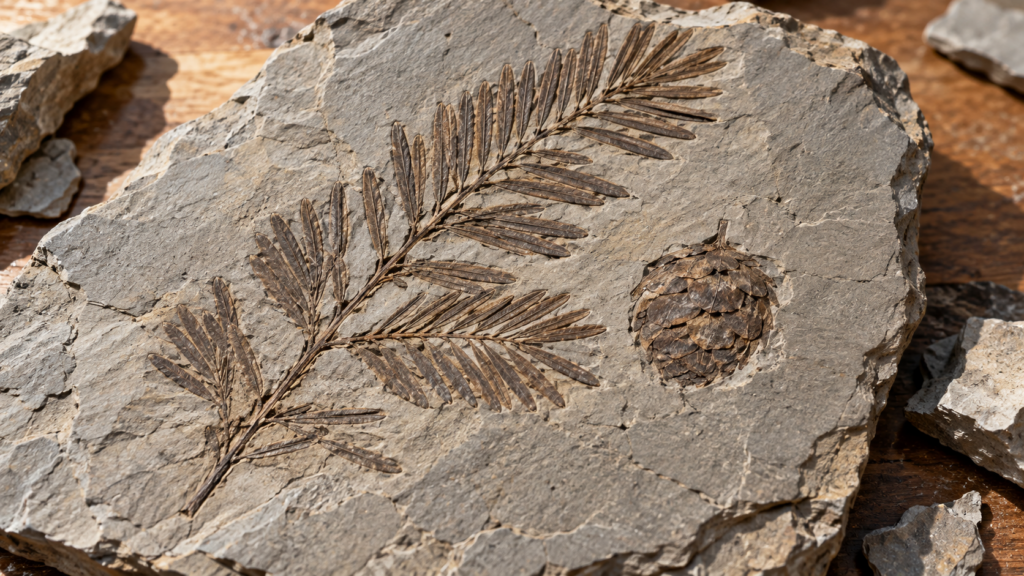
| Leaves | About 50 flat, linear leaves set in opposite pairs along branchlets 3–8 cm long; the branchlets themselves also grow in opposite pairs. In autumn they turn reddish brown and fall together with the branchlets |
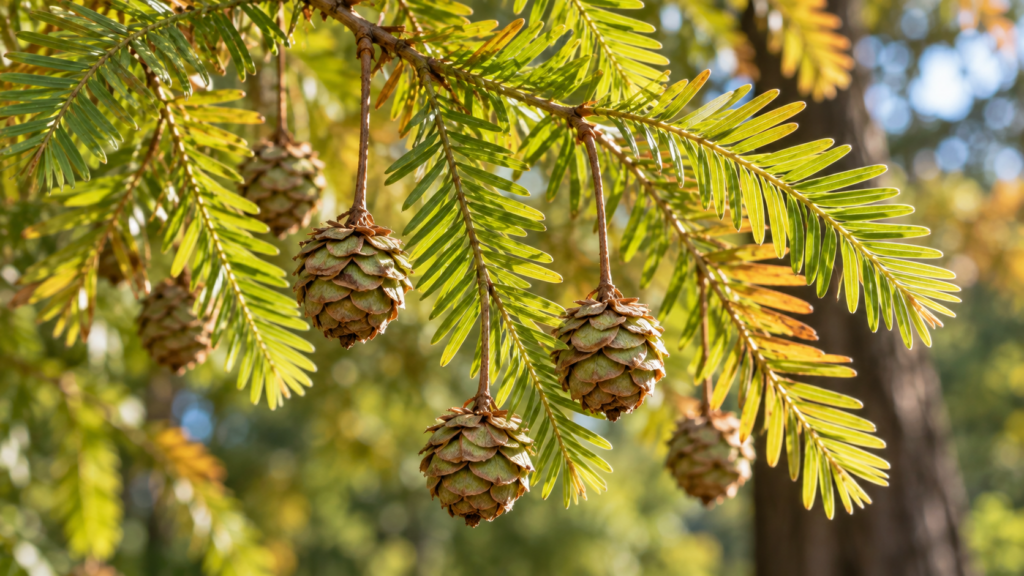
| Cones | Up to about 2.5 cm long, with 20–30 woody scales in opposite pairs, each pair set at right angles to the next |
| Wild trees | 5,393 counted in a 2002–2003 survey. Listed as Endangered (EN) on the IUCN Red List |
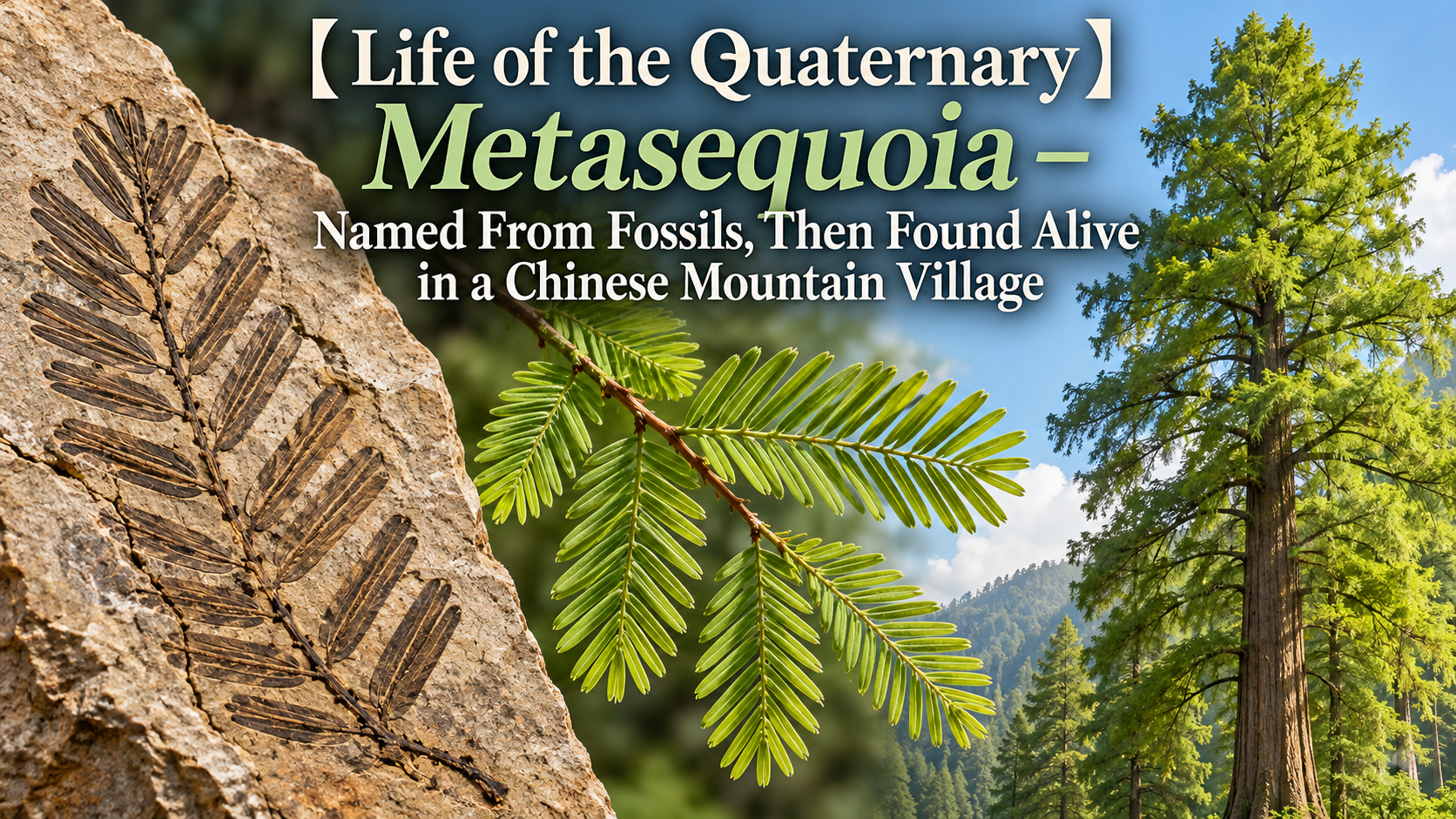
Metasequoia is a deciduous conifer of the cypress family. From the Cretaceous onward it formed forests across the Northern Hemisphere, and in Japan it grew until the Early Pleistocene. In 1941 the Japanese paleobotanist Shigeru Miki gave it a name as a fossil plant, and a few years later a member of the same genus was found alive in a mountain village in China.
Form and Life
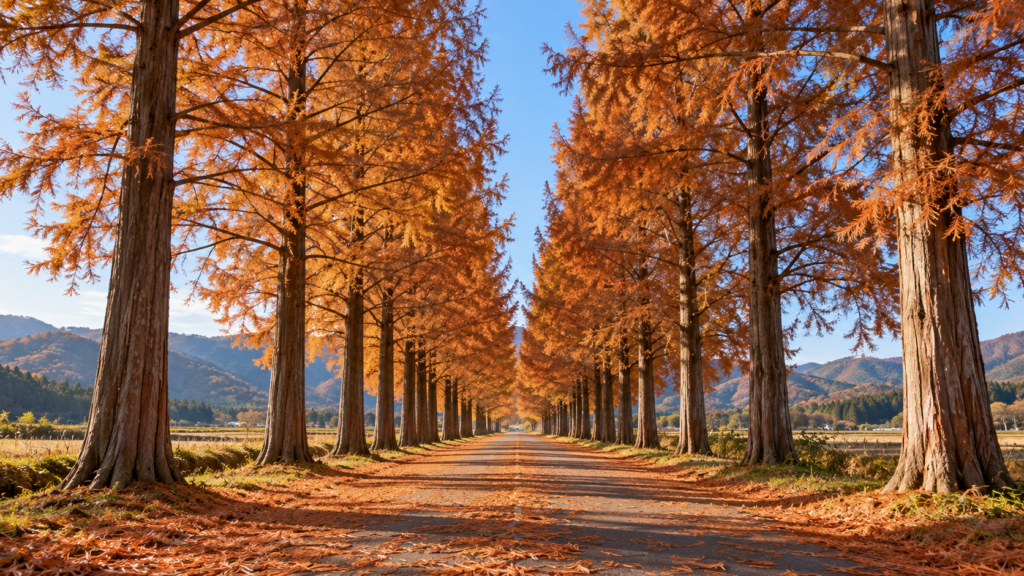
Metasequoia is a tall tree with a straight trunk and branches that spread into a cone shape. For a conifer its leaves are soft and flat, lined up on both sides of each branchlet like the barbs of a feather. Both the leaves and the branchlets grow in opposite pairs, which is the key feature of the genus. In spring it puts out bright green leaves, and in autumn they turn reddish brown and drop, still attached to their branchlets. Only a few conifers, such as larches and bald cypress, shed their leaves in winter.
The cones are about the size of a fingertip and hang downward at the ends of stalks. The woody scales come in opposite pairs, and each pair is turned 90 degrees from the pair below it.
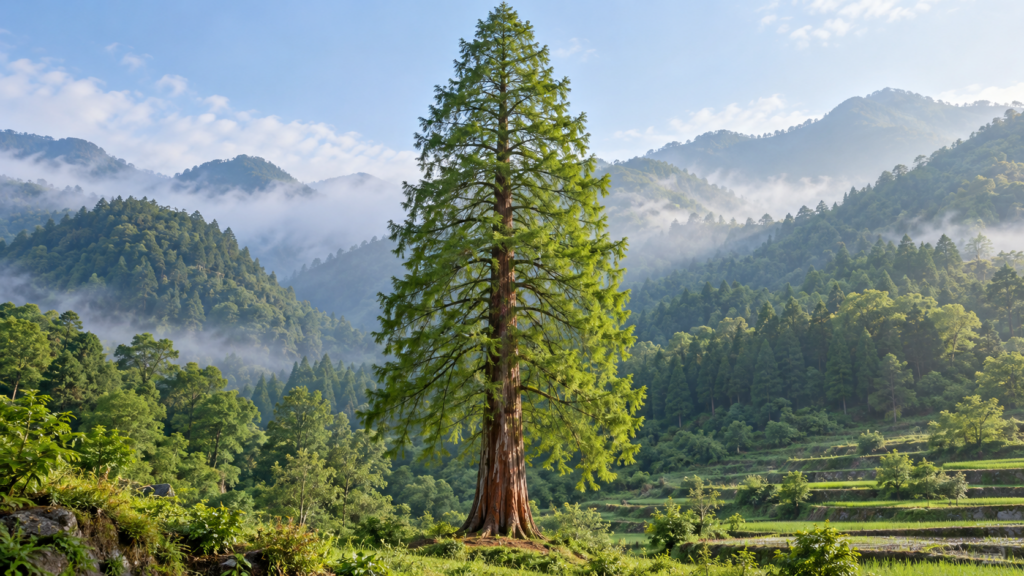
Wild trees survive in valleys at about 750–1,500 m elevation in central China, near where Hubei, Chongqing and Hunan meet.
Fossils appear in Late Cretaceous rocks, and in the first half of the Cenozoic the genus spread throughout the Northern Hemisphere. On Ellesmere and Axel Heiberg Islands in the Canadian Arctic, above 80° north, forests about 50 million years old are preserved. There, Metasequoia trunks, stumps, leaves and cones lie buried in three dimensions without having turned to stone, and even the plant fiber cellulose survives. Today these are islands of ice and rock, but at the time the Arctic was warm enough for Metasequoia to thrive.
As the Earth later grew cooler and drier, the range of Metasequoia shrank. It held on in Japan for a while. In the Osaka Group, which spreads across Osaka, Kyoto and Nara, its leaves, cones and seeds occur in layers below the Pleistocene marine clay bed known as “Ma2.” They do not appear in the layers above, and Metasequoia disappeared from Japan during the Early Pleistocene.
The Fossil Got Its Name First, and the Living Tree Was Found Later
The name Metasequoia was given to fossils, not to a living tree. The paleobotanist Shigeru Miki (1901–1974) had been collecting plant fossils from Neogene and Quaternary clay and lignite beds across Japan. Among them were specimens that differed from fossils previously assigned to the bald cypress genus (Taxodium) or the redwood genus (Sequoia). Their leaves and branchlets were arranged in opposite pairs, and so were the scales of their cones.
In 1941 Miki named this plant as a new genus, Metasequoia, and published the fossil species Metasequoia disticha and M. japonica. The paper appeared in the English-language Japanese Journal of Botany. At the time, Metasequoia was thought to be extinct.
Meanwhile, events were unfolding in China. In July 1943 the forester Wang Zhan collected specimens from a large conifer that villagers revered as a sacred tree in Modaoxi (now Moudao, in Lichuan), Hubei Province. Wang believed it was a new species but could not determine its affinities, and in 1944 one of his specimens was passed to the botanist Wan-Chun Cheng. In 1946 Cheng sent his student Chi-Ju Hsueh to collect more material, and the botanist Hsen-Hsu Hu recognized it as belonging to the same genus as Miki’s fossil Metasequoia. Hu announced in December 1946 that Metasequoia was still alive, and in May 1948 Hu and Cheng described the living species Metasequoia glyptostroboides.
Some sources date the discovery of the tree to 1941, but a 2024 history of the discovery by Chinese researchers concludes that no specimens were collected in 1941 and that the first specimens are Wang Zhan’s from 1943. The first tree found at Modaoxi was about 35 m tall, 2.4 m across at the trunk and some 400 years old as of 2003.
News of the living Metasequoia spread quickly. In 1947 Elmer Merrill, director of Harvard University’s Arnold Arboretum, sent money to fund seed collection, and in January and February 1948 seeds gathered in Hubei arrived at the arboretum. They were divided into at least 600 packets and sent to botanical gardens and universities around the world. Until new seed was collected in the 1990s, nearly every Metasequoia growing outside China came from these 1948 seeds.
In 1950, 100 seedlings arrived in Japan from the United States. Miki founded the Metasequoia Preservation Society, which distributed the seedlings to research institutions and local governments across Japan and propagated more from cuttings. In 1954 alone it shipped 4,426 young trees. Many of the Metasequoia now seen in Japanese parks, avenues and schools descend from the trees spread at that time. In China, meanwhile, a 2002–2003 survey counted 5,393 wild trees, about 7% fewer than 20 years earlier. The tree that was named from fossils has been planted all over the world, yet in its home valleys it is an endangered species.
Related products
You can find books and products related to this article on Amazon.
If you buy through the links above, this blog may earn a commission.
Sources
Tsukagoshi, M. (2016). Discovery and spread of Metasequoia (Dawn Redwood): 75 years from the discovery by Dr. Shigeru Miki. Fossils (Palaeontological Society of Japan) 100, 1–2 (in Japanese). https://www.palaeo-soc-japan.jp/publications/100_TsukagoshiFP.pdf
Miki, S. (1941). On the change of flora in Eastern Asia since Tertiary Period (I). The clay or lignite beds flora in Japan with special reference to the Pinus trifolia beds in Central Hondo. Japanese Journal of Botany 11, 237–303.
Hu, H. H. & Cheng, W. C. (1948). On the New Family Metasequoiaceae and on Metasequoia glyptostroboides, a living species of the genus Metasequoia found in Szechuan and Hupeh. Bulletin of the Fan Memorial Institute of Biology, New Series 1, 153–161.
Qian, H., Shao, G. & Liu, Q. (2024). The history of discovering Metasequoia glyptostroboides. Biodiversity Science 32, 24378. https://doi.org/10.17520/biods.2024378
Arnold Arboretum of Harvard University, Expeditions: Metasequoia Collection. https://arboretum.harvard.edu/expeditions/metasequoia-collection
Yang, H. & Leng, Q. (2018). Old Molecules, New Climate: Metasequoia’s Secrets. Arnoldia 76(2). https://arboretum.harvard.edu/stories/old-molecules-new-climate-metasequoias-secrets
Royal Botanic Garden Edinburgh, Threatened Conifers of the World: Metasequoia glyptostroboides. https://threatenedconifers.rbge.org.uk/conifers/metasequoia-glyptostroboides
The Gymnosperm Database: Metasequoia glyptostroboides. https://www.conifers.org/cu/Metasequoia.php
Kyoto Prefecture Red Data Book 2015, Metasequoia fossil locality (Fukakusa) (in Japanese). https://www.pref.kyoto.jp/kankyo/rdb/geo/db/soi0005.html

コメント