This article contains affiliate links. As an Amazon Associate I earn from qualifying purchases.
| Name | Mesosaurus (“middle lizard”). The best-known species is Mesosaurus tenuidens (“thin tooth”) |
| Classification | Reptile, mesosaur (an early amniote) |
| Age | Early Permian (about 280 million years ago) |
| Where found | Southern Africa (South Africa, Namibia) and eastern South America (Brazil, Uruguay). The first specimen was found in South Africa and described in the 1860s |
| Length | About 1 m. Most specimens found are smaller |
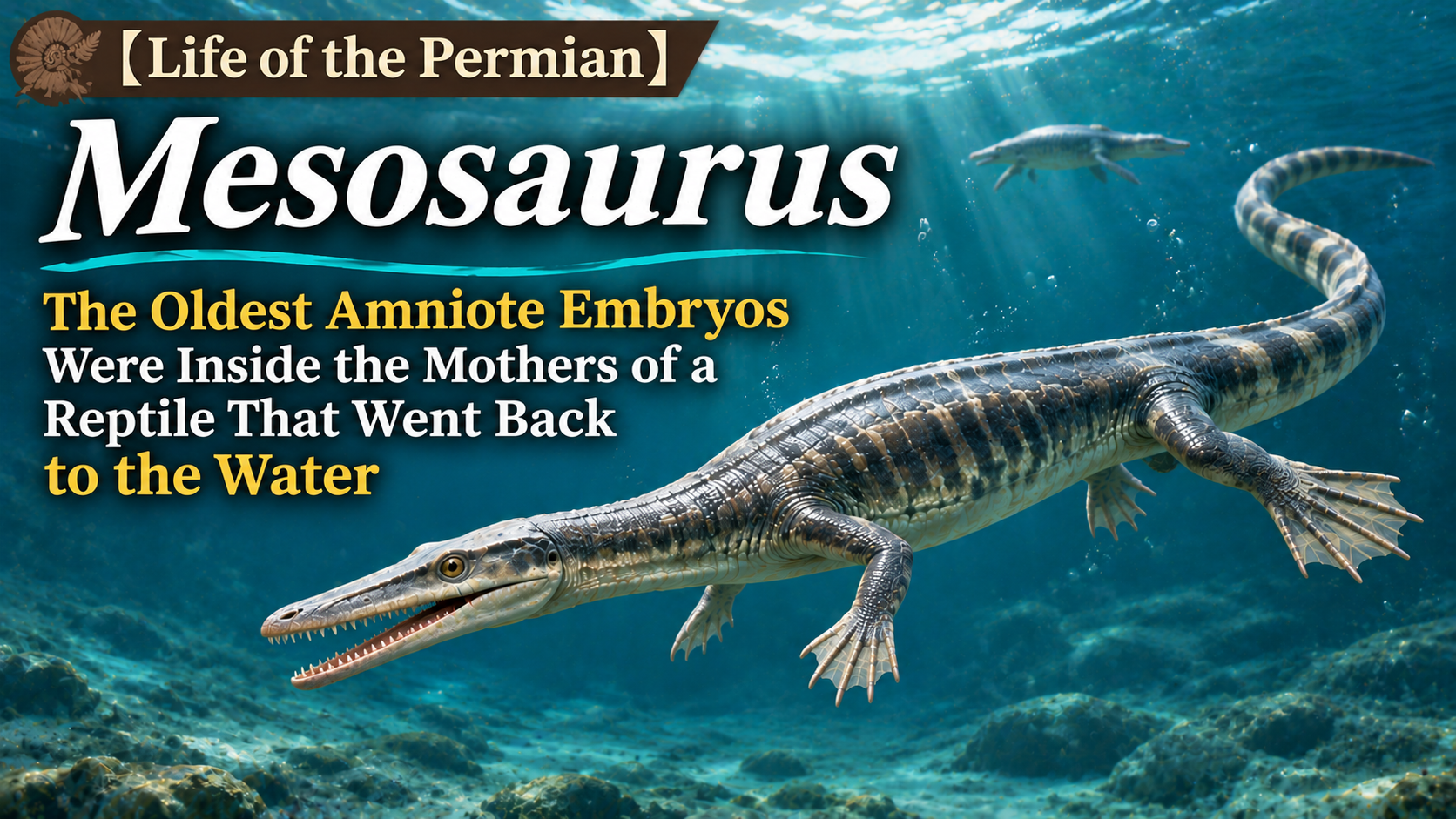
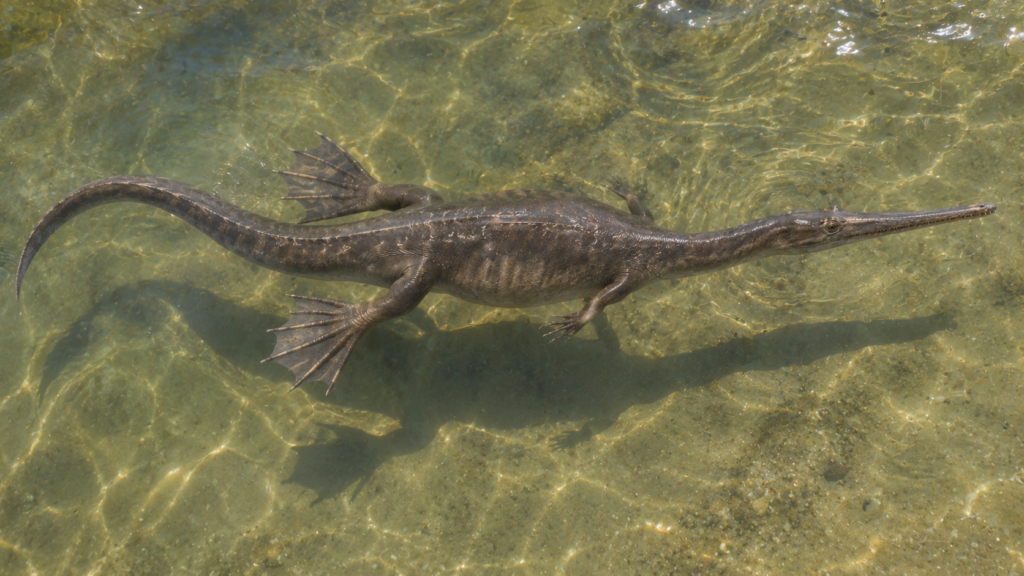
Mesosaurus was a slender reptile about a meter long that lived in an Early Permian sea. It is the earliest known member of the reptiles that went back to life in the water after their ancestors had moved onto land. Fossils from Uruguay and Brazil include the oldest known embryos of any amniote.
Body and way of life
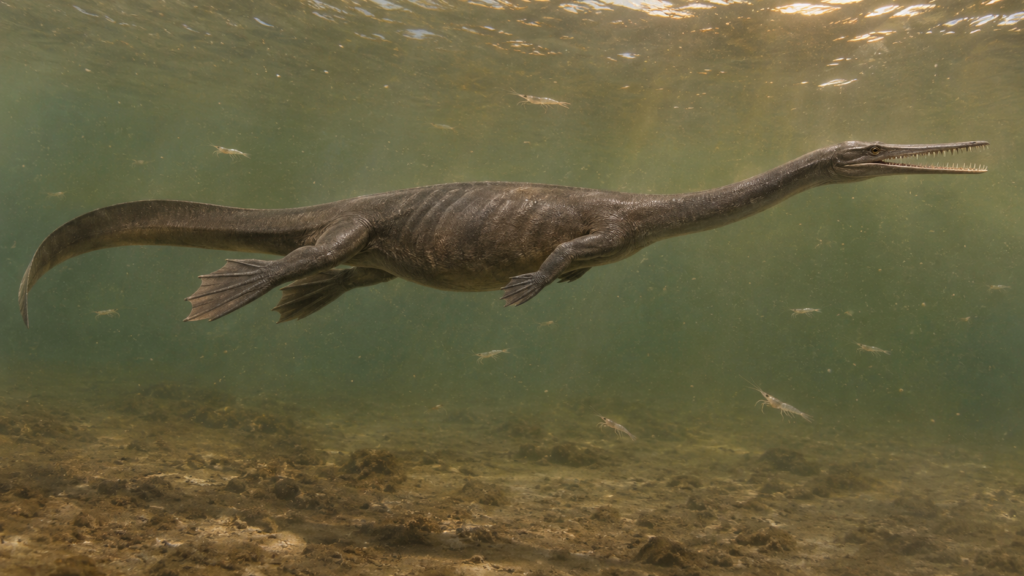
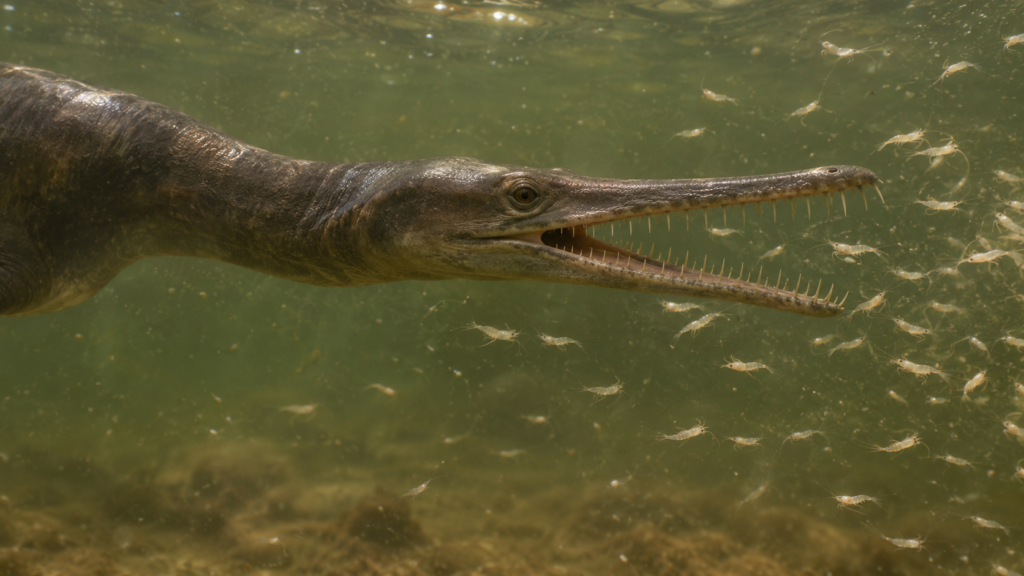
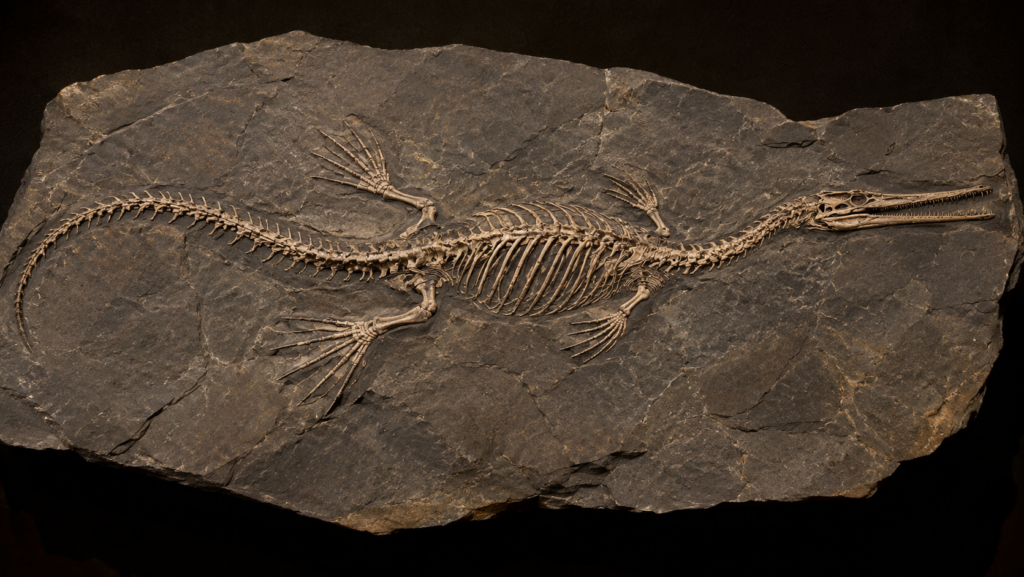
The head was long and narrow, and the long snout was packed with thin, long, needle-like teeth. The neck was long, and the ribs of the trunk were thick, banana-shaped bones, solid and heavy all the way through. The hind feet were large and are thought to have been webbed. The long tail drove the animal through the water. The heavy ribs probably helped it stay down and hold its posture underwater.
The rocks that yield Mesosaurus formed on the floor of an inland sea that spread across South America and southern Africa, which were joined at the time. The same rocks are full of small shrimp-like crustaceans. These are thought to have been Mesosaurus‘s main food, and crustaceans have also been found in stomach contents and fossil droppings. For a long time it was thought to strain crustaceans from the water with its rows of thin teeth. A 2022 study comparing the size and shape of 270 specimens suggests instead that young animals chased and caught small prey and shifted toward straining food as they grew.
Because the same kind of fossil turns up in both South America and Africa, on opposite sides of the Atlantic, the German meteorologist Alfred Wegener cited Mesosaurus as one piece of evidence for continental drift. A small reptile living in a shallow inland sea is unlikely to have swum across an ocean.
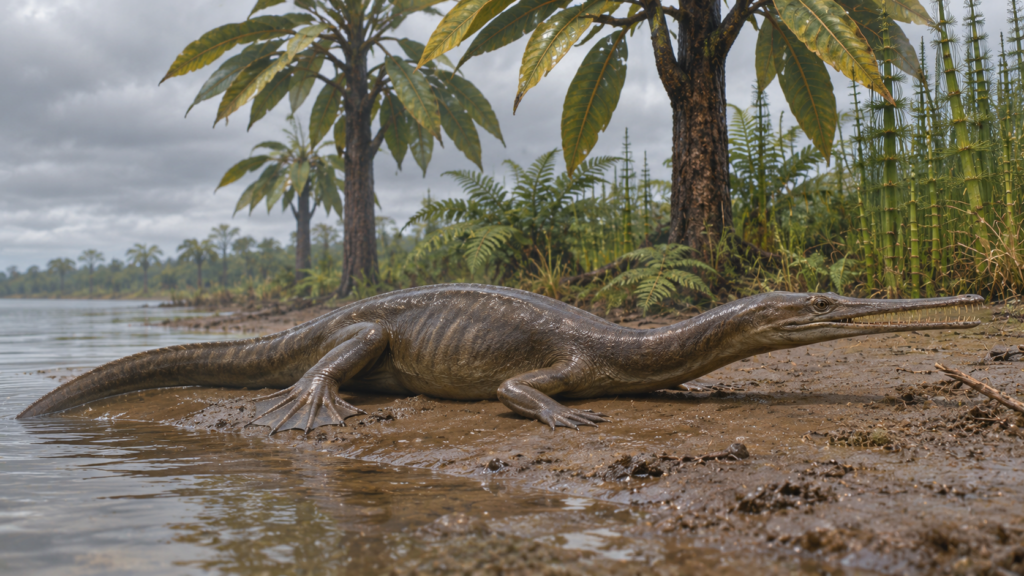
Mesosaurus was long regarded as an animal that spent its whole life in water. In 2018, a team from Uruguay and France compared the pattern of lengths along its backbone and the shape of its limb bones with those of living aquatic and semi-aquatic animals. The results matched the semi-aquatic pattern more closely, and the team suggested that larger, older individuals may sometimes have spent time on land.
Embryos inside the mother’s body
Reptiles, birds and mammals are grouped together as amniotes. They wrap the embryo in a membrane called the amnion, which lets them raise young on dry land, and the “amniotic egg” is often seen as what allowed vertebrates to leave the water’s edge and spread across the land. Yet fossils that show directly how early amniotes reproduced are rare, and eggs or embryos of the earliest amniotes had hardly been found.
In 2012, Graciela Piñeiro of the University of the Republic in Uruguay and colleagues reported embryo fossils of Mesosaurus from Early Permian rocks in Uruguay and Brazil. In one specimen, a small individual lay inside the trunk of an adult, surrounded by its ribs. The team interpreted it as an embryo developing inside its mother. Another specimen was a single curled-up embryo with no trace of a hard, calcified eggshell around it.
The team identified these as the oldest known amniote embryos and concluded that Mesosaurus may have carried its young inside the mother’s body and given birth, rather than laying hard-shelled eggs on land. It may instead have hatched eggs inside the body before birth, and which of the two it did is still open. A 2016 study then examined how the ankle bones formed in a Mesosaurus at an advanced stage of development before birth.
Among the amniotes, the group that gained the means to lay eggs on land, the oldest surviving embryo fossils turned out to be young inside the mothers of Mesosaurus, a reptile that had gone back to the water. Marine reptiles that carried their young and gave birth are also known from later ichthyosaurs of the Triassic and Jurassic, but the Mesosaurus fossils are tens of millions of years older.
Related products
You can find books and products related to this article on Amazon.
If you buy through the links above, this blog may earn a commission.
About the images
The images in this article are illustrations created with AI (ChatGPT), and you are welcome to use them. If you do, we would appreciate a link back to this article as the source.
Sources
Piñeiro, G., Ferigolo, J., Meneghel, M. & Laurin, M. (2012). The oldest known amniotic embryos suggest viviparity in mesosaurs. Historical Biology 24, 620–630. https://doi.org/10.1080/08912963.2012.662230
Piñeiro, G., Núñez Demarco, P. & Meneghel, M. D. (2016). The ontogenetic transformation of the mesosaurid tarsus: a contribution to the origin of the primitive amniotic astragalus. PeerJ 4, e2036. https://doi.org/10.7717/peerj.2036
Núñez Demarco, P., Meneghel, M., Laurin, M. & Piñeiro, G. (2018). Was Mesosaurus a Fully Aquatic Reptile? Frontiers in Ecology and Evolution 6, 109. https://doi.org/10.3389/fevo.2018.00109
Verrière, A. & Fröbisch, J. (2022). Ontogenetic, dietary, and environmental shifts in Mesosauridae. PeerJ 10, e13866. https://doi.org/10.7717/peerj.13866


コメント