| Name | Crinoids, commonly called sea lilies. The class name Crinoidea comes from the Greek krinon (lily) and eidos (form), meaning “lily-like” |
| Classification | Phylum Echinodermata, class Crinoidea (the same phylum as sea urchins, starfish, brittle stars and sea cucumbers) |
| Age | Early Ordovician (about 485–478 million years ago) to the present |
| Localities | Marine rocks worldwide. The oldest known fossils come from Utah, USA |
| Size | The living Metacrinus rotundus has a stalk 30–50 cm long. The Jurassic Seirocrinus had stalks up to about 20 m long |
| Living species | Fewer than 100 stalked sea lilies; more than 500 stalkless feather stars |
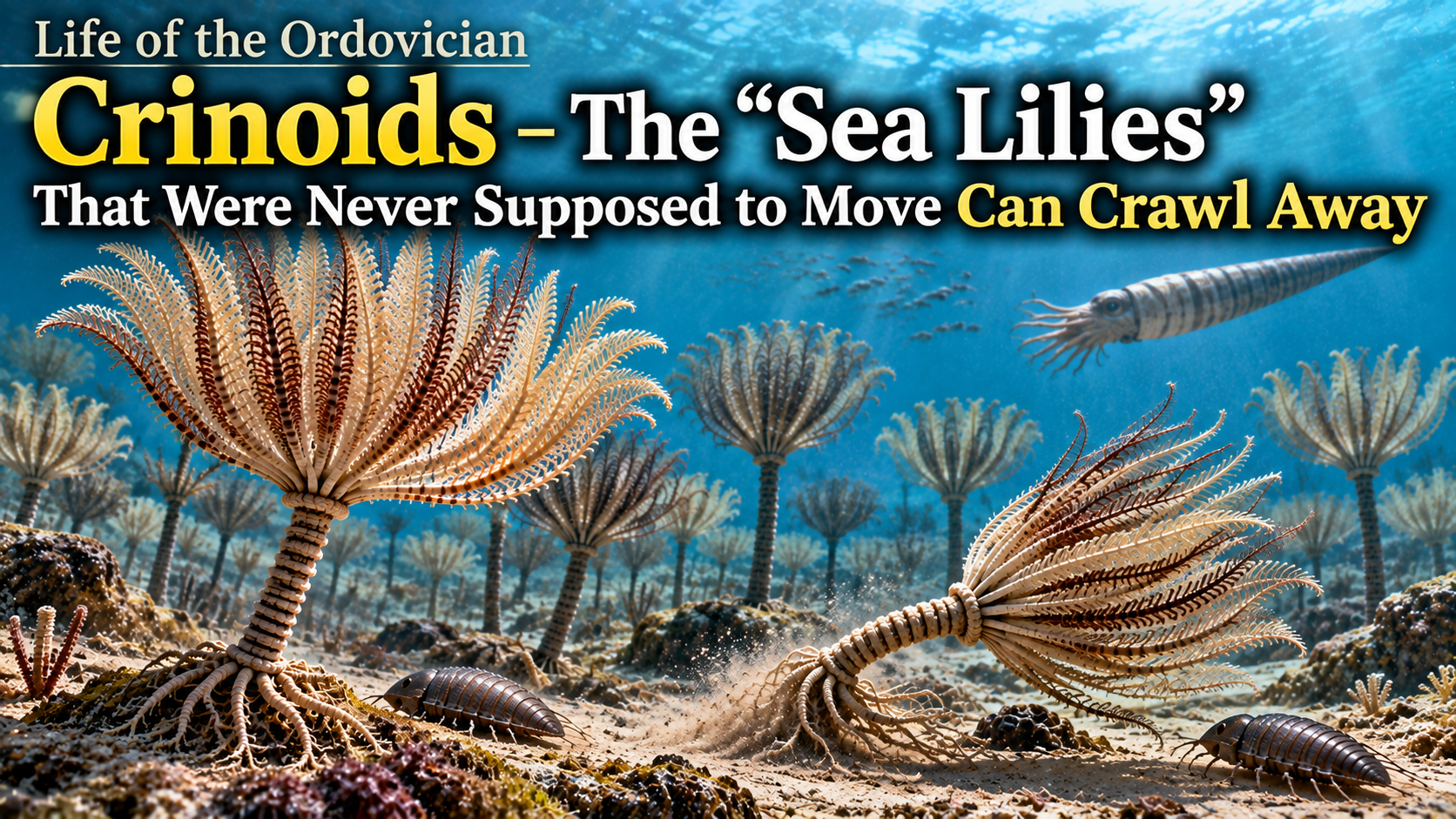
Crinoids are echinoderms, relatives of sea urchins and starfish. With feathery arms spread at the top of a stalk rising from the seabed, they look very much like flowers, but they are animals that catch plankton with their arms. The oldest definite fossils come from Early Ordovician rocks about 480 million years old, and crinoids still survive in deep water today. They were long regarded as animals rooted to the seabed and unable to move, but in the 1990s a submersible’s camera recorded one crawling across the bottom on its arms.
A Body That Looks Like a Flower
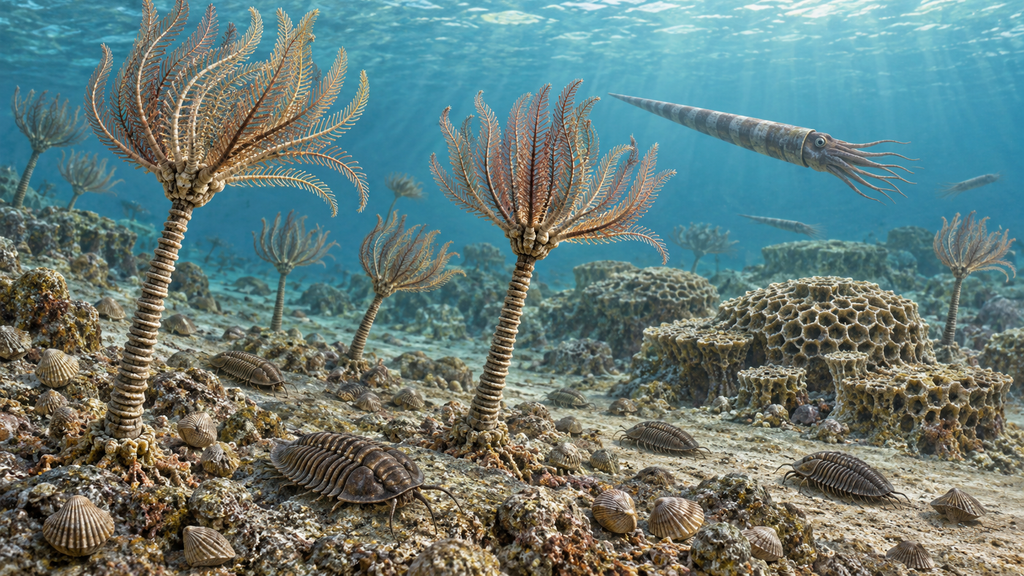
The body has three parts, from the bottom up: the stalk, the calyx and the arms. The stalk is a column of small disc-shaped calcite plates (columnals) stacked like coins, tens or hundreds of them, and the animal holds on to rock with slender appendages called cirri that grow from the base or along the stalk. The cup-shaped calyx at the top of the stalk houses the internal organs, and the arms extend from it. The basic number of arms is five, and in many species they branch into several dozen. The five-fold radial arrangement of the body is a feature shared with starfish, sea urchins and other echinoderms.
The arms are lined with fine side branches called pinnules, and tube feet on their surface catch plankton and organic particles from the water. The captured particles are passed into a groove running along the inner side of each arm and carried to the mouth at the centre of the calyx. The mouth faces upward, and the anus opens on the same upper surface. A starfish crawls with its mouth facing down; a crinoid lives in the opposite orientation, turned over and set on top of a stalk. Where there is a current, it spreads its arms into a dish-shaped fan facing the flow and filters the particles passing through.
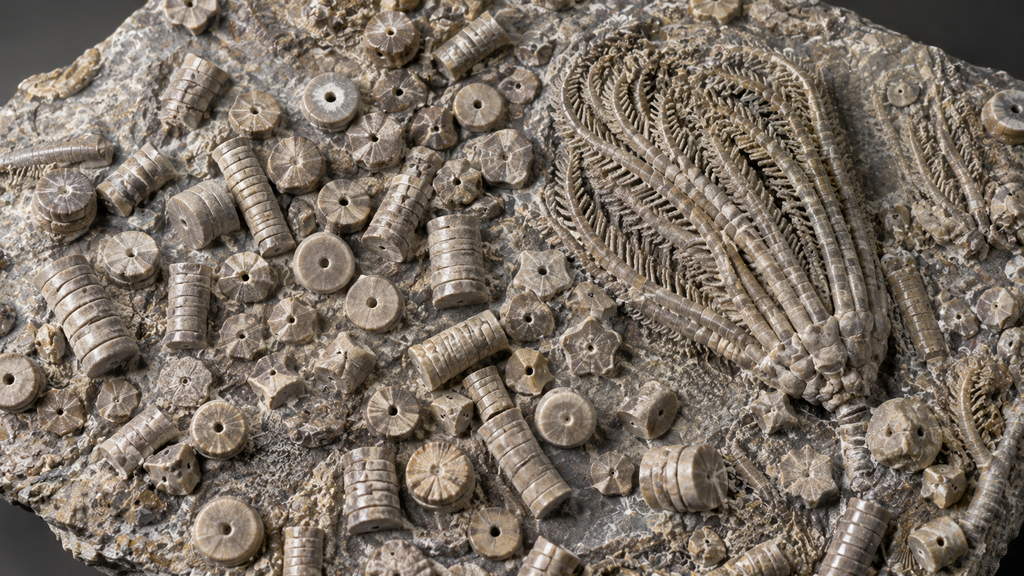
The skeletal plates are held together only by ligaments and other soft tissue, so the body falls apart soon after death. Most crinoid fossils are therefore not whole animals but scattered columnals. These are discs or stars with a hole in the centre, and in England they were threaded onto strings as beads and known as “St Cuthbert’s beads.”
Crinoid Forests in the Shallow Seas of the Paleozoic
The oldest known crinoids come from rocks of the earliest Ordovician (Tremadocian, about 485.4–477.7 million years ago) in Utah, USA. The fossils are few and imperfectly preserved, however, and which group of echinoderms the crinoids arose from is still debated. The Ordovician was a time when the variety of marine animals increased sharply, and crinoids diversified rapidly during this period. The shallow seas of the time were home to trilobites, brachiopods, straight-shelled cephalopods and tabulate corals, and crinoids spread their arms above them, feeding on particles carried by the water a little way above the seabed.
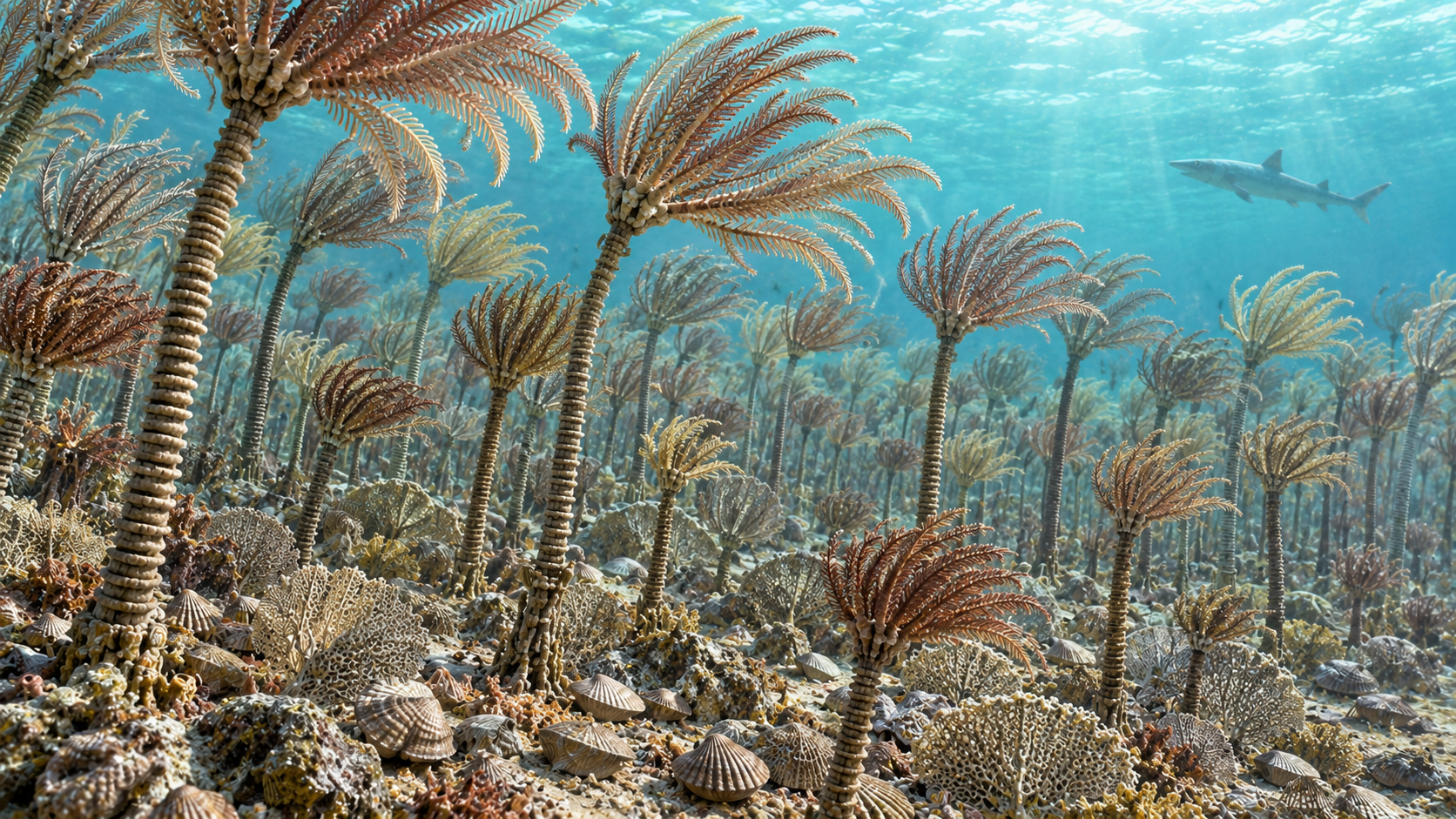
Crinoids reached their peak in the early Carboniferous, a time known as the “Age of Crinoids.” They grew as densely as forests on shallow sea floors, and the columnals scattered after death piled up thickly enough to form beds of limestone on their own. In Japan, stalk fossils are found in Paleozoic limestones such as those of Mount Kinshō in Gifu Prefecture.
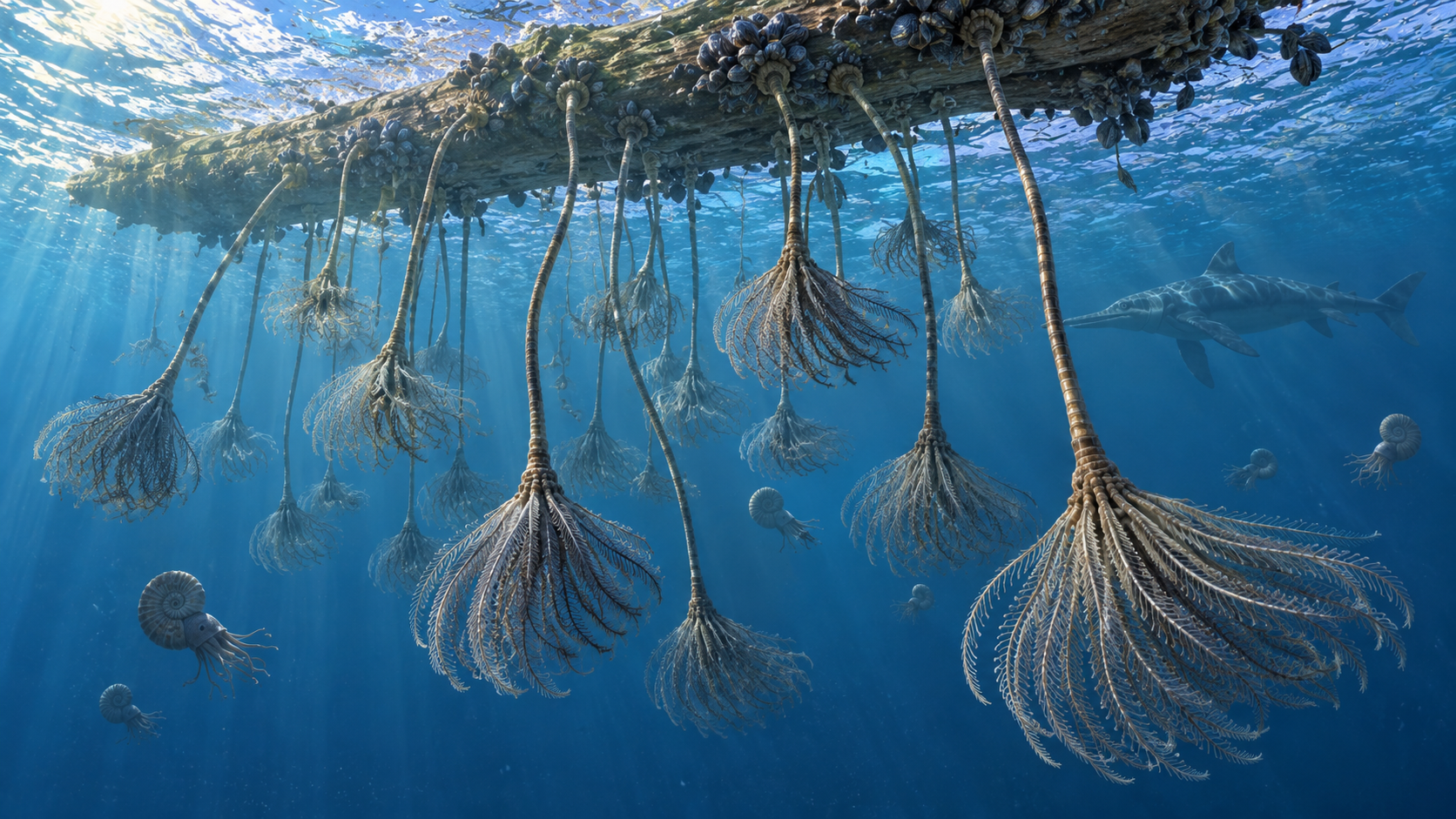
Crinoids almost disappeared in the end-Permian mass extinction about 252 million years ago. All living sea lilies and feather stars are descended from a single lineage that survived it, the subclass Articulata. In the Mesozoic that followed, some crinoids took up unusual ways of life. Seirocrinus, from the Early Jurassic, is thought to have lived hanging from driftwood floating at the sea surface, and its stalk reached lengths of up to about 20 m. Whole colonies fossilised together with their logs have been found at Holzmaden in Germany.
Sea Lilies in Deep Water, Feather Stars in the Shallows
There are fewer than 100 living species of stalked crinoids, and all of them live deeper than 100 m. By contrast, more than 500 species are known of feather stars, which shed their stalk as they grow, and these range from shallow coral reefs to the deep sea. Feather stars crawl over the bottom on their arms, and some species swim short distances by beating their arms alternately.
The stalked crinoid most commonly found around Japan is Metacrinus rotundus, known in Japanese as torinoashi (“bird’s foot”). Its stalk is 30–50 cm long and its arms branch into about 50. It lives on the sea floor at depths of roughly 100–500 m in Sagami Bay, the Kii Channel, Suruga Bay and elsewhere. Because this is shallow by world standards for a stalked crinoid, the animals can be collected and kept in aquaria, and Japan has become one of the centres of research on the behaviour of living sea lilies.
The “Immobile Animal” That Crawled Away
Whether stalked crinoids can move has been debated since the 19th century. Because some kinds do not cement the base of the stalk to rock, the English geologist William Buckland described a fossil crinoid as “a locomotive animal” in 1837. But no one had actually seen one move, and an echinoderm textbook published in 1987 still described living stalked crinoids as free-living but without the capacity to locomote.
From the late 1980s to the early 1990s, field observations in the Caribbean and aquarium experiments confirmed for the first time that isocrinids crawl with their arms and relocate, dragging the stalk behind them. In 1994 Birenheide and Motokawa recorded in detail how Metacrinus rotundus crawled in an aquarium. Its speed, however, was about 0.5 m per hour, or roughly 0.1 mm per second, too slow for the movement to be noticed with the naked eye.
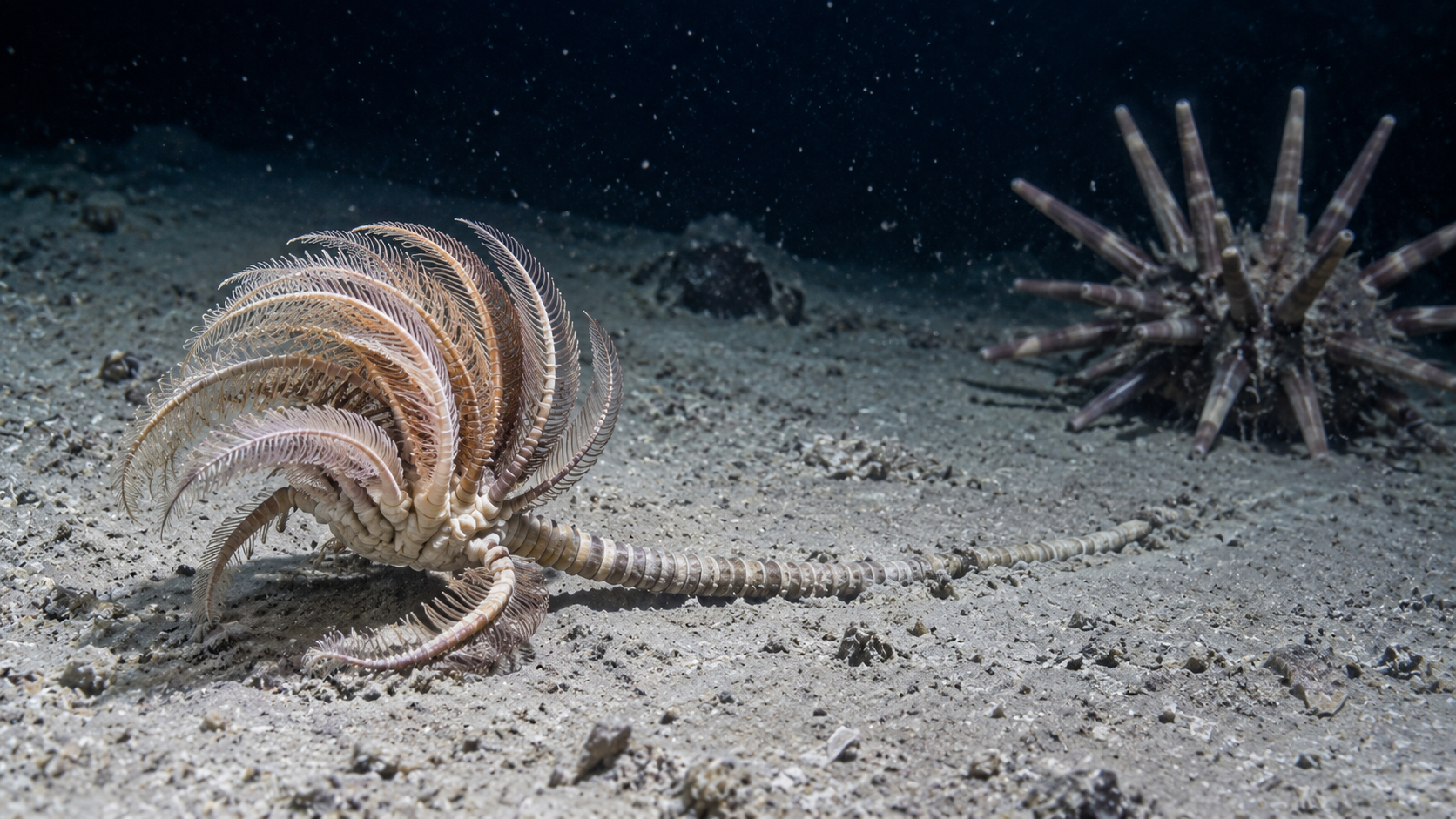
That figure was overturned by video shot between 1991 and 1998 from the Johnson Sea Link submersibles by Tomasz Baumiller of the University of Michigan and Charles Messing of Nova Southeastern University. At a depth of about 420 m off Grand Bahama Island in the Bahamas, a crinoid of the species Neocrinus decorus was recorded crawling more than 3 m in just under 5 minutes. It averaged about 10 mm per second with bursts of about 30 mm per second, roughly 100 times faster than any speed known until then. Whereas the crawling seen in aquaria used only the arm tips to pull against the bottom, the crinoid in the video bent its arms strongly backward and pressed their middle portions against the seabed, moving as if rowing. A drag mark left by the stalk remained on the sediment behind it. The observation was published in 2007.
The animals it is thought to be escaping from are cidaroid sea urchins. Crinoid skeletal pieces have been found in the guts of these urchins, which live on the same sea floor, and observations from submersibles and in the laboratory have confirmed that they feed on live crinoids. At 0.1 mm per second a crinoid cannot escape an urchin; at 10–30 mm per second it can. Baumiller and colleagues describe the sequence of shedding the lower part of the stalk and then crawling away unencumbered as an escape of the same kind as a lizard dropping its tail.
This pursuit can be traced back in the fossil record. Crinoid skeletal elements bitten by sea urchins carry distinctive marks, and the same marks have been found on Triassic crinoid fossils from Poland (2010). After their near-extinction at the end of the Permian, crinoids diversified again in the Middle to Late Triassic, and the forms that appeared then were mobile ones: crawlers, swimmers and drifters. A later study showed that throughout the Mesozoic the frequency of bite marks on fossil stalks rose and fell in step with sea urchin diversity, and that as urchins became more diverse, mobile crinoids increased while sessile ones declined (2012). In 2020, Tatsuo Oji of Nagoya University and colleagues found radiating and parallel scratch patterns beside fossil crinoid arms in rocks about 250 million years old in Utah. The patterns match those left on aquarium sand by the thrashing of arms that Metacrinus rotundus collected from Suruga Bay had cast off on their own, showing that the behaviour of shedding an arm when attacked had already begun at the start of the Triassic.
Most Paleozoic crinoids were sessile forms fixed in place, but after the end-Permian extinction, mobile forms came to make up more than half of all genera. From the later Mesozoic onward, stalked crinoids largely disappeared from shallow seas and persisted in deep water, and the crinoids living in shallow seas today are the feather stars, which gave up the stalk and became the most mobile of all.
Sources
Baumiller, T. K. & Messing, C. G. (2007) Stalked crinoid locomotion, and its ecological and evolutionary implications. Palaeontologia Electronica 10(1), 2A. https://palaeo-electronica.org/2007_1/crinoid/ (video of the crawling crinoid is available here)
Baumiller, T. K. et al. (2010) Post-Paleozoic crinoid radiation in response to benthic predation preceded the Mesozoic marine revolution. PNAS 107, 5893–5896. https://www.pnas.org/doi/10.1073/pnas.0914199107
Gorzelak, P., Salamon, M. A. & Baumiller, T. K. (2012) Predator-induced macroevolutionary trends in Mesozoic crinoids. PNAS. https://www.pnas.org/doi/10.1073/pnas.1201573109
Nagoya University press release (24 September 2020, in Japanese), on cast-off crinoid arms and an anti-predator strategy dating back 250 million years. https://www.nagoya-u.ac.jp/about-nu/public-relations/researchinfo/upload_images/20200924_num1.pdf / Paper: Gorzelak, P. et al. (2020) Scientific Reports 10, 15147. https://doi.org/10.1038/s41598-020-72116-1
Guensburg, T. E. et al. (2020) Athenacrinus n. gen. and other early echinoderm taxa inform crinoid origin and arm evolution. Journal of Paleontology 94(2), 311–333. https://doi.org/10.1017/jpa.2019.87
Microstructural design of the stalk in the crinoid Seirocrinus supports its pseudoplanktonic lifestyle. Scientific Reports (2025). https://www.nature.com/articles/s41598-025-16412-8
Kuroshio Biological Research Foundation, “Torinoashi (Metacrinus rotundus)” (in Japanese). https://kuroshio.or.jp/creature/トリノアシ/
Photographic observations of the stalked crinoid Metacrinus rotundus in Suruga Bay, central Japan. Journal of the Oceanographical Society of Japan 43(6). https://www.jstage.jst.go.jp/article/kaiyou1942/43/6/43_6_333/_article/-char/ja/


コメント