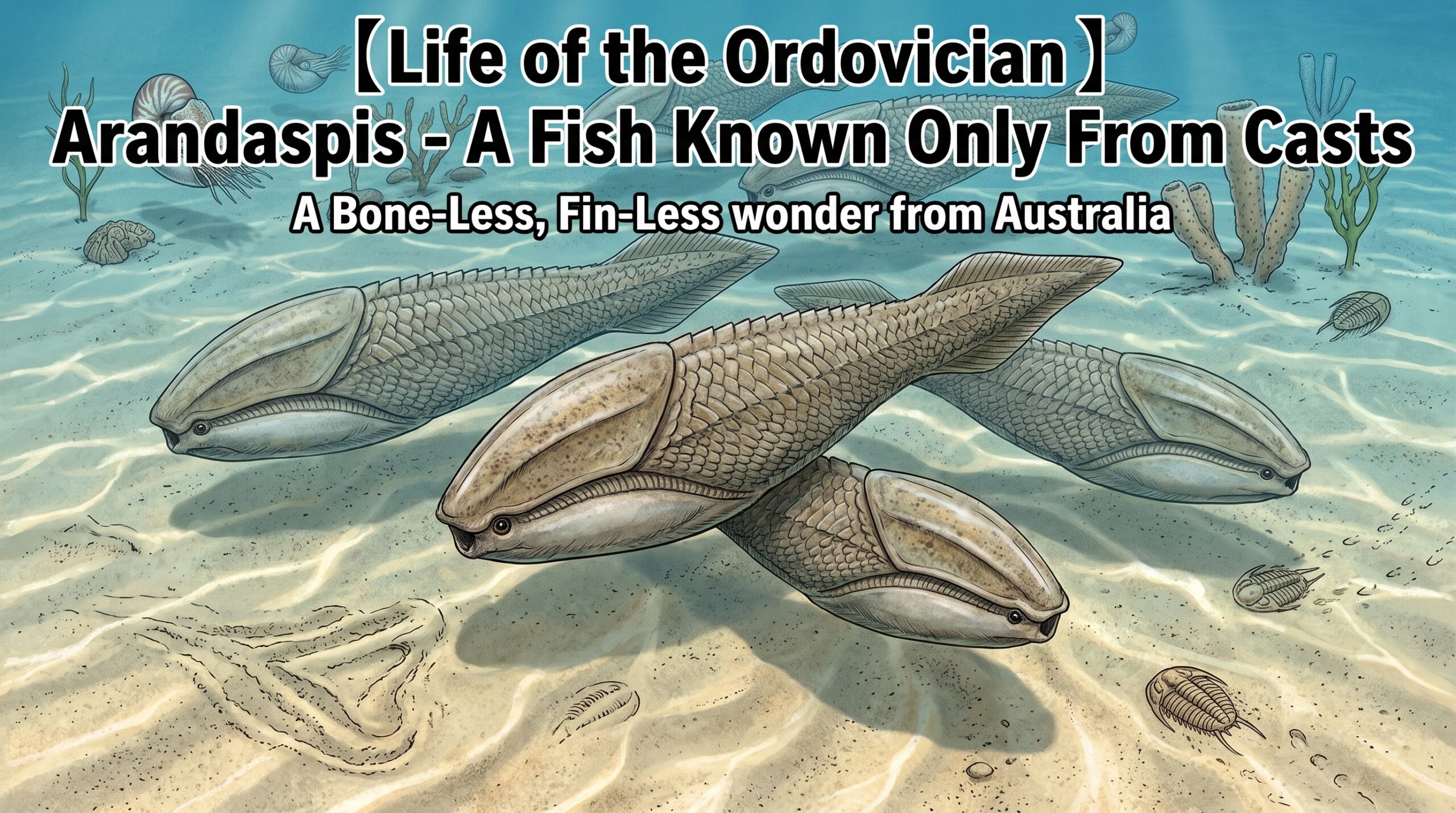
| Name | Arandaspis prionotolepis. The genus name means “Aranda shield,” the species name “saw-toothed scale” |
| Classification | Vertebrate, jawless fish, Pteraspidomorphi, order Arandaspida, family Arandaspidae |
| Age | Middle Ordovician (Darriwilian, about 465 million years ago) |
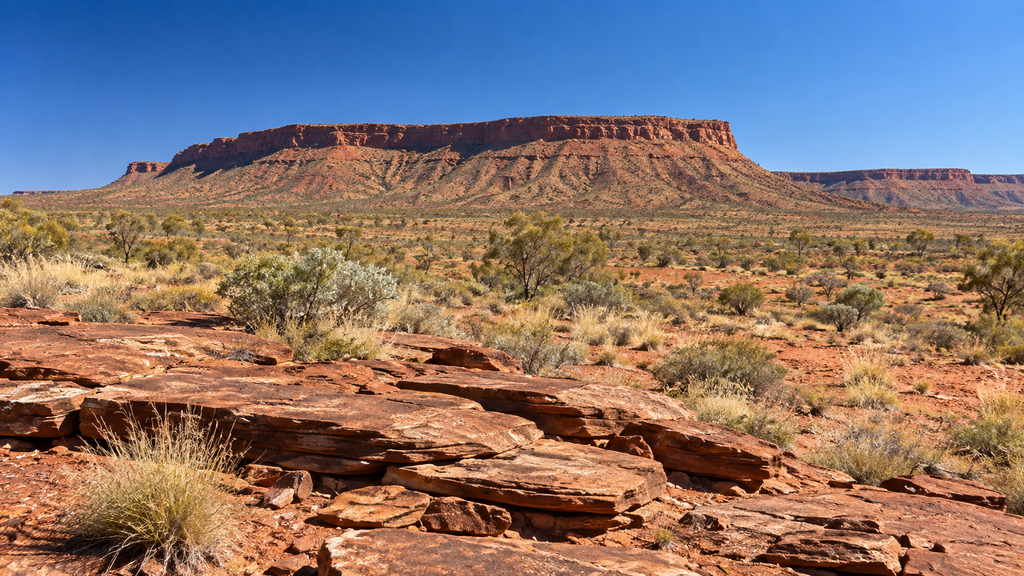
| Found in | The Stairway Sandstone at Mount Watt, near Alice Springs, Northern Territory, Australia |
| Length | About 12 to 16 cm (estimated, as the rear half of the body has not been found) |
| Weight | Some tens of grams (approximated from living fish of the same length; no published estimate exists) |
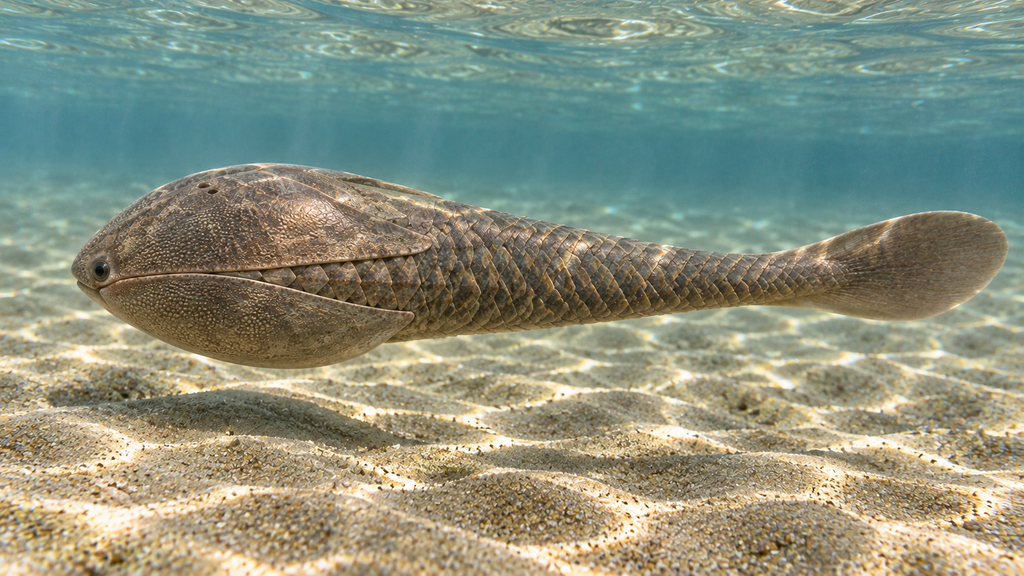
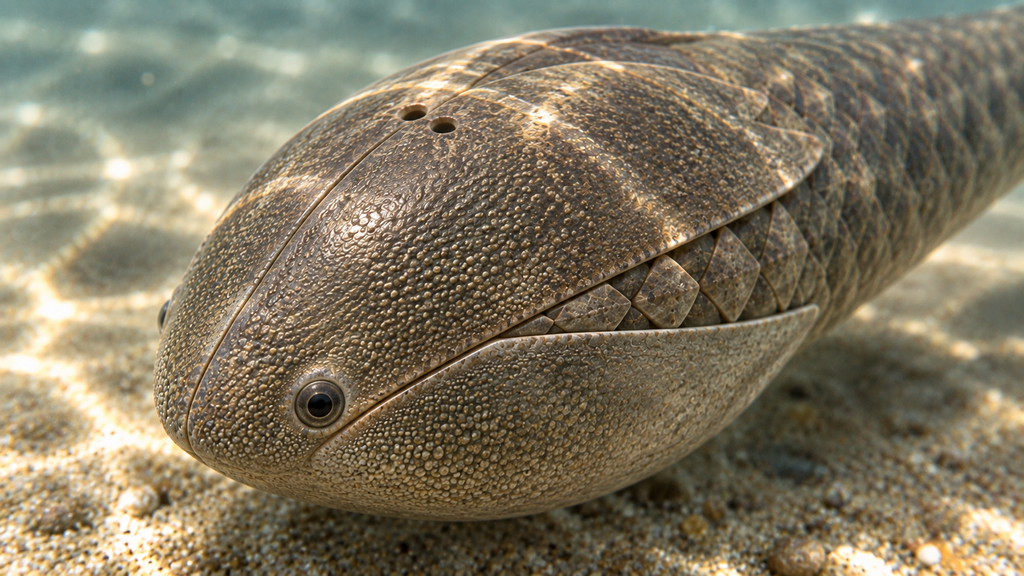
Arandaspis was a jawless fish. Its head and chest were enclosed in a pair of bony shields above and below, with long narrow scales covering the body behind them. It was the first Ordovician vertebrate whose body shape could be determined, and its locality is desert country near the center of what is now the Australian continent. Not a trace of bone survives in the fossils; the fish has been reconstructed entirely from the impressions it left in sandstone.
Form and way of life
The head shield is a somewhat flattened triangle on the dorsal side and a deep, rounded boat shape on the ventral side, the two enclosing the head and the gill region entirely. Between the two shields runs a single row of small diamond-shaped plates, taken to mark the position of the gills. The eyes sit one on each side at the front of the head, and two small openings lie side by side at the center of the dorsal shield. These are read not as eyes but as the openings of a light-sensing pineal organ. Grooves run along the sides of the shields, possibly marking a lateral line for sensing water movement.
Behind the shields, long narrow scales in rows covered the body. Each scale bears a row of small projections along its rear margin, giving the edge a serrated look. The species name, “saw-toothed scale,” comes from that shape. The genus name honors the Aranda (now written Arrernte), the Aboriginal people of the region where the fossils were found.
There are no paired fins such as pectorals or pelvics. Without fins for fine control of posture, it appears to have swum simply by flexing its body. The mouth opens on the underside of the head, and with no jaws it could not bite. The leading view is that it took in mud and particles of organic matter from the seafloor, though no firm evidence has been found.
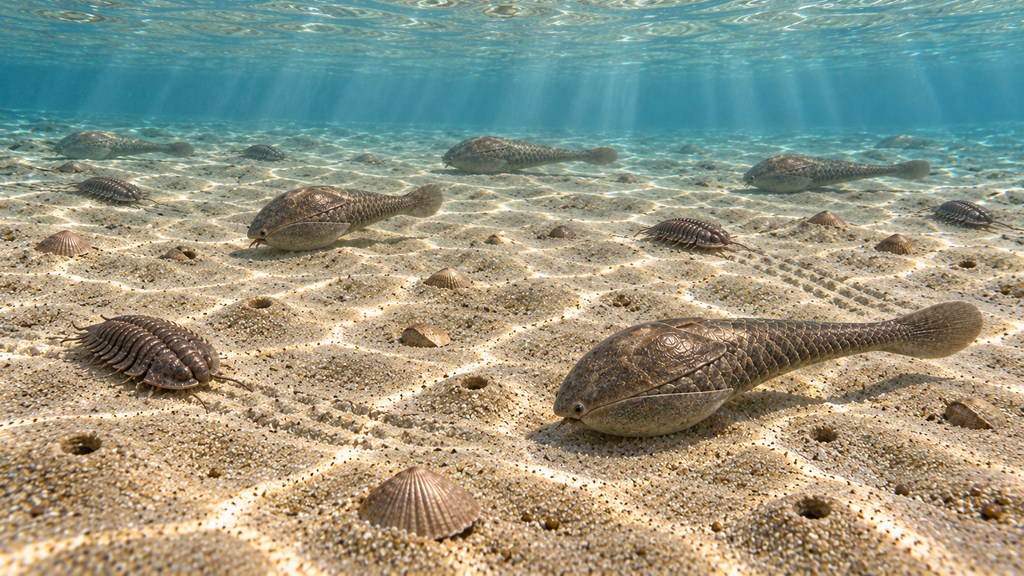
Australia at the time lay along the northern margin of Gondwana, with a shallow sea known as the Larapinta Seaway reaching into the continental interior. The Stairway Sandstone accumulated on a sandy bottom near the shoreline of that sea, and preserves abundant trilobite trails (Cruziana) and the vertical burrows of animals that lived in the sand. A study of the sedimentary structures and trace fossils concluded that arandaspids did not venture offshore, living only in very shallow water where fresh water and sediment from rivers flowed in seasonally. Localities of their relatives in Bolivia and Oman gave the same result.
A fish without a fragment of bone
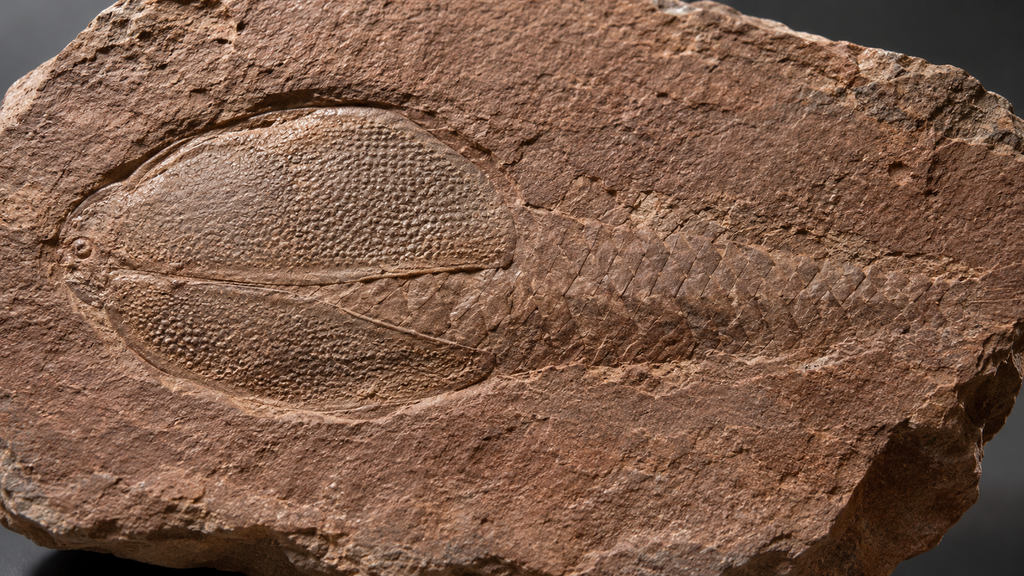
Arandaspis fossils contain no bone at all. What survives are impressions of the shields and scales pressed into the surface of fine-grained sandstone. The dead fish was buried in sand; after the sand hardened, the bone alone dissolved away, leaving a cavity. The description paper calls this mode of preservation a natural mold of the dermal bone.
The shield bone is estimated to have been only about 0.1 mm thick. Even so, because the sand grains were fine, the molds captured both the outer and inner faces of the shields, and it is possible to read the pattern of fine tubercles on the surface, the arrangement of the scales, and the positions of the eyes and mouth. Fossils preserved as molds like this are generally studied by taking a cast in rubber or resin to restore the original convex surface before examination.
The first specimens were found near Alice Springs in 1959. What the patterns in the sandstone actually were, however, was not immediately clear, and they were not recognized as vertebrate fossils until the late 1960s. Alex Ritchie of the Australian Museum and Joyce Gilbert-Tomlinson of the federal geological survey formally described them in 1977, eighteen years after the discovery.
Until then, Ordovician vertebrates such as Astraspis and Eriptychius were known from the Harding Sandstone in North America, but all as scattered fragments of bony plates, with no indication of what the living body looked like. Arandaspis was the first Ordovician vertebrate from the Southern Hemisphere, and at the same time the first case in which the outline of a fish from this period could be made out. At the time of its description it was also the oldest vertebrate in the world whose body shape was known.
The molds extend only as far as the head shields and the scales immediately behind them, however. The rear half of the trunk and the tail have never been found, and the shape of the tail fin is unknown. The tadpole-shaped whole-body reconstruction familiar from field guides and museums fills in the rear half from the closely related Sacabambaspis. Reported from Bolivia in 1986, that member of the same family is known from some thirty articulated whole-body specimens complete to the tail, with bone tissue preserved as well. The spread in published length estimates, from 12 to 16 cm, likewise follows from the rear half being inferred from a relative.
The position of oldest fish moved back by some 50 million years in 1999, when the Cambrian Myllokunmingia and Haikouichthys were reported from Chengjiang in China. Those fish had no bone, and as bone-armored fish, the arandaspids still rank among the oldest. The age given at the time of description, Early Ordovician (Arenig), has since been revised to Middle Ordovician following a reassessment of the stratigraphy.
Sources
Ritchie, A. & Gilbert-Tomlinson, J. (1977) First Ordovician vertebrates from the Southern Hemisphere. Alcheringa 1(4): 351–368. https://www.tandfonline.com/doi/abs/10.1080/03115517708527770
Davies, N. S. & Sansom, I. J. (2009) Ordovician vertebrate habitats: a Gondwanan perspective. PALAIOS 24(10): 717–722. https://doi.org/10.2110/palo.2009.p09-040r
Davies, N. S., Sansom, I. J., Nicoll, R. S. & Ritchie, A. (2011) Ichnofacies of the Stairway Sandstone fish-fossil beds (Middle Ordovician, Northern Territory, Australia). Alcheringa 35(4): 553–569. https://www.tandfonline.com/doi/abs/10.1080/03115518.2011.557565
Paleobiology Database: Arandaspis prionotolepis (type specimen and type locality). https://paleobiodb.org/classic/basicTaxonInfo?taxon_no=150088
M. H. Monroe, Arandaspis prionotolepis. Australia: The Land Where Time Began (an account drawing on John A. Long, The Rise of Fishes, 1995, among other sources). https://austhrutime.com/arandapsis.htm
コメント