| Name | Horseshoe crab (named for its horseshoe-shaped shell; the scientific name Xiphosura means “sword tail”) |
| Classification | Arthropoda, Chelicerata, order Xiphosura. Not a crab; closer to spiders and scorpions |
| Age | Ordovician (about 480 million years ago) to the present |
| Oldest fossils | Manitoba, Canada (Lunataspis, about 445 million years old). Even older, still unnamed specimens are reported from Morocco and North America |
| Length | Living species (the tri-spine horseshoe crab of Japan): 50–80 cm including the tail spine. The Ordovician Lunataspis: a few centimetres |
| Weight | Living species: females 1.4–4 kg, males 0.6–1.7 kg |
| Living species | Four (tri-spine, Atlantic, Indo-Pacific, and mangrove horseshoe crabs) |
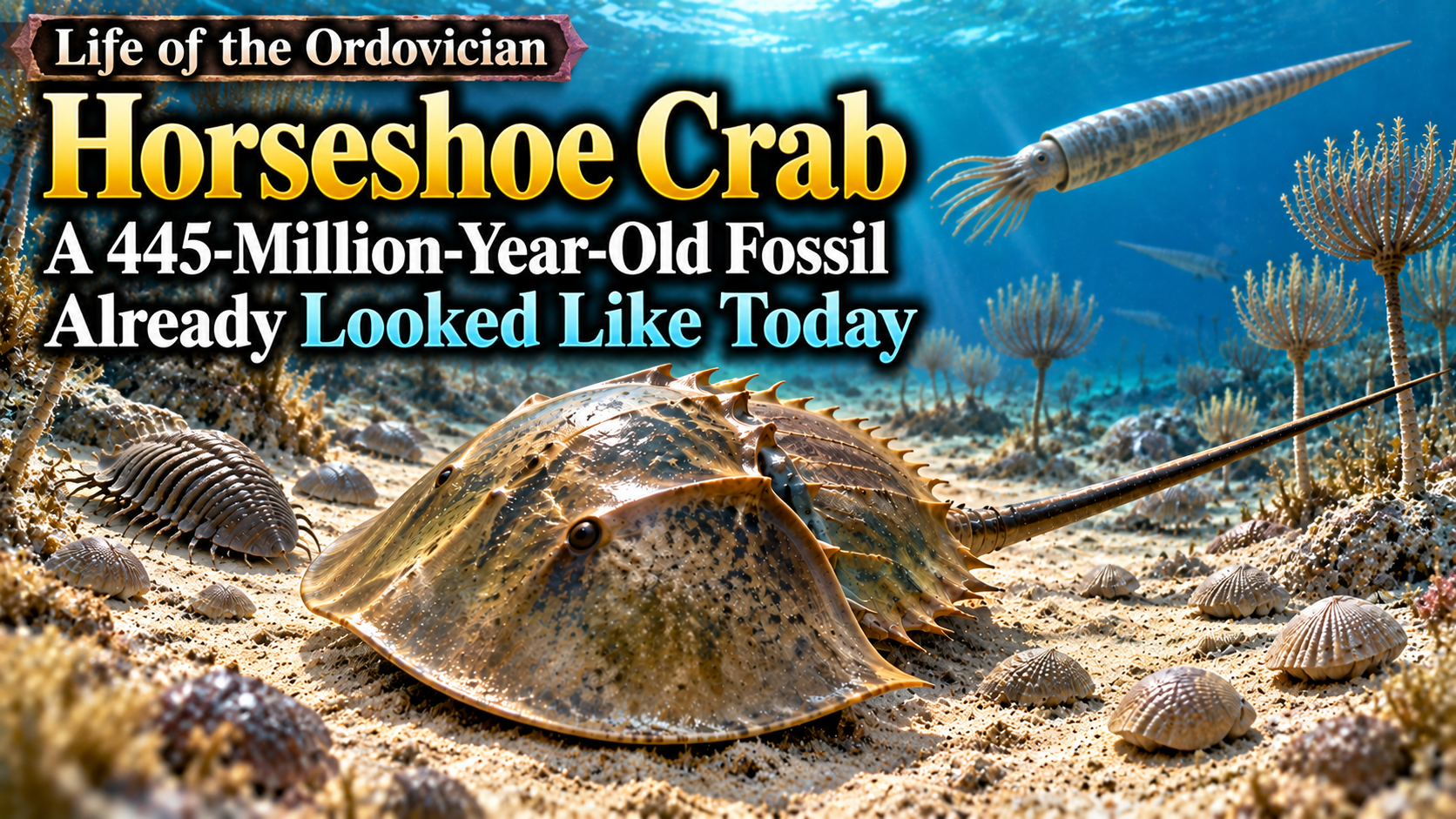
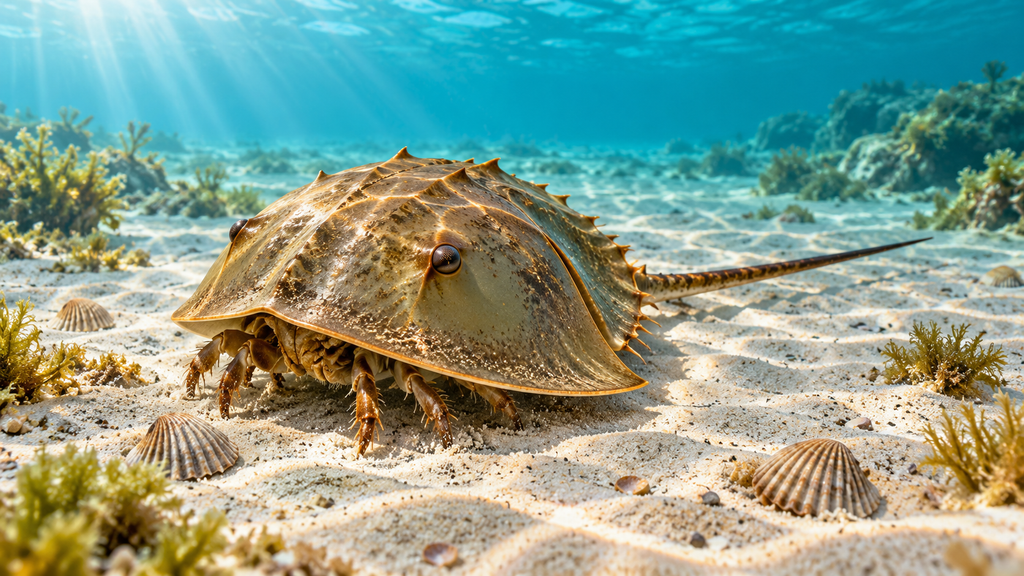
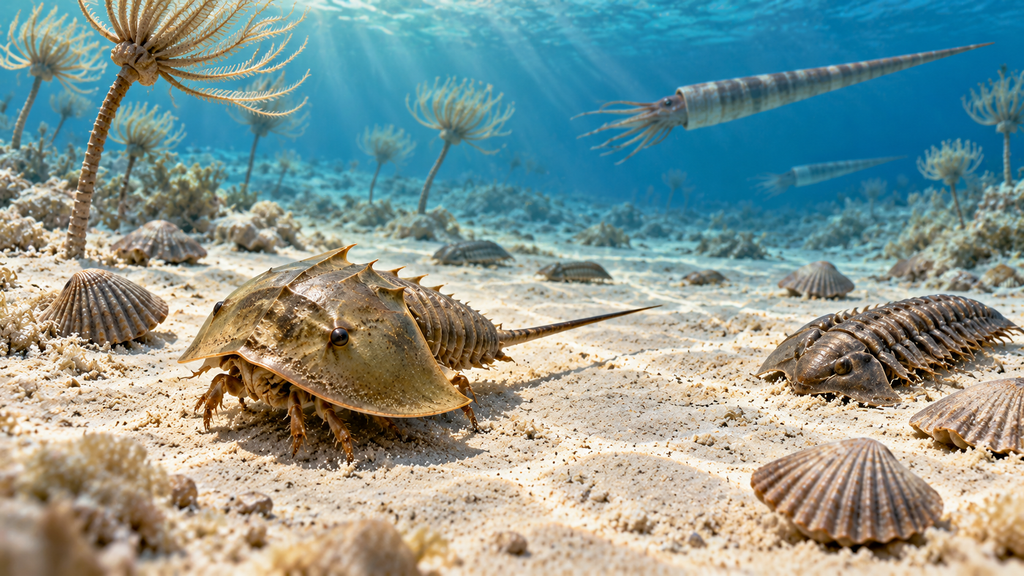
The horseshoe crab is an arthropod that walks along the seafloor, with a rounded shell and a sword-like tail. Despite the name, it is not related to crabs or shrimp; it belongs to the chelicerates, the same group as spiders and scorpions. Its relatives were already living in the sea about 480 million years ago, in the Ordovician. They appeared alongside the trilobites, outlived them, and four species still survive on the world’s coastlines today. Because fossils about 445 million years old look almost identical to the living animals, the horseshoe crab is one of the best-known examples of a “living fossil.”
Appearance and Way of Life
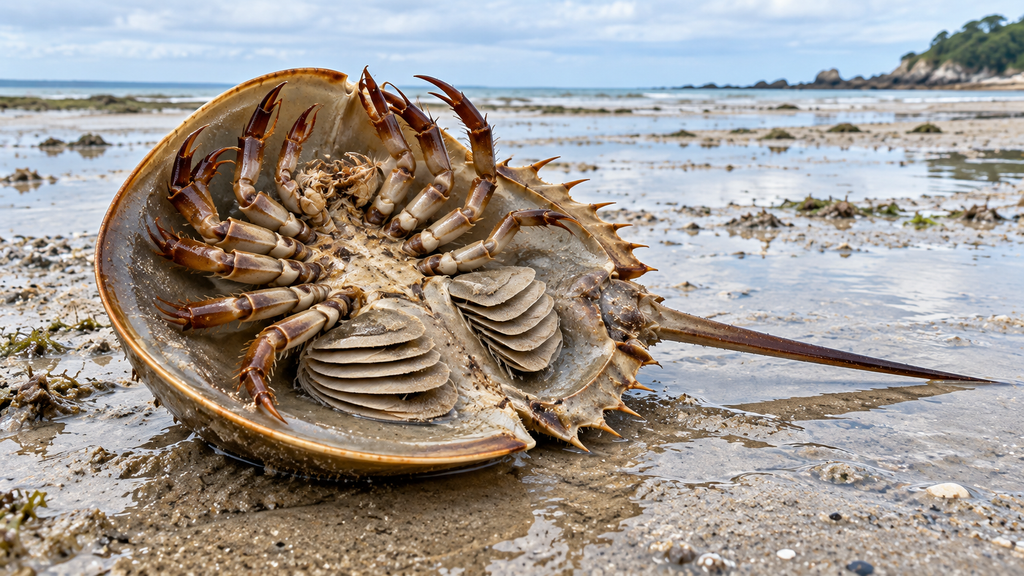
The body has three parts, from front to back: a large horseshoe-shaped front section, a trapezoid-shaped rear section, and a long thin tail spine. A pair of compound eyes sits on top of the front shield, with several smaller simple eyes scattered elsewhere. All the legs are hidden under the shell; turned over, the animal shows six pairs of appendages. The front pair are small pincers used to move food to the mouth. The next five pairs are walking legs, and spines at their bases grind up food. Horseshoe crabs have no jaws, so they effectively chew with the bases of their legs.
On the underside of the rear section are the “book gills,” thin plates stacked like the pages of a book, which take in oxygen from the water. The tail spine is not a weapon. It is a lever the animal uses to right itself after being flipped over by waves.
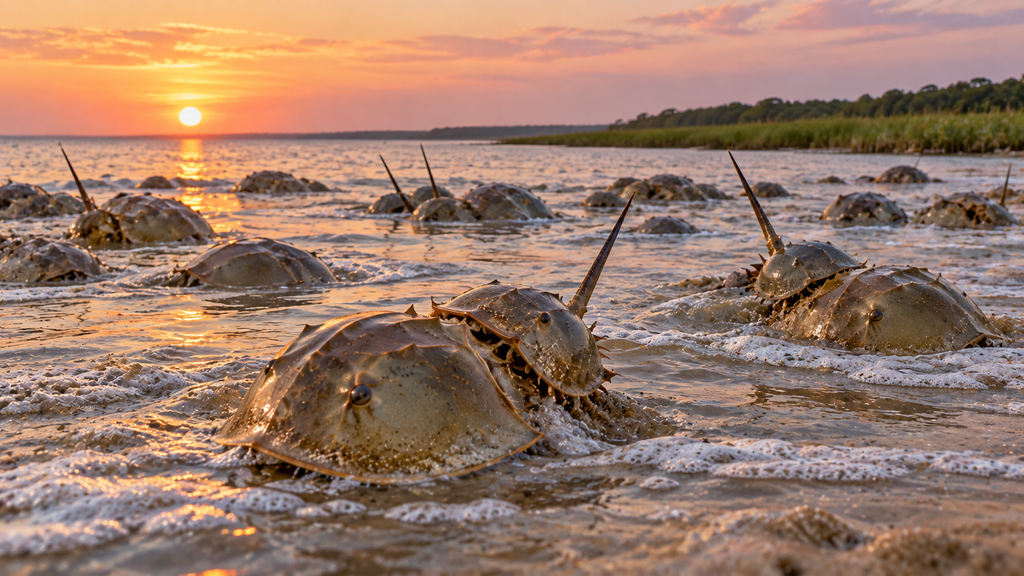
Horseshoe crabs live on sandy or muddy bottoms in shallow seas, where they dig out small animals such as clams and polychaete worms. In the breeding season they come up onto sandy beaches on the high tides of the spring tides; the female lays her eggs in the sand while the male clings to her rear and fertilises them. The newly hatched larvae still have very short tail spines, and the way their rounded bodies swim resembles a trilobite, which is why they are called “trilobite larvae.” They moult more than a dozen times on the way to adulthood and take over ten years to mature.
Their blood is blue. Human blood carries oxygen with iron, but horseshoe crabs use hemocyanin, which contains copper and turns blue when it binds oxygen. Cells in this blood clot on contact with bacterial toxins, and an extract from them is used to test whether injectable drugs and medical devices are free of bacterial contamination.
A Final Walk Preserved in Stone
The best-known horseshoe crab fossils are those of Mesolimulus, from the Late Jurassic (about 150 million years ago) of Solnhofen in southern Germany. Solnhofen is the fine-grained limestone locality famous for Archaeopteryx. At the time it was a lagoon cut off from the open sea, and the bottom waters were oxygen-free and highly saline, so anything that washed in was preserved without decaying.
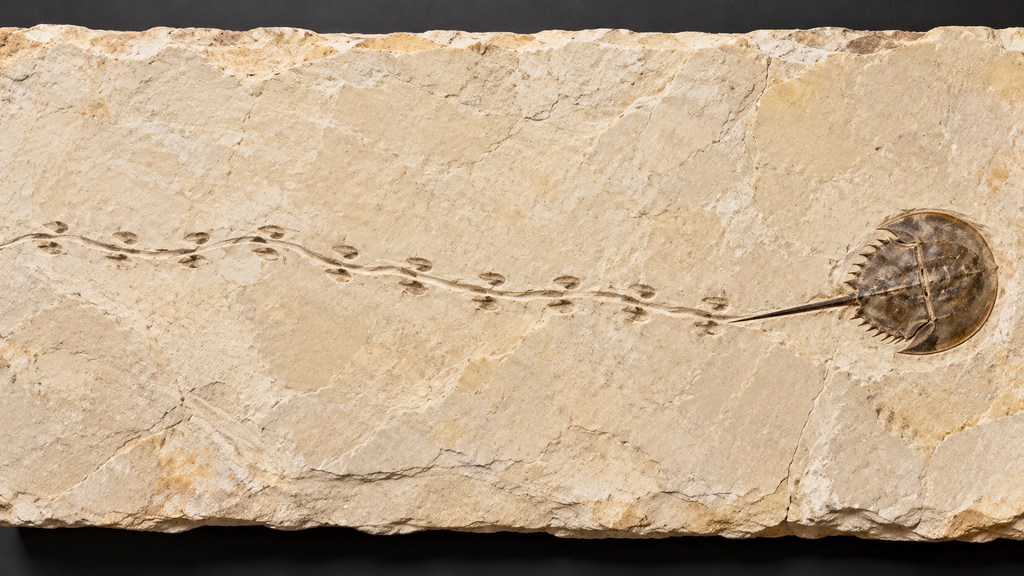
In 2002, a 9.7-metre trackway was discovered in a quarry in this limestone. Footprints and a groove dragged by the tail spine run on and on, and at the very end lies the animal that made them: a young Mesolimulus about 12.7 cm across, exactly where it stopped. The interpretation is that a storm swept the animal into the lagoon, it kept walking across the oxygen-free bottom, and it became a fossil where it gave out. The style of walking changes several times along the way, with stretches of straight movement, stretches where the body swung from side to side, and stretches where the front shield was pressed against the bottom. The specimen was described in 2012 and is regarded as the longest complete example of a “mortichnia,” a death march in which the trackway and the animal that made it are preserved together.
Finding a trackway together with its maker is extremely rare in the fossil record. Normally, the maker of a set of fossil footprints can only be inferred. Here no inference is needed, and the way a horseshoe crab walked 150 million years ago can be traced directly.
Already This Shape 445 Million Years Ago
The oldest named horseshoe crab fossil is Lunataspis, from rocks about 445 million years old (end of the Ordovician) in Manitoba, Canada. It was described in 2008, and its name means “crescent shield of the dawn.” The animal was only a few centimetres long, but its basic layout—a large crescent-shaped front shield, spines projecting from its rear corners, compound eyes on the back, and a pointed tail spine—is immediately recognisable as the same design as living horseshoe crabs. The researchers who described it concluded that the characteristic horseshoe crab body plan was already complete far earlier in the Palaeozoic than had been thought.
Later work has reported even older fossils. Specimens of horseshoe crabs that have not yet been formally named are known from rocks about 480 million years old in Morocco and from Early Ordovician rocks in Utah and Idaho. In 2026, a horseshoe crab about 465 million years old (Middle Ordovician) was described from AlUla in northwestern Saudi Arabia. Every individual was preserved upside down, which is interpreted as the trace of animals that were carried in by storms and tried, unsuccessfully, to right themselves. Because they turn up repeatedly in several layers at the same site, the study suggests that behaviour like the modern habit of gathering on the same beach every year to spawn may already have existed in the Ordovician.
Taken this far, the horseshoe crab looks like an animal that has kept the same shape for more than 400 million years. But the fossil record as a whole shows that the forms in between were not so uniform. In the Carboniferous, some relatives moved into fresh water and swamps, and many fossils come from the coalfields of North America and Europe. From the Permian into the Triassic, a group called the Austrolimulidae appeared, with the spines at the edges of the front shield stretched out like wings. Austrolimulus from Australia had long projections on either side of the shield like the head of a pickaxe, and Vaderlimulus from the United States had a front shield shaped like a pointed helmet. The family all but vanished in the end-Triassic mass extinction; a single genus found in 2021 in earliest Jurassic rocks of Germany is, so far, the last record.
In terms of species numbers, horseshoe crab diversity peaked in the Triassic and then declined through the Cretaceous. Only one fossil species from the entire Cenozoic has been named, and just four species survive today. The living form called a “living fossil” is therefore one type out of the many that horseshoe crabs tried, the one that came through the extinctions and was left at the end. The resemblance between Lunataspis at 445 million years and the living species is not because nothing changed, but because only the lineages that kept returning to this type kept on surviving.
Views on where horseshoe crabs sit in the family tree have also shifted recently. For a long time they were treated as the closest relatives of the arachnids (spiders, scorpions and their kin) but as an ancestral lineage outside that group. In a 2019 study, a team at the University of Wisconsin analysed genome-scale data and found that, whichever method they used, horseshoe crabs came out nested inside the arachnids, placing them as “arachnids that stayed in the sea.” The result is disputed and the question is not settled, but either way, horseshoe crabs are far from crabs and firmly on the side of spiders and scorpions.
The Horseshoe Crab in Japan Today
The species found in Japan is Tachypleus tridentatus, the tri-spine horseshoe crab, known in Japanese simply as kabutogani. It is the largest of the four living species and lives on the tidal flats of the Seto Inland Sea and northern Kyushu. The habitat at Kasaoka in Okayama Prefecture was designated a national natural monument, the “Horseshoe Crab Breeding Ground,” in 1928, and the city has a museum devoted to the animal. Land reclamation of tidal flats has shrunk its habitat, and in 2019 the IUCN Red List assessed the species as Endangered. The reason a lineage that has lasted more than 400 million years is now in decline is not a mass extinction, but the loss of beaches and tidal flats.
Sources
Description of Lunataspis, the oldest named species: Rudkin, Young & Nowlan, “The oldest horseshoe crab: a new xiphosurid from Late Ordovician Konservat-Lagerstätten deposits, Manitoba, Canada” (Palaeontology, 2008)
Royal Ontario Museum announcement of the Lunataspis discovery: Ancient Horseshoe Crabs – Canadian Fossil Discovery Makes Waves (Royal Ontario Museum)
Middle Ordovician horseshoe crabs from AlUla, Saudi Arabia, and their upside-down preservation: Ordovician horseshoe crab body and trace fossil association preserved in a unique taphonomic setting (Gondwana Research, 2026)
The 9.7-metre death march from Solnhofen: Lomax & Racay, “A Long Mortichnial Trackway of Mesolimulus walchi from the Upper Jurassic Solnhofen Lithographic Limestone near Wintershof, Germany” (Ichnos, 2012)
Overview of fossil and living species and changes in diversity: Bicknell & Pates, “Pictorial Atlas of Fossil and Extant Horseshoe Crabs, With Focus on Xiphosurida” (Frontiers in Earth Science, 2020)
The last record of the Austrolimulidae: New horseshoe crab fossil from Germany demonstrates post-Triassic extinction of Austrolimulidae (Geological Magazine, 2021)
Phylogenetic analysis placing horseshoe crabs within the arachnids: Horseshoe crabs are really relatives of spiders, scorpions (University of Wisconsin–Madison / ScienceDaily, 2019; original paper: Ballesteros & Sharma, Systematic Biology, DOI: 10.1093/sysbio/syz011)

コメント