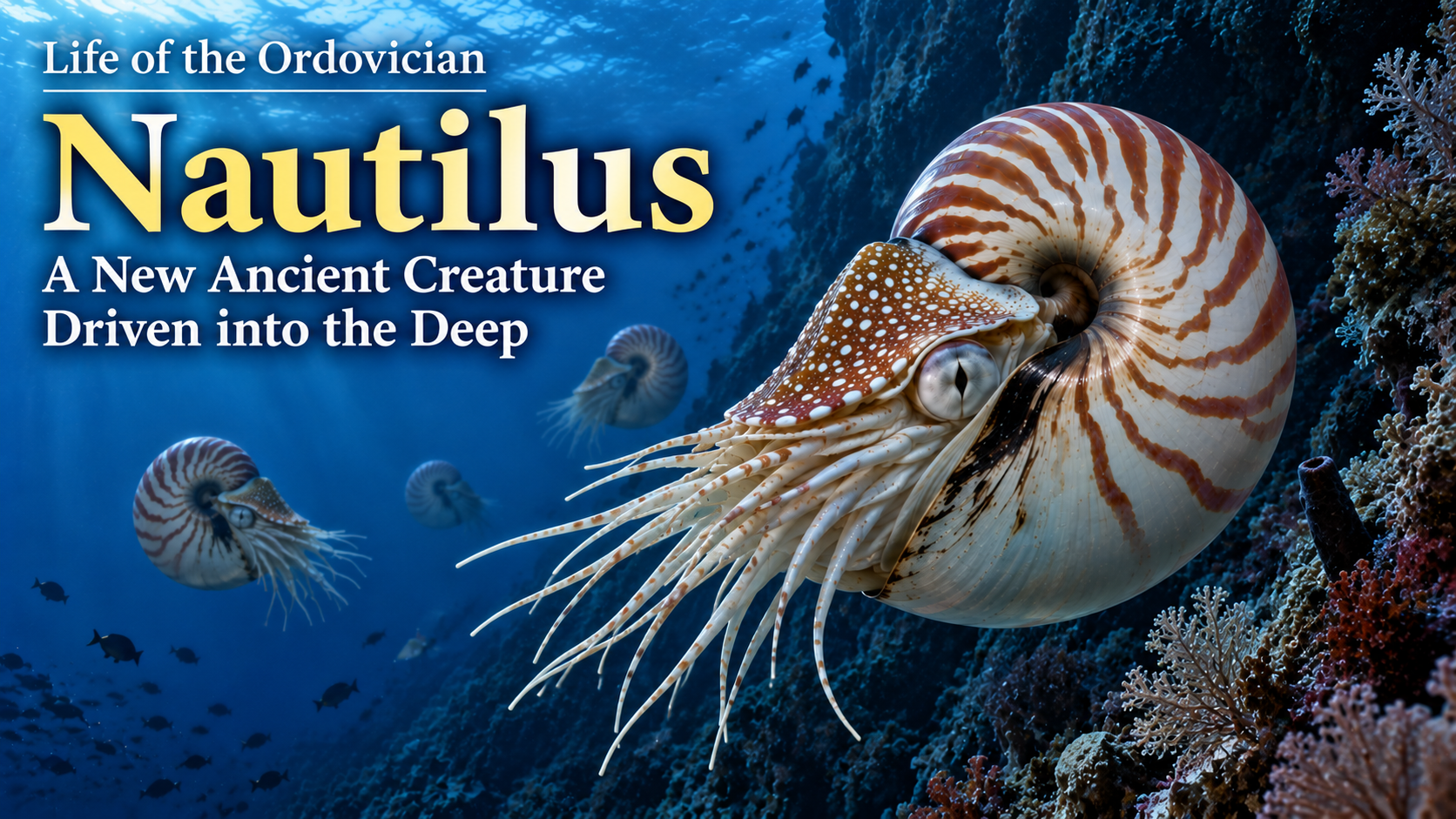
| Name | Nautilus (genus Nautilus; from the Greek word for “sailor”) |
| Classification | Mollusca, Cephalopoda, Nautilida, Nautilidae |
| Age | Living. The order Nautilida goes back about 400 million years (Devonian); fossils of the genus Nautilus itself date from the Cretaceous onward |
| Range | Eastern Indian Ocean to the western Pacific (Philippines, Palau, Australia, New Caledonia, Fiji, Samoa and elsewhere) |
| Shell diameter | About 16–20 cm; up to about 27 cm (populations off northwestern Australia) |
| Weight | Around 1 kg including the shell; up to about 1.7 kg |
| Depth | Mostly 100–700 m. The shell implodes at a pressure equivalent to roughly 800 m |
The nautilus is a cephalopod, a relative of squid and octopuses. Although it is often grouped with shellfish in everyday language, it belongs to a different lineage from clams and snails, and it is the only shelled cephalopod that has survived to the present day. The inside of the shell is divided into gas-filled chambers, and the animal adjusts its buoyancy with the gas that accumulates in them. Ancestors with shells built on the same plan flourished in the seas of the Ordovician about 480 million years ago, and the nautilus is routinely introduced as the textbook example of a “living fossil.” Yet the modern genus Nautilus does not carry the form of those early cephalopods forward unchanged, a point that researchers who work on the animal have been making for a long time.
Appearance and way of life
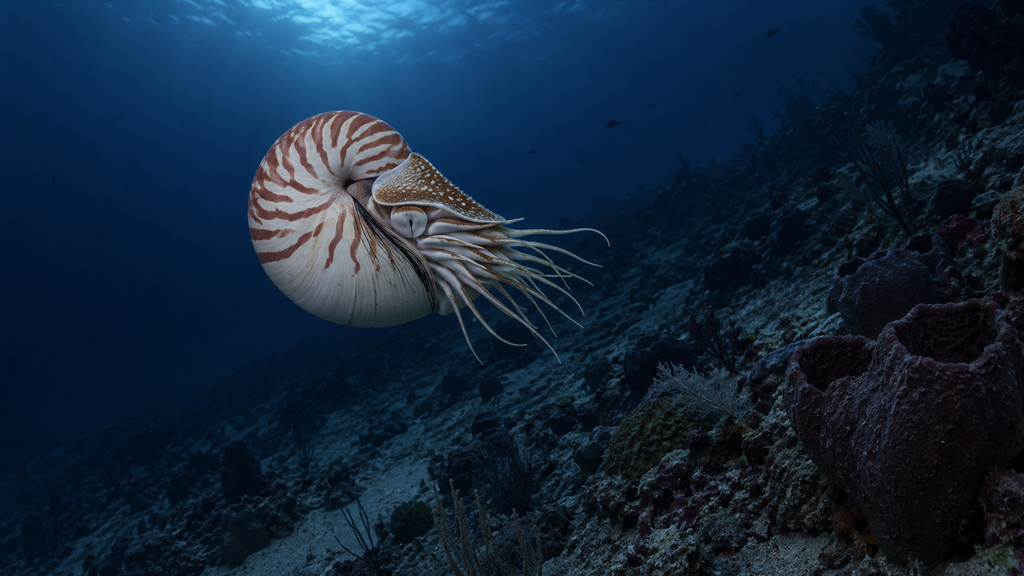
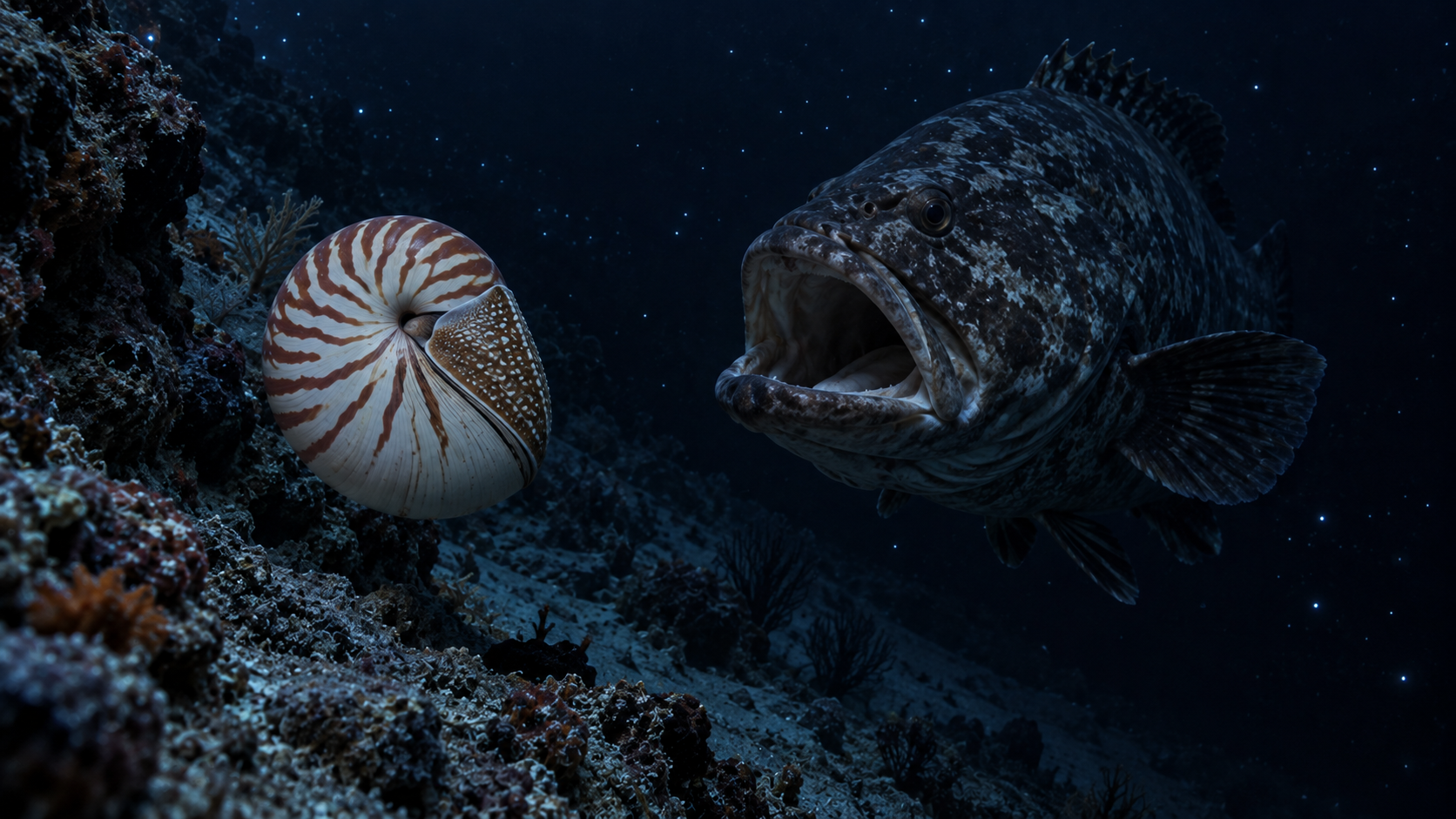
The outside of the shell is white with reddish-brown stripes, and the inside gleams with mother-of-pearl. A living nautilus swims with only its head and tentacles protruding from the shell opening. It has up to about 90 tentacles, and unlike the arms of squid and octopuses they carry no suckers. Instead they secrete a sticky mucus for gripping objects and also serve as organs of smell. On top of the head sits a thick, leathery lid called the hood; when threatened, the animal draws its body into the shell and seals the opening with it.
The eye is unusual among cephalopods in having no lens. It works like a pinhole camera, admitting light through a small opening, so the image is blurred but the direction of light and changes in brightness can be sensed. When the genome was sequenced in 2021, it was confirmed that some of the genes for the proteins that build a lens have been lost. At the genetic level, the nautilus has taken a different path from the lensed eyes of squid and octopuses.
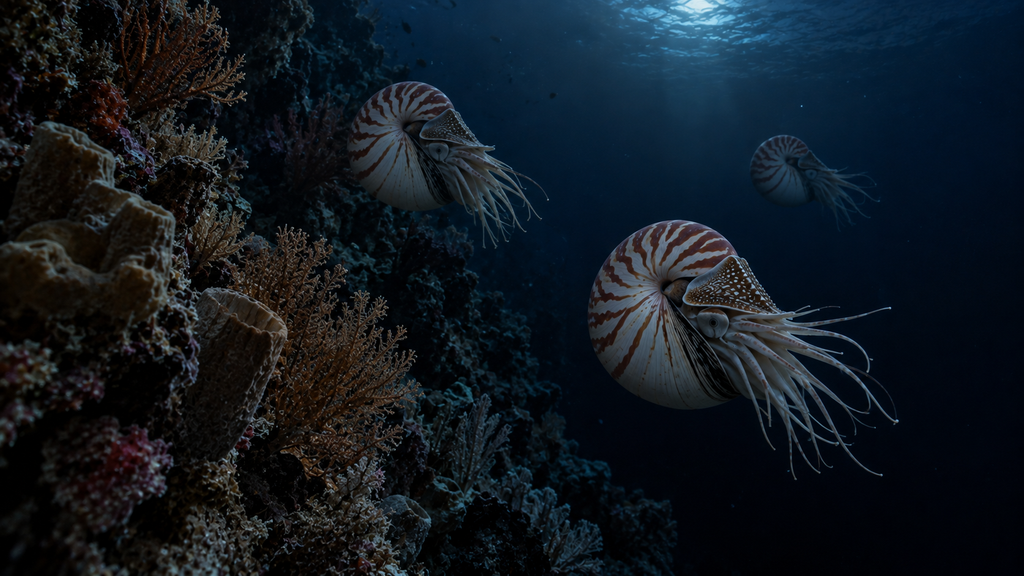
Its home is the slope where the outer edge of a coral reef drops away into deep water. By day it stays in the dark at 300–700 m, and at night it rises to around 100 m. It swims by jet propulsion, forcing water out of a funnel beneath the body, and travels backward with the shell opening facing forward. Fast movement is not its strength. Its food is mostly whatever has fallen to the seabed, such as dead shrimp and crabs and the cast shells of molted crustaceans; it has never been observed attacking live prey, either in the wild or in aquaria. With a keen sense of smell that draws it from a distance toward the scent of flesh, it lives by gathering the sparse nutrition scattered across the sea floor.
Growth is very slow: in the wild, maturity takes 12–15 years. Whereas most cephalopods die once they have reproduced, the nautilus goes on living for years after maturing. At Osprey Reef in Australia, a tagged individual was recaptured five years later, and the lifespan is thought to exceed 20 years. It also lays few eggs, and each takes close to a year to hatch.
Chambers and buoyancy
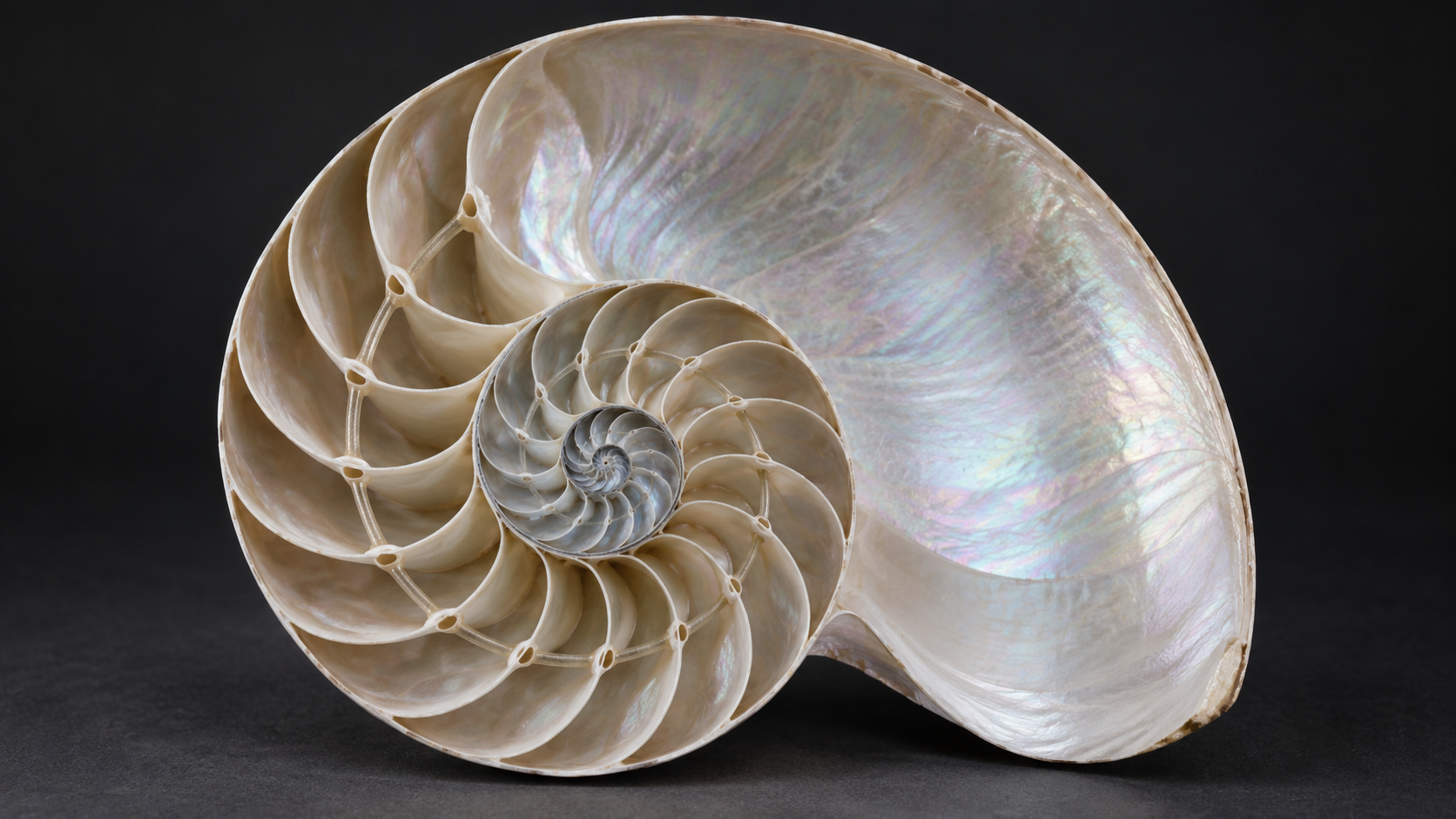
The interior of the shell is divided into small compartments by partitions called septa. A hatchling has about four chambers; each time the animal grows it moves forward and lays down a new septum behind it, adding another chamber. An adult has more than 30. The body occupies only the large outermost chamber, while the inner chambers hold gas and a small amount of liquid.
Every septum has a hole at its center, through which runs a thin tube called the siphuncle. By moving liquid in and out of the chambers through this tube, the animal keeps its overall density in balance with the surrounding seawater. The principle is almost the same as a submarine’s ballast tanks, but in the nautilus the transfer of liquid is a slow process driven by osmosis, and at depth, where the pressure is high, emptying a newly formed chamber takes time. This is thought to be one reason growth is so slow.
The shell has its limits. In the 1980s a research group at Kagoshima University placed living nautiluses in a pressure chamber and found that the shells imploded at pressures equivalent to depths of 785–830 m. The lower limit of the actual habitat, around 700 m, sits just short of that boundary.
The Ordovician seas and the shelled cephalopods
Cephalopods with chambered shells appeared at the end of the Cambrian and diversified explosively in the Ordovician that followed (about 485–444 million years ago). The stars of that age, however, had straight, cone-shaped shells rather than coiled ones. Slender forms like Orthoceras and giants like Endoceras, whose shells are estimated to have reached several meters in length, cruised the seas and, together with trilobites, crinoids and brachiopods, made up the scenery of the Ordovician sea floor. Jawed fish had not yet appeared, and the shelled cephalopods were among the largest predators in the ocean.
These Ordovician cephalopods had the same chambers and siphuncle as the modern nautilus, and in a broad sense they are called nautiloids. Taxonomically, though, they belong to different orders, and all of them died out within the Paleozoic. The order Nautilida, to which the living nautilus belongs, enters the fossil record in the Devonian, about 400 million years ago. It went on to flourish from the Carboniferous through the Permian and shared the Mesozoic seas with the ammonites. When the ammonites vanished in the mass extinction at the end of the Cretaceous, several lineages of Nautilida survived, and one of them continues to this day.
What lies behind the “living fossil” label
The nautilus is usually presented as a living fossil that has looked the same for 400 million years. Yet Peter Ward of the University of Washington, who has studied the animal for more than four decades, and his colleagues wrote in a 2016 review that this label is one of the great misnomers of paleontology.
The first reason is a mismatch in time. In Ward’s assessment, the fossils that can be placed in the modern genus Nautilus go back no further than the Cretaceous, in the Mesozoic. Taxonomists of the mid-20th century even concluded that the genus had no fossil record at all. The straight-shelled cephalopods that thrived in the Ordovician are distant relatives on the family tree, and both their shell coiling and their habitats differ from those of the living nautilus. The broad grouping of nautiloids has indeed persisted for 480 million years, but the animal we call the nautilus has not stood still for 400 million of them.
The second reason concerns its way of life. Cretaceous and Paleogene nautilid fossils all come from shallow-water deposits. The present routine of hiding in the depths of the reef slope and rising to shallow water only at night cannot be read from the fossil record. Ward and his colleagues interpret it as the outcome of a gradual retreat: as shell-crushing fish evolved and spread into ever deeper water, the nautilus was pushed further and further down. In deep water it grows slowly, and the implosion depth of its shell is close at hand. The fact that animals kept in aquaria mature three times faster than in the wild suggests that the present habitat is not the best place for this animal but the place it was driven to. If this view is correct, the nautilus is less a creature that has preserved an ancient form than one that has recently adapted to a new environment, the deep sea.
The third reason is genetic. In 2017 a team from Harvard University and other institutions compared whole genomes across every known species. Most of the species that had been defined by shell shape did not match the genetic divisions; instead, five groups emerged, each corresponding to a geographically isolated population. These splits appear to be relatively recent, within the last few million years, and signs of ongoing natural selection were detected between populations. The conclusion was that the nautilus is an animal still in the midst of speciation, unnoticed only because the forms look so alike.
To sum up: of the claims packed into the phrase “living fossil,” it is true that the basic design of the shell was complete in the Paleozoic, and in that sense the nautilus remains an important guide to the biology of extinct cephalopods. At the same time, the modern genus Nautilus is a relatively young lineage that appeared in the Cretaceous, its life in deep water is younger still, and its species are still diverging. It is a far less static animal than the label suggests.
Current status
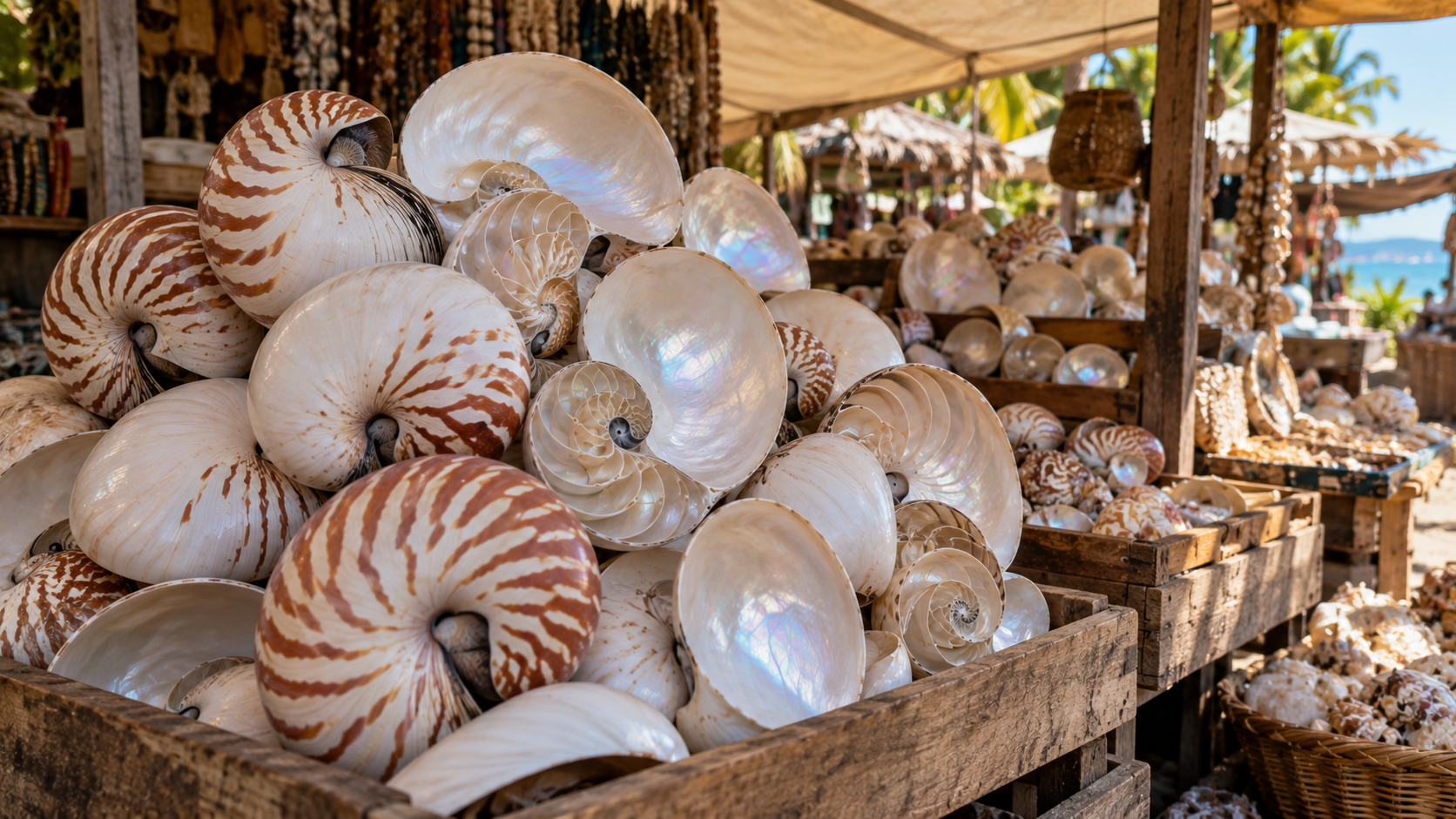
Nautilus shells have long been traded around the world as ornaments and souvenirs. A 2012 tally recorded more than half a million shells and shell products imported into the United States alone, many of them shipped from a handful of fishing grounds in the Philippines. Because the animal takes more than ten years to mature and lays few eggs, populations in heavily fished areas have failed to recover, and in some places it has disappeared locally. Surveys with underwater cameras estimate the density at only a dozen or so individuals per square kilometer, far fewer than the volume of the trade would suggest.
At the CITES Conference of the Parties held in South Africa in October 2016, all species of the family Nautilidae were listed in Appendix II, and from January 2017 international trade has required an export permit. Trade itself is not banned; rather, the exporting country must show that it is sustainable. Bringing a shell home as a souvenir falls under this regulation as well.
Sources
Ward, P., Dooley, F. & Barord, G.J. (2016) Nautilus: biology, systematics, and paleobiology as viewed from 2015. Swiss Journal of Palaeontology 135, 169–185.
https://doi.org/10.1007/s13358-016-0112-7
Combosch, D.J. et al. (2017) Genomic signatures of evolution in Nautilus—An endangered living fossil. Molecular Ecology 26, 5923–5938.
https://doi.org/10.1111/mec.14344
Huang, Z. et al. (2021) Genomic insights into the adaptation and evolution of the nautilus, an ancient but evolving “living fossil”. Molecular Ecology Resources.
https://doi.org/10.1111/1755-0998.13439
Kanie, Y. & Hattori, M. (1983) Shell Implosion Depth of Living Nautilus. Kagoshima University Research Center for the South Pacific, Occasional Papers No. 1.
https://ir.kagoshima-u.ac.jp/record/5183/files/AN10030752_v1_p30-35.pdf
FAO Species Catalogue for Fishery Purposes No. 4 Vol. 1: Cephalopods of the World — Nautilidae.
https://fao.org/docrep/pdf/009/a0150e/a0150e04.pdf
CITES CoP17 Prop. 48: Inclusion of the Family Nautilidae in Appendix II (2016).
https://cites.org/sites/default/files/eng/cop/17/prop/FJ_US_Chambered_nautilus.pdf
Digital Atlas of Ancient Life: “Nautiloidea” (changes in cephalopod shell form from the Ordovician to the Devonian)
https://www.digitalatlasofancientlife.org/learn/mollusca/cephalopoda/nautiloidea/

コメント