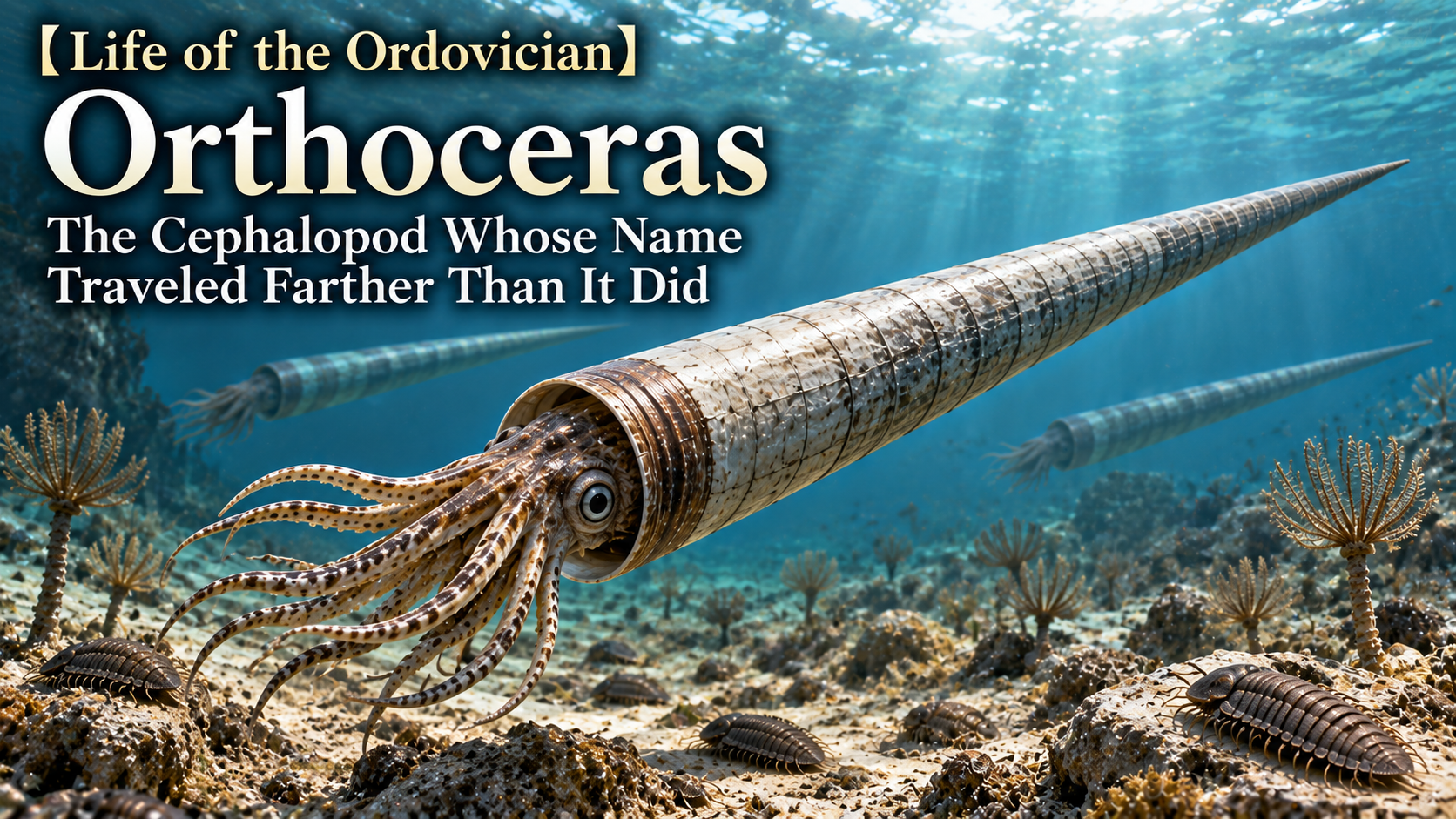
| Name | Orthoceras. From the Greek for “straight horn” |
| Classification | Cephalopoda, order Orthocerida, family Orthoceratidae |
| Age | Middle Ordovician (about 465–460 million years ago) |
| Where found | The Baltic region: Öland in Sweden, Estonia and neighbouring areas. Also in glacial erratics in northern Germany and Poland |
| Maximum shell diameter | About 4 cm |
| Length | Not established, since no complete specimen is known. With an apical angle of only about 2 degrees, an individual that reached 4 cm in diameter would have been several tens of centimetres long |
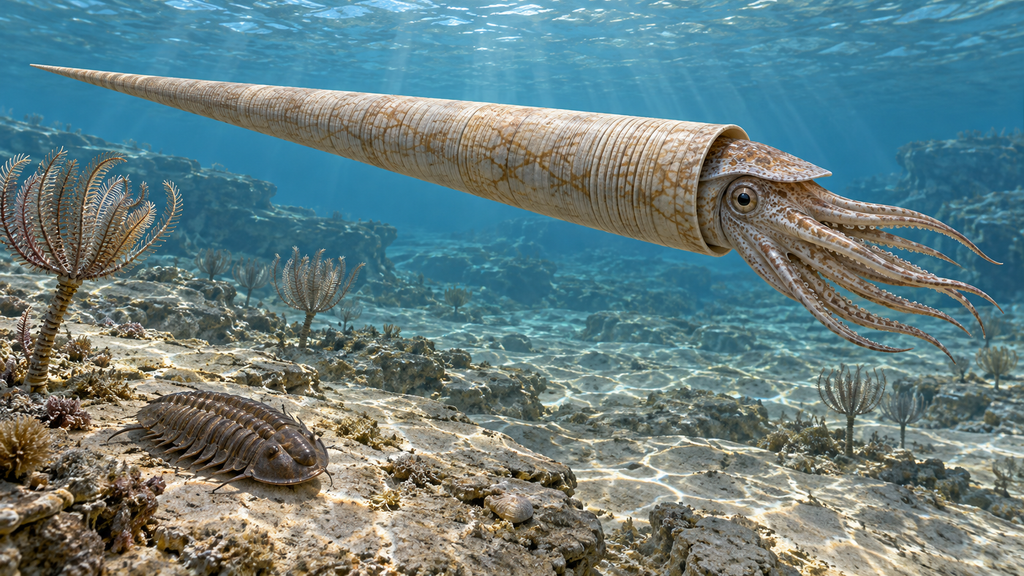
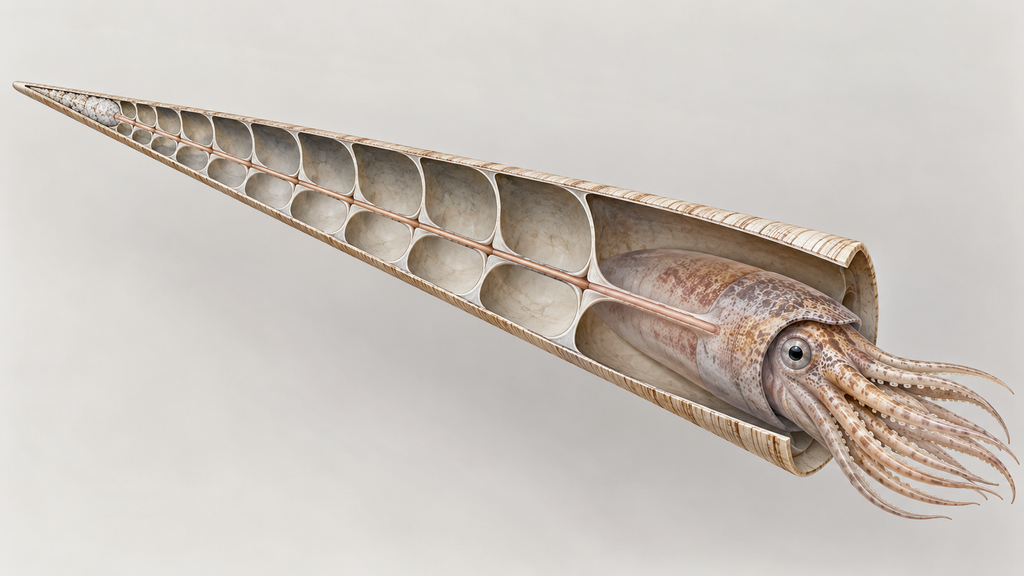
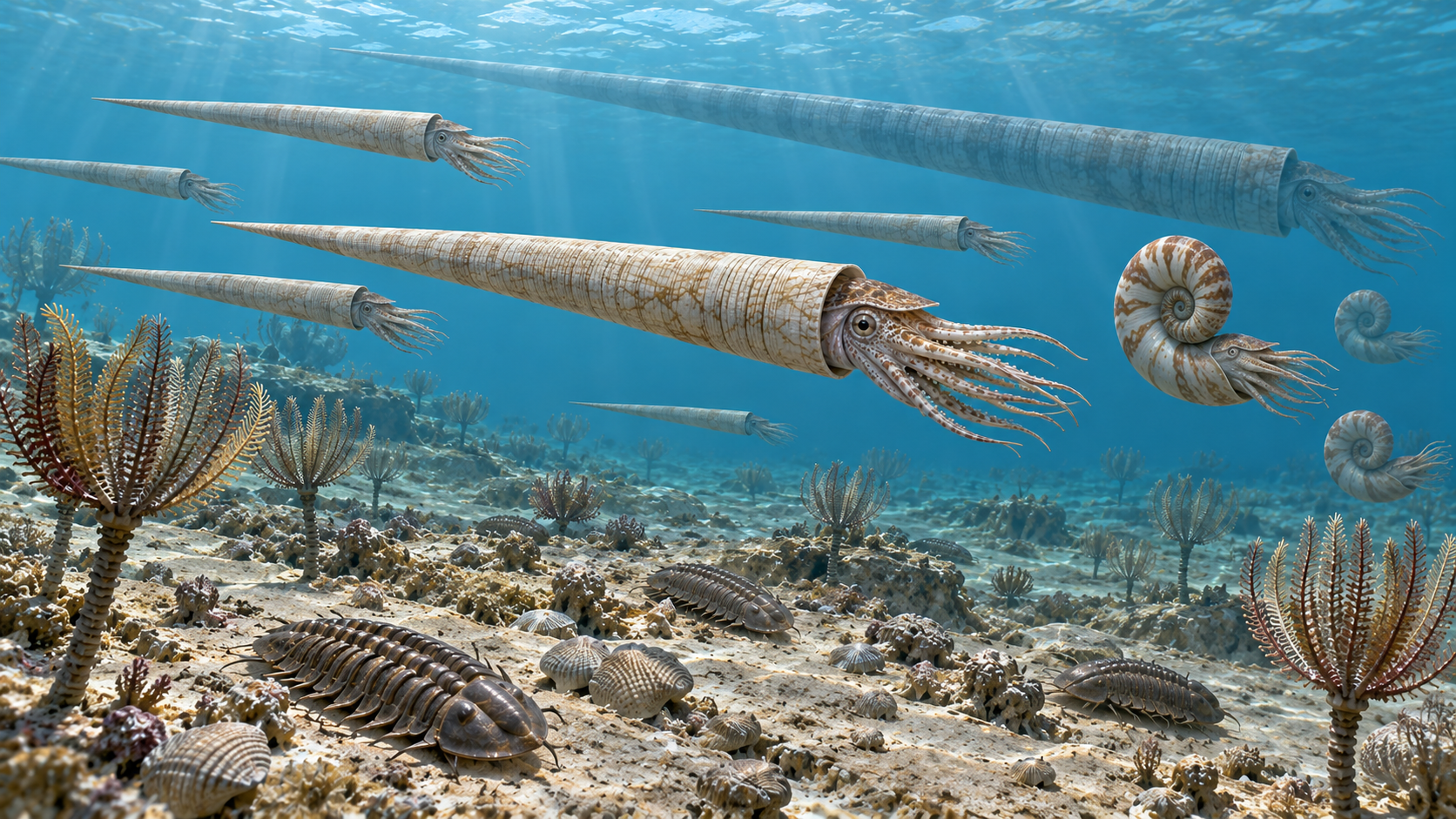
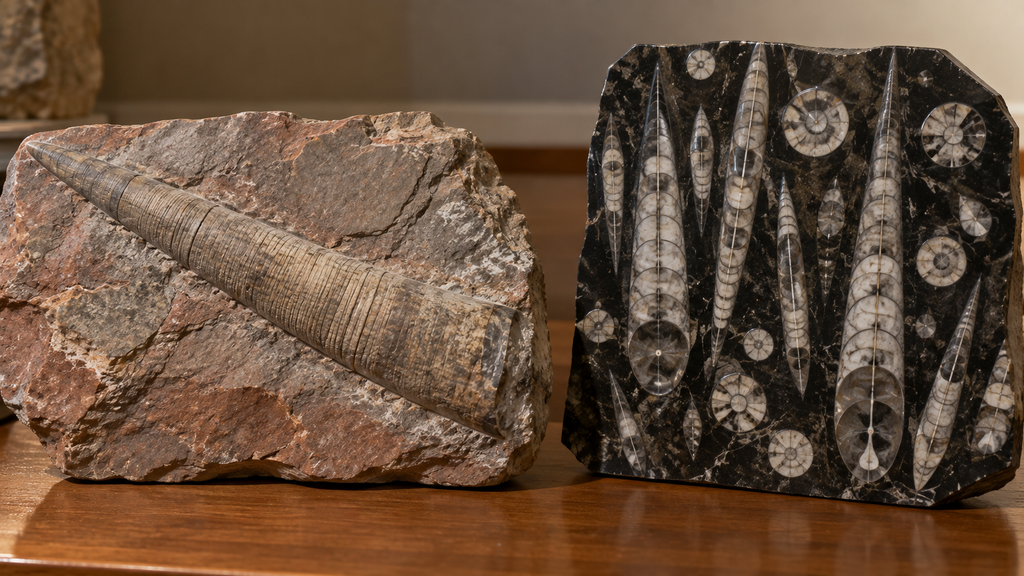
Orthoceras is a cephalopod with a straight, conical shell. It belongs to the same group as the nautilus, squid and octopus. The inside of the shell is divided into many chambers by walls, with a thin tube running through their centre. The name is widely known from the black polished fossil plates sold around the world as souvenirs and decor, but most of the fossils on those plates do not belong to this genus.
Appearance and Way of Life
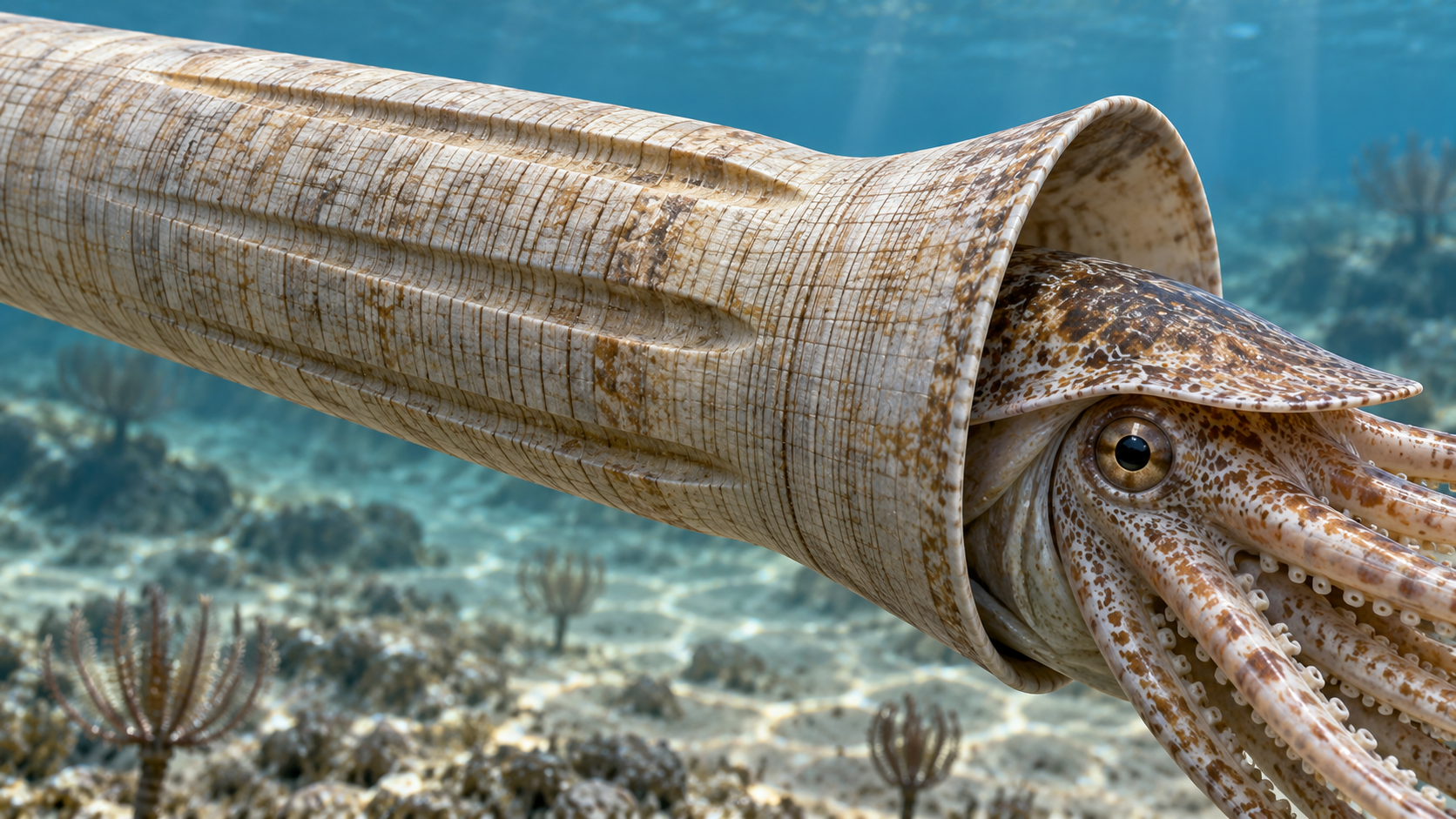
The shell is a long cone that narrows very gradually toward the tip, circular in cross-section. Its apical angle is only 1.7 to 2.9 degrees, so a considerable length was needed before the shell reached 4 cm across. The surface carries dense, fine transverse striae, and in well-preserved specimens even finer longitudinal lines run across them, producing a net-like pattern. Among the straight-shelled cephalopods of the Ordovician Baltic, this net-like ornament is unique to the genus Orthoceras.
The soft body sat in the outermost and widest chamber, the body chamber. In mature individuals, three elongated depressions run along the outside of the body chamber at equal spacing, and the shell is slightly constricted where they lie. The depressions vary in length from 1.5 to 5 cm between individuals, and the aperture flares out sharply beyond the constriction. The number and arrangement of these depressions is how closely related species are told apart.
Behind the body chamber lies a series of gas chambers separated by septa. Each chamber is about half as tall as the shell is wide, and the siphuncle running through the centre is roughly 15 percent of the shell’s diameter. Near the tip of the shell, calcareous deposits have been found inside this tube. Weighting the narrow end is thought to have balanced it against the wide end that held the body, keeping the shell level in the water. In a nautilus the coiled shell places the gas chambers directly above the body, but a straight shell offers no such arrangement, and a different mechanism was needed to control posture.
No soft parts have been preserved. The arms and eyes in reconstructions are modelled on the living nautilus, and even the number of arms is unknown. Some specimens preserve muscle attachment scars deep inside the body chamber, and these show how the body was anchored to the shell. Like other straight-shelled cephalopods, it is regarded as a predator of small animals or a scavenger.
Its habitat was the shallow shelf sea that covered what is now the Baltic region. Sediment accumulated there extremely slowly; tens of millions of years of deposits together are sometimes less than 150 metres thick. These thin beds are packed with trilobites and straight-shelled cephalopods, and have been called the Orthoceratite Limestone since the early nineteenth century. The same sea held the trilobite Asaphus, the coiled Lituites, and the giant straight-shelled Endoceras, whose shell reached several metres and whose name has become that of a stratigraphic zone.
A Name That Traveled the World
The name Orthoceras was in use before Linnaean nomenclature began. In 1732 the naturalist Breynius of Danzig (now Gdańsk, Poland) applied it to straight-shelled fossils from the glacial erratics around the city. The stones that glaciers had scraped from the Baltic bedrock and carried south contained the same Middle Ordovician fossils as Öland. As a formal genus it was established by the French naturalist Bruguière in 1789, and Orthoceratites regularis, described by Schlotheim in Germany in 1820, later became its type species.
Over the following century the genus became a catch-all for straight-shelled cephalopods from everywhere. Species from North America, Europe, Asia, Africa and Australia, ranging from the Ordovician to the Triassic, were placed in Orthoceras one after another without their internal shell structure ever being examined, and the number of species swelled into the hundreds. A paper published in 1936 by the American palaeontologists Teichert and Miller was titled “What is Orthoceras?”; by then the genus had lost any taxonomic meaning.
The clean-up began in 1931 with Troedsson’s study of Baltic Orthoceras in Sweden. Troedsson described the shell sculpture and body-chamber depressions of the type species, Orthoceras regulare, in detail and restricted the genus to forms sharing those features. The Treatise on Invertebrate Paleontology adopted this narrow definition in 1964, and in 2004 Kröger in Germany re-examined about 450 specimens, leaving only three species in the genus, regulare among them. All three come from the Middle Ordovician of the Baltic region, and by current consensus Orthoceras is a small group confined to that area and that age.
The Black Plates from Morocco
The black fossil plates sold as “Orthoceras” in gift shops and online come almost entirely from Morocco. They are quarried around Erfoud and Alnif in the Tafilalt region of the Anti-Atlas Mountains in the country’s southeast, then cut, polished and worked into dishes, ornaments and tabletops for export.
This black limestone dates from around the boundary between the Late Silurian and Early Devonian, roughly 425 to 419 million years ago. That is some 40 million years younger than Orthoceras regulare, and the setting was not the Baltic in the northern hemisphere but the northern margin of Gondwana, then at high southern latitudes. The sea floor was poor in oxygen, and the black colour reflects that environment. The beds are mass accumulations of straight-shelled cephalopods and bivalves, and even in the local geological literature they go by the informal name “Orthoceras Limestone”.
The cephalopod fossils of this region were described in detail by Kröger in 2008, from more than 2,000 specimens collected through a single stratigraphic section. They comprised 52 genera and 86 species, of which 17 genera and 39 species were new. There is no room among them for Orthoceras, which lived only in the Middle Ordovician Baltic. As for what the fossils on the plates actually are, Michelinoceras, Arionoceras and Orthocycloceras have been suggested, but none has been confirmed.
The reason they cannot be confirmed lies in the manufacturing process itself. The features that separate genera are details: the pattern on the shell surface, the depressions on the body chamber, the shape of the shell’s tip, and the internal structure of the siphuncle. The plates are made by slicing the shells at whatever angle looks best and polishing the surface, so those features are cut away or ground off. What remains is a cross-section of septa and siphuncle, and that supports no identification beyond “straight-shelled cephalopod”. Among researchers it is customary to write such specimens as “Orthoceras” in quotation marks, to signal a trade name rather than a genus. The Japanese term chokkakuseki works the same way, covering straight-shelled cephalopods as a whole.
The situation extends to the names of the rocks themselves. The Baltic “Orthoceratite Limestone” was named not for the genus Orthoceras but for straight-shelled cephalopods in general, Endoceras included. As a genus, Orthoceras is now limited to three species from around Öland. The range the name covers has shrunk again and again, yet as a trade name “Orthoceras” has reached the shelves of people who have never looked at a fossil.
Sources
Kröger, B. 2004. Revision of Middle Ordovician orthoceratacean nautiloids from Baltoscandia. Acta Palaeontologica Polonica 49(1): 57–74.
https://app.pan.pl/archive/published/app49/app49-057.pdf
Kröger, B. 2008. Nautiloids before and during the origin of ammonoids in a Siluro-Devonian section in the Tafilalt, Anti-Atlas, Morocco. Special Papers in Palaeontology 79: 1–110.
https://palass.org/publications/special-papers-palaeontology/archive/79/article_pp1-110
Lubeseder, S. 2008. Palaeozoic low-oxygen, high-latitude carbonates: Silurian and Lower Devonian nautiloid and scyphocrinoid limestones of the Anti-Atlas (Morocco). Palaeogeography, Palaeoclimatology, Palaeoecology 264: 195–209.
https://www.sciencedirect.com/science/article/abs/pii/S0031018208002228
Fossiilid.info (Estonian geological collections): Orthoceras Brugière, 1789
https://fossiilid.info/1284
Wilson, M. 2013. Wooster’s Fossils of the Week: Very common orthocerid nautiloids from the Siluro-Devonian of Morocco. Wooster Geologists.
https://woostergeologists.scotblogs.wooster.edu/2013/11/03/woosters-fossils-of-the-week-very-common-orthocerid-nautiloids-from-the-siluro-devonian-of-morocco/
Squires, R. L. 2024. An orthocone nautiloid from Morocco. Paleo & Geo Topics.
http://rsquirespaleo.blogspot.com/2024/02/an-orthocone-nautiloid-from-morocco.html
Monks, N. Essential collectibles (Part 4): Orthoceras nautiloids. Deposits Magazine.
https://depositsmag.com/2016/04/29/essential-collectibles-4-orthoceras-nautiloid/

コメント