| Name | Tyrannosaurus rex, meaning “tyrant lizard king” |
| Classification | Saurischia, Theropoda, Tyrannosauridae |
| Age | End of the Cretaceous (Maastrichtian), about 68–66 million years ago |
| Found in | Western North America (Montana, South Dakota, Wyoming, and Alberta and Saskatchewan in Canada, among others) |
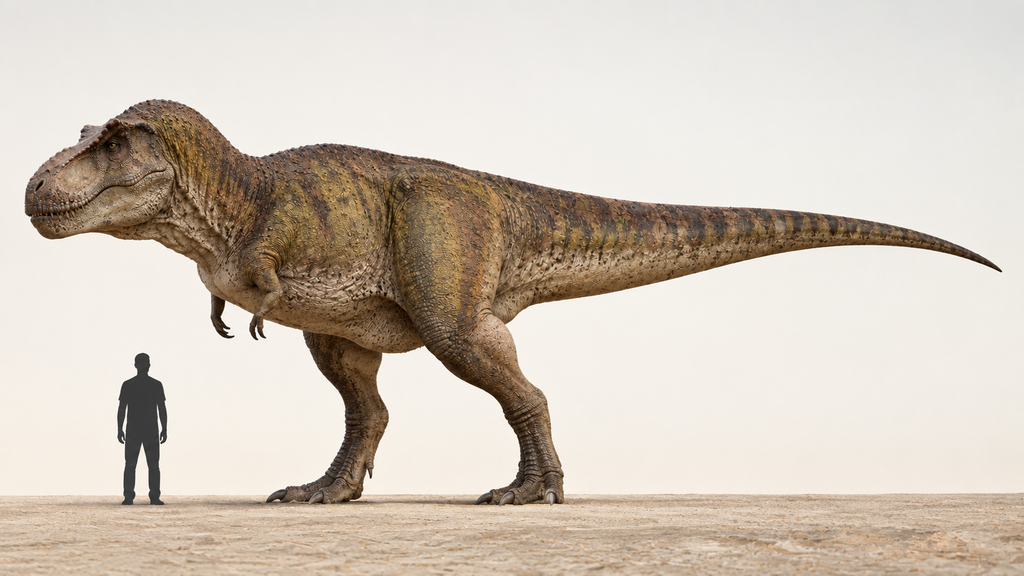
| Length | About 12–13 m (12.3–12.4 m for “Sue,” the most complete specimen; about 13 m for “Scotty”) |
| Hip height | About 3.7–4 m |
| Weight | Estimated at roughly 5–9 tonnes (8.4–8.9 tonnes for the largest individuals) |
| Skull length | Up to about 1.5 m |
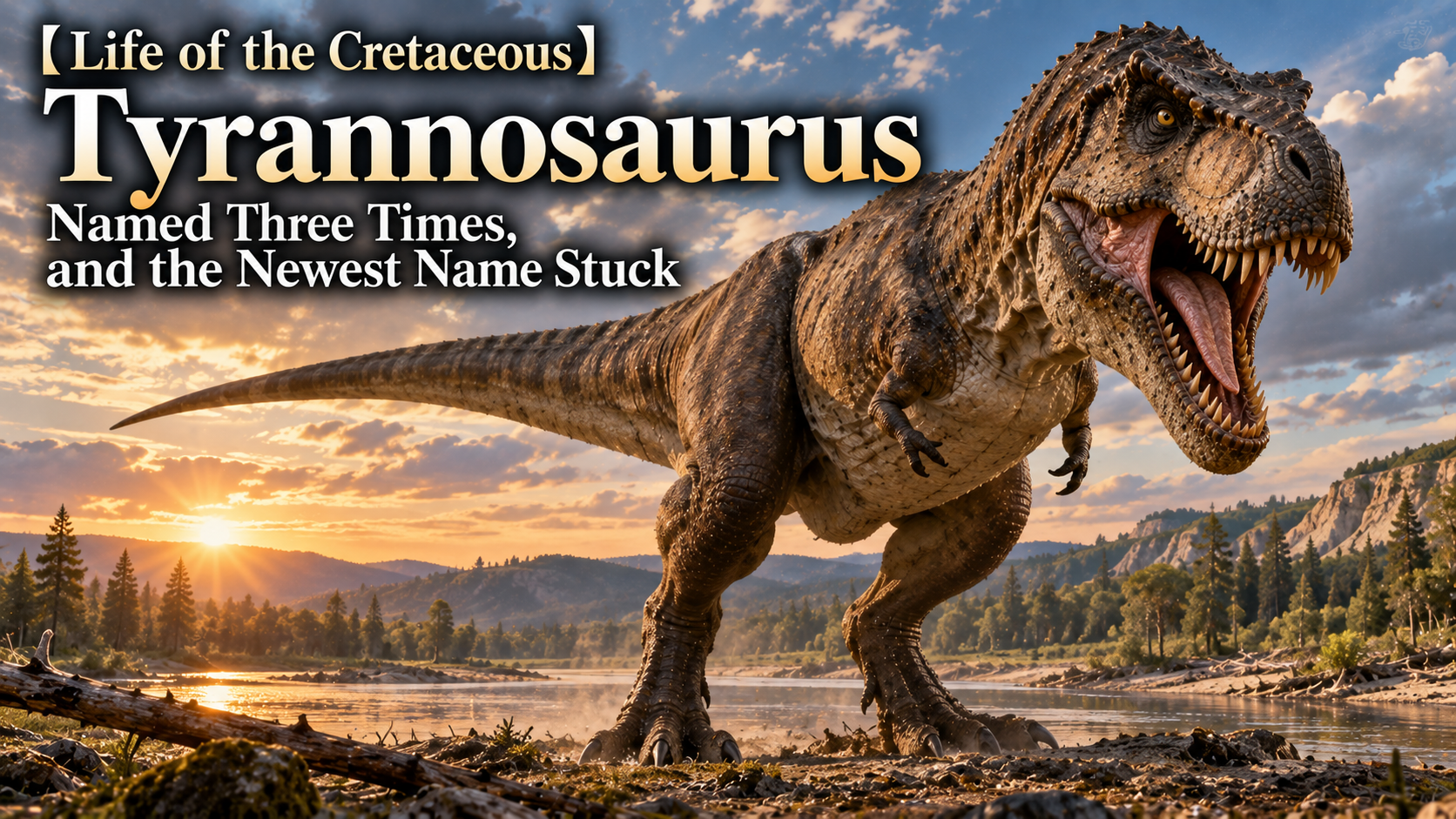
Tyrannosaurus was a large carnivorous dinosaur that lived in western North America at the very end of the Cretaceous. It carried a 1.5-metre skull on a body more than 12 metres long, and its bite was among the most powerful of any land animal that has ever lived. It was also one of the last dinosaurs, surviving right up to the moment they disappeared. The scientific name was given in 1905, but it took a detour of roughly a hundred years before that name was settled for good.
Appearance and way of life
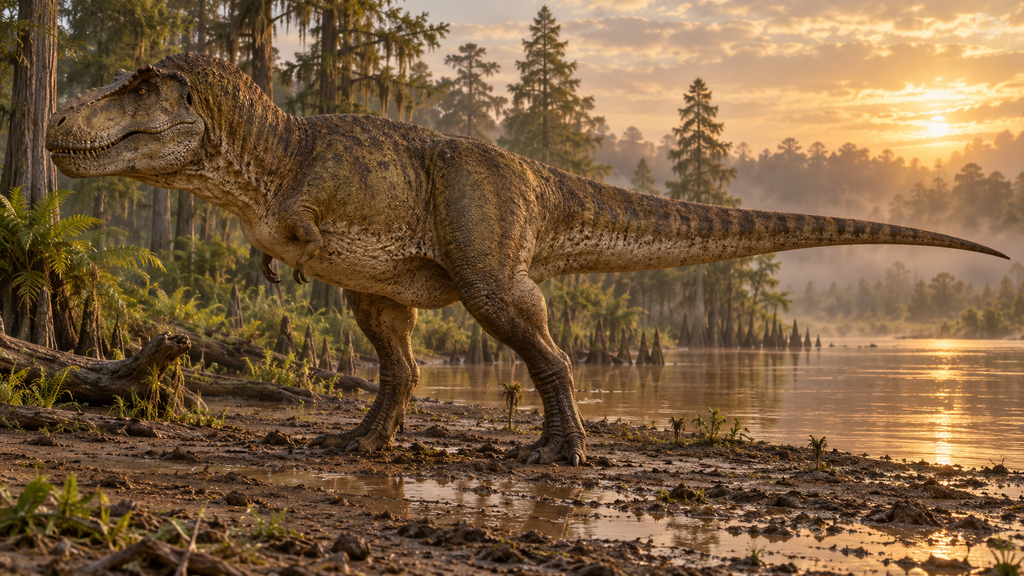
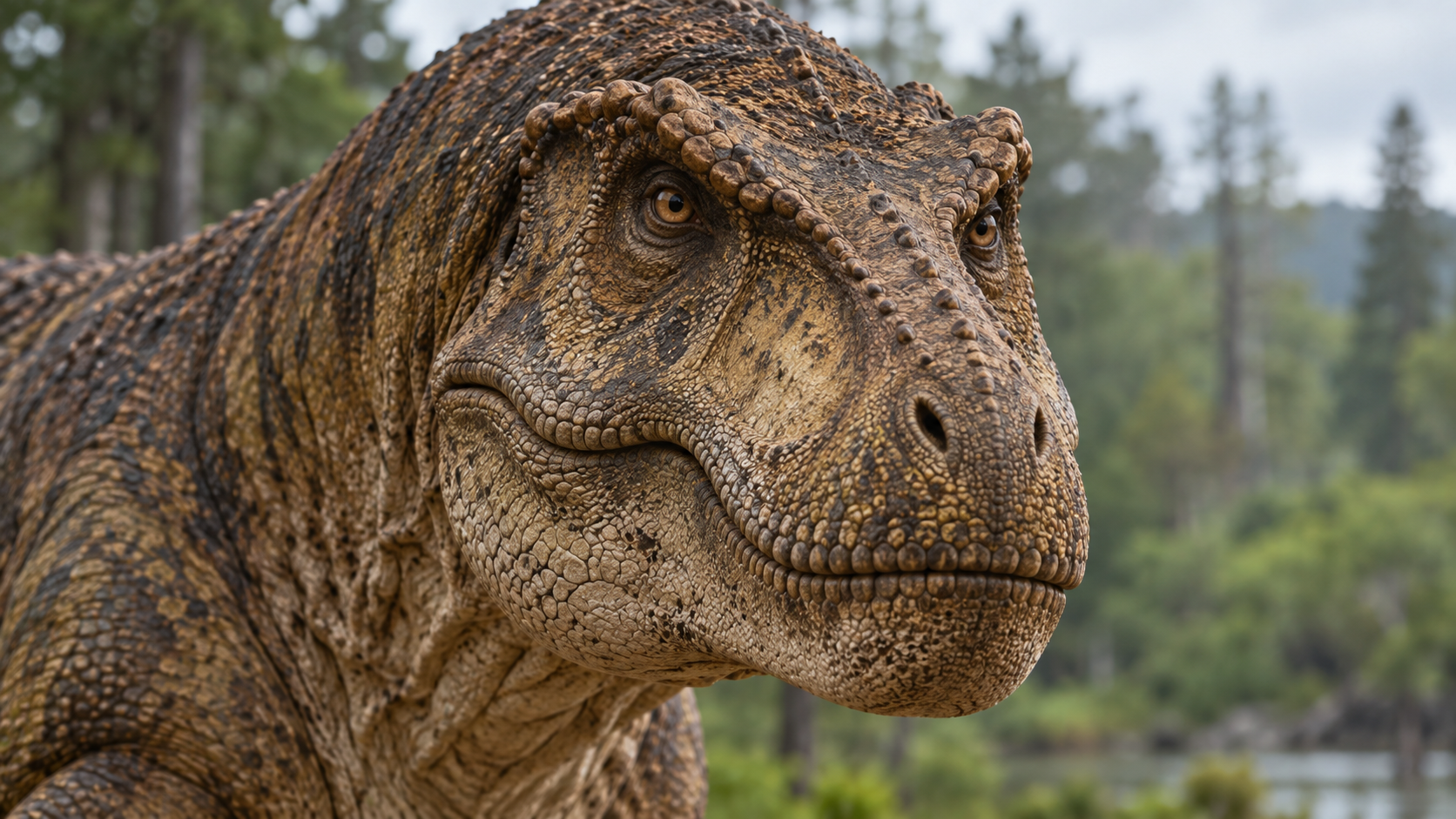
The head is broad, flaring out widely toward the back, while the snout stays narrow. This shape lets both eyes face forward, giving an overlapping field of view of about 55 degrees, wider than that of a modern hawk. The teeth come in two kinds: small chisel-shaped teeth at the front of the upper jaw, and thick, banana-shaped teeth lining the rest of the mouth. The largest tooth reaches 30 cm including the root. Where most carnivorous dinosaurs had thin, blade-like teeth, those of Tyrannosaurus were built thick enough to crush bone. Bite marks left on the bones of its prey, and fossil dung packed with bone fragments, confirm how they were used.
The hind legs are long for the size of the body, and the middle bone of the foot is pinched between its neighbours so that the three are bound into a single unit, a structure that transmits force efficiently when walking. The forelimbs, by contrast, are only about a metre long and have just two fingers. Even so, the bones carry the scars of heavy muscle attachment, and the force of flexing the elbow is estimated at more than three times that of an adult human. The prevailing view today is that the arms, small as they were, were not mere ornaments.
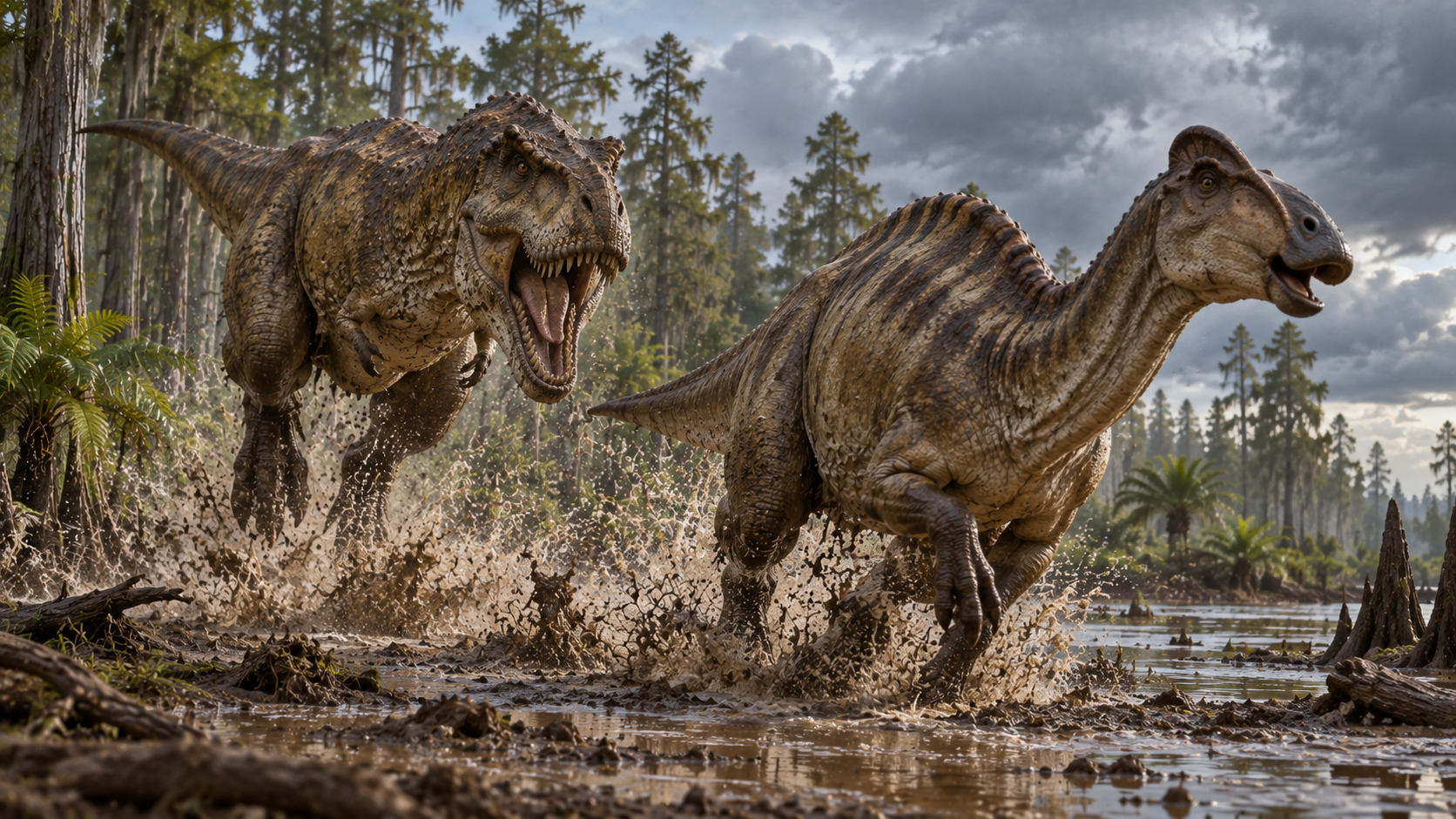
Its food was the hadrosaurs such as Edmontosaurus and the Triceratops that turn up in the same rock layers. A Triceratops hip bone bearing the tooth marks of Tyrannosaurus, and an Edmontosaurus tail bone that was bitten and then healed, show that it attacked living prey and did not simply scavenge carcasses. Estimates of its running speed vary from study to study, with many putting it around 20–30 km/h, and some calculations suggest that at its weight a full sprint would have broken its leg bones. Its body was suited less to chasing prey down than to closing in quietly and finishing the job with a single bite.
It lived on the plains of rivers, forests and wetlands along the western shore of the inland sea that then ran north to south through North America. The Hell Creek Formation, stretching from present-day Montana into South Dakota, is the classic example, and besides Tyrannosaurus it has yielded Triceratops, Ankylosaurus, Pachycephalosaurus, and small mammals, crocodiles and turtles. At the very top of this formation lies a thin layer rich in iridium, the trace of the asteroid impact, marking the point where the age of Tyrannosaurus ended in extinction.
How the reconstruction has changed
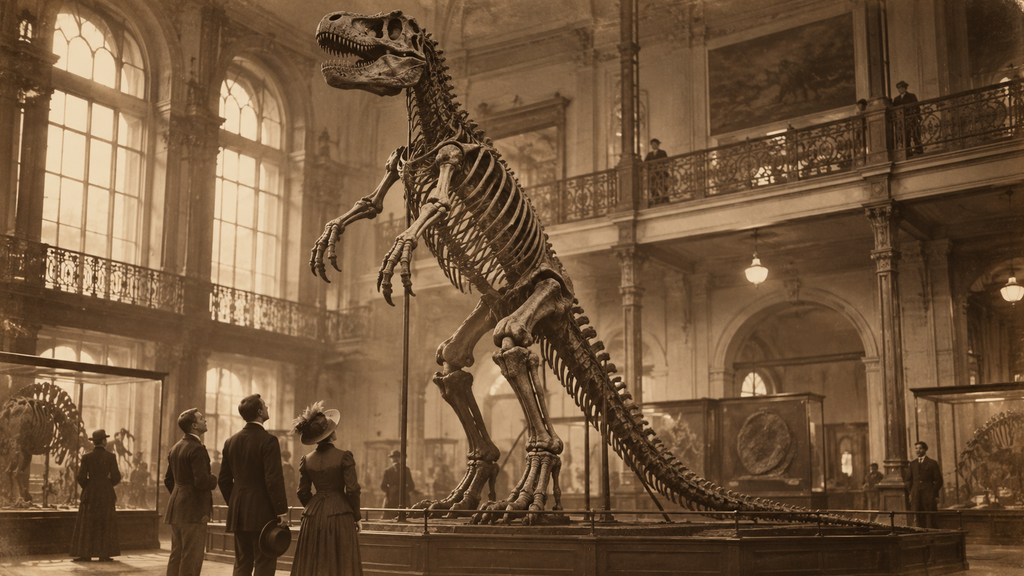
The first complete skeleton, unveiled at the American Museum of Natural History in 1915, was mounted in a kangaroo-like stance, body upright and tail dragging on the floor. Around 1970 it was pointed out that this posture would have strained the joints beyond what they could bear, and the skeleton was finally remounted in 1992. The modern pose, with the spine held close to horizontal and the tail stretched out behind to balance the head, reached the general public in the 1990s through films and other media.
The forelimbs, too, were drawn from guesswork for a long time. In 1905 the only arm bone known was the humerus, and the 1915 mount was given long, three-fingered arms modelled on the related Allosaurus. Complete forelimbs of the real animal were not found until 1989.
As for feathers, traces of them in early tyrannosaurs led for a while to more reconstructions showing Tyrannosaurus with feathers as well. A 2017 review of skin fossils, however, concluded that every skin impression from Tyrannosaurus itself, from the neck, hips and tail, shows fine scales, and that any feathers would have been confined to a small area along the back. Current reconstructions take a scaly body as the default.
Named three times, and the newest name stuck
The name Tyrannosaurus rex was given in 1905 by Henry Fairfield Osborn of the American Museum of Natural History. It was based on a partial skeleton that Barnum Brown had dug out of the Hell Creek Formation in Montana in 1902. In the same paper, Osborn gave another skeleton, one Brown had found in Wyoming in 1900, the name Dynamosaurus imperiosus. That specimen had bony armour plates mixed in with it, and so was judged to be a different genus. The following year, 1906, Osborn realised the two were the same species and settled on Tyrannosaurus. The armour plates later turned out to belong to a different dinosaur that had been buried alongside it.
There was, however, a name older than either of these. In 1892 Edward Drinker Cope had named two huge fossil vertebrae from South Dakota Manospondylus gigas, meaning “giant porous vertebra.” Cope took them to be from a horned dinosaur close to Triceratops. In 1907 they were reidentified as theropod bones, and Osborn himself noted their resemblance to Tyrannosaurus in a 1917 paper. But one of the two vertebrae had already been lost, and Osborn judged that the remaining one was not enough to pin down a species, so he stopped short of formally declaring them the same animal.
Zoological names follow a principle that the earlier name takes precedence. If Manospondylus and Tyrannosaurus were the same animal, the valid name should have been the older one, Manospondylus. The issue came to the surface in June 2000. The Black Hills Institute of Geological Research in South Dakota located what appeared to be the site of Cope’s find and excavated about a tenth of a Tyrannosaurus skeleton from it. Peter Larson of the institute suggested that this was the same individual as Cope’s fossil and raised the question of priority publicly.
What saved the name Tyrannosaurus was a rule that had come into force six months earlier. The fourth edition of the International Code of Zoological Nomenclature, which governs how scientific names are used, took effect on 1 January 2000. Its Article 23.9 states that when an older name has not been used as valid since 1899, and the newer name has been used in at least 25 publications by at least 10 authors over the preceding 50 years, the newer name is to be maintained. Tyrannosaurus rex cleared that bar by a wide margin. In 2003 Christopher Brochu laid out this point and also noted that Cope’s badly weathered fossil could never be proven to be the same individual as the newly excavated bones. As a result, Tyrannosaurus is treated as a nomen protectum, a “protected name,” and Manospondylus as a nomen oblitum, a “forgotten name.”
Three fossils found in 1892, 1900 and 1902 were each given a different name. The first was mistaken for a horned dinosaur, the second was assigned to a separate genus because of armour from an ankylosaur mixed in with it, and only the name given to the third survived. When that order was called into question more than a century later, what decided the matter was not the fossils themselves but a revision of the rules for how names are used.
Sources
Osborn, H. F. (1905) Tyrannosaurus and other Cretaceous carnivorous dinosaurs. Bulletin of the American Museum of Natural History 21: 259–265: AMNH Digital Library (original description of Tyrannosaurus rex and Dynamosaurus imperiosus)
Osborn, H. F. (1906) Tyrannosaurus, Upper Cretaceous carnivorous dinosaur (second communication). Bulletin of the American Museum of Natural History 22: 281–296: AMNH Digital Library (Dynamosaurus merged into Tyrannosaurus)
Osborn, H. F. (1917) Skeletal adaptations of Ornitholestes, Struthiomimus, Tyrannosaurus. Bulletin of the American Museum of Natural History 35: 733–771: AMNH Digital Library (notes the resemblance to Manospondylus)
International Code of Zoological Nomenclature, 4th edition, Article 23 (Principle of Priority): code.iczn.org (Article 23.9, “Reversal of precedence”)
Brochu, C. A. (2003) Osteology of Tyrannosaurus rex: Insights from a nearly complete skeleton and high-resolution computed tomographic analysis of the skull. Society of Vertebrate Paleontology Memoir 7: 1–138 (osteological description and a review of the Manospondylus naming issue)
Taylor, M. P. “So why hasn’t Tyrannosaurus been renamed Manospondylus?”: The Dinosaur FAQ (explains the Code revision and the naming issue)
Bell, P. R. et al. (2017) Tyrannosauroid integument reveals conflicting patterns of gigantism and feather evolution. Biology Letters 13: 20170092 (review of skin fossils; evidence for scales)
Stevens, K. A. (2006) Binocular vision in theropod dinosaurs. Journal of Vertebrate Paleontology 26: 321–330 (estimate of binocular overlap)
Persons, W. S. et al. (2020) An older and exceptionally large adult specimen of Tyrannosaurus rex. The Anatomical Record 303: 656–672 (description of “Scotty” and its mass estimate)
For an overview of size, age and specimens, the primary literature compiled in the English Wikipedia entry “Tyrannosaurus” was also consulted.

コメント