| Name | Cameroceras. From the Greek for “chambered horn” |
| Classification | Mollusca, Cephalopoda, order Endocerida, family Endoceratidae |
| Age | Ordovician (about 485 to 444 million years ago), most common in the Late Ordovician |
| Found in | New York State (Trenton Limestone) and other parts of North America, Sweden, Estonia, China and elsewhere |
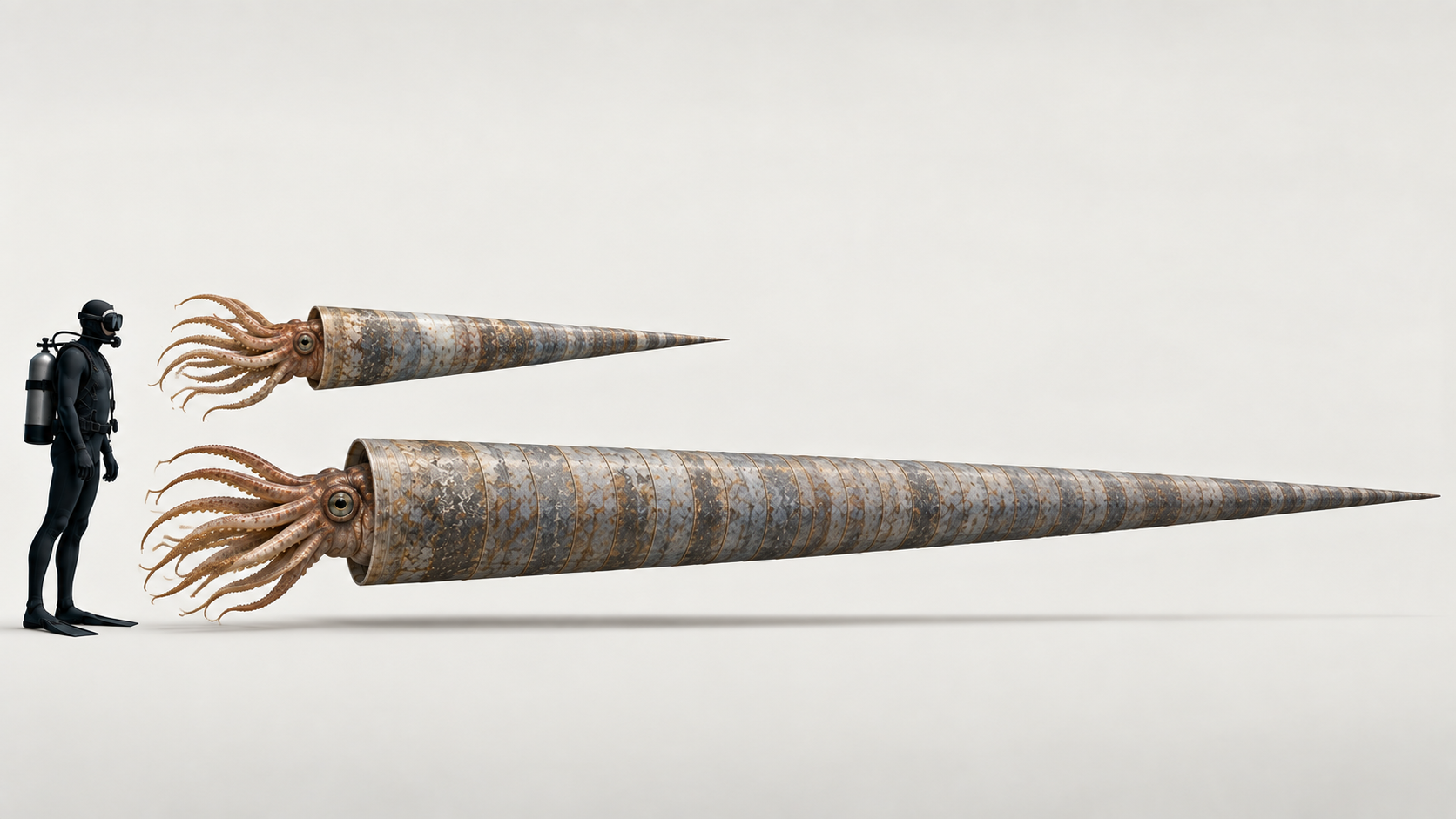
| Shell length | From around 10 cm to about 2 m depending on the species (the largest is Cameroceras turrisoides). Figures of “6 to 9 m” rest on specimens of the related Endoceras and on unverified reports |
| Weight | Around 15 kg for a 2 m shell (a rough figure treating the shell as a cone, in line with the estimate of about 100 kg for 5 m endocerids) |
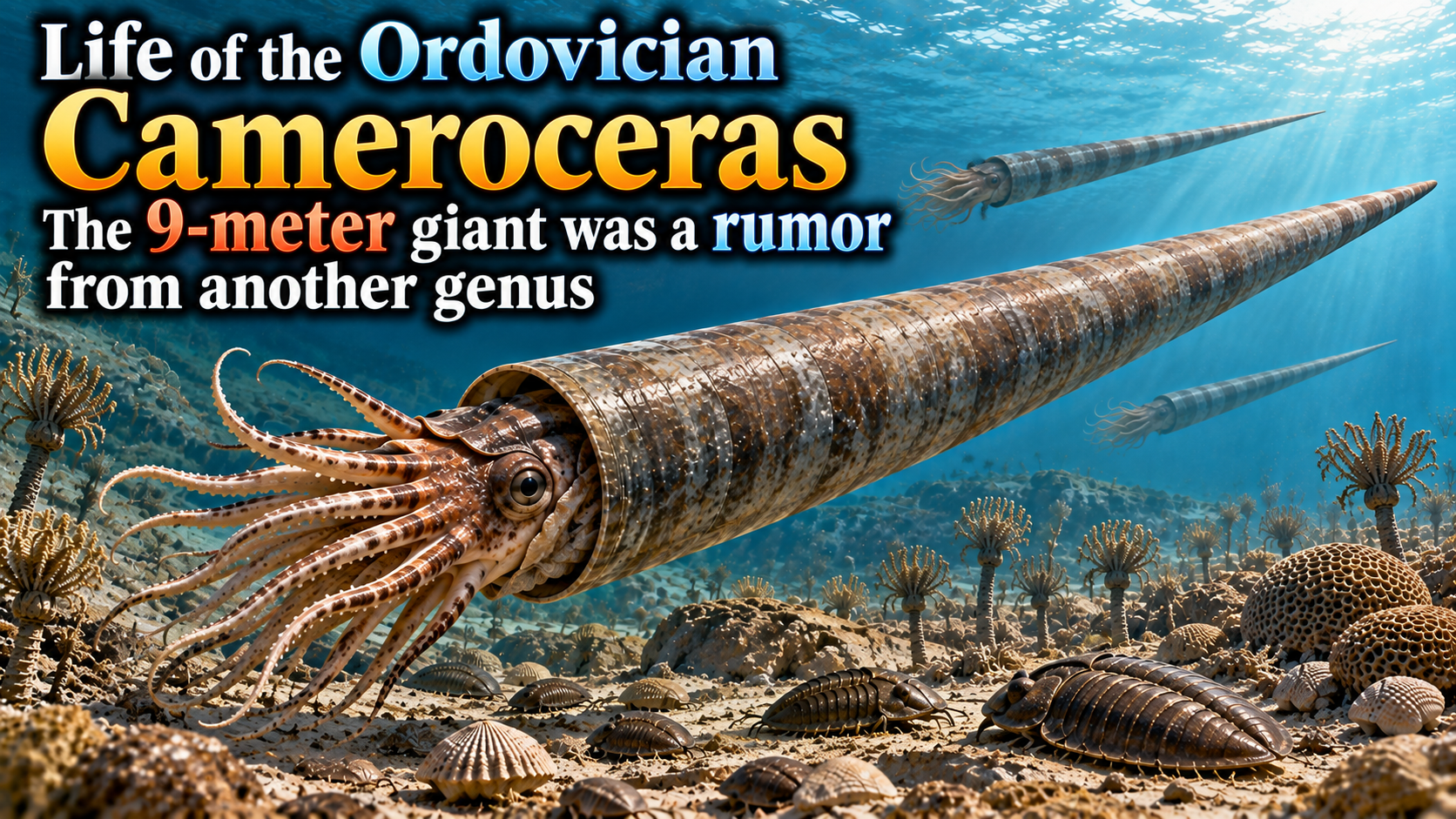
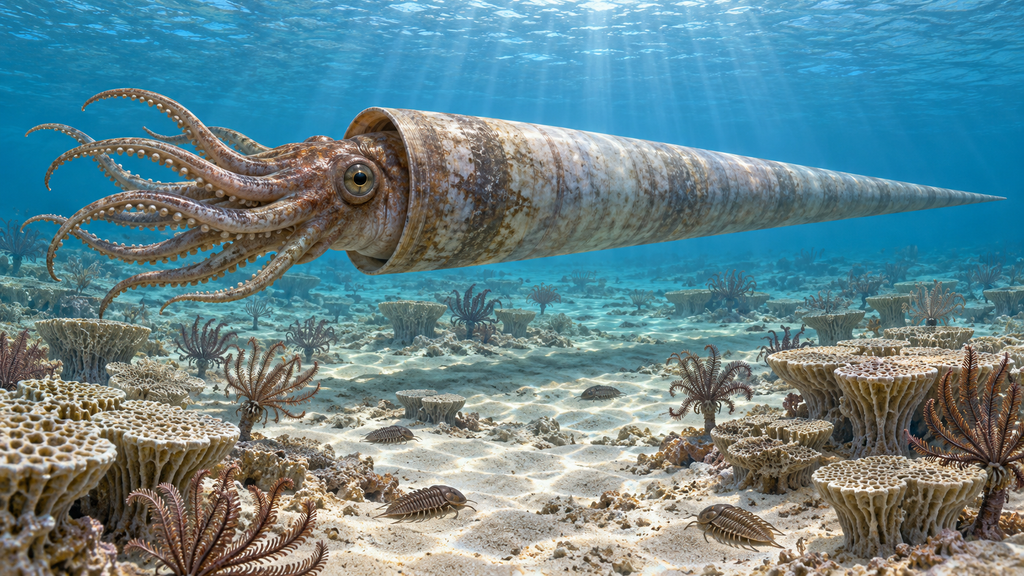
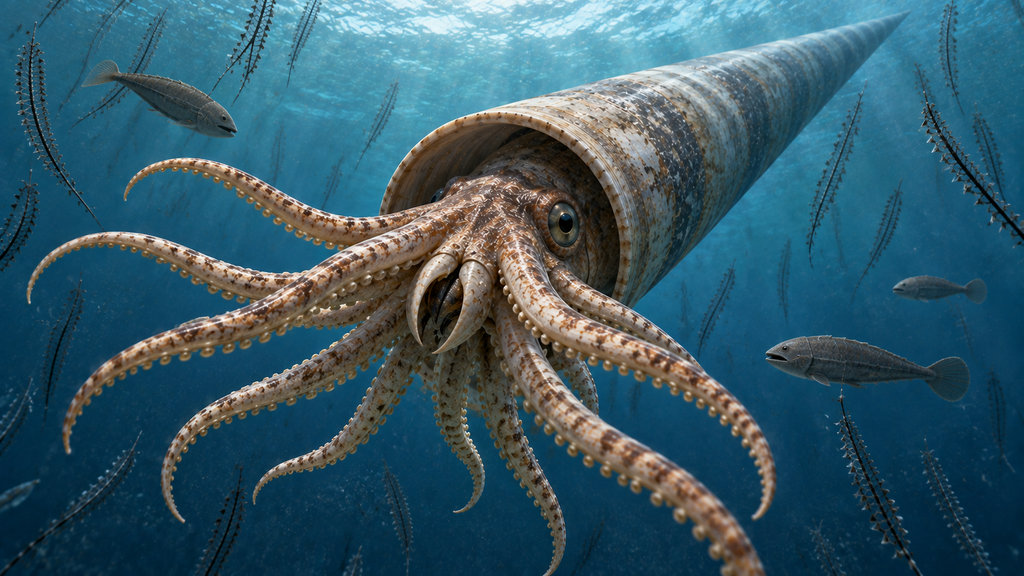
Cameroceras is a cephalopod with a long, straight, conical shell. It lived widely in the shallow seas near the Ordovician equator, and its fossils have been found in North America, around the Baltic, in Siberia and in China. Like squid, octopuses and the nautilus, it was a cephalopod: its body sat inside the shell, with the head and tentacles extending from the opening.
It has been presented in reference books and television programmes as a “9-metre shell, the largest animal of the Palaeozoic”. Yet the largest Cameroceras shell that can actually be confirmed from fossils is only about 2 m long. Tracing the 9-metre figure back to its source leads to a specimen of a different genus and to a report for which neither a photograph nor a specimen survives.
Appearance and way of life
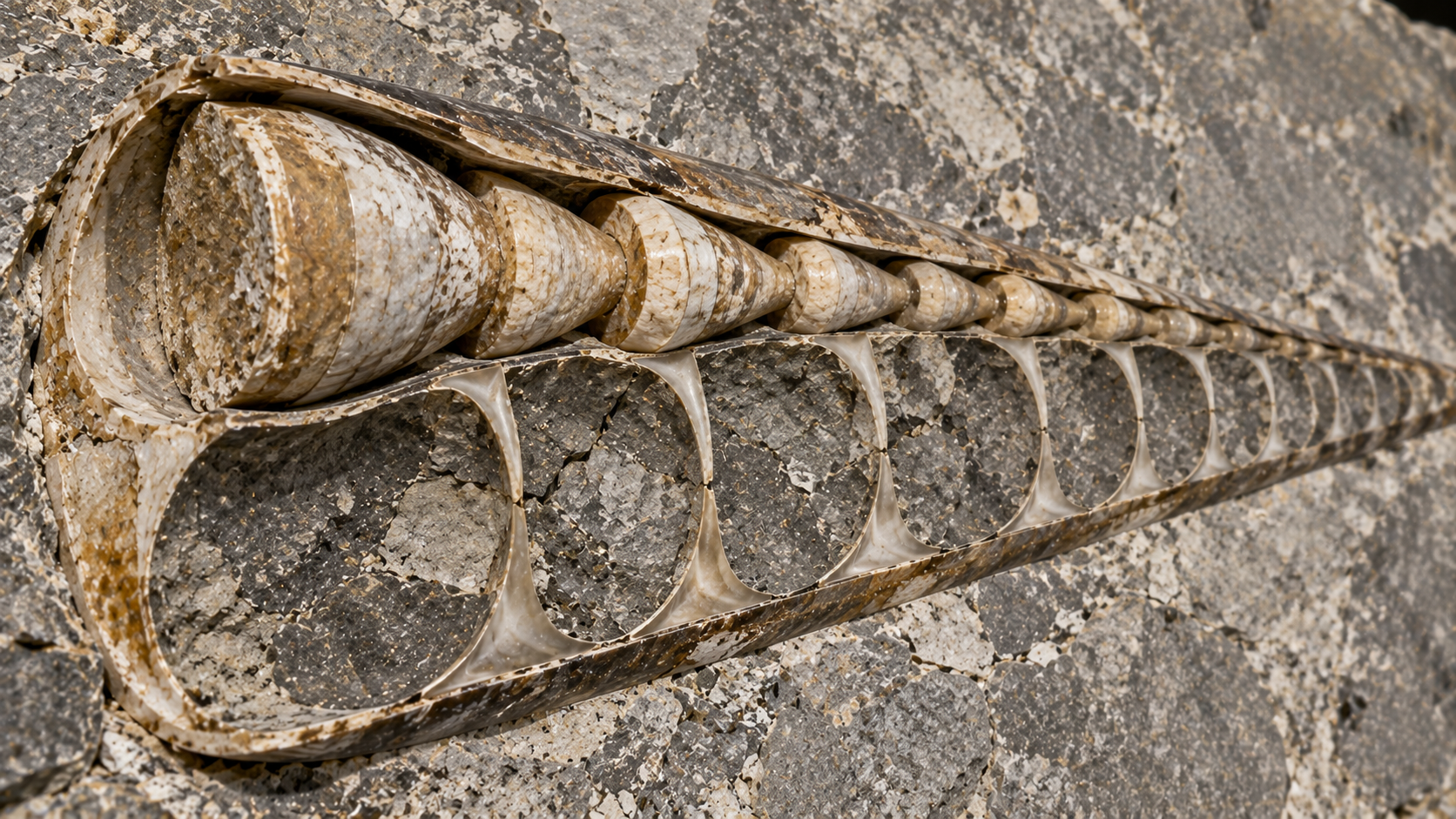
The shell is a long cone tapering toward the tip, circular in cross-section or slightly wider than it is tall. Inside, it is divided by walls into many small chambers, and a tube known as the siphuncle runs through them. What marks out the endocerids, Cameroceras included, is the thickness of this tube: in some species it reaches half the diameter of the shell. Inside the tube, cone-shaped calcareous deposits are stacked one inside the other. These are the “endocones” that gave the order Endocerida its name. Cameroceras is told apart from its close relative Endoceras mainly by the shell surface: Endoceras carries fine ring-like ridges, while the shell of Cameroceras is smooth.
Because the endocones are concentrated toward the tip of the shell, they are thought to have acted as a counterweight, preventing the animal from being top-heavy at the opening end where its body sat. Buoyancy calculations published in 2019 concluded that this counterweight kept the shell almost horizontal in the water, suiting a life drifting close to the seafloor. Not every straight-shelled cephalopod floated upright, and the endocerids are treated as the classic example of a horizontal posture.
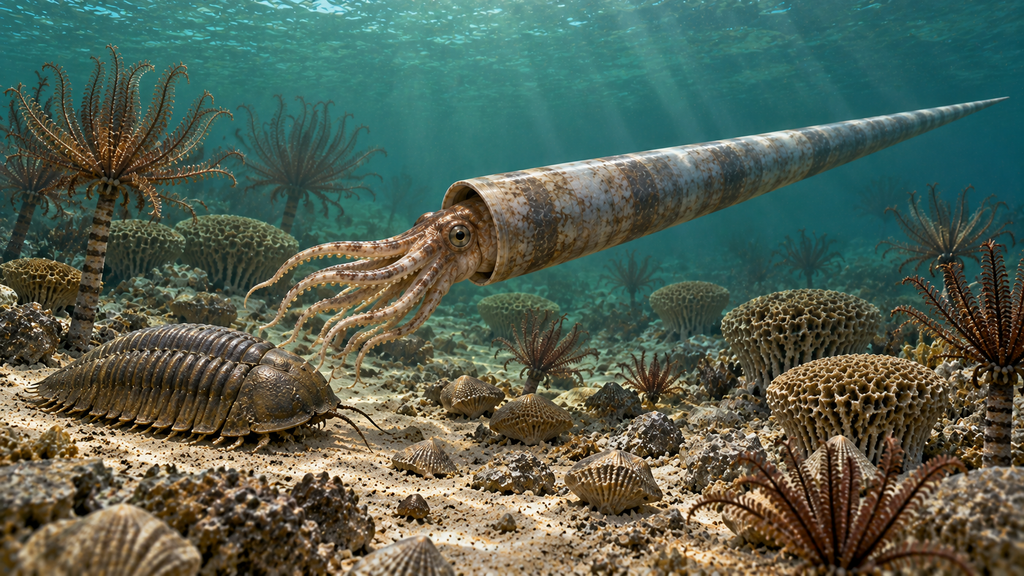
Since only the shell fossilises, direct evidence of diet is scarce. By comparison with the living nautilus, Cameroceras is usually reconstructed as a predator that seized prey with its tentacles and broke shells and exoskeletons with a hard beak. From Late Ordovician rocks in Ontario, Canada, comes a fossil of the large trilobite Isotelus bearing a partly healed wound that looks like a bite mark; judging by its size, a large endocerid has been put forward as the likely attacker. On the other hand, a 2018 study proposed that the large endocerids were suspension feeders, stretching a membrane between the tentacles to strain plankton from the water. That idea has been questioned on buoyancy grounds, and the matter is not settled.
The Late Ordovician seas in which Cameroceras swam held trilobites, brachiopods, crinoids, tabulate corals, drifting graptolites and jawless fish. Endocerids were among the largest bodies in that world, and because large individuals are found in great numbers over a wide area from the Baltic to the New York region, they are thought to have accounted for a considerable share of the biomass in those seas. Most endocerids disappeared in the mass extinction at the end of the Ordovician. Straight-shelled cephalopods continued after that, but they never returned to this scale.
Where the “9-metre shell” came from
The figure of 9 or 10 metres that accompanies the name Cameroceras has no fossil behind it. Its source is a 1955 paper by the palaeontologist Rousseau Flower, who recorded, as hearsay, that an endocerid shell 30 feet (about 9.1 m) long had been found in a quarry in New York State and destroyed before it could be recovered. No photograph or specimen survives, and the person who measured it has never been identified.
The largest specimen that can be confirmed in the flesh is a shell of Endoceras giganteum in the Museum of Comparative Zoology at Harvard University, collected from the Late Ordovician of New York State. The surviving portion alone is 3 m long, and both the tip and the opening end are missing. Teichert and Kummel, who described the specimen in 1960, estimated its complete length at about 8 m. Set beside that estimate, the 30-foot story that Flower had passed on looked entirely plausible.
The estimate was later revised downward by recalculating the full length geometrically from the angle at which the shell widens, and a 2015 study put the total at 5.73 m. That value assumes the body chamber took up 30% of the shell; since complete endocerid specimens are known in which the body chamber is shorter, the real figure may have been smaller still. A 2025 survey of cephalopod body size through geological time likewise states that the 3 m Harvard fragment is the largest cephalopod fossil currently known, and that the reports of 9 to 10 m are doubtful because they have no physical evidence and exceed the longest confirmed specimen more than threefold. The same paper stresses that the idea of endocerids as uniformly gigantic is itself a misconception, and that the great majority were far smaller.
And that largest specimen is assigned not to Cameroceras but to the genus Endoceras. The two are almost identical in structure and can be distinguished only by the presence or absence of ring-like ridges on the shell surface, so some researchers have treated them as one genus. Flower himself was among them and did not separate the two. The BBC series “Sea Monsters”, made in 2003, set a “Cameroceras” with a 9 to 10 m shell in the seas of New York State; that creature combined Flower’s hearsay with the classification of an era in which the boundary between the genera was blurred. Through the programme, the 9-metre giant cephalopod spread under the name Cameroceras.
Cameroceras as a genus
Cameroceras was named in 1842 by Timothy Conrad on the basis of fossils from the Trenton Limestone of New York State. That original specimen has since been lost. With no reference specimen and only a brief original description, there was no firm standard for which fossils should be called Cameroceras, and the genus came to serve as a holding place for large, straight-shelled endocerids. Many species have since been moved to other genera, and for a time Endoceras itself was treated as part of Cameroceras.
Both genera are considered valid today, though some species still sit on an unclear boundary. Setting the naming aside, the species currently called Cameroceras range from small forms about 1 cm in diameter to Cameroceras turrisoides from the Boda Limestone of Sweden, with a diameter of about 17 cm and a total length of about 2 m. What remains in place of the “9-metre Cameroceras” is this 2-metre species. Even so, it was among the largest animals of the Ordovician seas, and it would count as a large cephalopod in the oceans of today.
Sources
Klug, C. et al. (2025). Cephalopod body size and macroecology through deep time. Scientific Reports 15, 30736. https://doi.org/10.1038/s41598-025-13940-1
Klug, C., De Baets, K., Kröger, B., Bell, M. A., Korn, D. & Payne, J. L. (2015). Normal giants? Temporal and latitudinal shifts of Palaeozoic marine invertebrate gigantism and global change. Lethaia 48, 267–288. https://doi.org/10.1111/let.12104
Teichert, C. & Kummel, B. (1960). Size of endoceroid cephalopods. Breviora 128, 1–7. https://www.biodiversitylibrary.org/page/3199928
Flower, R. H. (1955). Status of endoceroid classification. Journal of Paleontology 29(3), 329–371. https://www.jstor.org/stable/1300321
Kröger, B. (2013). The cephalopods of the Boda Limestone, Late Ordovician, of Dalarna, Sweden. European Journal of Taxonomy 41, 1–110. https://doi.org/10.5852/ejt.2013.41
Frey, R. C. (1995). Middle and Upper Ordovician nautiloid cephalopods of the Cincinnati Arch region of Kentucky, Indiana, and Ohio. U.S. Geological Survey Professional Paper 1066-P. https://doi.org/10.3133/pp1066P
Peterman, D. J., Barton, C. C. & Yacobucci, M. M. (2019). The hydrostatics of Paleozoic ectocochleate cephalopods (Nautiloidea and Endoceratoidea) with implications for modes of life and early colonization of the pelagic zone. Palaeontologia Electronica 22(2), 24. https://doi.org/10.26879/884
Mironenko, A. A. (2018). Endocerids: suspension feeding nautiloids? Historical Biology 32, 1–9. https://doi.org/10.1080/08912963.2018.1491565
Teichert, C. (1964). Endoceratoidea. In: Moore, R. C. (ed.), Treatise on Invertebrate Paleontology, Part K, Mollusca 3. Geological Society of America & University of Kansas Press, K160–K189. https://journals.ku.edu/InvertebratePaleo/article/view/5259

コメント