
| Name | Dickinsonia, after Ben Dickinson, Director of Mines for South Australia |
| Classification | An animal — though which living group it is closest to remains undetermined |
| Age | Late Ediacaran, Proterozoic (about 560 to 550 million years ago) |
| Found in | The Flinders Ranges (Ediacara Hills) of South Australia, the White Sea coast of Russia, and Ukraine |
| Length | A few millimeters to about 80 cm. Specimens over a meter have been reported |
| Thickness | Under a few millimeters. Fossils are impressions in sandstone only, so no weight estimate exists |
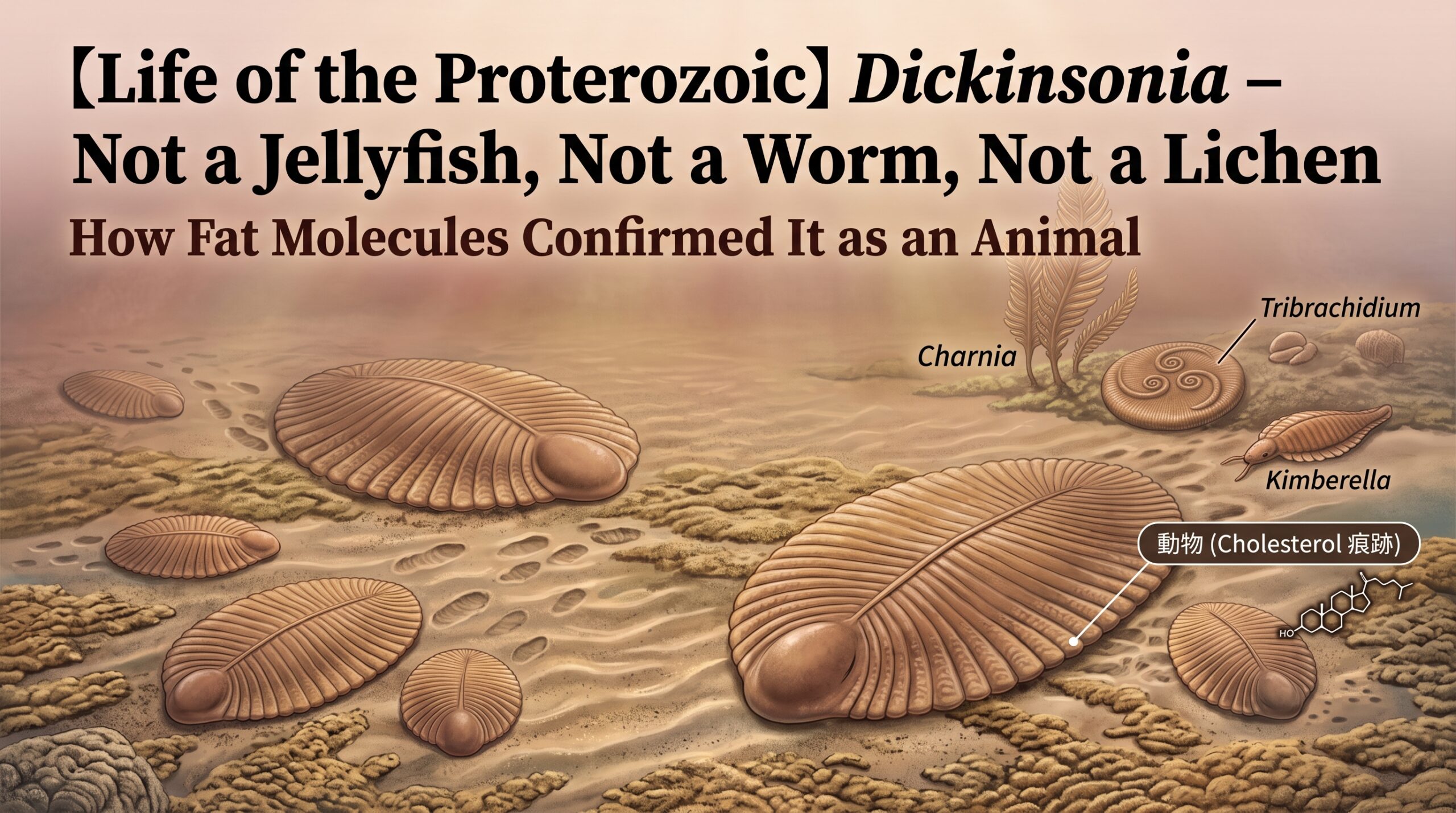
Dickinsonia was a flat, oval organism living on the Ediacaran seafloor. Fine partitions are arranged regularly on either side of its body, and large individuals grew to the length of the short side of a tatami mat. For more than seventy years after it was described in 1947, explanations of what it was kept rotating — jellyfish, polychaete worm, lichen, giant single-celled organism — until in 2018 fat molecules preserved in the fossils identified it as an animal.
Form and way of life
The body is shaped like a thin cushion, with a single line running down the middle and elongate units (modules) arranged to either side of it. The number of units runs to a few dozen in small individuals and several hundred in large ones. The units are not strictly symmetrical left to right; they look offset by half and interlocked, and interpretation of this point is still divided. The units at one end are larger than the rest, and that end is taken to be the front. Measurements of more than a thousand specimens from South Australia show that it grew by adding new units at one end of the body, with the shape adjusted so that the overall outline did not break down as growth proceeded.
Neither mouth nor gut, neither eyes nor legs, have been found. It is thought to have lain flat on the microbial mats covering the seafloor (films layered with bacteria and algae), digesting and absorbing the mat directly through its underside. The evidence is not the fossils themselves but the marks left around them. Near a Dickinsonia body fossil, a series of thin outlines of the same shape and size sometimes survives, interpreted as feeding traces where the mat was dissolved and thinned beneath the body.
These feeding traces also became evidence that Dickinsonia moved under its own power. A 2019 study examined the orientation of the traces for a group of up to around 200 individuals excavated from a single bedding surface in South Australia. Had they been swept along by tides or storms, individuals on the same surface should all have moved in the same direction. In fact the orientations were scattered, and individual by individual there was a tendency to advance with the end bearing the larger units leading. It appears to have crawled by extending and contracting the body, like an earthworm.
The body was soft, and fossils are found of individuals stretched, twisted or torn by water currents. That a body with no hard parts whatsoever nonetheless survived as an impression is because the seafloor mat acted as a mold, protecting the outline of the fossil from the influx of sand. Living on the same seafloor were Kimberella, a mollusk-like animal that left crawling traces, the triradial Tribrachidium, and frond-shaped relatives of Charnia.
Seventy years of argument, settled by fat molecules
Dickinsonia is one of the fossils the geologist Reg Sprigg found in the Ediacara Hills of South Australia in 1946. Sprigg himself first took it for a jellyfish fossil. The description published the following year, 1947, treated it as a flattened polychaete, a relative of marine worms. Later, the fact that it matched no living animal became the problem, and interpretations moved outside the animal category altogether. Proposals included a giant single-celled organism lying on the seafloor, and even a lichen growing on land. Gregory Retallack, who argued for the lichen, takes the position that Ediacaran strata themselves are terrestrial soils rather than seafloor. Form settled nothing, and for a long stretch textbooks simply wrote “affinity unknown.”
The thread that settled it was not the shape of the fossil but the molecules preserved in it. In 2018, Ilya Bobrovskiy, Jochen Brocks and colleagues at the Australian National University analyzed Dickinsonia about 558 million years old, collected from cliffs on the White Sea coast of Russia. Fossils from this locality are exceptional in that they preserve not only sandstone impressions but a thin organic film on the fossil surface. The team extracted lipids from that film and compared their composition with the surrounding sediment.
The result was unambiguous. Most of the molecules from the fossil were cholesteroids, cholesterol altered within the strata. The surrounding sediment was dominated by a different class of steroids derived from algae, and only the fossil showed a clearly distinct composition. Using cholesterol alone as the main component of cell membranes is confined to animals. Fungi use ergosterol, and algae and single-celled organisms produce more miscellaneous combinations. Neither the lichen hypothesis nor the giant-cell hypothesis can account for this skew in composition. The same result came from Andiva, a related genus from the same locality. The paper positioned Dickinsonia and its relatives as the oldest large animals confirmable in the rock record.
The result also meshed with the evidence of form and behavior that had been accumulating beforehand. Regular growth by adding units at one end of the body, movement under its own power, and a life spent eating mat through its underside are all animal characteristics. With molecular evidence added, treating Dickinsonia as an animal became the mainstream view.


Sources
Identifying Dickinsonia as an animal from lipids preserved in the fossils: Bobrovskiy et al., “Ancient steroids establish the Ediacaran fossil Dickinsonia as one of the earliest animals” (Science, 2018)
Showing self-powered movement from the orientation of feeding traces: Evans, Gehling & Droser, “Slime travelers: Early evidence of animal mobility and feeding in an organic mat world” (Geobiology, 2019)
Statistically re-examining the South Australian specimens and revising the number of species and their sizes: Evans et al., “Species of Dickinsonia Sprigg from the Ediacaran of South Australia” (Palaeontology, 2023)
Showing that the Indian “Dickinsonia” is the impression of a beehive: Meert et al., “Stinging News: ‘Dickinsonia’ discovered in the Upper Vindhyan of India not worth the buzz” (Gondwana Research, 2023)
コメント