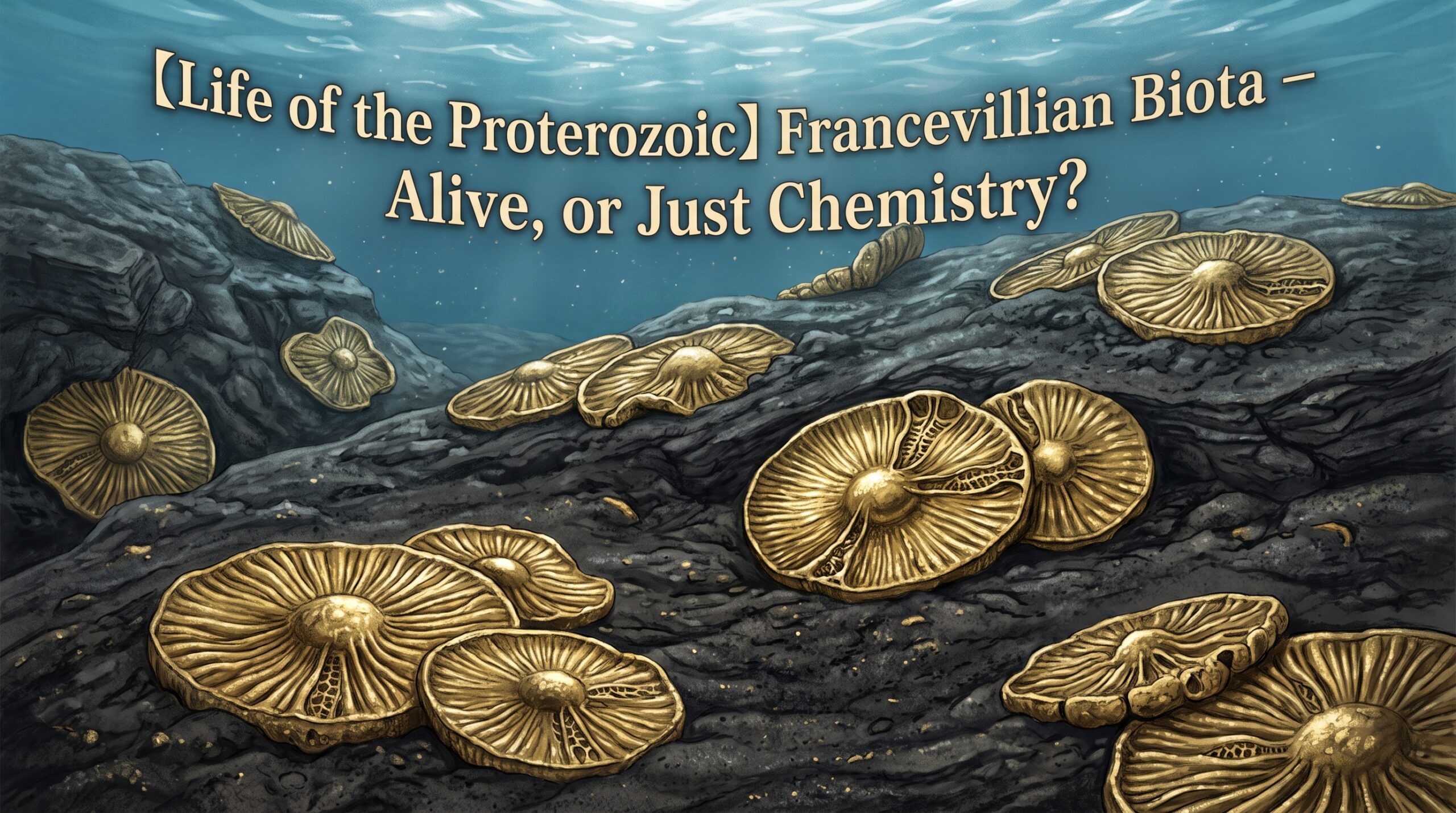

| Name | The Francevillian biota, after the town of Franceville where it was found. Also known informally as the Gabonionta |
| Classification | Undetermined. Proposals for a colonial multicellular organism, for a eukaryote, and for a non-biological origin all stand side by side |
| Age | Paleoproterozoic, about 2.1 billion years ago |
| Found in | Black shale of the Francevillian Basin (FB2 Formation), Gabon |
| Size | Mostly a few centimeters. Up to 12 cm, with specimens reaching 17 cm reported later |
| Density | Up to 40 individuals per square meter in the densest areas |
| Discovery | Found in 2008 and reported in 2010, by an international team led by Abderrazak El Albani of the University of Poitiers, France |
The Francevillian biota is an assemblage of structures large enough to see with the naked eye, found in strata about 2.1 billion years old in Gabon, central Africa. They date from shortly after oxygen began increasing in the atmosphere, and if they are organisms, they rank among the oldest known with multicellular bodies. Whether they are fossils of organisms at all, however, remains undecided more than fifteen years after their discovery.
Form
The fossils are preserved on bedding surfaces in black shale, replaced by pyrite. The most typical are flat discs, or ovals stretched from them, with a body ranging from spherical to rugby-ball shaped at the center and radial folds running from it toward the rim. The rim is bent into a wavy outline, and some specimens are wrinkled. Others are divided into several types: strands extending like cords, rod-shaped forms, and rows of small spheres strung together that spread like a flower at the tip. Non-pyritized disc-shaped specimens and microscopic microfossils with organic walls also occur in the same strata.
The basis for reconstruction is three-dimensional imaging of the specimens by micro-CT. Because the surface folds and the central structure continue into the interior, the team that reported them interpreted these as soft sheet-like tissue folded and grown radially. The arrangement of the folds is regular, and individuals appear to have grown to the same design, which is taken to indicate a mechanism close to that of multicellular organisms, with cells exchanging signals and growing in step.
Way of life and environment
The fossil-bearing strata are muds deposited at the front of a delta where a river met the sea. The fossils are clustered on bedding surfaces, with as many as 40 individuals per square meter in places. The disc-shaped type is inferred to have settled in groups on a shallow seafloor. Chemical analysis of the sediments shows that the overlying seawater held dissolved oxygen, and respiration using oxygen has been suggested.
The setting in time is distinctive too. The Great Oxidation Event, when oxygen surged in Earth’s atmosphere, is placed at about 2.45 to 2.32 billion years ago, and the Francevillian biota comes directly after it. In 2024, Ernest Chi Fru of Cardiff University and colleagues analyzed sediments from this basin and proposed that submarine volcanism following the collision of two continents created a shallow inland sea cut off from the open ocean, into which nutrients such as phosphorus flowed, producing a locally oxygen-rich environment. On this reading, the Francevillian biota was a temporary phenomenon occurring only within that enclosed sea.
In 2019, cord-like structures 6 mm wide and up to 17 cm long were reported from the same strata. The research team interpreted these as traces of an organism moving both laterally and vertically through the sediment. If that interpretation is correct, it pushes back the evidence for self-powered movement by about 1.5 billion years.
Fifteen years and counting, without deciding whether it was alive
The center of the argument over the Francevillian biota is not its form but whether it is biological at all.
Immediately after the 2010 report, Adolf Seilacher of Yale University stated that these were not fossils of organisms but pseudofossils formed as pyrite grew within the sediment. Pyrite not uncommonly forms radial or spherical masses in sediment, producing shapes easily confused with fossils. In 2016, similarly shaped structures from strata about 1.1 billion years old in Michigan were examined and concluded to be concretions — masses formed as minerals harden within sediment. The authors of that paper indicated that the Gabon specimens may share the same origin. A 2018 review described the biogenicity of these structures as questionable, and a 2023 review judged that distinguishing biological from non-biological structures in Paleoproterozoic rock is extremely difficult, and that the Francevillian biota does not meet the strict criteria for acceptance as fossils.
The discovering team has answered with chemistry rather than form. The 2010 report argued that because the sulfur and carbon isotope values of the pyrite differ from the surrounding mud, the structures are organic remains replaced by pyrite early in deposition. In 2014, more than 400 additional specimens were added, with the types classified and their modes of preservation organized. In 2023, the specimens were reported to be enriched in zinc and skewed toward the light isotope. Zinc is essential to eukaryotic enzymes, and the manner of its incorporation is said to potentially indicate eukaryotic metabolism. In 2025, X-ray examination showed arsenic concentrated inside the specimens, and an interpretation was offered in which the organism sequestered arsenic in particular compartments while alive to survive its toxicity, with that arsenic then incorporated into the pyrite core after death. The grounds are that the distribution of the arsenic differs from that in an inorganic mass.
Neither side has produced decisive evidence. No cells themselves survive, and there are no features sufficient to call them organisms from form alone. The chemical anomalies, meanwhile, are things that can be explained if these are organisms — not demonstrations that they cannot be explained otherwise. On top of that, the oldest widely accepted fossils of eukaryotes date to about 1.7 to 1.6 billion years, and the Francevillian biota is more than 400 million years older than that, which is grounds for caution. The absence of a formal taxonomic name follows from this situation as well. The nickname Gabonionta was used in a 2014 exhibition at the Natural History Museum Vienna and is not a formal scientific name.


Sources
El Albani et al. (2010) Large colonial organisms with coordinated growth in oxygenated environments 2.1 Gyr ago (Nature)
El Albani et al. (2014) The 2.1 Ga Old Francevillian Biota: Biogenicity, Taphonomy and Biodiversity (PLOS ONE)
El Albani et al. (2019) Organism motility in an oxygenated shallow-marine environment 2.1 billion years ago (PNAS)
Anderson et al. (2016) Macroscopic structures in the 1.1 Ga continental Copper Harbor Formation: concretions or fossils? (PALAIOS)
Javaux & Lepot (2018) The Paleoproterozoic fossil record: Implications for the evolution of the biosphere during Earth’s middle-age (Earth-Science Reviews)
Fakhraee et al. (2023) Earth’s surface oxygenation and the rise of eukaryotic life: Relationships to the Lomagundi positive carbon isotope excursion revisited (Earth-Science Reviews)
Ossa Ossa et al. (2023) Zinc enrichment and isotopic fractionation in a marine habitat of the c. 2.1 Ga Francevillian Group: A signature of zinc utilization by eukaryotes? (Earth and Planetary Science Letters)
Chi Fru et al. (2024) Hydrothermal seawater eutrophication triggered local macrobiological experimentation in the 2100 Ma Paleoproterozoic Francevillian sub-basin (Precambrian Research)
El Khoury et al. (2025) A battle against arsenic toxicity by Earth’s earliest complex life forms (Nature Communications)
Cardiff University: Complex life on Earth began around 1.5 billion years earlier than previously thought, new study claims
コメント